Emergency Medical Numbers in Italy (112, 118, 1500)
Navigate medical emergencies in Italy with confidence. This comprehensive guide explains the critical emergency phone numbers, including the European 112, the medical-specific 118, and the 1500 health hotline, ensuring expats and travelers know exactly how to get fast, life-saving help.
Disclosure: This post may contain affiliate links. We may earn a commission at no extra cost to you if you make a purchase through these links. Read full disclosure.
Introduction to Emergency Medical Numbers in Italy
The Italian healthcare system, known as the Servizio Sanitario Nazionale (SSN), is consistently ranked among the best in the world for its quality of care and commitment to universal access. A massive pillar of this system is its robust, highly responsive emergency medical network. However, for those accustomed to dialing 911 in North America or 999 in the United Kingdom, the Italian emergency phone number system can initially seem confusing. Italy has historically utilized a fragmented system of direct lines for different emergency services—one number for the police, another for the fire department, and yet another for medical ambulances.
In recent years, Italy has made significant strides in streamlining its emergency response by adopting the European Union’s universal standard. Yet, the legacy numbers remain deeply ingrained in the culture and are still fully functional. Knowing whether to dial 112 or 118, understanding what the 1500 hotline is actually used for, and knowing what to say to the dispatcher can save precious, life-saving minutes.
This exhaustive guide is designed to empower you with the exact knowledge you need to handle a medical crisis in Italy. We will explore the ongoing transition to the single European 112 number, detail the legacy 118 medical dispatch system, and clarify the purpose of the Ministry of Health’s 1500 hotline. Furthermore, we will break down the unique Franco-German model of Italian ambulance response, provide actionable advice on overcoming the language barrier during a call, and explain the triage protocols if you end up in an Italian emergency room. By mastering this information, you can ensure your safety and secure profound peace of mind during your Italian journey.
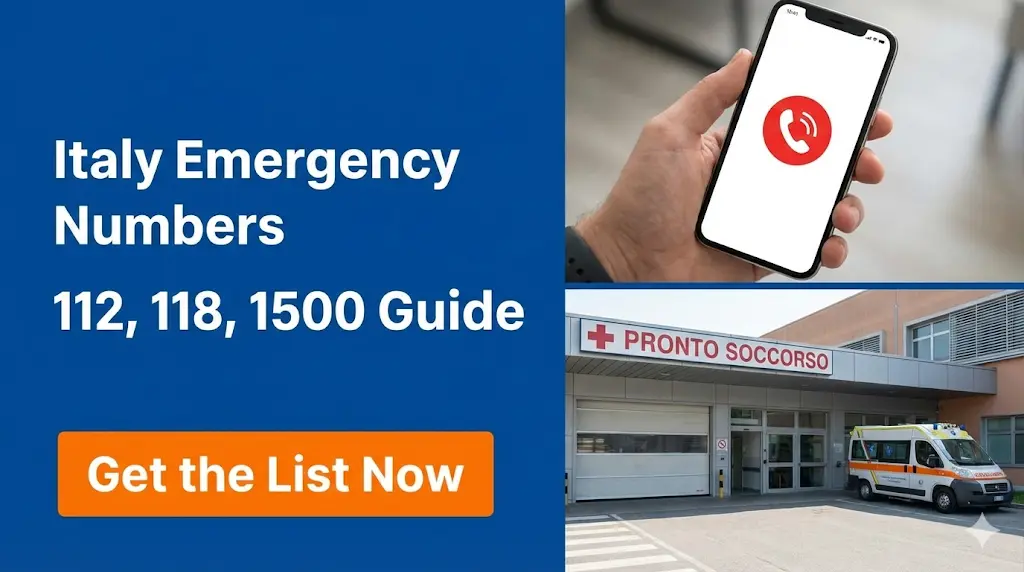
The Single European Emergency Number 112
If you only remember one phone number during your time in Italy, it must be 112.
The Single European Emergency Number (112) is a mandatory, harmonized freephone number for all member states of the European Union. It was designed to ensure that any citizen or traveler within the EU can access emergency services using a single, easily recognizable number, regardless of which member state they are currently visiting.
In Italy, the rollout of the 112 system—often referred to as the Numero Unico Europeo delle Emergenze (NUE 112)—has been a gradual, region-by-region process. Today, dialing 112 connects you to a highly advanced, centralized dispatch center known as a Public-Safety Answering Point (PSAP).
Key Features of the 112 System
- Universal Access: Dialing 112 is completely free of charge. You can dial it from any landline, public payphone, or mobile phone. Due to international telecommunications standards, the number will connect even if your mobile phone is locked, if you are out of your specific carrier’s network, or if your phone does not have a SIM card installed.
- Automatic Call Localization: One of the most significant advantages of the modern 112 system is its ability to instantly locate the caller. Within seconds of connecting, the PSAP uses Advanced Mobile Location (AML) technology via GPS to pinpoint your exact location. This is incredibly crucial if you are panicked, lost in a rural area, or unfamiliar with Italian street names.
- Multilingual Support: The 112 dispatch centers are equipped to handle calls from international visitors. If the primary operator realizes you do not speak Italian, they can seamlessly initiate a teleconference with a multilingual interpreting service that supports up to 20 different languages, including English.
- Centralized Triage: When you call 112, the operator does not dispatch the ambulance directly. Instead, they quickly assess the nature of your emergency (medical, fire, or criminal) and electronically transfer your localized file directly to the appropriate specialized operations center. If your situation requires multiple agencies—for example, a severe car crash requiring an ambulance, the fire brigade to extract a passenger, and the police to manage traffic—the 112 operator coordinates all three simultaneously.
The National Medical Emergency Number 118
While 112 is the overarching European standard, 118 remains the historic and dedicated National Medical Emergency Hotline in Italy.
For decades, 118 has been the direct line for dispatching ambulances and managing urgent health crises across the peninsula. In regions where the centralized 112 PSAP system is still being fully integrated, or for locals who are habituated to the old system, dialing 118 connects you straight to the medical dispatch center without the intermediate 112 operator.
When to Specifically Dial 118
You should dial 118 (or 112) for any situation where a person’s life, limb, or long-term health is in immediate danger. This includes:
- Severe, crushing chest pain or symptoms of a heart attack.
- Signs of a stroke (facial drooping, sudden weakness, slurred speech).
- Loss of consciousness or severe breathing difficulties.
- Major trauma, such as a severe fall, an industrial accident, or a high-speed road collision.
- Uncontrollable bleeding or severe burns.
The 118 dispatch centers are staffed directly by specialized medical personnel, including doctors and highly trained emergency nurses. Because of this, they can provide immediate, life-saving medical advice over the phone—such as how to perform CPR or how to manage a choking victim—while you wait for the ambulance to arrive.
The Ministry of Health Public Hotline 1500
It is crucial to understand that not all three- or four-digit numbers are for dispatching emergency vehicles. The number 1500 is a specific public utility hotline managed directly by the Italian Ministry of Health (Ministero della Salute).
You should never dial 1500 if you need an ambulance or are facing a life-threatening medical crisis.
The Purpose of 1500
The 1500 hotline is activated by the government during specific national public health emergencies to provide citizens and tourists with verified, scientific information and guidance.
- Pandemic and Viral Outbreaks: The 1500 number became globally recognized during the COVID-19 pandemic, serving as the primary hotline for individuals seeking information on quarantine protocols, vaccination locations, and reporting non-urgent symptoms. It has previously been activated during Ebola scares and localized viral outbreaks.
- Severe Heatwaves: During the blistering Italian summers, the Ministry of Health often activates the 1500 line to provide guidance on avoiding heatstroke (colpo di calore), identifying symptoms of dehydration, and offering advice for protecting vulnerable populations like the elderly and infants.
Think of 1500 as an informational lifeline designed to prevent public panic and reduce the burden on actual 112/118 emergency dispatchers during a widespread health crisis.
Types of Ambulances and Responders in Italy
If you call 112 or 118 for a medical emergency, the vehicles and personnel that arrive at your door might look very different from what you are used to in the US or UK.
Italy primarily follows the Franco-German model of emergency medical services. Unlike the Anglo-American model (which focuses on rapidly scooping up the patient and rushing them to the hospital), the Franco-German model focuses on bringing the hospital directly to the patient. The goal is to stabilize the individual extensively on the scene before transport.
Depending on the severity of the emergency reported to the dispatcher, one of the following specialized units will be deployed:
1. Basic Life Support Ambulances
These are the most common ambulances you will see on Italian streets. Interestingly, they are typically operated by historic volunteer organizations such as the Croce Rossa Italiana (Italian Red Cross), Croce Verde, Croce Bianca, or the Misericordie. The crews consist of highly trained volunteer EMTs known as soccorritori. They respond to less critical emergencies and provide essential stabilization and transport. It is not uncommon to see crews of three or four volunteers in a single ambulance.
2. Advanced Life Support Ambulances
For severe, life-threatening crises, the operation center will dispatch an Advanced Life Support (ALS) unit. These ambulances are staffed by paid, hospital-based medical professionals. The crew commonly includes an emergency physician or an anesthetist, alongside a critical care nurse. They are authorized to perform complex procedures, administer strong medications, and intubate patients directly on the street or in your living room.
3. Automedica
Sometimes, an ambulance will not be the first vehicle to arrive. An automedica is a rapid-response physician car. It does not transport patients. Instead, it carries an emergency doctor, a nurse, and advanced medical equipment. The automedica races to the scene to provide immediate ALS interventions and stabilize the patient, while a standard volunteer BLS ambulance arrives shortly after to handle the actual transportation to the hospital.
4. Elisoccorso (Air Ambulance)
In rural areas, mountainous terrains like the Alps, or for incredibly time-sensitive traumas (like major strokes or spinal injuries), regional health authorities deploy helicopters. The elisoccorso is staffed by the highest tier of medical personnel—physicians, critical care nurses, and specialized mountain rescue operators.
Communicating During an Emergency Call
The effectiveness of the emergency response depends heavily on the information you provide. When you dial 112 or 118, the operator will guide you through a structured interview. You must stay calm, speak clearly, and never hang up until the operator explicitly tells you to do so.
Be prepared to answer the following questions:
- Who is calling? Provide your full name and the phone number you are calling from.
- Where are you? While modern 112 systems have GPS localization, you should still verbally confirm your exact location. Provide the city, street name, building number, and any recognizable landmarks. If you live in an apartment, provide the floor number and the name on the intercom.
- What happened? State the nature of the emergency clearly (e.g., “My husband collapsed and is not breathing,” or “There has been a severe car accident”).
- Who is involved? Tell the operator how many people are injured or sick.
- What is their condition? The operator needs to know if the victim is conscious, if they are breathing normally, and if there is severe bleeding.
Overcoming the Language Barrier
While 112 operators have access to multilingual interpreters, there may be a brief delay as they patch the translator into the call. To save time, it is highly recommended to learn a few vital Italian phrases for emergencies:
- “Aiuto!” – Help!
- “Ho bisogno di un’ambulanza.” – I need an ambulance.
- “Non respira.” – He/She is not breathing.
- “Infarto.” – Heart attack.
- “Incidente stradale.” – Car accident.
If you are an expat with limited Italian proficiency, it is a wise strategy to befriend a trusted Italian neighbor or landlord. In a moment of panic, you can ask them to make the 118 call on your behalf to ensure complex medical symptoms and rural directions are communicated flawlessly.
Emergency Rooms and the Triage System
If the ambulance transports you, or if you drive yourself to the hospital, you will arrive at the Emergency Room, known in Italian as the Pronto Soccorso.
It is crucial to note that emergency rooms in Italy are found almost exclusively in public hospitals. Private clinics and luxury hospitals generally do not have the massive trauma infrastructure required for emergency medicine.
When you walk into the Pronto Soccorso, you will not be seen on a first-come, first-served basis. Italy uses a strict clinical triage system designed to prioritize care for those closest to death. A triage nurse will evaluate your vital signs and assign you a color code:
- Red (Rosso): Immediate, life-threatening emergency. You will bypass the waiting room and receive instant medical intervention.
- Orange/Yellow (Arancione/Giallo): Highly urgent condition with a risk of deterioration. You will be seen very quickly.
- Light Blue/Green (Azzurro/Verde): Minor urgency or deferrable condition. You are stable, but require diagnostic tests or simple treatments. You will wait until all red and yellow codes are cleared.
- White (Bianco): Non-urgent issue of minimal clinical relevance. You are using the ER for an issue that should have been handled by a family doctor. You will wait the longest—sometimes many hours.
Is the Emergency Room Free?
For severe emergencies (Red and Yellow codes), treatments, surgeries, and hospitalizations are provided completely free of charge to everyone, regardless of nationality or residency status. However, to deter people from abusing emergency resources for minor ailments, patients assigned a “White code” may be required to pay a small co-payment (the Ticket Sanitario, usually around €25) upon discharge. To fully understand your financial exposure, you can review our guide on the Cost of Healthcare in Italy: What Expats Need to Know.
When Not to Call for an Ambulance
To keep the 112 and 118 networks clear for true emergencies, you must know alternative routes for non-critical health issues.
If you develop a painful ear infection, a mild fever, or a rash on a Sunday afternoon when standard clinics are closed, you should not call an ambulance. Instead, you should utilize the Guardia Medica (also known as Continuità Assistenziale).
The Guardia Medica is the state-run, out-of-hours medical service. It operates overnight, on weekends, and during public holidays. You can call your regional Guardia Medica phone number, and a doctor will assess your symptoms over the phone. They can offer advice, invite you to their clinic, or even perform a house call to write you a necessary prescription. For more detailed strategies on managing routine healthcare, explore our resources on Healthcare in Italy: An Expats’ Guide.
Additionally, for very minor ailments like a seasonal cough or a scraped knee, your first stop should always be the local pharmacy. Italian pharmacists are highly trained clinical advisors who can dispense potent over-the-counter remedies. You can learn more about this in our article: Finding and Using Pharmacies in Italy.
Essential Emergency Apps and Technology
Italy is modernizing its emergency infrastructure to accommodate digital users. The government officially endorses the “Where Are U” smartphone application.
This app is directly linked to the 112 PSAP network. When you use the app to call for help, it automatically bypasses verbal communication of your location and instantly beams your exact GPS coordinates to the dispatcher. Furthermore, the app includes features for making “silent calls” or initiating a text-based chat, which is incredibly vital for deaf users, individuals hiding during a home invasion, or victims of domestic violence who cannot speak aloud. Expats are strongly encouraged to download this app upon arriving in Italy.
Other Important Italian Emergency Numbers
While 112 is designed to centralize all calls, the legacy direct-dial numbers for specific emergency branches remain fully active and are widely used by locals. If you know exactly which service you need, dialing these numbers can sometimes save a few seconds of routing time:
- 113 – State Police (Polizia di Stato): Use this number for urgent law enforcement intervention, reporting ongoing crimes, assaults, massive public disturbances, or severe traffic accidents.
- 115 – Fire Brigade (Vigili del Fuoco): The direct line for active fires, structural collapses, gas leaks, and severe weather emergencies.
- 1530 – Coast Guard (Guardia Costiera): With Italy’s extensive coastline, this is a vital number. Dial 1530 for maritime emergencies, shipwrecks, drowning risks, or boating accidents in Italian territorial waters.
- 114 – Child Emergency: A specialized hotline managed by social services for reporting the abuse, neglect, or immediate distress of children and adolescents.
Summary of Italian Emergency Phone Numbers
| Service Required | Primary Number to Dial | Legacy / Direct Number | When to Use |
| All General Emergencies | 112 | N/A | When you are unsure who to call, or need police, fire, and medical simultaneously. |
| Medical / Ambulance | 112 | 118 | Heart attacks, severe bleeding, loss of consciousness, major trauma. |
| Police Intervention | 112 | 113 (State) / 112 (Carabinieri) | Active crimes, assaults, major traffic accidents. |
| Fire and Rescue | 112 | 115 | Building fires, gas leaks, extractions. |
| Coast Guard / Sea Rescue | 112 | 1530 | Drowning, boating accidents, maritime distress. |
| Public Health Information | N/A | 1500 | Pandemics (Covid-19), extreme heatwaves, health guidance. |
Conclusion
The prospect of facing a medical emergency in a foreign country is undoubtedly frightening, but knowledge is your most powerful defense. Italy’s emergency medical infrastructure is a highly sophisticated, deeply egalitarian system designed to protect human life above all else. By memorizing the European 112 standard and the legacy 118 medical hotline, you ensure that you are never more than a phone call away from world-class medical intervention.
Take the time to download the “Where Are U” app, save these critical numbers in your phone, and familiarize yourself with your local Pronto Soccorso locations. Understanding the difference between a minor ailment suited for the Guardia Medica and a life-threatening crisis demanding an Elisoccorso will not only save you from potential hospital co-pays but could ultimately save a life. With your safety protocols firmly in place, you can turn your attention fully to the magnificent culture, art, and lifestyle that Italy has to offer.
References
Primary sources (official)
- NUE 112 (Numero Unico Europeo): Official regional portals detailing the technical rollout of the 112 system, the Advanced Mobile Location (AML) technology, and the PSAP centralized dispatch infrastructure. https://www.nue112er.it/en
- Ministero della Salute (Ministry of Health): Official guidelines on the 1500 public health hotline and the operational standards of the Servizio Sanitario Nazionale (SSN). https://www.salute.gov.it/
Other helpful sources
- Università degli Studi di Milano: Practical emergency guides for international students detailing the specific uses of 112, 118, and 1500 in urban centers. https://www.unimi.it/
- Lodgerin: Comprehensive breakdowns of Italian emergency contact numbers, including 113 for the State Police, 115 for the Fire Brigade, and 1530 for the Coast Guard. https://www.lodgerin.com/
Disclaimer
The information provided in this article is for educational and informational purposes only and does not constitute official medical, legal, or financial advice. Healthcare protocols, emergency dispatch systems, triage color codes, and hospital fee structures in Italy are subject to change by regional and national health authorities. In the event of a medical emergency, always dial 112 or 118 immediately, or seek assistance from trained medical professionals at the nearest hospital or clinic. Ensure you possess appropriate health coverage or travel insurance before embarking on your journey.