Complementary Medicine: Homeopathy and Acupuncture in Italy
Explore the landscape of complementary and alternative medicine in Italy. This guide covers the strict legal regulations surrounding homeopathy and acupuncture, how to find qualified medical practitioners, associated costs, and the integration of holistic therapies within the Italian healthcare system.
Disclosure: This post may contain affiliate links. We may earn a commission at no extra cost to you if you make a purchase through these links. Read full disclosure.
Introduction
Complementary and alternative medicine has experienced a significant surge in popularity across Europe over the last few decades, and Italy is no exception. Today, millions of Italians incorporate some form of non-conventional therapy into their healthcare routines. However, the way these therapies are regulated, practiced, and dispensed in Italy might differ drastically from what you are accustomed to in the United States, the United Kingdom, or other parts of the world.
In many countries, practitioners of acupuncture, homeopathy, and herbal medicine operate entirely outside the conventional medical system. They may hold certifications from independent holistic boards but lack formal medical degrees. In Italy, the legal framework is uniquely strict, designed specifically to protect patients from unregulated practitioners and to ensure that alternative therapies are integrated safely with conventional treatments. Understanding this legal distinction is the first and most crucial step for any expatriate seeking alternative therapies.
This comprehensive guide will demystify the practice of complementary medicine in Italy. We will deeply explore the rigid regulations governing who can legally administer acupuncture and prescribe homeopathic remedies. Additionally, we will discuss the cultural significance of the traditional Italian herbalist shop, outline the typical costs associated with these treatments, and explain how to verify the credentials of your chosen practitioner. Whether you are managing a chronic illness or simply seeking natural wellness solutions, this information will empower you to navigate Italy’s holistic health sector safely and effectively.
The Legal Landscape of Alternative Medicine in Italy
The defining characteristic of complementary medicine in Italy is its strict integration with conventional medical qualifications. The Italian State and the National Federation of Orders of Doctors and Dentists take a very firm stance on who is allowed to diagnose patients and prescribe treatments, regardless of whether those treatments are pharmaceutical or holistic.
The Landmark State Regions Agreement
The turning point for complementary medicine in Italy occurred with the State-Regions Agreement. This pivotal piece of legislation officially recognized three specific non-conventional medical disciplines: Acupuncture, Phytotherapy (clinical herbal medicine), and Homeopathy.
Crucially, this agreement established that the practice of these three disciplines constitutes a formal “medical act.” Therefore, under Italian law, only individuals who hold a full degree in Medicine and Surgery (or Dentistry, for specific dental applications) and who are officially registered with the Italian Medical Council are legally permitted to practice acupuncture, homeopathy, and clinical phytotherapy.
Why the Medical Degree Requirement Matters
For expatriates, this legal requirement offers an immense layer of safety and quality assurance. If you book an appointment for acupuncture in Italy, you are guaranteed to be treated by a licensed medical doctor. This means your practitioner possesses a comprehensive understanding of human anatomy, physiology, and pathology. They are fully capable of recognizing when a holistic approach is appropriate and when a condition requires immediate conventional medical intervention.
You will not find “lay” acupuncturists or independent homeopathic consultants operating legally in Italy without a medical degree. Any individual attempting to practice these therapies without being a registered physician can be prosecuted for the abusive practice of the medical profession.
Acupuncture in Italy Integration and Practice
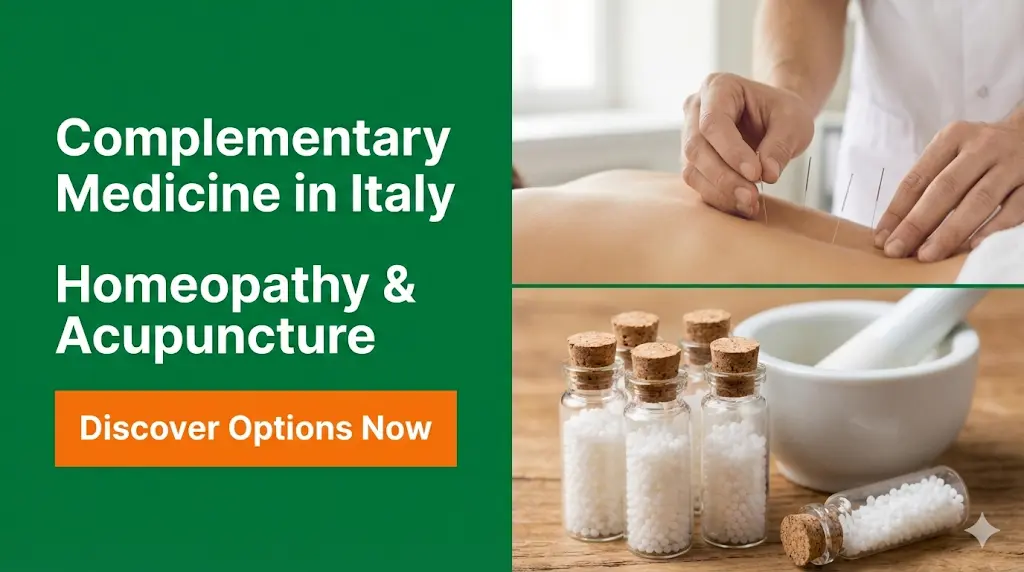
Acupuncture, rooted in Traditional Chinese Medicine, is perhaps the most widely respected and integrated form of complementary medicine within the Italian healthcare landscape.
Common Uses for Acupuncture
Italian patients and doctors frequently turn to acupuncture for a variety of conditions, often using it as a complementary therapy alongside conventional treatments. It is highly regarded for pain management, particularly for chronic lower back pain, sciatica, osteoarthritis, and severe migraines.
Furthermore, acupuncture has gained significant traction in the fields of women’s health and oncology. Many Italian fertility clinics recommend acupuncture to support in vitro fertilization cycles, manage endometriosis pain, and regulate menstrual cycles. In oncology wards, specialized medical acupuncturists often provide treatments to help patients manage the nausea, fatigue, and neuropathy associated with chemotherapy.
Training for Medical Acupuncturists
To become an acupuncturist in Italy, a licensed medical doctor must complete an extensive postgraduate training program recognized by the state. These programs typically last three to four years and require hundreds of hours of theoretical study and clinical practice. Once completed, the doctor is added to a specific registry of acupuncturists maintained by their local provincial medical board.
Homeopathy in Italy A Popular Complementary Choice
Homeopathy remains a highly popular choice among the Italian population, particularly for pediatric care, minor acute illnesses, and the management of seasonal allergies. Many Italians utilize homeopathic remedies as a gentle, first-line defense before turning to stronger pharmaceuticals.
How Homeopathy is Prescribed
Because homeopathy is legally recognized as a medical act, you can consult a specialized homeopathic doctor for a comprehensive evaluation. A homeopathic consultation in Italy is often quite lengthy, as the physician will take a detailed history of your physical symptoms, emotional state, and lifestyle habits to prescribe a highly individualized remedy.
Interestingly, it is also very common for conventional Italian pediatricians and general practitioners to recommend homeopathic products for minor ailments. For instance, if your child is teething, experiencing mild colic, or suffering from a common cold, an Italian pediatrician might write a prescription for a homeopathic syrup or suppository alongside conventional advice.
Buying Remedies at the Pharmacy
In Italy, homeopathic remedies are sold exclusively in licensed pharmacies. You will not find them on the shelves of supermarkets or standard health food stores.
When navigating the pharmaceutical system, you must understand the distinction between different health shops. If you have a specific homeopathic prescription, you must present it to a pharmacist. To fully understand how these shops operate and the rules surrounding medication, reviewing our guide on Italian Pharmacies: Prescription, Over-the-Counter, and Supplies is highly recommended. The pharmacist is trained to dispense these remedies and can also offer over-the-counter homeopathic advice for minor issues like bruises, mild burns, or travel sickness.
The Role of Phytotherapy and the Erboristeria
While clinical phytotherapy—the medical use of plant extracts to treat diseases—is restricted to medical doctors, Italy has a rich, culturally ingrained tradition of herbalism that is accessible to everyone through the Erboristeria.
What is an Erboristeria?
An Erboristeria is a traditional Italian herbalist shop. These shops are ubiquitous across the country, found in almost every neighborhood and town center. Walking into an erboristeria is a sensory experience, characterized by the aromas of dried flowers, essential oils, and natural soaps.
The professionals who run these shops are known as Erboristi. While they are not medical doctors, they typically hold a university degree in Herbal Sciences and Technologies. They are highly educated experts in plant properties, natural cosmetics, and dietary supplements.
How to Use the Herbalist Shop
An erborista cannot legally diagnose a medical condition or claim to cure a disease. However, they are the perfect resource for maintaining general wellness and addressing minor, non-clinical discomforts.
If you are suffering from mild insomnia, indigestion, stress, or a mild sore throat, you can visit an erboristeria and explain your symptoms. The herbalist will often mix a custom herbal tea blend, recommend specific tinctures, or provide essential oils tailored to your needs. They also sell high-quality, plant-based skincare and natural dietary supplements. For expatriates looking to embrace a more natural, preventative approach to their daily health, the erboristeria is an invaluable community resource.
Does the Public Healthcare System Cover Complementary Medicine?
A primary concern for any expatriate is how to fund their healthcare. Italy’s public healthcare system provides universal coverage, but its inclusion of complementary medicine is complex and heavily dependent on where you live. For a broader overview of how to access public services, you can consult Healthcare in Italy: An Expats’ Guide.
Regional Autonomy and Essential Levels of Care
The Italian Ministry of Health defines the Essential Levels of Care, which outline the treatments the public system must provide. Generally speaking, homeopathy and herbal medicine are not included in these essential levels, meaning they are considered out-of-pocket expenses.
However, healthcare in Italy is administered on a regional basis, allowing local governments to expand coverage beyond the national minimums. Acupuncture is the most frequently integrated complementary therapy within the public system. In several regions—most notably Tuscany, Emilia-Romagna, and Lombardy—acupuncture is offered in public hospitals and specialized public pain management clinics.
In these specific regions, if your public general practitioner determines that acupuncture is medically necessary for pain relief or anesthesia support, they can write a public referral. You would then receive the treatment at a public hospital, paying only the standard, heavily subsidized co-payment. Nevertheless, access to public acupuncture is highly competitive, and waiting lists can be exceptionally long.
Private Health Insurance and Alternative Therapies
Because public access to complementary medicine is limited and geographically inconsistent, the vast majority of expats and Italians utilize the private healthcare sector for these therapies.
If you rely heavily on acupuncture, homeopathy, or clinical phytotherapy, it is highly advisable to factor this into your insurance decisions. Many local Italian supplementary insurance policies provide limited or zero coverage for alternative medicine. However, premium international health insurance plans designed for expatriates frequently offer optional wellness modules.
These modules often provide an annual allowance specifically for complementary therapies, allowing you to seek treatment from any licensed private medical acupuncturist or homeopathic doctor and claim reimbursement. If you are currently evaluating your coverage options to ensure your holistic needs are met, reviewing resources on Choosing Private Health Insurance Plans in Italy can help you make an informed decision.
Estimated Costs of Complementary Medicine in Italy
When seeking complementary medicine in the private sector, costs are paid out-of-pocket and can vary significantly based on the practitioner’s experience, the clinic’s location (major cities like Milan and Rome are generally more expensive), and the length of the consultation.
To help you budget for your holistic healthcare needs, here is a general breakdown of the estimated costs you can expect to encounter in Italy:
| Type of Complementary Therapy | Estimated Cost Range (Private Sector) | Description of Service |
| Acupuncture (Initial Visit) | €80 – €150 | Includes a full medical diagnostic assessment and the first needle treatment. |
| Acupuncture (Follow-up) | €50 – €100 | Standard follow-up sessions, usually lasting 30 to 45 minutes. |
| Homeopathic Consultation | €100 – €200 | Extensive initial consultation exploring physical, emotional, and lifestyle factors. |
| Homeopathic Remedies | €5 – €25 | Cost per individual remedy, purchased out-of-pocket at a licensed pharmacy. |
| Clinical Phytotherapy Visit | €80 – €150 | Medical consultation resulting in a prescribed clinical herbal treatment plan. |
| Erboristeria Consultation | Free – €30 | Advice is often free; costs reflect the purchase of custom herbal teas or tinctures. |
How to Find Qualified Practitioners
Finding a trusted medical professional in a foreign country requires diligence, especially when seeking specialized complementary therapies. Because the law mandates that these practitioners must be medical doctors, verifying their credentials is straightforward if you know where to look.
Utilizing Professional Medical Registries
Every practicing doctor in Italy must be registered with the Provincial Order of Physicians and Dentists. These provincial orders maintain public registries that specify any recognized additional qualifications the doctor holds. If you are looking for an acupuncturist or a homeopathic doctor, you can search the registry of your specific province to ensure the practitioner has completed the state-recognized training in that discipline.
Specialized Associations
Several national associations maintain directories of highly qualified, licensed practitioners. For instance, the Italian Federation of Acupuncture Societies and the Italian Federation of Homeopathic Medical Associations and Societies provide search tools on their websites. These directories are excellent resources for finding practitioners committed to the highest standards of their respective fields.
Integrating Conventional and Alternative Care
One of the most profound benefits of Italy’s regulatory framework is the seamless integration of conventional and alternative medicine. Because your acupuncturist or homeopath is also a licensed medical doctor, you do not have to hide your alternative treatments from your primary care physician.
In many cases, your general practitioner and your complementary specialist can collaborate. For example, if you are undergoing conventional treatment for hypertension, a medical acupuncturist understands exactly how their treatments will interact with your prescribed blood pressure medication. They can read your blood work, interpret your medical history, and ensure that any herbal tinctures or homeopathic remedies do not cause adverse drug interactions.
This integrative approach removes the stigma often associated with alternative medicine. It empowers patients to build a comprehensive, holistic healthcare team that respects natural healing modalities without ever compromising on medical safety and scientific rigor.
Conclusion
Embracing complementary medicine in Italy offers expatriates a unique, highly regulated, and deeply safe approach to holistic health. The Italian requirement that all acupuncturists and clinical homeopaths hold full medical degrees ensures that your pursuit of natural wellness is always anchored in comprehensive medical expertise.
While the public healthcare system’s coverage of these therapies remains localized and limited, the thriving private sector provides excellent access to integrative care. By understanding the legal landscape, utilizing the traditional knowledge found in the local erboristeria, and knowing how to verify the credentials of medical specialists, you can seamlessly incorporate alternative therapies into your new Mediterranean lifestyle. Whether you are looking to manage a chronic condition or simply enhance your overall vitality, Italy provides a beautifully balanced environment where ancient healing traditions and modern medical science work hand in hand.
References
Primary sources (official)
- Ministero della Salute (Ministry of Health): The central governmental body detailing the regulations and official recognition of non-conventional medicine as medical acts within the Italian healthcare framework. https://www.salute.gov.it/
- FNOMCeO (National Federation of the Orders of Doctors and Dentists): The official medical board overseeing the licensing, registration, and ethical guidelines for all medical doctors practicing acupuncture, phytotherapy, and homeopathy in Italy. https://portale.fnomceo.it/
Other helpful sources
- FISA (Federazione Italiana delle Società di Agopuntura): The leading Italian federation for acupuncture societies, providing directories of qualified medical acupuncturists and research updates. https://www.agopuntura-fisa.it/
- FIAMO (Federazione Italiana Associazioni e Medici Omeopati): A comprehensive resource for finding licensed homeopathic medical doctors and understanding the practice of homeopathy in Italy. https://www.fiamo.it/
Disclaimer
The information provided in this article is intended for general educational and informational purposes only and does not constitute official medical, legal, or financial advice. Healthcare regulations, the legal status of alternative therapies, and private medical costs in Italy are subject to change. Always consult directly with a licensed Italian medical doctor or a registered pharmacist before beginning any new treatment, including acupuncture, homeopathy, or herbal supplements, to ensure they are safe and appropriate for your specific medical needs.