Medical Evacuation and Repatriation From Italy: When It’s Needed
Your father slips on a wet step in Positano and breaks his hip, or a friend hiking in the Dolomites suffers a heart attack at a mountain hut, and suddenly you are facing questions nobody prepares you for. Can he be treated here, or does he need to be moved? Who pays for a helicopter, or for an air ambulance home to Chicago or Melbourne? This guide explains when medical evacuation and repatriation from Italy are actually needed, what they involve, what they can cost, and how to make sure the right insurance is in place before you need it.
Disclosure: This post may contain affiliate links. We may earn a commission at no extra cost to you if you make a purchase through these links. Read full disclosure.
I have lived in Italy long enough to have helped two visiting families through medical emergencies, one with a happy ending and one far more difficult. In both cases, what mattered most was not the quality of Italian hospitals, which is generally very good, but whether someone had thought about evacuation and repatriation before the trip.
Evacuation and Repatriation: What They Mean and When They Happen
People often use these terms loosely, but insurers and hospitals use them precisely, and the difference matters when you make a claim.
The Key Terms
| Term | What it means | Typical example in Italy |
|---|---|---|
| Rescue | Getting a patient from the scene of an accident to medical care | Helicopter lift from a mountain path in the Dolomites |
| Medical evacuation | Moving a patient to the nearest hospital able to give the treatment needed | Transfer from a small island hospital to a specialist centre on the mainland |
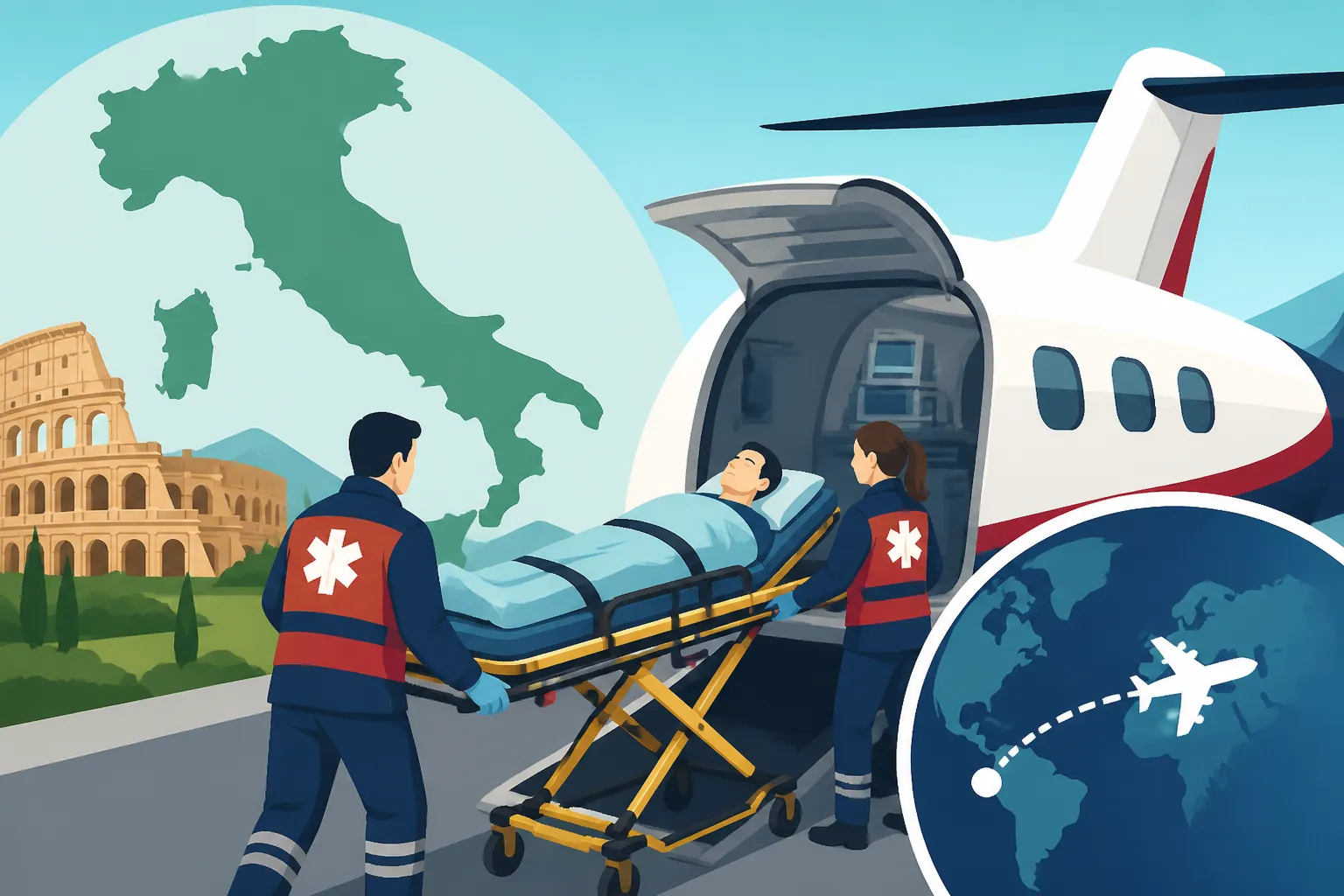
| Medical repatriation | Transporting a patient back to their home country for further treatment or recovery once stable | Stretcher flight from Rome to London after hip surgery |
| Repatriation of remains | Returning the body or ashes of someone who has died abroad | Transport of a coffin from Naples to New York |
Most travel medical policies cover some combination of evacuation and repatriation, but each is defined in the policy wording, usually with the condition that it must be medically necessary and arranged by the insurer’s assistance team.
When Evacuation Within Italy Is Needed
Italy’s health system is strong, especially in large cities. Hospitals in Rome, Milan, Bologna, Florence, Turin and Padua offer advanced care, and public emergency treatment is available to everyone. In most cases, a tourist who falls ill in a city will be treated in the nearest hospital and never needs to be moved.
Evacuation becomes necessary in a few typical situations:
- Remote mountain accidents. Hiking, climbing and skiing accidents in the Alps and Dolomites often need helicopter rescue to reach the nearest trauma centre.
- Small islands. The Aeolian Islands, Lampedusa, Pantelleria and some smaller islands have limited hospital facilities. Serious cases are flown or shipped to Sicily or the mainland.
- Specialist care. Severe burns, complex cardiac cases, spinal injuries and some paediatric emergencies may need a transfer to a regional centre of excellence.
- Rural areas in the south. In parts of the interior of Sicily, Sardinia, Calabria and Basilicata, the nearest hospital with the right specialist may be some distance away.
Within Italy, emergency transfers between public hospitals are generally organised by the health system. The bigger cost questions arise with mountain rescue, private transport, and repatriation abroad.
When Repatriation Home Is Needed
Repatriation is usually considered once a patient is stable enough to travel and the treating doctors agree that continuing care at home is appropriate. Common situations include:
- A long recovery after surgery that would mean weeks in an Italian hospital far from family.
- A serious illness, such as a stroke or cancer diagnosis, where ongoing treatment is better organised at home.
- A patient who cannot fly on an ordinary commercial seat because of a cast, stretcher needs or oxygen requirements.
- A death abroad, where the family wishes the body to be returned home.
The key point is that repatriation is a medical and logistical decision made jointly by the treating doctors and the insurer’s medical team. Wanting to go home is understandable, but a policy usually pays only when the move is medically justified or when the policy specifically covers it.
Mountain Rescue in the Alps and Dolomites
Helicopter rescue in the Italian mountains is impressive and fast. It is generally part of the regional emergency service, called through 112. However, in some Alpine regions, patients may be charged a fee for helicopter rescues that are judged not medically necessary, for example lifting an uninjured but exhausted hiker who could have walked down with help. The rules and charges vary by region and change over time.
If you are heading into the mountains, read What to Pack for Hiking in the Dolomites, and make sure your policy covers rescue costs as well as medical treatment.
What Evacuation and Repatriation Can Cost
These are among the most expensive things that can happen to a traveller. Insurance exists precisely because few families could pay these bills from savings.
How the Costs Are Built Up
Prices vary widely by distance, aircraft type, medical staff required and the patient’s condition. The table below describes the shape of the costs rather than specific prices:
| Service | What drives the cost | Relative cost |
|---|---|---|
| Ground ambulance within Italy | Distance, private or public provider | Low to moderate; emergency public transport is often free or low cost, private transfers are charged |
| Helicopter rescue in the mountains | Region, flight time, whether judged necessary | Can range from free to several thousand euros where charges apply |
| Commercial flight with a medical escort | Number of seats needed, escort fees | Moderate; several seats may be booked to lay a patient flat |
| Stretcher on a commercial flight | Airline availability, escort, seats removed | Higher; requires airline approval and planning |
| Air ambulance within Europe | Flight distance, aircraft, medical crew | High; often tens of thousands of euros |
| Air ambulance across the Atlantic or to Australia | Long flight, crew rest stops, aircraft type | Very high; can exceed one hundred thousand euros |
| Repatriation of remains | Embalming, coffin, permits, cargo flight | Several thousand to over ten thousand euros, depending on destination |
These figures are broad ranges for the type of service, not quotes from any provider.
Hospital Treatment Before Transport
Before any evacuation or repatriation, there is usually a hospital stay. For visitors from outside the EU, emergency treatment in an Italian public hospital is provided, but non-residents may be billed for some services, especially if admitted. EU visitors with a European Health Insurance Card can access public care on the same terms as Italian residents, which helps with treatment but does not pay for repatriation home. The card’s limits are explained in Using Your European Health Insurance Card (EHIC) in Italy.
Who Actually Pays
| Situation | Who generally pays |
|---|---|
| Emergency treatment in a public hospital, EU visitor with an EHIC | The public system, with the patient paying any normal patient charges |
| Emergency treatment, non-EU visitor | The patient, or their travel medical insurer |
| Transfer between public hospitals within Italy | Usually the public system |
| Mountain helicopter rescue judged unnecessary | The patient in some regions, or their insurer if covered |
| Repatriation to the home country | The patient, or their insurer if medically necessary and covered |
| Repatriation of remains | The family, or the deceased’s insurer if covered |
Neither the Italian health system nor the EHIC pays for repatriation home. That cost falls on the traveller unless insurance covers it.
Insurance That Covers Evacuation and Repatriation
This is where planning pays off. A policy that includes evacuation and repatriation turns a financial disaster into a manageable process.
Why SafetyWing Is a Strong Choice for Italy
For travellers, digital nomads and long-stay visitors in Italy, SafetyWing is one of the most practical ways to get this protection. Its travel medical insurance is designed for people abroad, can be bought before you leave or while you are already travelling, and includes emergency medical evacuation and repatriation as part of the medical cover, along with the hospital treatment that usually comes first.
What makes SafetyWing particularly useful in an evacuation scenario is the assistance service behind it. When something serious happens, the insurer’s assistance team works with the treating doctors in Italy to decide whether a transfer or repatriation is medically necessary, and then organises it, so the family is not left trying to charter an aircraft on their own.
As with any policy, read SafetyWing’s own policy documents for the current limits on evacuation and repatriation, the conditions for coverage, and how to contact assistance. These details change over time, so check them at the point of purchase rather than relying on someone else’s summary.
What to Check in Any Policy
Whether you choose SafetyWing or another insurer, compare policies on these points:
- Evacuation limit. Is there a separate limit for evacuation, and is it high enough for a long-haul air ambulance to your home country?
- Repatriation conditions. Does the policy cover repatriation to your home country, or only evacuation to the nearest adequate facility?
- Repatriation of remains. Is it included, and up to what amount?
- Mountain rescue. Are search and rescue costs covered, and do any activity exclusions apply to hiking, climbing or skiing?
- Pre-existing conditions. Are complications of existing conditions excluded? See Pre-Existing Conditions and Italian Visa Insurance: What Gets Excluded.
- Who decides. Most policies require the insurer’s medical team to approve and arrange the transport. Unapproved arrangements may not be reimbursed.
- Family travel. Is there cover for a family member to travel to the patient, or to accompany them home?
Do Not Confuse Travel Insurance With Residence Insurance
If you live in Italy, your insurance needs are different. Residents registered with the public health system, the SSN, receive treatment in Italy, but the SSN does not repatriate you to another country. Private health insurance bought for a visa application may or may not include repatriation. If you have family in another country and would want to be treated there in a serious illness, check this carefully. International Health Insurance Options for Italy covers the options for residents.
For visitors weighing up cover in the first place, Do You Need Travel Insurance to Visit Italy? answers the basic question.
What to Do If Evacuation or Repatriation Is Needed
When the emergency happens, a calm, clear sequence of steps protects both the patient and the insurance claim.
Step by Step in an Emergency
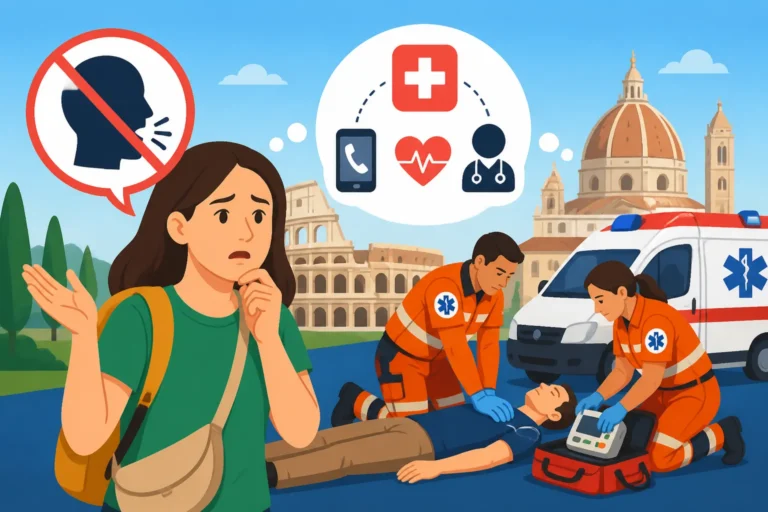
- Call 112. It is the single emergency number in Italy and connects you to ambulance, police and fire services. How to Call 112 in Italy: What to Say and What Happens explains what to expect.
- Follow the emergency services. The patient will be taken to the nearest appropriate hospital, which is the right first step.
- Contact the insurer’s emergency assistance line as soon as possible, ideally within the first day. Give them the hospital name, the treating doctor’s contact details and the policy number.
- Let the doctors communicate. The insurer’s medical team will speak with the Italian doctors to understand the diagnosis and decide whether transfer or repatriation is appropriate.
- Do not arrange transport yourself without the insurer’s approval, unless it is a genuine life-threatening emergency and you cannot reach them.
- Collect documents. Medical reports, discharge letters and itemised bills are needed for the claim. Filing a Claim From Italy: Documents Italian Clinics Will and Won’t Give You explains what to request.
- Arrange translation if needed. Medical reports will be in Italian, and the insurer may ask for translations.
- Plan the arrival at home. Confirm which hospital or doctor will take over care, and that the patient’s records travel with them.
Two Scenarios From Real Life
These composite examples are based on the kinds of situations families in Italy actually face.
A fall on Salina. A retired couple from Toronto are spending a week in the Aeolian Islands when the husband falls on a steep lane and breaks his hip. The small local medical facility stabilises him, but hip surgery needs a proper orthopaedic unit. He is transferred by helicopter to a hospital in Sicily, where the operation goes well. Ten days later, the insurer’s medical team agrees with the Italian surgeons that he can fly home, but not in an ordinary seat. The insurer books a stretcher on a commercial flight via Rome, with a nurse escort, and arranges an ambulance from the airport in Toronto. Because the couple had travel medical cover with evacuation and repatriation, they paid almost nothing beyond their deductible. Without it, the helicopter transfer, surgery, hospital stay and stretcher flight would have added up to a sum many families could not cover. If you are planning a similar trip, The Aeolian and Other Small Italian Islands explains how remote some of these islands really are.
A stroke in Florence. A digital nomad from Sydney, living in Florence on a long stay, has a stroke. She is treated at a major public hospital in the city, where the care is excellent, and no evacuation within Italy is needed. After several weeks of rehabilitation, her family wants her home in Australia. Here the question is whether repatriation is medically justified and covered. Her insurer’s medical team reviews the case, agrees that long-term rehabilitation near her family is appropriate, and arranges a medically escorted flight. This is exactly the kind of case where a policy such as SafetyWing, held continuously while she lived abroad, makes the difference between a coordinated journey home and a family trying to organise and pay for a long-haul medical flight on their own.
If Someone Dies in Italy
Repatriation of remains is emotionally devastating and bureaucratically complex. The process usually involves:
- Registering the death with the local comune.
- Contacting the consulate of the deceased’s country, which can advise and issue documents.
- Appointing a funeral director experienced in international repatriation.
- Obtaining the international mortuary passport and other permits required for transport.
- Arranging the flight, usually as air cargo, in coordination with the funeral director at the destination.
If the deceased had travel insurance covering repatriation of remains, contact the insurer immediately, as they will usually coordinate the process and pay the funeral director directly.
Practical Advice From Experience
The families I helped taught me three things. First, write the insurer’s emergency number in your phone and on paper before the trip, along with your policy number. Second, tell someone at home where the policy documents are. Third, if you are travelling with older relatives or anyone with a health condition, buy cover that includes evacuation and repatriation, and check the limits.
Italy is a wonderful place to travel and live, and the chance that you will need an air ambulance is small. But the cost if you do is large enough that it should never be left to chance. Before your next trip, get a quote from SafetyWing, read its evacuation and repatriation section, and keep the assistance number with your passport. It is a small step that can make an enormous difference on the worst day of a trip.
Disclaimer
This article is for general informational purposes only and does not constitute professional advice. Laws, prices and regulations vary by location and change over time. Consult a qualified professional for guidance on your specific situation.