Residency Requirements for Health Coverage in Italy
Navigating the Italian healthcare system requires a clear understanding of legal residency. This comprehensive guide details how expats can qualify for the SSN, the difference between mandatory and voluntary registration, and the essential steps to secure long-term health coverage.
Disclosure: This post may contain affiliate links. We may earn a commission at no extra cost to you if you make a purchase through these links. Read full disclosure.
Introduction
The Italian National Health Service operates on a regional basis, providing universal coverage based on the principle of human dignity and equality. For many foreigners, the transition to Italy involves a significant amount of paperwork, often referred to as the dreaded Italian bureaucracy. Understanding the residency requirements for health coverage is perhaps the most critical part of this “settling in” phase. Without a formal link between your physical presence in a city and your registration in the local population registry, the doors to the public healthcare system remain firmly closed for non-emergency care.
In Italy, health coverage is divided into two primary categories: mandatory registration (iscrizione obbligatoria) and voluntary registration (iscrizione volontaria). While both paths ultimately lead to the issuance of the Tessera Sanitaria (Health Card), the requirements, costs, and residency prerequisites vary significantly. This guide will walk you through the essential components of qualifying for healthcare, from the initial Permesso di Soggiorno to the final registration with your local health unit, ensuring you have the protection you need to enjoy your new life in Italy with peace of mind.
Defining Legal Residency for Healthcare Purposes
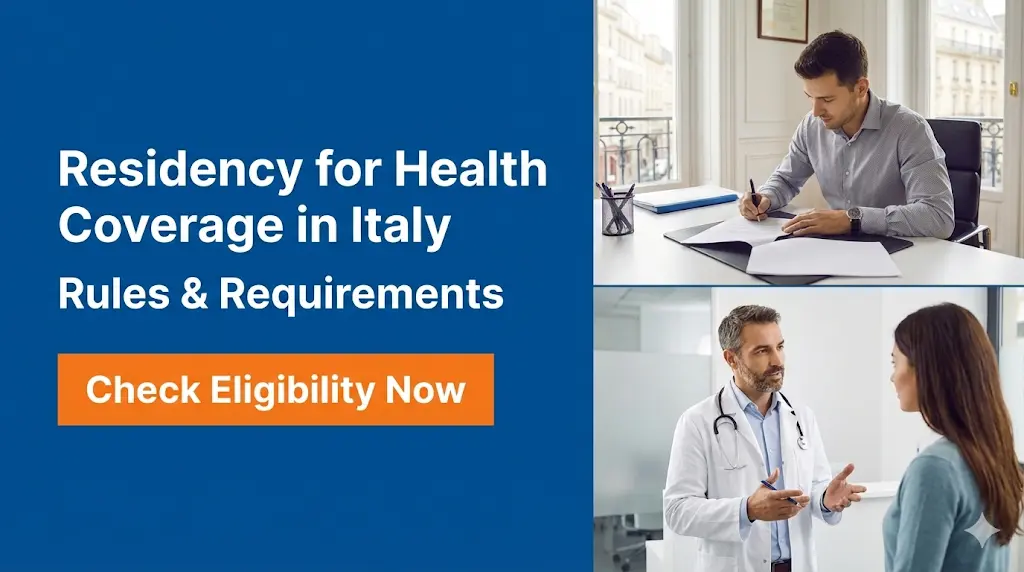
In Italy, “residency” is more than just having a lease on an apartment. To the Italian state, you are a resident only when you have completed the iscrizione anagrafica at the Comune (Town Hall). This process involves a local police officer (vigile) physically visiting your home to verify that you actually live there. This formal residency is the “golden key” to many social services, including the health system.
For non-EU citizens, residency is a two-step dance. Once you have the receipt of your Permesso di Soggiorno application, you can initiate your residency at the Comune. For healthcare purposes, the SSN requires proof that you are staying in the country legally and long-term. Short-term visitors on a 90-day Schengen visa generally do not qualify for residency or public health coverage and must rely on private travel insurance.
Mandatory vs Voluntary Registration
The path you take toward health coverage depends on why you are in Italy. The system distinguishes between those who contribute to the economy (or are here for humanitarian reasons) and those who are here on a self-sufficient basis.
Mandatory Registration (Iscrizione Obbligatoria)
This category is for those who are legally required to be covered by the SSN. It is generally free of charge because it is funded by the taxes you or your employer pay. You qualify for mandatory registration if you hold a residence permit for:
- Work (subordinate or self-employed)
- Family reunification
- Asylum or subsidiary protection
- Waiting for employment (attesa occupazione)
If you fall into this category, your health coverage is tied to the validity of your residence permit. When you renew your permit, you must also renew your health registration. This is a vital step in Registering with an Italian Family Doctor (Medico di Base), as your doctor is assigned only once your SSN registration is active.
Voluntary Registration (Iscrizione Volontaria)
If you do not fall into the mandatory categories, you can still access the SSN, but you must pay an annual fee. This is common for:
- Students
- Au pairs
- Religious personnel
- Holders of an Elective Residence Visa (retirees)
Voluntary registration is strictly based on the calendar year. This means if you pay the fee in October, your coverage still expires on December 31st. For many non-EU expats, especially those on an elective visa, understanding the Cost of Healthcare in Italy: What Expats Need to Know is essential before committing to the voluntary path, as the annual contribution is calculated based on your global income.
The Role of the Permesso di Soggiorno
For non-EU citizens, the Permesso di Soggiorno is the most important document you will own. It acts as the bridge between your visa and your right to access the SSN. Upon arriving in Italy, you have eight days to apply for this permit at a post office using a “Yellow Kit.”
The receipt you receive from the post office (la ricevuta) is legally sufficient to begin your healthcare registration process. You do not have to wait several months for the physical plastic card to arrive. The ASL (Azienda Sanitaria Locale) will use the barcode on your receipt to grant you a temporary health card. It is a common misconception that you are “uncovered” during the waiting period; as long as you have that receipt, you have a right to the system.
Residency Requirements for EU Citizens
If you are a citizen of an EU member state, the process is slightly different but still rooted in residency. EU citizens do not need a residence permit, but if they stay longer than three months, they must register at the Comune.
To qualify for health coverage, an EU citizen must prove they are:
- Employed or Self-Employed: In this case, registration is mandatory and free.
- A Student or Self-Sufficient: In this case, you must show proof of private health insurance or pay for voluntary SSN registration.
- A Family Member: Of an EU citizen who meets the criteria above.
Documents Needed for ASL Registration
Once you have established your residency at the Comune (or applied for it), you must visit your local ASL office. The documents required are standardized but essential:
- A valid Passport and Visa.
- The Permesso di Soggiorno or the post office receipt.
- Your Codice Fiscale (Tax Code).
- Certificate of residency or a self-declaration of your address.
- Proof of payment (if applying for voluntary registration).
Healthcare Enrollment Comparison Table
| Category | Registration Type | Residency Requirement | Cost |
| Worker (Non-EU) | Mandatory | Yes (Permesso + Comune) | Free (Tax-funded) |
| Family (Non-EU) | Mandatory | Yes (Permesso + Comune) | Free (Tax-funded) |
| Student (Non-EU) | Voluntary | Yes (Visa + Permesso) | Flat fee (~€700/year) |
| Retiree (Non-EU) | Voluntary | Yes (Elective Residence) | % of Income (Min ~€2,000) |
| EU Citizen (Worker) | Mandatory | Yes (Comune) | Free (Tax-funded) |
| Tourist (Any) | None | No | Out-of-pocket / Insurance |
Challenges with the “Residency Certificate”
A frequent hurdle for expats is the “Chicken or the Egg” problem: the ASL often asks for a residency certificate, but the Comune won’t finish the residency process until you have health insurance. To solve this, the Italian Ministry of Health has issued circulars stating that a “self-certification” of residence or the receipt of the residency application should be enough to get your health card.
If you encounter a rigid clerk at the ASL, politely remind them that under Presidential Decree (DPR) 445/2000, you have the right to self-certify your residency for the purpose of accessing public services.
Healthcare for Non-Residents and Undocumented Persons
Italy is unique in that it offers a safety net even for those who do not yet meet the residency requirements. If you are a foreigner without a valid residence permit or residency certificate, you cannot register for the full SSN, but you can obtain an STP code (Straniero Temporaneamente Presente).
The STP code grants access to:
- Urgent and essential outpatient and hospital care.
- Pregnancy and maternity care.
- Vaccinations and infectious disease prophylaxis.
This ensures that health is protected regardless of administrative status. However, an STP code does not allow you to have a family doctor or access non-urgent specialist visits at the subsidized rate.
Maintaining Coverage During Residency Renewal
Your health coverage is legally tied to your residency status. For non-EU residents, this means that when your Permesso di Soggiorno expires, your health card technically expires too. To prevent a gap in coverage, you must go to the ASL with the receipt of your renewal application.
They will issue a temporary paper health card that is valid for six months or until your new permit is issued. It is vital to keep this updated, as pharmacies and hospitals will see a “blocked” card in the system if you let the dates lapse. If you are a student, remember that your voluntary payment must be renewed every January, regardless of when your residency was established.
Conclusion
Residency is the cornerstone of the Italian health system. While the bureaucracy can be intimidating, the system is designed to be inclusive for those who follow the legal path to residency. By securing your Tax Code, applying for your Residence Permit, and registering at your local Comune, you fulfill the prerequisites to join one of the world’s most comprehensive health networks.
Whether you are a worker contributing through taxes or a retiree contributing through a voluntary fee, the SSN provides a level of security that allows you to focus on the joys of living in Italy rather than the “what ifs” of medical emergencies. Stay proactive with your paperwork, keep your receipts organized, and you will find that the Italian healthcare system is a reliable partner in your expatriate journey.
References
Primary sources (official)
- Ministero della Salute: The official portal for the Italian National Health Service, detailing the rights of foreign citizens. https://www.salute.gov.it/
- Agenzia delle Entrate: Official site for the Codice Fiscale and tax-related health card information. https://www.agenziaentrate.gov.it/
Other helpful sources
- Life in Italy: Expat resources on navigating Italian bureaucracy and health clinics. https://www.lifeinitaly.com/
- Portale Immigrazione: The official portal for the “Yellow Kit” tracking and residence permit updates. https://www.portaleimmigrazione.it/
Disclaimer
The information provided in this article is for general informational purposes only and does not constitute official legal or medical advice. Italian immigration and healthcare laws are subject to frequent changes and regional variations. Always consult with your local ASL, the Questura, or a qualified immigration professional regarding your specific situation. In the event of a medical emergency in Italy, dial 112 immediately.