Artisan and Craftsmanship Apprenticeships in Italy
Italy’s legendary craftsmanship is preserved through a rigorous system of artisan apprenticeships. This guide explores how aspiring makers can enter traditional trades, the legal frameworks of apprenticeship contracts, and the cultural importance of the “Made in Italy” heritage.
Disclosure: This post may contain affiliate links. We may earn a commission at no extra cost to you if you make a purchase through these links. Read full disclosure.
Introduction
The allure of Italy often begins with its aesthetic—the perfect curve of a leather heel, the intricate gold leafing on a Florentine frame, or the precise mechanics of a high-end sports car. These are the fruits of “Made in Italy,” a brand that represents centuries of refined skill. However, behind every masterpiece lies a unique educational tradition: the apprenticeship. In Italy, being an artisan is not just a job; it is a vocation passed down from master to pupil, and for those looking to enter these trades, the path is as much about character and patience as it is about technical ability.
In 2026, as the world moves toward mass automation, Italy has doubled down on its artisanal heritage. The government and regional bodies have introduced new incentives to ensure that traditional trades do not vanish. For international enthusiasts and young professionals, this provides a rare opportunity to learn from the world’s best. However, entering an Italian workshop requires more than just passion. It involves navigating a specific legal system of contracts, regional regulations, and linguistic requirements. Understanding the Work Culture in Italy: What Expats Should Expect is vital for anyone hoping to thrive in the intimate, hierarchy-driven environment of a traditional bottega.
The Heritage of the Italian Bottega
The concept of the bottega (workshop) dates back to the Renaissance. It was in these spaces that masters like Leonardo da Vinci and Michelangelo first learned their crafts. Today, the modern bottega still functions as a sanctuary for skill. Whether it is a violin maker in Cremona, a glassblower in Murano, or a tailor in Naples, the focus remains on the “manual intelligence” required to create something unique.
Apprenticeships in these sectors are highly sought after because they offer something a classroom cannot: the physical “feel” of materials and the secrets of the trade that are never written down. For many, this is the ultimate form of continuing education. If you are a graduate looking to pivot into a hands-on career, you might first explore Continuing Education and Postgraduate Options in Italy to see how university-level design programs can bridge the gap into professional craftsmanship.
Legal Framework of the Apprendistato Professionalizzante
In Italy, an apprenticeship is not a casual arrangement; it is a specific type of employment contract known as the Apprendistato. This contract is designed to blend work with formal training, providing the apprentice with a salary and social security benefits while the employer receives tax incentives for teaching the trade.
The Three Types of Apprenticeship
The Italian labor code defines three main levels of apprenticeship:
- Level 1: For those seeking a professional qualification or diploma while still in school.
- Level 2 (Professionalizzante): The most common for artisans. It is aimed at young people (aged 18-29) and focuses on learning a specific trade through on-the-job training.
- Level 3: Higher education apprenticeships, often used for research roles or high-level professional certifications.
For most aspiring craftsmen, Level 2 is the entry point. It typically lasts between three and five years, depending on the complexity of the craft. During this time, the apprentice is a regular employee with rights protected by Labor Laws in Italy: Worker Rights and Unions, ensuring they receive fair pay and safe working conditions.
Top Sectors for Artisanal Apprenticeships
While almost any manual trade can have an apprenticeship, certain sectors are iconic to the Italian identity and offer the most robust support systems for new makers.
Leatherworking and Fashion
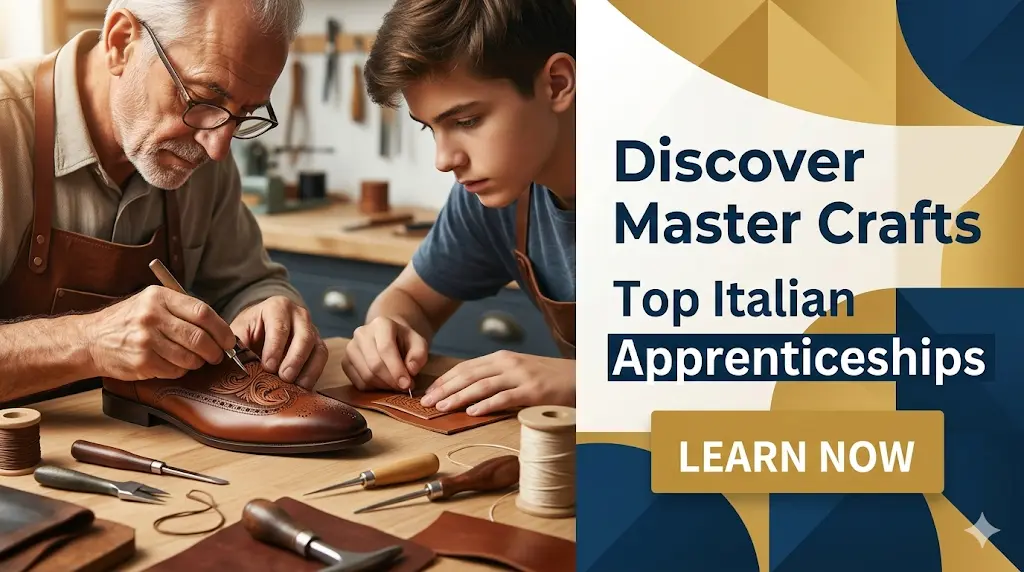
Florence and the surrounding Tuscany region are the global headquarters for leather. From high-fashion handbags to bespoke shoes, the apprenticeship system here is legendary. Schools like the Scuola del Cuoio in Florence offer paths that transition from intensive courses into workshop placements.
Ceramics and Pottery
Faenza and Vietri sul Mare are just two of the many “cities of ceramics” in Italy. Apprentices here learn the chemistry of glazes, the physics of the wheel, and the traditional patterns that have defined their regions for centuries.
Musical Instrument Making (Luthier)
Cremona remains the world capital for violin making. To become a luthier, one must usually attend the international school in Cremona and then spend years as an apprentice in a master’s workshop. The precision required is immense, and the “secrets” of the varnish are still some of the most guarded mysteries in the artisan world.
Restoration and Heritage Skills
Italy has more UNESCO World Heritage sites than any other country. This creates a massive demand for restorers—specialists who can fix centuries-old frescoes, stone carvings, and gilded altarpieces. These apprenticeships often require a high level of academic background in art history.
Finding an Artisan Apprenticeship
Finding a master willing to take on an apprentice can be more challenging than finding a standard office job. It often requires a mix of formal research and traditional networking.
- Chambers of Commerce (Unioncamere): Every Italian province has a Chamber of Commerce with a dedicated “Artigianato” (Artisans) department. They maintain registries of authorized workshops.
- Confartigianato and CNA: These are the two largest associations representing artisans in Italy. They often host career fairs and maintain lists of workshops looking for new talent.
- Regional Portals: Many regions, such as Lombardy or Tuscany, have specific portals for Youth Guarantee and Training Programs in Italy that include artisanal pathways funded by the European Social Fund.
- The “Spontaneous Application”: In the artisan world, walking into a shop with a well-crafted CV (and perhaps a portfolio of any creative work you’ve done) is still a valid and respected move.
Language and Cultural Barriers
You cannot learn a craft in Italy without speaking Italian. While the master might use gestures to show you how to hold a chisel, the nuances of the materials, the technical terminology, and the social integration of the workshop depend on the language.
Most apprenticeship contracts for non-EU citizens will require a minimum level of Italian proficiency. If you are serious about this path, you should focus on Italian Language Certificates (CILS, CELI) Explained to ensure you have the official credentials needed to satisfy both your master and the immigration authorities.
Table: Comparison of Artisanal Apprenticeship Hubs in Italy
| Craft / Sector | Key Region | Famous Hubs | Apprenticeship Focus |
| Leather & Shoes | Tuscany | Florence, Santacroce | Tanning, Cutting, Hand-stitching |
| Musical Instruments | Lombardy | Cremona | Wood selection, Varnish, Acoustic tuning |
| Textiles & Silk | Lombardy | Como | Weaving, Pattern design, Dyeing |
| Glassblowing | Veneto | Murano (Venice) | Furnace techniques, Sculpture |
| Goldsmithing | Veneto / Tuscany | Vicenza, Arezzo | Filigree, Setting, Casting |
| Ceramics | Emilia-Romagna | Faenza | Glazing, Kiln management, Decoration |
The Financial Reality of an Apprentice
Apprentices in Italy earn a salary, but it is typically a percentage of what a fully qualified professional makes. Under the Apprendistato contract, the employer can pay the apprentice at a lower “contractual level” initially, with the salary increasing as the apprentice gains more skills.
For international apprentices, this means careful budgeting is essential. While the cost of living in smaller artisanal hubs is often lower than in Milan or Rome, you must still prove financial self-sufficiency to maintain your residence permit. Navigating these Salary Expectations in Italy: Jobs and Industries will help you understand the long-term financial payoff of becoming a master craftsman.
Transitioning to a Master Craftsman
The end goal of any apprenticeship is to become a Maestro Artigiano. In many regions, this title is legally protected and requires passing a final exam at the end of the apprenticeship period. Once you hold this title, you are authorized to open your own workshop and, eventually, take on apprentices of your own, continuing the cycle of the “Made in Italy” heritage.
Conclusion
Artisan and craftsmanship apprenticeships in Italy offer a unique bridge between the past and the future. They provide a path for those who find fulfillment in the tactile and the permanent, rather than the digital and the ephemeral.
While the road to becoming a master is long and requires a commitment to language, culture, and a modest starting salary, the reward is a skill that is globally respected and a career that is truly an art form. In 2026, as Italy continues to protect its artisanal soul, there has never been a better time for dedicated makers to seek out a master and begin their journey in the bottega.
References
Primary sources (official)
- Ministero del Lavoro – Apprendistato: Official government guidelines on the different types of apprenticeship contracts. https://www.lavoro.gov.it/temi-e-priorita/occupazione/focus-on/Apprendistato/Pagine/default.aspx
- Confartigianato Imprese: The leading national association representing Italian artisans and small businesses. https://www.confartigianato.it/
Other helpful sources
- Scuola del Cuoio (Florence): An example of a world-renowned artisanal school that leads to professional apprenticeships. https://scuoladelcuoio.it/en/
Disclaimer
The information provided in this article is for general informational purposes only and does not constitute professional legal, financial, or career advice. Italian labor laws and apprenticeship regulations are subject to frequent change and can vary significantly between regions. Always consult with the official Italian authorities, a qualified labor consultant (Consulente del Lavoro), or your local Chamber of Commerce before signing an apprenticeship contract or making relocation decisions.