CV and Interview Tips for Working in Italy
Landing a job in Italy requires understanding local recruitment nuances. This guide provides essential tips for crafting an Italian-style CV and mastering the interview process, ensuring international candidates can navigate the professional landscape of the “Bel Paese” with confidence and success.
Disclosure: This post may contain affiliate links. We may earn a commission at no extra cost to you if you make a purchase through these links. Read full disclosure.
Navigating the Italian Job Market as a Foreigner
Entering the Italian workforce is an exciting prospect that promises a unique blend of professional challenge and an unparalleled quality of life. However, for many expats, the initial hurdle is not just finding a vacancy, but understanding how to present themselves effectively to Italian recruiters. The Italian job market relies heavily on specific administrative standards and cultural expectations that differ significantly from those in the United States, the UK, or even other parts of Northern Europe.
Whether you are aiming for a high-tech role in Milan or a creative position in Florence, your first impression is made through your curriculum vitae. In Italy, the “CV” is more than just a list of past jobs; it is a formal document that often follows a standardized European format. Beyond the document itself, the interview process in Italy is deeply rooted in personal connection, formality, and a demonstration of cultural fit. Before diving into the specifics of your application, it is helpful to understand the broader Italian Job Market 2027: In-Demand Skills and Sectors to ensure your profile aligns with current economic needs.
Mastering the Italian CV Format
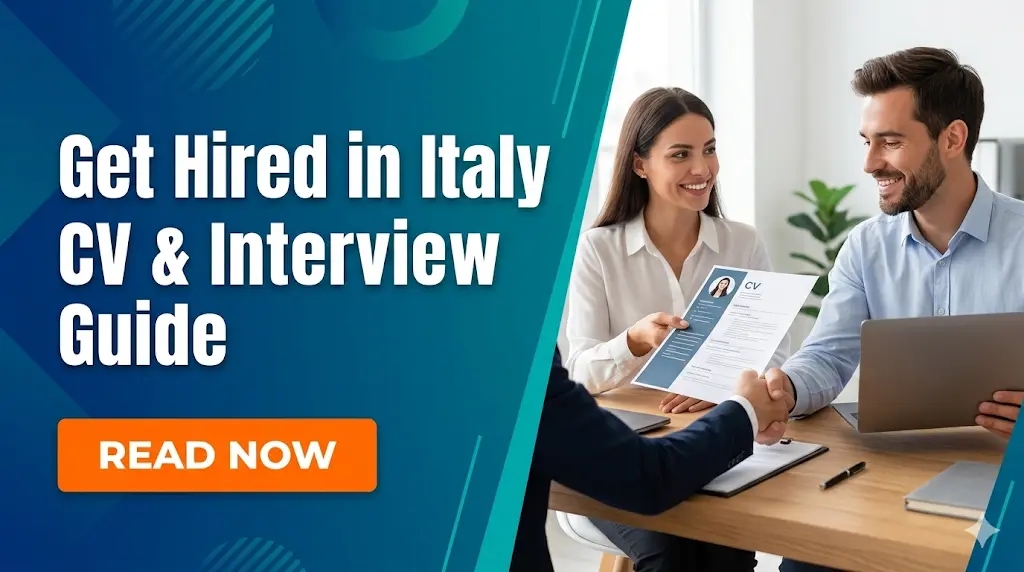
The most significant difference many international candidates notice is the structural requirement of an Italian CV. While a one-page “resume” is the gold standard in America, Italian employers often prefer a more comprehensive document. In many sectors, particularly the public sector or larger traditional corporations, the Europass CV remains a highly respected format.
The Europass Standard
The Europass format is a standardized template used across Europe to make skills and qualifications clearly understood. While some modern creative agencies might find it too rigid, many Italian HR managers appreciate its clarity and the ease with which they can compare candidates. Using this format ensures that you include all the “hidden” requirements that Italian law and custom demand.
Essential Personal Details
Unlike in many English-speaking countries where “blind recruitment” practices discourage the inclusion of personal data to prevent bias, Italian CVs are traditionally quite personal. You should include:
- Full Name and Contact Information: Ensure your phone number includes the international country code (+39 for Italy).
- Date of Birth and Place of Birth: This is a standard requirement for Italian administrative purposes.
- A Professional Photograph: This is nearly mandatory in Italy. A high-quality, professional headshot at the top of your CV helps recruiters put a face to the name and is seen as a sign of transparency.
- Citizenship/Work Permit Status: If you are a non-EU citizen, explicitly stating that you already possess a valid permesso di soggiorno can significantly increase your chances of getting a callback.
The GDPR Privacy Clause
One of the most critical elements of an Italian CV is the privacy disclaimer. Under Italian and EU law (GDPR), companies cannot legally process your personal data without your explicit consent. At the bottom of your CV, you must include a statement similar to: “Autorizzo il trattamento dei miei dati personali ai sensi del Decreto Legislativo 30 giugno 2003, n. 196 e del GDPR (Regolamento UE 2016/679).” Without this sentence, many recruiters are technically required to delete your application immediately.
Writing for the Italian Recruiter: Language and Tone
The language you choose for your CV depends heavily on the company and the role. If you are applying to a multinational firm in a tech-heavy city, an English CV is often acceptable. However, if the job description is in Italian, your CV should be as well.
Demonstrating Language Proficiency
Language skills are highly valued in Italy. Instead of just saying you are “fluent” or “beginner,” use the Common European Framework of Reference for Languages (CEFR) levels (A1, A2, B1, B2, C1, C2). This provides a concrete standard that recruiters understand. If you have officially recognized certifications, such as those from Learning Italian: Language Courses and Tests for Expats, make sure to list them prominently.
Highlighting Education
In Italy, academic background often carries more weight than in other markets. Listing your university degree, the final grade (if it was high), and even the title of your thesis can be beneficial, especially for entry-to-mid-level positions. Ensure that your foreign degree is clearly translated into its Italian equivalent (e.g., Bachelor’s vs. Laurea Triennale).
Preparing for the Italian Job Interview
Once your CV has opened the door, the interview is your opportunity to demonstrate your “human value.” Italian business culture is deeply relational. While technical skills are essential, the interview is often used to gauge how well you will fit into the existing team and whether you respect the company’s hierarchy and values.
The Importance of Formality
Italy is a formal country, especially in professional settings. This begins with how you address the interviewer. Always use the formal Lei instead of the informal tu until you are explicitly invited to do otherwise. Address your interviewers by their titles—Dottore or Dottoressa is the standard for university graduates, while Ingegnere or Architetto is used for those in specific professional orders.
Dressing for Success
The concept of bella figura—making a good impression—is vital. Even in the tech sector, Italian candidates tend to dress more formally than their counterparts in Silicon Valley. A well-tailored suit or professional business attire is expected. Showing up underdressed can be interpreted as a lack of respect for the interviewer and the company.
Navigating Cultural Questions
Don’t be surprised if the interview feels a bit more “personal” than what you are used to. It is common for interviewers to ask about your interests, your family, or why you chose to live in Italy. While they are looking for professional competence, they are also trying to see if you have the resilience and cultural adaptability to succeed in a new country. Understanding the Work Culture in Italy: What Expats Should Expect can help you prepare anecdotes that show you are ready for the Mediterranean office environment.
Key Differences: Italy vs. The International Standard
To help you transition your current application materials, consider the following comparisons between the typical “International/US” style and the “Italian” style.
| Feature | International/US Standard | Italian Standard |
| CV Length | Strict 1-page limit | 2 to 3 pages is common |
| Personal Info | Minimal (No age/gender) | Mandatory (Birth date/Citizenship) |
| Photo | Discouraged | Highly Recommended |
| Privacy Clause | Not required | Legally mandatory (GDPR) |
| Tone | Direct and results-oriented | Formal, polite, and detailed |
| Interviews | Behavioral/Competency-based | Relational/Cultural-fit focused |
Technical Interviews and Skills Assessment
In specialized sectors like IT, engineering, or finance, the process will naturally include technical assessments. However, even these are conducted with an Italian flair.
Group Interviews and Assessments
For larger companies (like Eni, Ferrero, or major banks), you may be invited to an “Assessment Center.” This often involves group exercises where recruiters observe your leadership, communication, and teamwork skills. In the Italian context, showing that you can collaborate harmoniously is often more important than proving you are the loudest voice in the room.
Portfolio and Certifications
If you are in a creative or technical field, having a digital portfolio is standard. However, Italian companies also place high value on “official” certifications. If you have industry-specific qualifications (Microsoft, Cisco, CFA, etc.), ensure they are clearly listed and that you have the digital badges or certificates ready to present. For those in specialized fields, checking the Tech Jobs in Italy: Hotspots and Salary Overview can provide a benchmark for the skills most valued by local firms.
Follow-up Etiquette in Italy
The post-interview phase is a delicate time. While “thank you” notes are a nice touch in many countries, in Italy, the follow-up should be handled with professional patience.
The Thank-You Note
Sending a brief, formal email to thank the interviewer for their time is appreciated. Keep it concise and reiterate your enthusiasm for the role and the company. Use formal closings like Cordiali Saluti or Distinti Saluti.
Managing the Timeline
Italian recruitment cycles can be slower than those in Northern Europe or North America. It is not uncommon for several weeks to pass between interview stages. While it is acceptable to follow up if you haven’t heard back within the promised timeframe, avoid being overly aggressive. Patience is seen as a sign of professional maturity.
Practical Tips for Success
- Tailor Your CV for Every Role: Do not send a generic Europass to every company. Highlight the specific skills mentioned in the job description using the exact Italian terminology where possible.
- Highlight Your “Soft Skills”: In Italy, being simpatico (likable) and flessibile (flexible) are highly prized traits. Use your interview to show you are a team player.
- Prepare Your Questions: An Italian recruiter will expect you to have done your homework. Ask about the company’s history, its role in the Italian market, and its long-term vision.
- Proofread Everything: A CV with typos in Italian will be rejected immediately. If you are not a native speaker, have a local friend or a professional service check your grammar and spelling.
Conclusion
Securing a job in Italy is a rewarding journey that requires a blend of technical preparation and cultural intelligence. By adapting your CV to meet local standards—including the necessary personal data and privacy clauses—and approaching the interview with the right level of formality and warmth, you can successfully bridge the gap between “foreign applicant” and “valuable asset.”
Remember that in Italy, your ability to connect with people is just as important as your ability to perform the job. Stay patient, stay formal, and focus on building the relationships that define the Italian professional world.
References
Primary sources (official)
- Ministero del Lavoro e delle Politiche Sociali: The official Italian Ministry of Labor website provides insights into labor laws and national employment standards. https://www.lavoro.gov.it/
- Europass Official Portal: The official European Union site for creating a standardized CV and understanding skills passports. https://europa.eu/europass/en
Other helpful sources
- ISTAT (Istituto Nazionale di Statistica): Offers data on employment trends and the most required professional qualifications in Italy. https://www.istat.it/
Disclaimer
The information provided in this article is for general informational and educational purposes only and does not constitute professional career or legal advice. Recruitment practices and labor laws in Italy are subject to change. Every job search is unique, and success depends on a wide range of factors including individual qualifications, market conditions, and employer preferences. Always consult with a qualified career coach or legal professional before making significant career decisions in Italy.