Employer-Sponsored vs Self-Sponsored Work Visas
Choosing the right Italian work visa is the first step toward a successful professional life in the Mediterranean. This guide compares employer-sponsored and self-sponsored pathways, detailing the requirements, quotas, and strategic advantages of each option for non-EU expats.
Disclosure: This post may contain affiliate links. We may earn a commission at no extra cost to you if you make a purchase through these links. Read full disclosure.
Introduction
Navigating the Italian immigration system can feel like a daunting task, especially when your professional future is on the line. For many non-EU citizens, the dream of living and working in Italy begins with a fundamental question: Should I find a company to sponsor me, or should I strike out on my own? The choice between an employer-sponsored and a self-sponsored work visa is not just a matter of preference; it is a strategic decision dictated by your qualifications, your professional goals, and the current legal landscape.
Italy remains a highly sought-after destination for talent, but it is also a country with a rigid bureaucratic framework. Unlike “at-will” immigration systems found in some other parts of the world, Italy’s work authorization is deeply tied to the “Decreto Flussi”—an annual government decree that sets specific quotas for foreign workers. Understanding how these quotas affect different visa types is essential. Before you commit to a path, it is often helpful to review the Major Updates in Italian Immigration Law for 2026 to see how current policies might impact your application timeline.
Defining the Employer-Sponsored Pathway
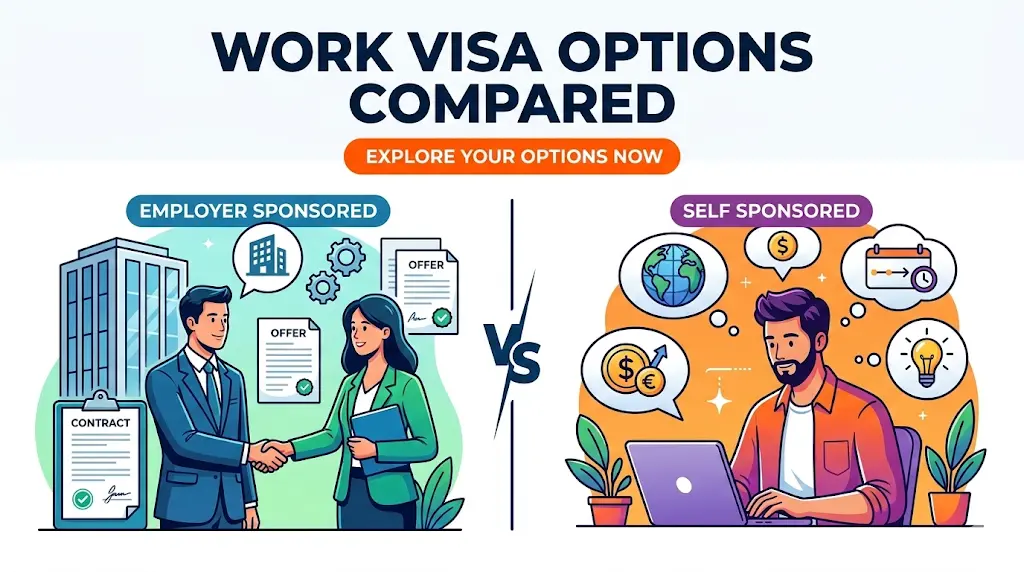
An employer-sponsored work visa, legally known as “Lavoro Subordinato,” is the most common route for professionals entering the Italian workforce. In this scenario, your right to live and work in Italy is directly linked to a specific job offer from an Italian company or a foreign company with a legal branch in Italy. The employer acts as your sponsor, taking on the administrative burden of proving that the position exists and that no suitable Italian or EU candidate could be found to fill it.
The Role of the Nulla Osta
The cornerstone of the employer-sponsored process is the “Nulla Osta” (Certificate of No Impediment). Your prospective employer must apply for this document through the local immigration office (Sportello Unico per l’Immigrazione). This is not a simple task; the company must demonstrate financial stability, tax compliance, and adherence to the National Collective Labor Agreement (CCNL). If you are targeting high-level roles, you might find that EU Blue Card in Italy: Salary Requirements and Process offers a more streamlined alternative to the standard Nulla Osta, provided you meet the specific educational and income thresholds.
Quota Restrictions and the Decreto Flussi
The majority of employer-sponsored visas fall under the annual quota system. This means that even if you have a perfect job offer, you cannot apply until the government opens the application window. These quotas are often filled within hours of opening, making it a highly competitive “click day” process. For 2026, the government has slightly adjusted these numbers to prioritize sectors with labor shortages, such as construction, hospitality, and logistics.
Exploring the Self-Sponsored Pathway
For those who value independence or already have an established client base, self-sponsorship via the “Lavoro Autonomo” visa is the primary alternative. This category is designed for freelancers, entrepreneurs, and highly skilled independent professionals who wish to set up their own business or professional practice in Italy.
The Self-Employment Visa for Freelancers
This visa is ideal for digital nomads, consultants, and artists. Unlike the employer-sponsored route, you are the one responsible for proving your professional credentials and financial viability. You must demonstrate that you have sufficient income—typically exceeding the minimum threshold for exemption from healthcare participation costs—and that you have secured the necessary professional certifications. If you are a remote worker, you should also compare this with the Italy Digital Nomad Visa: Eligibility and Application which offers different residency rules for those employed by foreign firms.
The Startup and Entrepreneur Visa
Italy is increasingly welcoming to innovative founders. The “Italia Startup Visa” is a specialized self-sponsored path for non-EU entrepreneurs who wish to establish an innovative startup. This path is unique because it offers a centralized, digital-first application process that bypasses some of the traditional local bureaucracy. It requires a minimum investment of €50,000 and a business plan that is vetted by a technical committee.
Comparing the Two Pathways: A Quick Reference
| Feature | Employer-Sponsored (Subordinato) | Self-Sponsored (Autonomo) |
| Primary Requirement | Valid Job Offer / Employment Contract | Business Plan / Professional Credentials |
| Sponsorship | Mandatory (by an Italian Company) | Self-Sponsorship |
| Quota System | Strictly tied to Decreto Flussi | Strictly tied to Decreto Flussi |
| Financial Proof | Provided by Employer (Company Stability) | Provided by Applicant (Personal Savings/Income) |
| Residency Permit | Permesso per Lavoro Subordinato | Permesso per Lavoro Autonomo |
| Flexibility | Tied to the specific employer initially | Full professional independence |
| Processing Time | Often 3-6 months | Often 4-8 months |
Professional Qualifications and Certifications
Regardless of the path you choose, the Italian authorities will want to see that you are actually qualified for the role you intend to perform. This is where the concept of “Recognition of Qualifications” comes into play.
For Sponsored Employees
Your employer will need to submit your educational transcripts as part of the Nulla Osta application. If you are entering a regulated profession—such as engineering, nursing, or law—you will need to go through a formal process to have your degree recognized by the relevant Italian ministry. Understanding the nuances of Certifications and Professional Qualifications in Italy can save you months of delays during the document preparation phase.
For Self-Employed Professionals
Freelancers must often register with a professional order (Albo) or the Chamber of Commerce (Camera di Commercio). This requires proving that you possess the specific skills listed in your visa application. For instance, an architect must prove they have the equivalent of an Italian architectural license. For “non-regulated” professions, such as marketing or software development, you may instead need a statement of comparability from CIMEA.
Financial Requirements: What You Need to Show
Money is a central theme in Italian immigration. The government wants to ensure that every foreign worker can support themselves without becoming a burden on the state’s social welfare systems.
Employer-Sponsored Financials
In this case, the financial burden is largely on the company. They must provide their “DURC” (proof of regular social security contributions) and their latest tax returns (Unico) to show they can afford to pay your salary. The salary offered must comply with the minimums set by the National Collective Labor Agreement for your specific “Livello” (professional level).
Self-Sponsored Financials
Self-employed applicants face a higher personal financial bar. You must demonstrate that you have access to a specific amount of capital—often around €10,000 to €20,000—in a bank account. Furthermore, you must show that your projected annual income will exceed the legal minimum for residency. For freelancers, this often involves showing existing contracts with clients or a robust portfolio that suggests future earning potential. If you are setting up a more formal structure, you should look into Freelancing in Italy: Registering for Partita IVA to understand the long-term tax implications of your self-sponsored status.
Administrative Procedures: The Step-by-Step Journey
Both pathways involve a three-stage process: the pre-clearance in Italy, the visa issuance at the consulate, and the residency permit application upon arrival.
- Stage 1: The Italian Clearance. For employer-sponsored visas, the employer applies for the Nulla Osta. For self-employed visas, the applicant (or a representative) applies for the “Attestazione di Parametri” or the “Nulla Osta per Lavoro Autonomo.”
- Stage 2: The Consular Visa. Once the clearance is granted, you visit the Italian consulate in your home country to receive the physical visa in your passport.
- Stage 3: The Permesso di Soggiorno. Within eight days of arriving in Italy, you must go to a post office to mail the “Kit Giallo” (Yellow Kit) to apply for your residence permit. This is the final step that grants you full legal rights as a resident.
Conclusion
The decision between an employer-sponsored and a self-sponsored work visa in Italy depends on your risk tolerance and your professional assets. The sponsored route offers the security of a guaranteed income and a company to help navigate the bureaucracy, but it ties your residency to a single employer.
The self-sponsored route offers the freedom to build your own brand in one of the world’s most beautiful countries, but it carries a higher administrative and financial burden. Regardless of your choice, success in the Italian market requires meticulous preparation, a clear understanding of the quota system, and a proactive approach to document legalization. By choosing the path that best aligns with your long-term vision, you can turn the dream of an Italian career into a legal and prosperous reality.
References
Primary sources (official)
- Visto per l’Italia – Ministry of Foreign Affairs: The official government database for checking visa requirements based on nationality and purpose. https://vistoperitalia.esteri.it/home/en
- Ministero dell’Interno – Immigration Department: Official site for residence permit (Permesso di Soggiorno) regulations and the annual Decreto Flussi. https://www.interno.gov.it/it/temi/immigrazione-e-asilo
Other helpful sources
- InfoCamere – Italian Chamber of Commerce: Information on registering as a self-employed professional or “Ditta Individuale” in Italy. https://www.registroimprese.it/en/home
Disclaimer
The information provided in this article is for general informational and educational purposes only and does not constitute professional legal, immigration, or financial advice. Italian immigration laws, including the annual quotas of the Decreto Flussi and specific visa requirements, are subject to frequent changes by the Ministry of the Interior and the Ministry of Foreign Affairs. Every individual’s situation is unique; therefore, it is highly recommended to consult with a qualified Italian immigration lawyer or a professional relocation consultant before making significant career or relocation decisions in Italy.