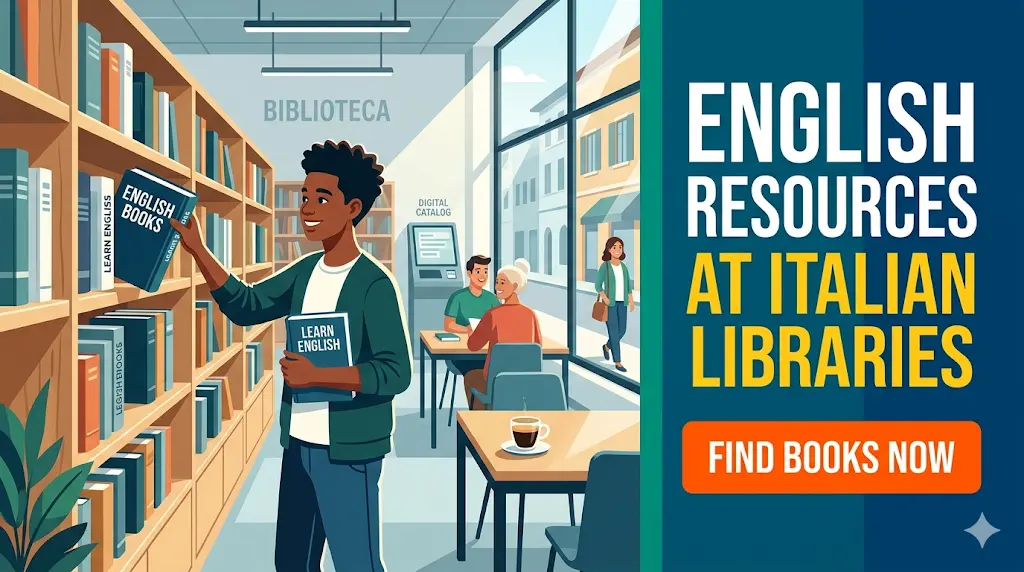
English Resources at Italian Public Libraries
Walking into an Italian library craving a simple paperback in your native language, only to find a single dusty shelf of translated travel guides, is deeply isolating. I spent my first winter in Florence desperately re-reading the same English novel because I didn’t understand the local lending system. This guide explains how to access English resources at Italian public libraries.
Disclosure: This post may contain affiliate links. We may earn a commission at no extra cost to you if you make a purchase through these links. Read full disclosure.
Navigating the Italian Public Library System
The Registration Process
Italian public libraries (biblioteche comunali) are wonderful, culturally rich institutions, but they are also deeply entangled in the local municipal bureaucracy. You cannot simply walk up to the circulation desk with your foreign passport and expect to walk out with a stack of books. The library card (tessera della biblioteca) is a formal document that ties you to the local regional network.
To secure your library card, you absolutely must possess an official Italian tax code. If you have just arrived and have not finalized this paperwork, you need to read our guide on Checking Your Italian Tax Code Codice Fiscale Status before attempting to register. The librarians will require you to present your physical tax card or the stamped paper certificate, alongside your official ID. Furthermore, many regional networks require proof of your local address (domicilio or residenza). Because public libraries are funded by the municipality, they want to ensure their resources are being utilized by actual residents.
Dealing with the registration desk is often your first real taste of local administrative friction. The clerks might ask you to fill out extensive paper forms regarding data privacy laws (privacy). Navigating this paperwork is a miniature version of the larger hurdles discussed in Navigating Italian Bureaucracy Comune and Prefettura. However, once you successfully navigate this registration, your single card usually grants you access to an entire provincial network, allowing you to request books from dozens of smaller satellite branches to be delivered to your local neighborhood hub.
The MLOL Digital Revolution
If you are searching for physical English books, the standard Italian public library will likely leave you disappointed. However, the absolute secret weapon for expats living in Italy is the digital lending system known as MLOL (MediaLibraryOnLine). MLOL is the Italian equivalent of Libby or OverDrive, and it represents a massive digital revolution for foreign residents craving media in their native language.
When you register for your physical library card, you must explicitly ask the librarian to activate your MLOL account. They will email you a username and a PIN. Once you log into the MLOL portal or app, you unlock a treasure trove of international content. Through MLOL’s integration with platforms like PressReader, you get completely free, daily access to major global publications like The New York Times, The Washington Post, and The Guardian. It also provides access to thousands of English-language ebooks and audiobooks, saving you a massive amount of money and helping you balance your Cost of Living in Italy 2026 Budgeting for Expats.
To initially set up the MLOL app and authenticate your account while standing at the librarian’s desk, you need an immediate and reliable internet connection. Instead of fighting with the library’s notoriously spotty public Wi-Fi network, I highly recommend downloading a data eSIM from Airalo before you even visit. Having Airalo active on your smartphone ensures you have secure, high-speed cellular data to download the app, reset your passwords if necessary, and immediately start browsing the English catalog. Relying on Airalo means you never have to leave the library empty-handed just because of a digital authentication error.
Finding English Books and Media in Major Cities
Metropolitan Hubs and Foreign Language Sections
While small-town libraries struggle with foreign acquisitions, the major metropolitan hubs have recognized the need to serve their massive expat and international student populations. If you live in Rome, Milan, Turin, or Florence, you simply need to know which specific branch houses the sezione in lingua straniera (foreign language section).
In Rome, the Biblioteca Europea is the crown jewel for expats, offering a massive, constantly updated collection of contemporary English fiction, non-fiction, and periodicals. In Milan, the central Biblioteca Sormani dedicates significant floor space to international literature. These specific branches employ librarians who actually specialize in foreign acquisitions, meaning you can find recent bestsellers rather than just thirty-year-old mass-market paperbacks left behind by backpackers.
However, you must be prepared for the fact that Italian libraries often use specialized, closed-stack archiving systems for older materials. You cannot always browse the shelves freely. You must look up the book on the digital catalog (OPAC), write the call number on a slip of paper, and wait for a librarian to retrieve it from the subterranean archives. This process requires patience and a basic understanding of library Italian.
| City | Key Library Branch | English Resource Quality | Digital Platform |
| Rome | Biblioteca Europea | Excellent (Contemporary & Classic) | MLOL / PressReader |
| Milan | Biblioteca Sormani | Very Good (Large foreign section) | MLOL |
| Florence | Biblioteca delle Oblate | Good (Strong historical/art focus) | MLOL |
| Turin | Biblioteca Civica Centrale | Good (Growing international section) | MLOL |
| Rural Towns | Local Comunale Branches | Poor (Mostly donated/translated) | MLOL (Usually active) |
Independent and Expat-Run Alternatives
When the public system does not meet your needs, you must tap into the parallel network of independent, expat-run, and institutional libraries. Italy is home to numerous foreign cultural institutes that maintain incredible libraries for their members. The British Institute of Florence, for example, houses the largest lending library of English books in continental Europe.
These private institutional libraries usually require an annual membership fee, ranging from €30 to €100 depending on your student or resident status. Paying this fee is often the best investment an avid reader can make. To handle these local membership fees effortlessly, many expats rely on local digital payment systems, a topic covered extensively in Using Mobile Payment Apps Satispay etc in Italy.
Beyond formal institutions, almost every major Italian city has independent English bookstores, like The Almost Corner Bookshop in Rome or the Paperback Exchange in Florence. These shops often act as unofficial community centers, hosting book swaps and allowing you to trade in your read paperbacks for store credit. Before planning a trip across the city to visit any of these libraries or independent shops, always check the local calendar. Italian cultural institutions are notorious for shutting down completely during regional holidays, a frustrating logistical hurdle explained in Italian Bank Holidays 2026 When Banks Are Closed.
Expat Workarounds for Reading in English
Leveraging E-Readers and Online Marketplaces
Even with MLOL and the metropolitan hubs, there will be times when you simply cannot find the specific English book you want to read. The waitlists for popular digital audiobooks on the public system can stretch for months, and special ordering an English hardcover through a local Italian bookstore is exorbitantly expensive due to import taxes and distributor markups.
When the public library system falls short, veteran expats pivot entirely to e-readers and localized online marketplaces. I survived my first few years in Italy by heavily relying on Amazon Italy. You can easily purchase an e-reader or order physical English paperbacks directly through Amazon Italy without paying the massive international shipping fees or dealing with customs duties that you would face if ordering from the US or UK.
Having a massive selection of familiar English literature delivered directly to your door via Amazon Italy is a massive comfort when the culture shock hits hardest. You can maintain your normal reading habits seamlessly. Utilizing Amazon Italy to build your own personal library or upgrade your digital reading hardware completely bypasses the limitations of the local municipal archives.
Temporary Housing and Building Your Network
The hardest period for securing English resources is the first few months of your relocation. When you first arrive, you likely will not have the official residency required to get a public library card, and you will be too busy fighting bureaucracy to trek across town to a private institute. You will be stuck in a state of administrative limbo.
To bypass the stress of unstable temporary housing and secure a comfortable base where you can actually relax and read, veteran expats use Spotahome. By renting a verified, mid-term apartment through Spotahome, you secure a legitimate residential address from day one. Because Spotahome vetted the property, you know exactly what kind of living space you are getting, allowing you to choose an apartment with a great reading nook or one located strictly within walking distance of the central library branch.
Securing your initial lease through Spotahome protects you from the predatory local classifieds discussed in Avoiding Rental Scams on Italian Housing Websites and provides the stability needed to tackle major hurdles like Signing an Italian Rental Contract and Setting Up Utilities in Italy.
While you are getting settled into your Spotahome apartment, you will constantly need internet access to stream audiobooks, browse the MLOL catalog, and find independent bookstores. Keeping a data eSIM from Airalo active on your device ensures you are never disconnected. Relying on Airalo gives you the high-speed data necessary to download massive audiobook files while riding the metro, bridging the digital gap until your permanent home Wi-Fi is installed. By combining the digital power of MLOL, the cultural wealth of major city branches, and smart local workarounds, you can maintain a vibrant reading life anywhere in Italy.
References
Primary sources (official)
- MediaLibraryOnLine (MLOL) – The digital lending network for Italian public libraries – https://www.medialibrary.it/
- Biblioteche di Roma – The official portal for the Rome public library network – https://www.bibliotechediroma.it/
Other helpful sources
- The British Institute of Florence – The Harold Acton Library – https://www.britishinstitute.it/en/library
- The Local Italy – How to use Italy’s public libraries – https://www.thelocal.it/
Disclaimer
The information provided in this article is for educational and informational purposes only. The requirements for obtaining a public library card (tessera della biblioteca) and the specific availability of English language resources vary drastically between individual Italian municipalities (Comuni) and regional library networks. Access to the MediaLibraryOnLine (MLOL) digital platform depends entirely on the funding and subscription level of your specific local library branch. Always verify the current registration requirements, accepted forms of identification, and operating hours directly on the official website of your local municipal library.