Filing Taxes Jointly with Your Spouse in Italy
Assuming you can simply check a “Married Filing Jointly” box to slash your tax bill in Italy is a massive, costly expat mistake. I remember staring blankly at my commercialista when she told me my wife and I had to be taxed entirely separately despite being legally married. This guide demystifies Italian joint filing so you can navigate spouse deductions and tax credits without the confusion.
Disclosure: This post may contain affiliate links. We may earn a commission at no extra cost to you if you make a purchase through these links. Read full disclosure.
The Myth of the Joint Tax Return in Italy
Individual Taxation as the Rule
In the United States or the United Kingdom, getting married often allows you to aggregate your incomes. This “income splitting” can push a high-earning spouse into a lower, much more forgiving tax bracket if their partner earns significantly less. If you move to Italy expecting this exact same financial perk, you are in for a brutal awakening.
In Italy, the personal income tax (IRPEF) is strictly individual. The Italian state does not care if you have been married for twenty years or if you share a bank account; your income is taxed on your own personal progressive scale. If you earn €80,000 a year and your spouse earns zero, you cannot divide that income into two €40,000 chunks to lower your tax liability. You will bear the full, unfiltered brunt of the highest Italian Income Tax Brackets for 2026. Before negotiating an Italian salary, you and your spouse must calculate your individual net pay projections accurately. Assuming you have a joint tax shield will severely damage your household Cost of Living in Italy 2026 Budgeting for Expats.
In Italy, married couples do not typically file taxes jointly in the same way as in some other countries. Instead, Italy follows an individual taxation system, meaning each spouse files their own tax return and is taxed separately on their personal income. However, there are still ways spouses can benefit from their marital status within the tax framework.
One key advantage is the ability to claim certain deductions and tax credits related to a dependent spouse. If one spouse has little or no income, the other may be eligible for a “dependent spouse” tax deduction, which reduces the overall tax burden. The eligibility and amount depend on income thresholds and family circumstances. Additionally, certain expenses can be shared or allocated between spouses, such as medical costs, education expenses, or mortgage interest, provided proper documentation is maintained. These deductions can help optimize the household’s total tax liability.
Couples may also use the joint tax return form (Modello 730 congiunto) in specific cases, where one spouse files on behalf of both. This simplifies the administrative process but does not change the principle of separate taxation, as each individual’s income is still assessed independently. Understanding these rules is essential for effective tax planning. While Italy does not offer full joint taxation, couples can still benefit from strategic use of deductions and credits. Consulting a tax professional can help ensure compliance and maximize available advantages within the Italian tax system.
The Dependent Spouse Deduction (Familiare a Carico)
If true income splitting does not exist, what happens if your spouse doesn’t work? The Italian system offers a small consolation prize called the coniuge a carico (dependent spouse) deduction.
If your spouse earns less than €2,840.51 gross in a calendar year, the state legally considers them financially dependent on you. In this scenario, you are entitled to a tax deduction (detrazione) that slightly lowers your overall IRPEF bill. The exact amount of this deduction slides based on how much you earn—the higher your income, the smaller the deduction gets, eventually phasing out entirely for very high earners. While it is nowhere near as lucrative as the US joint filing brackets, it does provide a minor buffer against the high taxes associated with standard Types of Italian Employment Contracts Contratti di Lavoro.

The Modello 730 Congiunto: What It Actually Does
Who Qualifies for a Joint 730?
If Italian taxation is strictly individual, you might be confused by locals mentioning the 730 Congiunto (Joint 730). The 730 Congiunto is purely an administrative convenience, not a tax-saving loophole. It allows a married couple to file a single piece of paperwork rather than submitting two entirely separate tax returns.
To qualify for a joint return, at least one spouse must be an employee or a pensioner who is eligible to use the simplified Modello 730. If both you and your spouse are freelancers operating with a VAT number (Partita IVA), you cannot use this form; you must file separate Modello Redditi PF forms.
The Benefit of Offsetting Tax Debts and Credits
If it doesn’t save you money on tax brackets, why do Italian couples use the 730 Congiunto? The true superpower of this joint form is its ability to instantly offset tax debts against tax credits between spouses.
Imagine you owe €1,000 in underpaid taxes for the year, but your spouse is owed a €1,200 refund due to a massive accumulation of deductible medical expenses (a system you can master by reading Deducting Health Insurance Premiums on Italian Taxes). If you file separately, you have to write a check to the government for €1,000 by July, while your spouse waits months—sometimes years—for the state bureaucracy to process their €1,200 refund check.
By filing a 730 Congiunto, the Agenzia delle Entrate simply nets the two amounts. The €1,000 debt is wiped out by the €1,200 credit, and the remaining €200 refund is deposited directly into the employed spouse’s very next paycheck. It is an incredible cash-flow optimization tool.
| Feature | US/UK “Married Filing Jointly” | Italian “730 Congiunto” |
| Primary Purpose | Combines income to access lower tax brackets | Administrative convenience and offsetting debts/credits |
| Tax Bracket Calculation | Joint / Aggregated Income | Strictly Individual Income |
| Eligibility | Married couples (generally all income types) | Married couples (at least one must be an employee/pensioner) |
| Refund Speed | Standard government processing time | Near-instant via the employee’s next payslip (conguaglio) |
Handling Foreign Assets and Investments as a Couple
Quadro RW and Dual Declarations
The most complex part of filing taxes as an expat couple involves managing the assets you left behind. In Italy, any foreign real estate or financial accounts must be declared on a specific section of the tax return called the Quadro RW.
If you and your spouse own a home abroad jointly, you cannot just list it under the primary earner’s name. You must both declare 50% of the property on your individual Quadro RW sections. The exact same rule applies to joint bank accounts or joint brokerage accounts. If you hold a joint investment account on Interactive Brokers, for example, your accountant must split the reporting precisely down the middle. To understand the severe penalties for getting this specific property declaration wrong, read Declaring a Foreign Property in Italy’s Quadro RW.
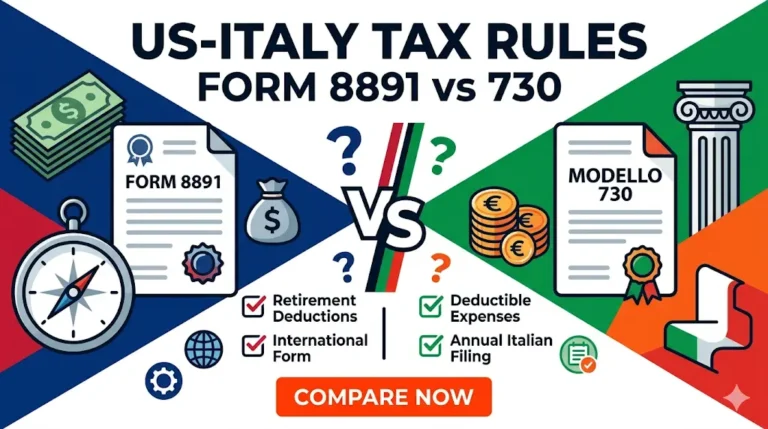
Many expat couples maintain a joint portfolio on Interactive Brokers to shield their capital from punitive Italian mutual fund taxes. Because Interactive Brokers provides clean, standardized tax reports, your commercialista can easily split the data to ensure both spouses remain perfectly compliant with Italy’s strict wealth monitoring laws. To grasp how these wealth taxes operate under double-taxation treaties, reviewing US-Italy Tax Compliance Form 8891 vs Modello 730 is essential.
Managing Cross-Border Transfers and Tax Payments
When you file a joint return or dual Quadro RWs, you will inevitably trigger Italian wealth taxes like IVAFE (on foreign financial assets) or flat taxes like the Cedolare Secca Tax Flat Tax on Rental Income in Italy. The government will issue an F24 payment form that must be settled in euros.
If your primary liquid wealth is sitting in dollars or pounds in Interactive Brokers, transferring those funds directly to the Italian Revenue Agency via a traditional bank wire is a terrible financial move. Traditional banks will hit you with hidden exchange rate markups and hefty international transfer fees.
Instead, savvy expat couples route their tax payments through Wise. When tax time arrives, liquidating assets from Interactive Brokers and sending them to your Wise account allows you to convert the funds to euros at the real, mid-market rate. Wise provides local European bank details, meaning you can pay your F24 tax bill directly and instantly, entirely bypassing traditional banking friction. Managing your liquidity efficiently with Wise ensures your hard-earned money goes toward settling your tax bill, rather than lining a bank manager’s pockets. Having your cross-border finances perfectly organized is a mandatory survival skill, just as important as knowing your legal rights when Navigating Italian Bureaucracy Comune and Prefettura.
References
Primary sources (official)
- Agenzia delle Entrate – Dichiarazione Congiunta – https://infoprecompilata.agenziaentrate.gov.it/portale/dichiarazione-congiunta
- Agenzia delle Entrate – Familiari a Carico – https://www.agenziaentrate.gov.it/portale/-/5-familiari-a-carico
Other helpful sources
- Studio Bocca – The Italian Modello 730 Explained – https://www.studiobocca.it/en/modello-730-italian-tax-return/
- Taxing Wages 2026: Italy (OECD) – https://www.oecd.org/en/publications/taxing-wages-2026_3a5169ef-en/full-report/italy_9e7c857d.html
Disclaimer
The information provided in this article is for educational and informational purposes only and does not constitute official tax, financial, or legal advice. Italian tax laws regarding individual IRPEF brackets, the familiari a carico threshold, and the administrative rules of the 730 Congiunto are highly complex and subject to frequent legislative updates. Always consult directly with a dually qualified international tax advisor or a certified Italian commercialista to review your specific marital financial situation, joint foreign assets, and reporting requirements before filing your Italian tax return.