Italy visa for journalism: special permissions needed?
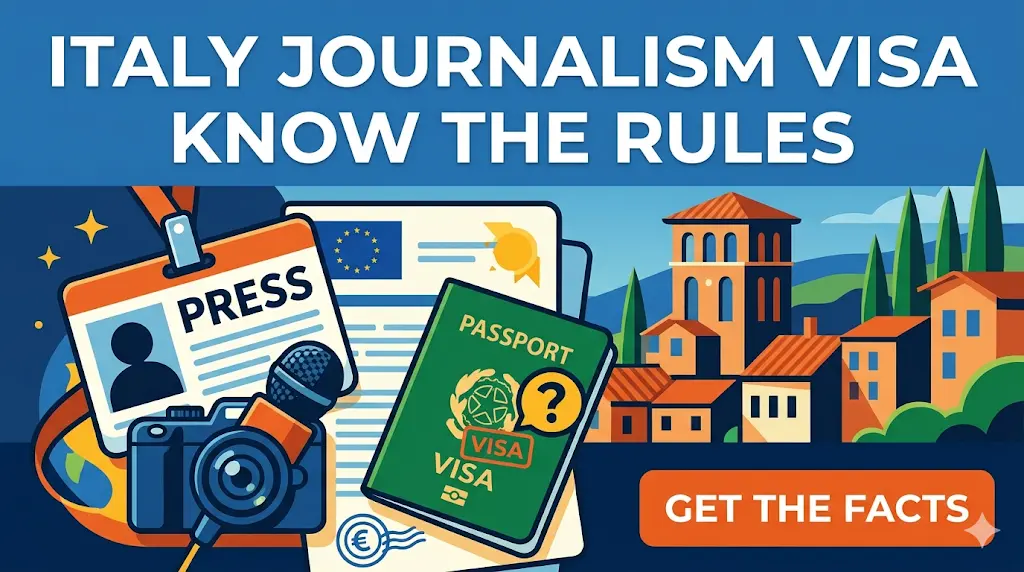
Landing an assignment in Rome feels like a dream until the Italian consulate demands official press accreditations you have never even heard of. I almost lost my first foreign correspondent role because I showed up with just a letter from my editor and zero ministerial clearances. This guide breaks down the exact permissions and bureaucracy needed to secure an Italian journalism visa.
Disclosure: This post may contain affiliate links. We may earn a commission at no extra cost to you if you make a purchase through these links. Read full disclosure.
The Press Visa Exemption and Immigration Law
Bypassing the Quota System
The single greatest advantage of moving to Italy as a professional journalist is that you are legally exempt from the infamous annual immigration quota limits. Standard foreign workers must battle hundreds of thousands of other applicants on a single day to secure a spot, a chaotic bottleneck heavily detailed in Understanding the Decreto Flussi in Italy.
However, under Article 27, letter (i) or letter (q) of the Italian Consolidated Immigration Act, foreign journalists who are officially dispatched by foreign press, radio, television, or digital media organizations are granted special status outside the quota. This means you and your employer can apply for this visa at any time of the year without waiting for a government decree to unlock available slots.
While bypassing the quota is a massive relief, it does not mean the application is simple. The Italian government tightly guards this visa category to prevent abuse. You must prove beyond a shadow of a doubt that you are a legitimate, salaried professional moving to Italy specifically to report the news for an established international outlet. If you fail to demonstrate this clear connection, the consulate will reject your application immediately.
Correspondents Versus Freelance Bloggers
The Italian bureaucratic machine does not understand modern digital nomadism or generic freelance content creation in the context of a traditional press visa. If you walk into the consulate and declare yourself a freelance travel blogger, a YouTube creator, or an independent Substack writer without an established media company backing you, your journalism visa application will be instantly rejected.
To qualify for the Article 27 press visa, you must be an officially accredited correspondent or a direct employee of a recognized foreign media organization. You need a formal assignment letter signed by your editor-in-chief stating that you are being posted to Italy, detailing your salary, and outlining the scope of your journalistic duties. If you are truly an independent freelancer without a specific media outlet sponsoring your transfer, you cannot use this route. You will be forced to explore the infinitely more difficult pathways outlined in Italian Self-Employment Visa Partita IVA Requirements or the recently established Digital Nomad Visa for Italy Guide.
| Applicant Status | Visa Route | Key Requirement | Required Documentation |
| Staff Correspondent | Article 27 Subordinate | Sent by a foreign media outlet. | Official assignment letter, editorial contract, translated credentials. |
| Freelance Journalist | Article 27 Autonomous | Commissioned by a foreign media outlet. | Proof of regular publication, formal editorial commissioning letters. |
| Independent Blogger | Standard Self-Employment | No specific outlet backing. | Business plan, massive financial proof, standard quota restrictions apply. |
Navigating the Foreign Ministry Farnesina
Securing Your Press Credentials
Unlike a standard corporate transfer, a journalism visa requires deep communication with the Italian Ministry of Foreign Affairs, commonly referred to as the Farnesina. Before the local consulate in your home country can issue the visa sticker, the media organization employing you must formally communicate your assignment to the Italian diplomatic network.
Your employer must draft a formal letter of assignment on official letterhead. This document must state your name, your specific editorial role, the duration of your assignment in Italy, and a guarantee that the media outlet assumes full financial responsibility for your stay. The Italian consulate will review these credentials and verify the legitimacy of your media organization.
Once you are approved and arrive in Italy, you will be expected to register with the Foreign Press Association in Italy. Securing your official foreign press badge through this association is essential. Without it, you will find it nearly impossible to gain access to government press conferences, parliament buildings, or official events, effectively paralyzing your ability to do your job on the ground.
The Translation and Legalization Trap
The Italian consulate will heavily scrutinize your professional portfolio. You must submit your university diplomas, your official national press cards from your home country, and your formal editorial contracts. Because the Italian government operates strictly in Italian, these dense, legally binding foreign documents are utterly useless if they are not flawlessly translated and certified.
Getting your complex editorial contracts and credentials translated is a massive bottleneck, which is exactly why you should rely on RushTranslate. By utilizing RushTranslate, you ensure that the consular officer receives certified, legally accurate documents formatted to the Italian government’s exact stringent standards. Do not attempt to translate these sensitive professional documents yourself to save a few dollars. Relying on RushTranslate guarantees full compliance with the strict standards of the Italian Ministry of Foreign Affairs. Having your pristine RushTranslate files properly organized and stamped is the most effective way to prevent your visa application from being delayed by a skeptical consular clerk trying to decipher your foreign job title. When it comes time to explain your specific salary brackets, having RushTranslate prepare your documents ensures perfect alignment with the local standards discussed in Types of Italian Employment Contracts Contratti di Lavoro.
Financial and Healthcare Requirements for Journalists
Proving Your Income and Housing
Even as an accredited journalist, the consulate will heavily scrutinize your financial stability. You must prove that your media organization is paying you a salary that comfortably exceeds the Italian minimum survival threshold. Properly translated pay stubs and employment agreements are vital here.
Furthermore, you cannot apply for this visa without proving you have a stable place to live in Italy. The consulate will demand a registered lease agreement or a formal hospitality declaration from an Italian resident. Because finding an apartment from abroad is notoriously difficult and fraught with scams, securing a legitimate, verifiable address is often the hardest part of the entire process. If you are struggling with this requirement, you must deeply review the strategies in Signing an Italian Rental Contract. If your employer is not providing corporate housing, you must ensure you have enough capital to cover the hefty deposits expected by private Italian landlords.
The Mandatory Health Coverage Hurdle
The most heavily scrutinized document in your entire visa portfolio, aside from your press credentials, is your proof of health insurance. As a newly arriving journalist, you legally cannot access the public health grid until you physically arrive, register your address, and obtain a residence permit. Therefore, to get the visa approved at the consulate, you must upload proof of a comprehensive private insurance policy that meets the strict Schengen minimum for emergency hospitalization and repatriation.
If you provide a digital policy document from a small, unknown travel insurer, the consular officer will likely reject it for insufficient long-term coverage. To completely bypass this delay, use Cigna Global. Because Cigna Global is a globally recognized expat insurance provider, their certificates of coverage are explicitly tailored to meet Italian national visa requirements.
Presenting a Cigna Global PDF to the consulate instantly satisfies the health checklist, preventing administrative pushback. Securing Cigna Global not only guarantees a smoother visa approval, but it also ensures you are safely covered from the exact moment you arrive in Rome or Milan to report on your first breaking story. Relying on this premium safety net protects your physical health and your savings while you navigate your chaotic first months, a crucial survival strategy covered in Healthcare in Italy An Expats Guide. You can later decide if you want to transition to the public system by Registering with the Italian Public Healthcare System SSN.
Transitioning to the Permesso di Soggiorno
Arrival Bureaucracy in Italy
Securing the Type D journalism visa in your passport is only half the battle. Once you land in Italy, the clock starts ticking immediately. Under Italian law, you have exactly eight days from the date of your arrival to visit a local post office and submit a massive yellow application kit for your physical residence permit.
This post office visit triggers a subsequent appointment at the central police station where you will be fingerprinted and your original translated press documents will be reviewed once again. Surviving this multi-step, deeply analog process is exhausting and requires extreme patience. It perfectly mirrors the bureaucratic hurdles you will face when establishing your official residency, a process detailed in Navigating Italian Bureaucracy Comune and Prefettura. You must bring all your original documents, including your Cigna Global health insurance policy and your RushTranslate certified contracts, to every single police appointment to avoid being sent to the back of the line.
Establishing Your Long Term Professional Footprint
Once your physical residence permit is printed and securely in your wallet, you must officially integrate into the Italian system to do your job effectively. You cannot sign long-term utility contracts, open an Italian bank account to receive local expenses, or even buy a designated press mobile phone plan without an official tax identifier. Ensuring you have this alphanumeric code is paramount, so you must urgently tackle Checking Your Italian Tax Code Codice Fiscale Status.
Because the life of a foreign correspondent involves constant international travel, you must be meticulous about tracking the expiration date of your residence permit. The journalism residence permit is typically tied directly to the length of your editorial assignment. If you are posted in Rome for three years, you will likely need to renew the permit annually or bi-annually, proving each time that you are still actively employed by the same foreign media outlet. Managing this ongoing paperwork is a stressful but necessary reality deeply explored in Renewing Your Italian Permesso di Soggiorno.
References
Primary sources (official)
- Ministero degli Affari Esteri – Visto per Lavoro Autonomo/Subordinato – https://vistoperitalia.esteri.it/home/en
- Normattiva – Testo Unico sull’Immigrazione (Art. 27, Ingresso per casi particolari) – https://www.normattiva.it/uri-res/N2Ls?urn:nir:stato:decreto.legislativo:1998-07-25;286
Other helpful sources
- Associazione della Stampa Estera in Italia (Foreign Press Association) – https://www.stampaestera.org/
- Studio Legale Metta – Italian Work Visa Exemptions (Article 27) – https://www.studiolegalemetta.com/
Disclaimer
The information provided in this article is for educational and informational purposes only and does not constitute official legal or immigration advice. The exemption from the immigration quota system under Article 27 of the Consolidated Immigration Act strictly applies to officially accredited journalists and directly employed foreign media staff. Freelance journalists or independent content creators without formal assignment letters from recognized media outlets may be subject to standard quota limitations and standard self-employment visa requirements. Always consult a registered Italian immigration attorney and the Italian consulate in your jurisdiction before initiating a visa application.