Public vs Private University Costs in Italy
Choosing between public and private universities in Italy involves more than just selecting a campus; it requires a deep dive into tuition structures, regional taxes, and scholarship opportunities to ensure your educational journey remains financially sustainable throughout 2026.
Disclosure: This post may contain affiliate links. We may earn a commission at no extra cost to you if you make a purchase through these links. Read full disclosure.
Navigating the Italian Higher Education Landscape
Italy has long been a global magnet for students seeking world-class education amidst a backdrop of unparalleled history and culture. Whether you are drawn to the ancient halls of the University of Bologna or the cutting-edge fashion and design labs of Milan, the financial commitment is a primary concern for every international applicant. The Italian higher education system is broadly divided into two main categories: state-funded public universities and independent private institutions.
Understanding the cost differences between these two paths is essential for any student looking to manage their budget effectively. While public universities are heavily subsidized by the government, making them some of the most affordable options in Western Europe, private universities offer different perks, such as smaller class sizes and direct pipelines to specific industries. Before you dive into applications, it is crucial to understand the Student Visa Italy: Admission, Requirements, and Process to ensure your legal status is secured alongside your financial plan. This guide provides an exhaustive breakdown of what to expect in terms of tuition, hidden fees, and living expenses for 2026.
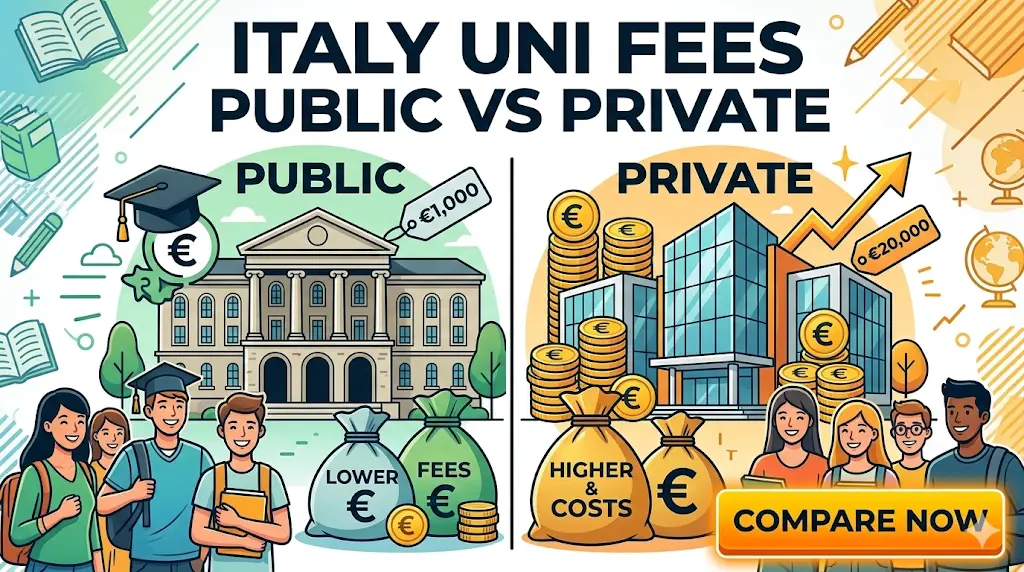
Tuition Fees at Public Universities in Italy
Public universities (università statali) in Italy are the backbone of the country’s academic system. Because they receive significant government funding, tuition fees are kept remarkably low compared to North American or British standards. However, the way these fees are calculated is unique and highly dependent on the student’s economic background.
The ISEE System and Fee Stratification
In Italy, public university tuition is not a flat rate. Instead, it is based on a concept called the “ISEE” (Indicatore della Situazione Economica Equivalente). This index measures a family’s financial standing, including income, assets, and property.
For 2026, the average tuition at a public university ranges from €900 to €4,000 per year. Students with a lower ISEE score can pay as little as €156 (the minimum regional tax), while those with a high ISEE or those who choose not to declare their income will pay at the top of the bracket. For international students from outside the EU, some universities apply a flat rate based on their country of origin’s economic status, while others allow the submission of an “ISEE Parificato” to access lower tiers. Navigating this financial bureaucracy is often the first hurdle, much like Applying to Italian Universities: A Step-by-Step Guide for the admissions process itself.
Regional Differences in Public Tuition
While the Ministry of Education sets general guidelines, individual universities have a degree of autonomy. For instance, a technical program at the Politecnico di Milano might have a higher cap than a humanities program at the University of Palermo. Additionally, every student must pay a regional tax (tassa regionale) and a stamp duty (marca da bollo), which combined usually add about €160 to €200 to the annual bill.
Costs at Private Universities in Italy
Private universities (università private) operate independently of government subsidies for their daily operations. As a result, they are significantly more expensive than their public counterparts. However, they are often the preferred choice for business, design, and medical programs where specialized equipment and networking are paramount.
Flat Rate vs. Tiered Private Tuition
Unlike public schools, many private institutions charge a flat annual rate regardless of family income. For the 2026 academic year, tuition at prestigious private universities like Bocconi in Milan or LUISS in Rome typically ranges from €12,000 to €20,000 per year.
Elite design schools like Istituto Marangoni or NABA can even exceed these figures, with some programs reaching €25,000 annually. For students considering these high-cost paths, Scholarships for International Students in Italy become an indispensable resource to offset the steep initial investment.
Value Proposition of Private Institutions
Why pay ten times more for a private degree? Students often choose the private route for:
- English-Language Options: While public universities are increasing their English offerings, private schools have historically led this trend.
- Career Services: Private universities often have dedicated placement offices with strong ties to corporate partners in Milan and abroad.
- Modern Facilities: Larger budgets often translate to newer laboratories, libraries, and campus amenities.
Comparison Table: Public vs Private University Costs 2026
The following table summarizes the typical annual costs for an international student in Italy.
| Expense Category | Public University (Avg) | Private University (Avg) |
| Annual Tuition Fees | €900 – €4,000 | €12,000 – €25,000 |
| Regional Tax & Fees | €160 – €200 | Included or extra €160 |
| Application Fee | €30 – €100 | €100 – €250 |
| Books & Materials | €200 – €500 | €300 – €600 |
| Average Class Size | 100 – 300+ students | 20 – 50 students |
| Language of Instruction | Mostly Italian (Increasing English) | Significant English options |
Hidden Costs of University Life in Italy
The tuition fee is only the tip of the iceberg. Students must budget for several other mandatory and optional expenses that can significantly impact their monthly outflow.
Housing and Accommodation
Housing is often the largest expense after tuition. The Italian rental market remains tight, especially in student-heavy cities like Bologna, Padua, and Milan.
- University Dorms: Public universities offer “Studentati,” which are very affordable (€250–€400/month) but extremely competitive and usually reserved for low-income scholarship recipients.
- Private Rentals: A room in a shared apartment in Milan can cost €600–€800 per month, while in Southern Italy, you might find a similar room for €300.
Health Insurance Requirements
For non-EU students, health insurance is a mandatory requirement for the residence permit. You can choose to enroll in the National Health Service (SSN) for a flat annual fee of approximately €700 (for students) or opt for a private policy.
Living Expenses and Lifestyle
Italy offers a high quality of life, but it comes at a price.
- Groceries: €200–€300 per month.
- Public Transport: Most cities offer a heavily discounted student pass (abbonamento) for €20–€35 per month.
- Dining and Socializing: A meal at a student “Mensa” (canteen) costs between €3 and €8, while a dinner out usually starts at €20.
Scholarships and Financial Aid
Fortunately, Italy is generous with financial aid, provided you are willing to navigate the paperwork.
DSU Scholarships (Diritto allo Studio Universitario)
Every region in Italy has a DSU office that provides need-based scholarships. These can include:
- Full tuition waivers.
- Free meals at the university canteen.
- A yearly stipend of up to €6,000.
- Accommodation in university dorms.
These are awarded based on the ISEE Parificato, meaning even international students from non-EU countries can qualify if they prove their family’s income is below a certain threshold.
Merit-Based Grants
Both public and private universities offer merit-based grants for high-achieving students. For example, the Italian Ministry of Foreign Affairs (MAECI) offers scholarships specifically for foreign students and Italians living abroad. Private universities like Bocconi also offer “International Awards” that can cover 50% to 100% of tuition.
Working While Studying
Many students look to part-time work to cover their costs. By law, international students on a student visa can work up to 20 hours per week.
In major cities, English-speaking students can often find work in:
- Tourism and hospitality.
- Private tutoring (English lessons).
- Freelance digital services.
- University student collaborations (collaborazioni studentesche).
However, salaries for part-time student jobs are modest, typically ranging from €8 to €12 per hour. While this can help with pocket money, it is rarely enough to cover full living expenses in cities like Milan or Rome.
Conclusion
Choosing between a public or private university in Italy is a balance of financial capacity and career goals. Public universities offer an unbeatable price-to-quality ratio, particularly for students who qualify for ISEE-based fee reductions or DSU scholarships.
On the other hand, private universities provide a more streamlined, English-friendly experience with superior networking opportunities, albeit at a significantly higher price point. The key to a successful Italian education is early preparation: get your ISEE documents ready, apply for scholarships before the deadlines, and choose a city that matches your budget.
References
Primary sources (official)
- Ministero dell’Università e della Ricerca (MUR): The official government body regulating university fees and DSU guidelines. https://www.mur.gov.it/it
- Study in Italy (MAECI): The official portal for international students to explore scholarships and university structures. https://studyinitaly.esteri.it/
Other helpful sources
- Bocconi University Financial Aid Office: Detailed breakdown of private university tuition and merit-based grants. https://www.unibocconi.it/
Disclaimer
The information provided in this article is for general informational and educational purposes only and does not constitute professional financial, legal, or academic advice. University tuition fees, regional taxes, and scholarship availability in Italy are subject to frequent changes based on government policy and institutional budgets for the 2026 academic year. Always verify specific costs and deadlines directly with your chosen university’s administrative office or the relevant regional DSU body.