SEPA vs SWIFT Transfers: Choosing a Money Transfer
Navigating international banking in Italy requires understanding the difference between SEPA and SWIFT transfers. This guide breaks down costs, speed, and security features to help expats choose the most efficient method for moving funds across borders.
Disclosure: This post may contain affiliate links. We may earn a commission at no extra cost to you if you make a purchase through these links. Read full disclosure.
Understanding the SEPA Network
Moving to Italy involves a significant amount of financial planning, from securing a rental property to setting up local utilities. One of the most frequent tasks an expatriate faces is moving money between a home country bank account and a new Italian one. Whether you are transferring savings to cover initial relocation costs or sending a monthly remittance to family abroad, the mechanism you choose—SEPA or SWIFT—will dictate how much you pay in fees and how quickly your money arrives.
In the modern financial landscape, Italy is fully integrated into European banking standards, yet it remains connected to the global economy through legacy systems. For most daily needs within Europe, SEPA is the undisputed king. However, for those moving from North America or Asia, SWIFT remains a necessary, albeit more expensive, reality. Understanding these systems is a vital part of Managing Your Budget in Italy: Banking, Currency, and Transfers to ensure your hard-earned capital isn’t eaten up by hidden bank margins and intermediary fees.
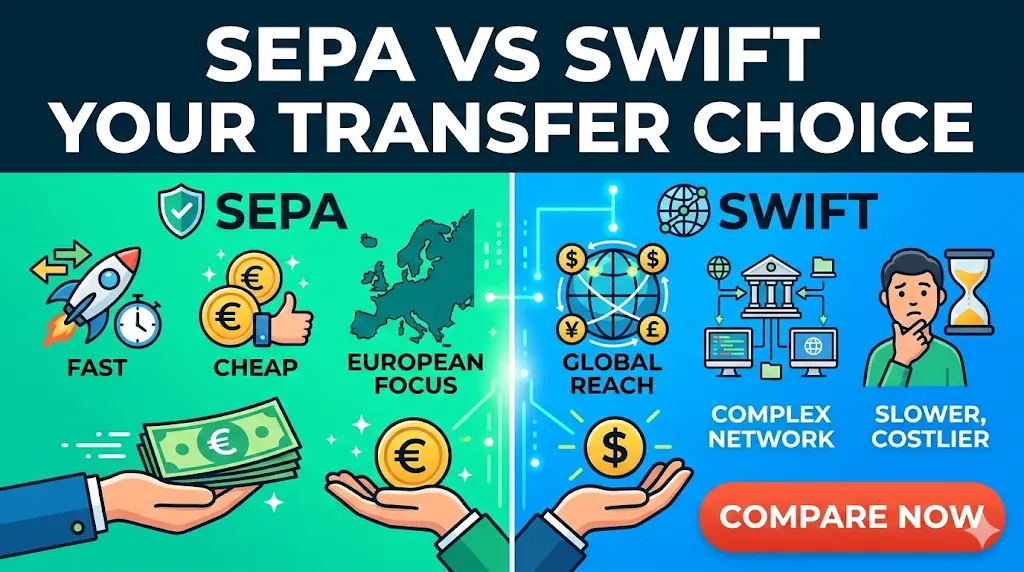
SEPA, which stands for Single Euro Payments Area, was established to simplify bank transfers denominated in Euro across Europe. The goal was to make cross-border Euro transfers as easy, fast, and cheap as domestic ones. Italy, as a founding member of the Eurozone, is a core participant in this network.
How SEPA Works in Italy
When you initiate a SEPA transfer to or from an Italian bank, the system treats the transaction as if it were happening within the same country. This is made possible by the IBAN (International Bank Account Number) system. Every Italian bank account has a unique 27-character IBAN starting with “IT.” By using this code, banks can route money directly through a centralized European clearinghouse.
The Three Flavors of SEPA
There are actually three different types of SEPA transfers you might encounter:
- SEPA Credit Transfer: The standard method, taking 1-2 business days.
- SEPA Instant Credit Transfer: Money arrives in less than 10 seconds, available 24/7/365. Many Italian banks now offer this by default.
- SEPA Direct Debit: Used primarily for automated payments like rent or electricity.
For most expats, setting up SEPA Direct Debits is one of the first things to do after How to Open a Bank Account in Italy, as it is the preferred method for paying recurring bills.
Exploring the SWIFT Network
While SEPA is a specialized European tool, SWIFT (Society for Worldwide Interbank Financial Telecommunication) is the global standard for international messaging between banks. It is used for transfers that fall outside the Eurozone or involve currencies other than the Euro.
The Correspondent Banking Model
Unlike SEPA, which is a direct clearing system, SWIFT is a messaging network. When you send a SWIFT transfer from a bank in New York to a bank in Rome, the money doesn’t move “instantly.” Instead, banks use a series of “correspondent” relationships. If the two banks don’t have a direct relationship, the money might pass through one or two intermediary banks, each of which may take a small “processing fee” out of the principal amount.
When You Need SWIFT in Italy
You will likely need to use the SWIFT network if:
- You are transferring funds from a non-EU country (e.g., USA, Canada, Australia).
- You are sending a currency other than Euro (e.g., USD, GBP, JPY).
- You are moving very large sums that require specific anti-money laundering documentation and high-level bank verification.
Because SWIFT involves more “hands” on the money, it is significantly more expensive and slower than SEPA. This makes choosing the right Money Transfer Services: Sending Money to Italy even more important for those coming from outside the European Union.
Key Differences: Cost, Speed, and Reach
Choosing between SEPA and SWIFT often comes down to where the money is coming from and what currency you are using. However, understanding the technical differences can help you plan your cash flow more effectively.
Fees and Transparency
SEPA transfers are famously low-cost. Under EU regulations, banks cannot charge more for a cross-border SEPA transfer than they do for a domestic one. In Italy, this often means SEPA transfers are free or cost less than €1.
SWIFT fees, however, are a “wild west” of banking. You may encounter:
- Outgoing Wire Fees: Charged by your home bank ($25 – $50).
- Intermediary Bank Fees: Deducted during transit ($10 – $30).
- Incoming Wire Fees: Charged by the Italian bank (€10 – €25).
- Exchange Rate Markup: The “hidden” fee where the bank gives you a rate 3-5% worse than the mid-market rate.
Speed of Delivery
SEPA Instant has set a new bar, with transfers arriving in seconds. Standard SEPA usually clears by the next business day. SWIFT, due to the intermediary bank chain and timezone differences, typically takes 3 to 5 business days. During this time, the money is often “in limbo,” which can be stressful when you are trying to close on a property or pay a deposit.
Table: SEPA vs. SWIFT Comparison
| Feature | SEPA Transfer | SWIFT Transfer |
| Primary Currency | Euro (EUR) only | Any global currency |
| Geographic Scope | 36 SEPA member countries (EU/EEA+) | Global (over 200 countries) |
| Transfer Speed | Seconds (Instant) to 2 days | 3 to 5 business days |
| Typical Cost | Free to ~€1 | €20 – €50+ plus exchange markups |
| Required Info | IBAN and Name | SWIFT/BIC Code, IBAN/Account No. |
| Reliability | Extremely High (Centralized) | High (but depends on intermediaries) |
Currency Exchange and Hidden Costs
The most common trap expats fall into is assuming that a “fixed fee” is the only cost of a transfer. While SEPA transfers are Euro-to-Euro (avoiding exchange fees), SWIFT transfers almost always involve a currency conversion.
The Exchange Rate Margin
When you send USD to an Italian Euro account via SWIFT, the bank must convert the money. Most high-street banks do not use the interbank rate (the one you see on Google). Instead, they apply a “spread.” If the mid-market rate is 1.10, the bank might give you 1.06. On a $10,000 transfer, that’s a $400 hidden fee.
SEPA for Non-Euro Countries
Interestingly, some countries that do not use the Euro (like Switzerland or the UK) are still part of the SEPA network. You can send a SEPA transfer from London to Rome, but it must be sent in Euro. The sender’s bank will perform the conversion before sending. This is often cheaper than a SWIFT transfer because it eliminates the intermediary bank fees.
Using Third-Party Transfer Services
For many expatriates, the best way to move money is to avoid the traditional bank SWIFT route entirely. Services like Wise, Revolut, or Remitly have revolutionized how we move money to Italy.
How They Bypass SWIFT
These services use a local-to-local model. If you want to send money from the US to Italy, you pay the service’s US bank account in USD. They then use their Italian bank account to send a SEPA transfer to your Italian account. The money never actually crosses an ocean; only the information does. This allows you to get the mid-market exchange rate and pay a much lower, transparent fee.
Using these services is particularly helpful when you are Handling Finances as an Expat in Italy: from Taxes to Investments, as they provide clear receipts and digital records that are necessary for Italian tax reporting.
Security and Regulatory Compliance
Both SEPA and SWIFT are highly secure, but they operate under different regulatory frameworks.
SEPA and EU Protections
SEPA is governed by the European Payment Services Directive (PSD2), which offers strong consumer protections against unauthorized transfers and ensures transparency in fees. Italian banks are required to adhere to these strict standards, making SEPA one of the safest ways to move money in the world.
SWIFT and AML Checks
Because SWIFT is used for global transfers, it is the primary focus of Anti-Money Laundering (AML) and “Know Your Customer” (KYC) regulations. When a large SWIFT transfer arrives in Italy, the bank’s compliance department may flag it. You might receive a call or email from your Italian bank asking for the “provenance of funds.” This is standard procedure, but it can delay your transfer by several days. Always keep a copy of your home country bank statements or property sale contracts as proof of the source of wealth.
Step-by-Step Guide to Initiating a Transfer
Making a SEPA Transfer within Italy/EU
- Log in to your Italian mobile banking app.
- Select “Bonifico SEPA.”
- Enter the recipient’s Name and IBAN.
- Select “Instant” if you need it to arrive immediately.
- Review the fee (usually €0 or small change) and confirm with your digital signature (token).
Making a SWIFT Transfer to Italy
- Obtain the Italian bank’s BIC/SWIFT code (8 or 11 characters) and the IBAN.
- Log in to your home country bank.
- Select “International Wire Transfer.”
- Choose who pays the fees (OUR = you pay all, SHA = shared, BEN = recipient pays).
- Ensure the currency is set to Euro if you want the Italian bank to know exactly what is arriving.
- Provide the reason for the transfer (e.g., “Personal savings transfer” or “Rent payment”).
Conclusion
For the vast majority of expats living in Italy, the SEPA network will be the primary tool for financial life. Its speed, low cost, and integration into the Italian billing system make it indispensable for daily survival. However, the SWIFT network remains the essential bridge for those with financial roots in North America or other non-EU regions.
The key to financial efficiency in Italy is knowing when to use each: SEPA for anything in Euro within the continent, and a specialized money transfer service for everything else. By mastering these two systems, you can ensure that your move to Italy is defined by the quality of your lifestyle, not the quantity of your banking fees.
References
Primary sources (official)
- European Central Bank (ECB) – SEPA Explained: The official regulatory overview of the Single Euro Payments Area. https://www.ecb.europa.eu/paym/integration/retail/sepa/html/index.en.html
- Banca d’Italia (Bank of Italy) – Payment Systems: Official data and regulations regarding transfers within the Italian banking system. https://www.bancaditalia.it/compiti/sistema-pagamenti/index.html
Other helpful sources
- Wise – SEPA vs SWIFT Guide: A practical comparison of international transfer methods for expatriates. https://wise.com/gb/blog/sepa-vs-swift
Disclaimer
The information provided in this article is for general informational and educational purposes only and does not constitute professional financial, tax, or legal advice. Banking regulations, transfer fees, and exchange rate margins are subject to frequent changes by financial institutions and international regulatory bodies. Always verify the specific terms and conditions with your bank or transfer provider before initiating a transaction. Italy’s anti-money laundering laws are strict; ensure all large transfers are accompanied by documentation proving the source of funds.