Comparing Living Costs: Italy vs USA/UK/Canada
Deciding to relocate to Italy requires a detailed financial analysis. This guide compares the cost of living in Italy against the USA, UK, and Canada, examining housing, healthcare, and lifestyle expenses to help you plan a sustainable move.
Disclosure: This post may contain affiliate links. We may earn a commission at no extra cost to you if you make a purchase through these links. Read full disclosure.
The Financial Reality of Moving to Italy
Relocating to Italy is often driven by the pursuit of the “dolce vita”—a lifestyle centered on high-quality food, rich history, and a slower pace of life. However, for expats from the USA, UK, or Canada, the transition involves a significant shift in financial dynamics. While Italy is frequently perceived as more affordable than its North American or British counterparts, the reality is a nuanced landscape of lower costs in some sectors and higher burdens in others.
The global economic environment has made budgeting more critical than ever. Italy offers a unique value proposition: a high standard of living for a lower price point than many major Western hubs, provided you understand the local economy. Whether you are a digital nomad, a retiree, or a professional, the key to success lies in Budgeting for Italy: Cost of Living by City variations. This article provides an exhaustive comparison of the primary expenses you will face when moving from the USA, UK, or Canada to the Italian peninsula.
Housing and Real Estate: Renting and Buying
Housing is consistently the largest expense for any household. When comparing Italy to the USA, UK, or Canada, the differences in both price and philosophy are striking.
Rental Markets
In major North American cities like New York, Toronto, or Vancouver, rental prices have reached historic highs, often consuming 40% to 50% of a resident’s net income. Similarly, London and the Southeast of the UK present a high-cost barrier to entry. Italy, while seeing price increases in hubs like Milan and Rome, generally offers more space for less money.
For example, a one-bedroom apartment in a desirable neighborhood in Turin or Florence might cost between €900 and €1,200. In contrast, a similar unit in Toronto or London could easily exceed €2,000. For those looking to settle long-term, Renting vs Buying: Financial Considerations in Italy becomes a vital calculation, as purchase prices in Italy are often more accessible than in the highly inflated North American markets.
The Cost of Ownership
Buying property in Italy involves higher closing costs and taxes than in the USA or Canada, but lower entry prices. While a modest home in a UK suburb might cost £350,000, you can often find a renovated apartment in a historic Italian town for €150,000 to €200,000. However, you must account for the specific taxes associated with ownership, such as the registration tax and the annual municipal levies.
Healthcare: Public Systems and Private Options
One of the most profound differences for expats, particularly those moving from the USA, is the approach to healthcare.
The Italian SSN vs the USA
In the United States, healthcare is primarily private and tied to employment, with high premiums and deductibles. In Italy, the Servizio Sanitario Nazionale (SSN) provides universal coverage. For residents, most services are free or require a small co-pay (ticket). For many American expats, the savings on healthcare alone can offset a lower Italian salary.
Comparison with the UK and Canada
While the UK (NHS) and Canada also have public systems, the Italian SSN is consistently ranked among the best in the world for efficiency and outcomes. However, like the NHS, it can suffer from long waiting lists for non-urgent procedures. Many expats choose to supplement their coverage. Insurance Options in Italy: Health, Car, Home provides a way to access private clinics and faster service for a fraction of the cost of US private insurance.
Comparative Monthly Living Costs (2026 Estimates)
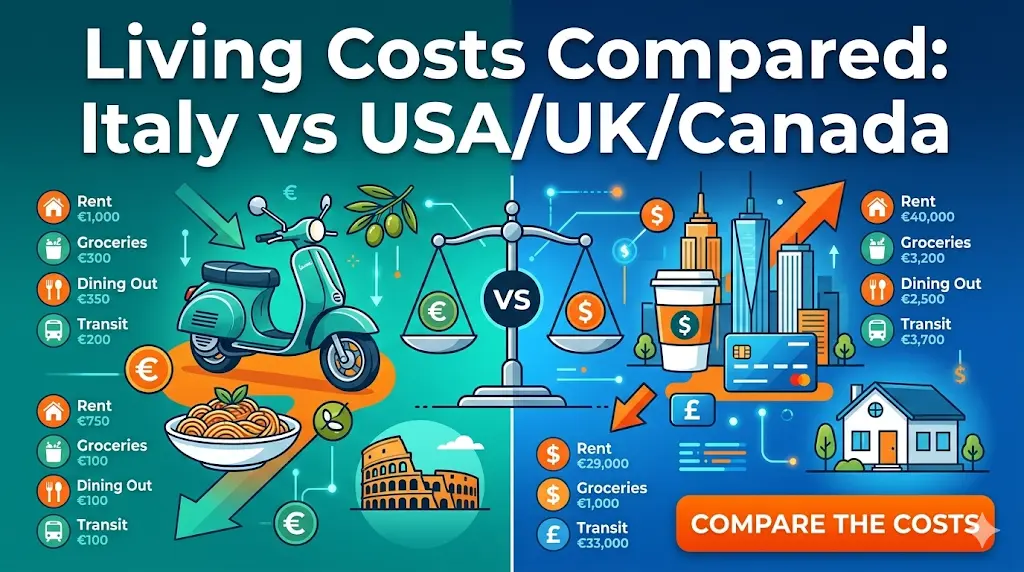
The following table provides a snapshot of how Italy compares to the USA, UK, and Canada across key expenditure categories. These figures are based on a single person living in a mid-sized city.
| Expense Category | Italy (Avg) | USA (Avg) | UK (Avg) | Canada (Avg) |
| Rent (1BR outside center) | €750 | €1,450 | €1,100 | €1,250 |
| Utilities (Electricity/Gas) | €180 | €160 | €210 | €140 |
| Groceries (Monthly) | €350 | €450 | €380 | €400 |
| Public Transport Pass | €35 | €75 | €85 | €70 |
| Health Insurance (Private) | €80 | €450 | €100 | €70 |
| Dining (Mid-range 3-course) | €35 | €65 | €60 | €55 |
Food and Groceries: Quality vs. Price
Italy is famous for its food culture, and fortunately for residents, high-quality ingredients are often cheaper than in the UK, USA, or Canada.
Supermarkets and Markets
In North America and the UK, “organic” or high-quality produce often carries a significant price premium. In Italy, seasonal, locally grown food is the standard. Shopping at a local mercato (open-air market) is not just a cultural experience; it is a budget-friendly strategy. A basket of fresh vegetables, local cheese, and wine that might cost €60 in Italy could easily exceed €100 in a premium North American grocery store.
Dining Out
Dining out in Italy offers incredible value. The “coperto” (service/bread charge) of €1–€3 is standard, and tipping is not required or expected as it is in the USA or Canada. A high-quality meal with wine in an Italian trattoria often costs significantly less than a mediocre meal in a British or American gastropub.
Utilities and Connectivity
While housing and food are generally cheaper in Italy, utilities can be a point of contention.
Energy Costs
Electricity and gas prices in Italy are among the highest in Europe. Unlike Canada or parts of the USA where energy is relatively abundant and cheap, Italy relies heavily on imports. Expats must be mindful of their consumption, as “bill shock” is common during the winter months.
Internet and Mobile
In a surprising twist, Italy has some of the most affordable mobile and internet rates in the world. While residents in Canada or the USA might pay €60–€80 for a high-speed fiber connection and a mobile plan, in Italy, you can often get both for under €40. This is a significant advantage for those who require high-speed connectivity for remote work.
Transportation: Cars, Trains, and Scooters
The way you move around Italy differs greatly from the car-centric culture of the USA and Canada.
Public Transit and Rail
Italy’s train network (Trenitalia and Italo) is efficient and affordable, connecting major cities with high-speed lines. Within cities, public transport passes are a bargain compared to the high costs of the London Underground or the TTC in Toronto.
Car Ownership
Owning a car in Italy is where costs begin to climb. Fuel prices are significantly higher than in the USA or Canada due to heavy taxation. Additionally, insurance and maintenance can be pricey. If you choose to live in a city center, a car is often more of a liability than an asset.
Taxes and Social Security
When comparing living costs, you cannot look at prices alone; you must look at your “net” take-home pay.
Income Tax Brackets
Italy has a progressive income tax system with relatively high rates for middle and high earners. When moving from the USA or parts of Canada, you may find that your “gross” salary is lower and your tax burden is higher. However, these taxes fund the social safety net, including the universal healthcare mentioned earlier.
Special Tax Regimes
To combat brain drain and attract investment, Italy offers several attractive tax incentives for new residents.
Lifestyle and Leisure
The cost of “fun” is where Italy often shines.
- Entertainment: Cinema tickets and theater performances are comparable in price, but the availability of free cultural events, historic piazzas, and public art is unparalleled in Italy.
- Travel: Being in the heart of Europe means that travel to other countries is fast and inexpensive. Budget airlines make weekend trips to Paris, Berlin, or Barcelona much cheaper than a domestic flight within the USA or Canada.
- Gyms and Fitness: Joining a fitness club is similar in price to the UK or Canada, though outdoor activities like hiking and cycling are essentially free in Italy’s diverse landscape.
Education Costs for Families
For expats with children, the cost of education is a major factor.
Public vs. Private Schools
Public education in Italy is free, though parents pay for meals and some supplies. This is similar to the UK and Canada but a major relief for Americans used to budgeting for college funds from birth.
International Schools
If you prefer your children to follow an English-language curriculum, international schools in Italy are expensive, ranging from €10,000 to €25,000 per year. These costs are comparable to private schools in London or Toronto but are an essential consideration for families who do not plan to stay in Italy long-term.
Summary of the Financial “Vibe”
Comparing Italy to the USA, UK, and Canada is essentially a trade-off:
- Italy: Lower housing costs, cheaper food, universal healthcare, and affordable internet. Higher taxes and energy costs.
- USA: Higher salaries but extremely high healthcare and housing costs. Cheaper energy and consumer goods (electronics).
- UK: High housing and transport costs. Excellent healthcare (when it works) and a strong job market.
- Canada: High housing and food costs. Good social safety net but high cost of living in urban centers.
Conclusion
Ultimately, Italy provides a high quality of life that is often more attainable on a moderate income than in the major cities of the USA, UK, or Canada. While you may earn a lower nominal salary, your expenses—particularly in healthcare, housing, and food—are likely to be lower as well. The key to a successful financial transition is preparation.
By understanding the regional cost differences and utilizing Italy’s tax incentives for new residents, you can ensure that your move is not just a romantic adventure, but a sound financial decision. Italy remains a land of opportunity for those who value time and quality over pure accumulation.
References
Primary sources (official)
- ISTAT (Italian National Institute of Statistics): Official data on inflation and consumer prices in Italy. https://www.istat.it/en/
- OECD Better Life Index: Comparison of housing, income, and health across member nations. https://www.oecdbetterlifeindex.org/
Other helpful sources
- Numbeo Cost of Living Comparison: A real-time tool for comparing prices between global cities. https://www.numbeo.com/cost-of-living/
Disclaimer
The information provided in this article is for general informational and educational purposes only and does not constitute professional financial, tax, or legal advice. Cost of living figures are estimates based on 2026 data and can vary significantly depending on your specific lifestyle, the city you choose, and changes in global economic conditions. Always consult with a certified financial advisor or an Italian accountant (commercialista) before making significant financial decisions regarding your relocation.