Permesso di Soggiorno (Italian Residence Permit): Guide
This comprehensive guide explains everything you need to know about the Permesso di Soggiorno, Italy’s essential residence permit for non-EU citizens. Learn about the application process, required documents, costs, renewal procedures, and your rights while living in Italy.
Disclosure: This post may contain affiliate links. We may earn a commission at no extra cost to you if you make a purchase through these links. Read full disclosure.
Introduction to Permesso di Soggiorno (Italian Residence Permit)
For anyone dreaming of a new life in Italy, the initial excitement often revolves around finding the perfect apartment in Rome or securing a job in Milan. However, the most critical component of your Italian adventure isn’t the view from your window or your daily espresso ritual—it is a small, plastic card known as the Permesso di Soggiorno.
Navigating Italian bureaucracy is a rite of passage for every expat. While the process can seem daunting, understanding the rules of the game is the best way to ensure your stay in the Bel Paese is legal and stress-free. The Permesso di Soggiorno (Permit of Stay) is the cornerstone of your legal status in Italy. Without it, your long-stay visa is merely an entry ticket that expires, leaving you vulnerable.
In this extensive guide, we will break down the entire lifecycle of the Italian residence permit. We will cover who needs one, how to apply, the costs involved, and what to do while you wait for the physical card. Whether you are a student, a retiree, or a professional, mastering this process is your first step toward true integration into Italian society.

Understanding the Permesso di Soggiorno
The Permesso di Soggiorno is a document issued by the Italian State Police (Polizia di Stato) that allows non-EU citizens to live in Italy for a specific period. It is distinct from your visa.
Difference Between Visa and Permit
A common misconception among new arrivals is that their visa covers their entire stay. This is incorrect.
- The Visa: This is issued by the Italian Consulate in your home country. It grants you the right to enter Italy.
- The Permit: This is issued in Italy. It grants you the right to stay in Italy.
Think of the visa as the key to the front door, while the residence permit is the lease that allows you to remain in the house. Your visa might be valid for a year, but if you do not convert it into a residence permit upon arrival, you become an irregular migrant after your initial visa period (or 90 days) expires.
Who Needs a Residence Permit
If you are a non-EU citizen planning to stay in Italy for more than 90 days, you must apply for a Permesso di Soggiorno. This applies to almost every long-stay category, including:
- Work (Subordinate or Self-Employment)
- Study
- Family Reunification
- Elective Residence (Retirement)
- Religious Reasons
- Medical Treatment (Long-term)
Note for EU Citizens: Citizens of EU/EEA countries do not need a Permesso di Soggiorno. However, if they plan to stay longer than three months, they must register their residence at the local Town Hall (Anagrafe). You can learn more about the administrative steps for residents in our guide on Registering with Comune: Residency, School, Health Card.
The Crucial 8 Day Rule
Time is of the essence when you arrive in Italy. Italian law mandates that non-EU citizens must apply for their residence permit within 8 working days of entering the country.
This countdown begins the moment your passport is stamped at the border control. If you arrive from another Schengen country (e.g., a flight from New York to Rome via Frankfurt), you must declare your presence to the local police (Dichiarazione di Presenza) immediately to start this official clock. Failing to apply within this window can lead to administrative hurdles and, in extreme cases, expulsion orders.
How to Apply Step by Step
The application process usually involves three main stages: the Post Office, the Police Headquarters (Questura), and the collection of the card.
Step 1 The Postal Kit Application
For most standard permits (employment, family, study, elective residence), the application begins at the post office. You cannot go to just any post office; you must find one with a “Sportello Amico” counter.
You will need to pick up a Kit Giallo (Yellow Kit). This large envelope contains the forms (Modulo 1 and Modulo 2) and instructions.
- Modulo 1: Used for all applications. It asks for your personal details, passport info, and address.
- Modulo 2: Used specifically for those with employment income (subordinate or self-employed).
Filling out these forms can be tricky as they are entirely in Italian and require specific codes. For a detailed walkthrough of this specific stage, we have a dedicated article on Getting Your Residence Permit Kit in Italy: Step-by-Step.
Step 2 Submission at Poste Italiane
Once you have filled out the forms and gathered your supporting documents (copies only—never originals at this stage), you return to the Sportello Amico.
- You will present your passport.
- You will pay the necessary fees (see the Costs section below).
- The clerk will give you a receipt (Ricevuta) and an appointment date for your visit to the Questura.
Important: Do not lose the Ricevuta. It is a legally binding document that proves you have applied for the permit. It allows you to stay in Italy legally while you wait for the actual card.
Step 3 The Questura Appointment
The post office will assign you a date and time to visit the Ufficio Immigrazione at your local Questura (Police Headquarters). This appointment involves:
- Phototgraphy: They will take your photo digitally, though you should also bring hard copies.
- Fingerprinting: You will have your fingerprints scanned for the biometric chip.
- Document Verification: You must bring the originals of all the documents you put in the postal kit. The officer will verify them against the copies.
Step 4 Collection of the Permit
After the Questura appointment, there is a waiting period for the card to be printed and sent back to the police station. This can take anywhere from 30 days to several months, depending on the backlog. You will usually receive an SMS or can check the status online using the police portal (Portale Immigrazione). When it is ready, you must return to the Questura to pick it up in person.
Required Documents Checklist
While requirements vary depending on your specific visa type (e.g., student vs. worker), there is a core set of documents everyone must provide.
- Valid Passport: Copies of all pages containing your personal data, visa, and entry stamps.
- Application Forms: The completed Modulo 1 (and Modulo 2 if applicable) from the Kit.
- Four Passport Photos: Recent and identical, usually required at the Questura appointment.
- Revenue Stamp (Marca da Bollo): A €16.00 stamp bought at a Tabaccheria.
- Proof of Accommodation: A rental contract, deed of ownership, or a declaration of hospitality.
- Proof of Financial Means: Bank statements, scholarship letters, or pension proof showing you can support yourself.
- Health Insurance: Proof of coverage (private insurance or enrollment in the National Health Service).
For highly specific variations, such as for those retiring in Italy, ensuring your financial documents meet the strict criteria is vital. The nuances of income proof are covered extensively in our guide on How much income is required for Italy’s elective residence visa?.
Costs and Fees
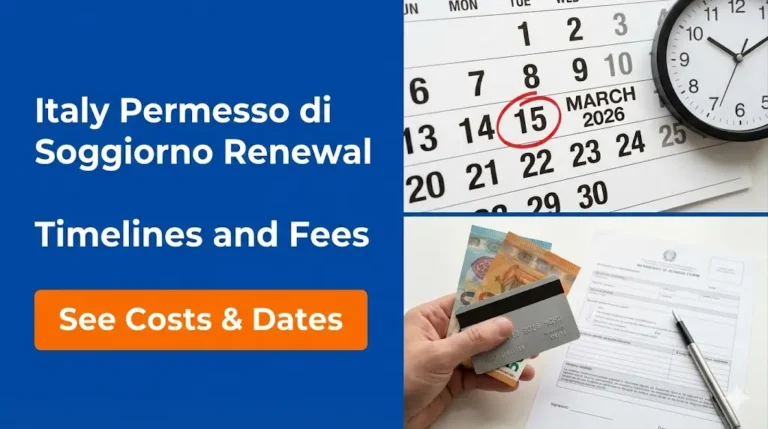
Applying for a Permesso di Soggiorno involves several different fees. As of 2026, you should budget for the following (note that government fees are subject to change):
| Item | Cost | Payable To |
| Marca da Bollo | €16.00 | Tabaccheria (Tobacco Shop) |
| Postal Shipping Fee | €30.00 | Poste Italiane |
| Electronic Card Fee | €30.46 | Poste Italiane (via Bulletino) |
| Permit Contribution Fee | €40.00 – €100.00 | Poste Italiane (via Bulletino) |
The Permit Contribution Fee varies based on the duration of your permit:
- €40.00 for permits valid between 3 months and 1 year.
- €50.00 for permits valid between 1 year and 2 years.
- €100.00 for long-term EU residence permits and specialized managers.
Note: Student permits and certain other categories are often exempt from the variable contribution fee, paying only the fixed costs.
Rights and Limitations
Once you hold a valid Permesso di Soggiorno, you gain significant rights that facilitate your life in Italy.
Travel Rights
Your permit acts like a visa for the rest of Europe. You can travel freely within the Schengen Area for up to 90 days in any 180-day period for tourism, without needing a separate visa. However, you must always carry your passport and your permit card together.
Work Rights
Most permits allow you to work, but with limitations:
- Work Permits: Full access to the labor market.
- Family Permits: Full access to the labor market.
- Student Permits: Allowed to work part-time (up to 20 hours per week, maximum 1,040 hours per year).
- Elective Residence: Strictly forbidden from working.
Access to Services
The permit is your key to unlocking Italian services. You need it to:
- Sign a long-term rental contract.
- Register with the National Health Service (SSN).
- Open a full resident bank account.
- Buy a car.
- Sign up for utilities (gas, light, internet).
The Renewal Process
The Permesso di Soggiorno is temporary. It typically matches the length of your visa or contract (e.g., 1 year for students, 2 years for some workers). You must renew it to stay legal.
When to Renew
You should begin the renewal process 60 days before your current permit expires. The process is almost identical to the initial application: get the Kit, pay the fees, go to the Questura.
Late Renewal
There is a grace period, but it is risky. Generally, you can renew up to 60 days after expiration, but you must have a valid reason. Applying late without justification can lead to a rejection.
From Temporary to Permanent Residency
The ultimate goal for many expats is the Permesso di Soggiorno UE per Soggiornanti di Lungo Periodo (formerly known as the Carta di Soggiorno). This is Italy’s permanent residence status.
You become eligible for this status after 5 years of continuous, legal residence in Italy. To qualify, you must:
- Pass an Italian language test (A2 level).
- Meet minimum income requirements.
- Have a clean criminal record.
- Show uninterrupted residency (no long absences from the EU).
This status is indefinite (though the card is updated every 10 years) and grants rights nearly identical to Italian citizens, except for voting.
Common Challenges and Solutions
The “Gap” Period
One of the most frustrating aspects of the system is the “gap” between when your old permit expires and your new one arrives. During the renewal phase, you may be without a valid card for months.
- Solution: Your postal receipt (Ricevuta) is your legal proof. Carry it everywhere. You can travel directly between Italy and your home country with the receipt and expired card, but you cannot transit through other Schengen countries.
Change of Address
If you move to a new apartment, you must update your permit. This usually involves notifying the Questura or the Anagrafe. Failure to do so can result in important notifications (like your renewal appointment) being sent to the wrong address.
Delays at the Questura
It is common for appointments to be scheduled months in advance.
- Solution: Patience is key. However, if the delay is unreasonable or blocking urgent travel, you may need legal assistance to expedite the process.
Conclusion
The Permesso di Soggiorno is more than just an ID card; it is the physical manifestation of your right to call Italy home. While the process of obtaining it involves forms, fees, and queues, it is a manageable system if approached with preparation and patience.
By understanding the timelines, keeping your documents organized, and respecting the renewal windows, you can ensure that your Italian residency remains secure. Remember, every expat in Italy has stood in that same line at the post office—it is the first true step of your Italian journey.
References
Primary sources (official)
- Polizia di Stato (Permesso di Soggiorno Info): https://www.poliziadistato.it/articolo/10617
- Portale Immigrazione (Application Status Check): https://www.portaleimmigrazione.it/
Other helpful sources
- Integrazione Migranti (Government Integration Portal): http://www.integrazionemigranti.gov.it/
Disclaimer
The information provided in this article is for educational and informational purposes only and does not constitute official legal or immigration advice. Fees, processing times, and document requirements for the Permesso di Soggiorno are subject to frequent change by the Italian government. Always verify the latest requirements with the Questura or a qualified immigration professional before submitting your application.