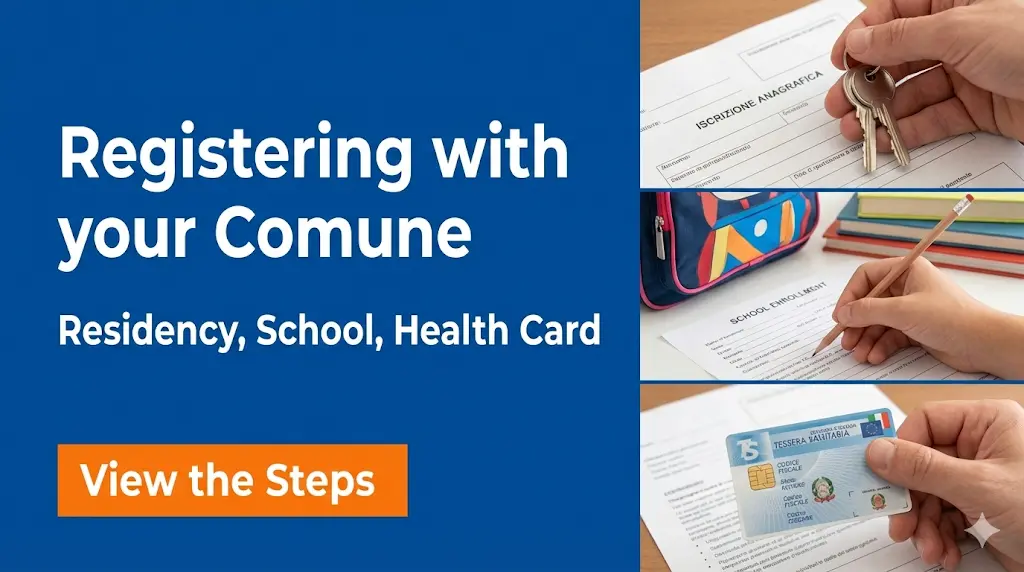
Registering with Comune: Residency, School, Health Card
Relocating to Italy? This comprehensive guide explains how to navigate your local town hall (Comune) to register your official residency (Iscrizione Anagrafica), enroll your children in public schools, and secure your Italian health card (Tessera Sanitaria) for public healthcare access.
Disclosure: This post may contain affiliate links. We may earn a commission at no extra cost to you if you make a purchase through these links. Read full disclosure.
Introduction to Registering with Comune
In Italy, the national government manages your immigration status, but the local Comune manages your actual daily existence. The town hall is the administrative beating heart of every Italian city, town, and village. It is the institution responsible for tracking demographics, managing local taxes, organizing public education, and providing the foundational documentation required to access state services.
For newly arrived expats, interacting with the Comune is an unavoidable and crucial rite of passage. You cannot truly live, work, or thrive in Italy without officially declaring your presence to local authorities. This foundational process triggers a domino effect of civic rights and responsibilities. Once you are registered as a resident, you unlock the ability to enroll your children in the public school system, register for a local doctor, and obtain the highly coveted Italian health card. Conversely, failing to register your address promptly can stall your residence permit renewal, prevent you from buying a car, and leave you without access to subsidized public healthcare.
This exhaustive guide is designed to demystify the holy trinity of local Italian bureaucracy: Residency, School Enrollment, and Healthcare Registration. We will break down the exact documents you need to bring to the Anagrafe (Registry Office), explain the infamous visit from the municipal police officer (Vigile), and outline the strict January deadlines for online school enrollment. Furthermore, we will walk you step-by-step through the process of visiting the local health authority to claim your Tessera Sanitaria. By understanding these interconnected systems, you can navigate your first few months in Italy with confidence and minimal stress.
Step 1: Establishing Residency (Iscrizione Anagrafica)
The absolute cornerstone of your administrative life in Italy is the Iscrizione Anagrafica (Registration of Residency). By Italian law, anyone who moves to Italy with the intention of staying permanently—or for an extended period—must register their residential address with the registry office (Ufficio Anagrafe) of their local Comune.
You generally have 20 days from the moment you move into your permanent Italian home to initiate this process. It is important to note that you cannot register your residency using a temporary hotel or a short-term holiday rental. You must have a legally registered, long-term housing contract. To understand the nuances of securing a qualifying lease, we highly recommend reviewing our guide on Navigating Italian Bureaucracy: Comune and Prefettura.
Required Documents for Residency
When you are ready to apply for residency, you cannot simply walk into the Comune empty-handed. You must prepare a meticulous dossier of documents. While slight variations exist between different municipalities, the core requirements are universally standardized.
If you are a Non-EU Citizen, you will need:
- Valid Passport: The original and a photocopy of the identification pages and the entry visa.
- Permesso di Soggiorno (Residence Permit): The original valid permit, or, if you are newly arrived, the postal receipt demonstrating that you have submitted your application for the permit.
- Codice Fiscale: Your Italian tax identification number. If you are unsure how to obtain this preliminary document, read our dedicated article on Local Tax Registration: Codice Fiscale and ISEE.
- Proof of Accommodation: A copy of your registered rental contract (contratto di affitto registrato) or property deed (rogito). If you are staying with family or friends, you need a formal letter of hospitality (dichiarazione di ospitalità) and a consent form signed by the property owner.
- Dichiarazione di Residenza: The official application form, fully completed and signed by all adult members of the household.
If you are an EU Citizen, the process is slightly different. Because you do not need a Permesso di Soggiorno, you must instead prove that you have the financial means to support yourself and that you possess comprehensive health insurance valid in Italy. Alternatively, providing a valid Italian employment contract satisfies these requirements.
The Vigile Visit (Municipal Police Verification)
Submitting your paperwork at the Comune is only the first half of the residency process. Italy employs a unique physical verification system to prevent address fraud.
Within 45 days of submitting your Dichiarazione di Residenza, a municipal police officer—known as the Vigile Urbano—will visit your stated address unannounced. Their job is to visually verify that you and your family actually live at the property.
To ensure this visit goes smoothly, you must immediately put your family’s last name on the building’s exterior doorbell (campanello) and on your physical mailbox (cassetta delle lettere). If the Vigile arrives and cannot find your name, or if you are consistently not home after multiple attempts, they will report a negative outcome to the Anagrafe, and your residency application will be rejected.
Once the Vigile successfully verifies your presence, your residency is officially confirmed retroactively to the date you originally submitted the application. With this status secured, you can request a Certificato di Residenza (Certificate of Residence), which is the golden key to unlocking schools and healthcare.
Step 2: Enrolling Your Children in the Italian School System
Italy boasts a robust, highly accessible public education system. By law, education is strictly compulsory for all children residing in Italy between the ages of 6 and 16, regardless of their nationality or immigration status. Even if a child is undocumented or waiting for a residence permit, they have an absolute legal right to attend an Italian public school.
If you are relocating with a family, coordinating your Comune residency with the school calendar is a critical logistical challenge.
The Annual Online Enrollment Window
The most surprising aspect of Italian public schools for expats is the timeline for enrollment. You cannot simply show up at the local school in August to register for a September start date.
For the primary (scuola primaria), lower secondary (scuola secondaria di primo grado), and upper secondary (scuola secondaria di secondo grado) levels, nationwide enrollment takes place entirely online during a highly specific window in the winter. This window typically opens in mid-January and closes by mid-February for the academic year beginning the following September. For example, enrollment for the 2026/2027 school year was mandated between January 13 and February 14, 2026.
To access the Ministry of Education’s centralized online enrollment portal (Unica), you must possess a verified Italian digital identity, either a SPID (Sistema Pubblico di Identità Digitale) or a CIE (Carta di Identità Elettronica). Through this portal, you can select up to three preferred schools in your area.
Catchment Areas and Mid-Year Arrivals
Public school placement in Italy is heavily dictated by proximity to your registered residence. Municipalities are divided into specific catchment areas, known as a Stradario. While you are technically free to request a school outside of your assigned zone, priority is strictly given to children who reside within the school’s immediate territorial boundary. If a school is oversubscribed, out-of-zone applications are the first to be rejected.
If your family relocates to Italy in the middle of the academic year, or if you miss the rigid January/February online deadline, you must bypass the digital portal. In this scenario, you must physically visit the secretariat (segreteria studenti) of the Comprehensive Institute (Istituto Comprensivo) that governs your local schools. The staff will assist you with a manual, paper-based enrollment, placing your child in a class that currently has open seats. For a broader look at private and international alternatives, explore our article on Education Options: Schools and Daycare for Expat Children.
Required Documents and Mandatory Vaccinations
When finalizing the enrollment, the school secretariat will require a specific set of documents to integrate your child into the system. You must provide:
- The child’s birth certificate (translated and legalized if issued abroad).
- The child’s and parents’ Codice Fiscale.
- Passports and Permessi di Soggiorno (if applicable).
- Prior academic records from your home country, translated into Italian, to help the school place the child in the appropriate grade level.
Most importantly, you must provide a comprehensive, officially translated vaccination certificate. Italy enforces strict mandatory vaccination laws (the Lorenzin Law) for school attendance. To attend public daycare, preschool, or primary school, children must be fully vaccinated against ten specific diseases, including Polio, Diphtheria, Tetanus, Hepatitis B, Pertussis, Haemophilus influenzae type b, Measles, Mumps, Rubella, and Varicella. If your child is missing any of these mandatory shots, they may be denied entry to early childhood programs, or you may face ongoing fines from the local health authority.
Step 3: Getting Your Health Card (Tessera Sanitaria)
Once your residency is verified and your children are registered for school, the final pillar of local integration is securing your access to the Italian public healthcare system. The Servizio Sanitario Nazionale (SSN) is a regionally managed, universally accessible healthcare system that provides heavily subsidized or entirely free medical care, including hospital visits, specialist care, and prescription medications.
Your physical proof of access to the SSN is the Tessera Sanitaria (Health Insurance Card). This blue plastic card, equipped with a microchip, also doubles as your official Codice Fiscale card and functions as a European Health Insurance Card (EHIC) for emergency medical coverage when traveling within the EU.
Mandatory vs. Voluntary SSN Enrollment
Before visiting the health office, you must understand how you qualify for the SSN. Expats fall into two distinct categories: Mandatory (Free) Enrollment and Voluntary (Paid) Enrollment.
Mandatory Enrollment (Iscrizione Obbligatoria):
You are entitled to free, mandatory registration with the SSN if you are a legal resident of Italy and fall into specific categories. This includes non-EU citizens holding a work visa (subordinate or self-employed), those holding a family reunification visa, and pregnant women. EU citizens working in Italy are also entitled to mandatory enrollment. For these individuals, healthcare is funded through the taxes automatically deducted from their Italian income.
Voluntary Enrollment (Iscrizione Volontaria):
If you do not meet the criteria for mandatory enrollment—for example, if you are a foreign student, an au pair, or a retiree living in Italy on an Elective Residence Visa—you are not automatically granted free healthcare. However, once you are an official resident, you can opt into the SSN by paying an annual flat fee. This fee is calculated based on your worldwide income from the previous year. You must pay this fee via an F24 tax form at the post office before applying for your card. For deeper insights into navigating private vs. public coverage, check out Getting Health Insurance in Italy: Public and Private Options.
Visiting the ASL and Choosing a Doctor
To obtain your Tessera Sanitaria, you must physically visit the local branch of your regional health authority. Depending on where you live in Italy, this office is called the ASL (Azienda Sanitaria Locale), ATS, or USL.
You must bring a comprehensive folder of documents to your ASL appointment:
- Your valid Passport or National ID.
- Your Permesso di Soggiorno (or the post office receipt proving you are renewing/applying for it).
- Your official Codice Fiscale certificate.
- Your Certificato di Residenza (or a self-certification form confirming your registered address).
- If mandatory: Proof of employment (work contract or recent pay slips).
- If voluntary: The postal receipt proving you paid the annual voluntary enrollment fee.
During this appointment, the ASL clerk will process your enrollment and ask you to select a Primary Care Physician (Medico di Base or Medico di Medicina Generale) from a list of doctors practicing in your specific postal code. If you are registering children under the age of 14, you will instead choose a pediatrician (Pediatra di Libera Scelta).
Receiving and Using the Tessera Sanitaria
At the conclusion of your ASL appointment, the clerk will hand you a temporary paper certificate. Do not lose this paper. It acts as your official health card, containing your doctor’s name and contact information, allowing you to book appointments and receive subsidized prescriptions immediately.
The physical plastic Tessera Sanitaria will be manufactured by the Ministry of Economy and Finance and mailed directly to your registered home address (which is why finalizing your Comune residency first is so vital). This mailing process typically takes between 30 and 60 days.
For non-EU citizens, the expiration date printed on the Tessera Sanitaria is directly tied to the expiration date of your Permesso di Soggiorno. Every time you renew your residence permit, you must return to the ASL with your new permit receipt to renew your health registration and trigger the mailing of a new card.
Summary: The Expat Integration Checklist
To help you visualize this bureaucratic journey, use the following quick-reference table outlining the three major municipal processes.
| Process | Managing Authority | Key Documents Required | Typical Timeline |
| 1. Residency (Iscrizione Anagrafica) | Comune (Ufficio Anagrafe) | Passport, Permesso di Soggiorno, Registered Lease, Codice Fiscale. | Apply within 20 days of moving; Vigile visits within 45 days. |
| 2. School Enrollment | Ministry of Education (Online) & Local School | SPID, Codice Fiscale, Vaccination Records, Prior Transcripts. | Annually between mid-January and mid-February. |
| 3. Health Card (Tessera Sanitaria) | ASL (Azienda Sanitaria Locale) | Passport, Permesso, Certificate of Residence, Work Contract/Fee Receipt. | Apply immediately after residency; card arrives in 30-60 days. |
Conclusion
Registering with the Comune and navigating the subsequent municipal services is an undeniable test of patience for any expatriate relocating to Italy. The sheer volume of photocopies, the rigid timelines for school enrollment, and the intricate rules surrounding healthcare qualification can feel overwhelming to a newcomer. However, these bureaucratic hurdles are not arbitrary; they are the foundational structures of a society that offers immense social benefits, from universally accessible healthcare to high-quality public education.
By approaching this process chronologically—first securing your registered lease, then waiting for the Vigile to verify your Iscrizione Anagrafica, and finally using that residency to unlock your Tessera Sanitaria and school placements—you can conquer the Italian administrative maze. Remember to keep physical copies of all your documents neatly organized in a folder, always carry your Codice Fiscale, and treat local clerks with a polite, patient demeanor. Once you hold your Certificato di Residenza and your blue health card, the bureaucratic anxiety will fade, allowing you to truly immerse yourself in the beauty, culture, and rhythm of your new Italian life.
References
Primary sources (official)
- Agenzia delle Entrate (Italian Revenue Agency) – Official guidelines on the issuance, validity, and renewal of the Italian Health Insurance Card (Tessera Sanitaria): https://www.agenziaentrate.gov.it/portale/the-italian-health-insurance-card
- Ministero dell’Istruzione e del Merito (Ministry of Education) – Centralized portal for mandatory online public school enrollment (Unica portal): https://unica.istruzione.gov.it/en/orientamento/iscrizioni
Other helpful sources
- Refugee.info Italy – Comprehensive guides on the Iscrizione Anagrafica process, required documents, and school enrollment for minors: https://italy.refugee.info/
- Welcome Office FVG – Step-by-step instructions for permanent residency registration and mandatory SSN health registration: https://www.welcomeoffice.fvg.it/
Disclaimer
The information provided in this article is for educational and informational purposes only and does not constitute official legal, immigration, or medical advice. Italian municipal laws regarding residency (Iscrizione Anagrafica), regional ASL health registration protocols, and national Ministry of Education enrollment deadlines are subject to frequent legislative changes. Always verify current requirements, required documentation, and specific enrollment deadlines directly with your local Comune, your assigned ASL office, and the secretariats of your local public schools before making relocation decisions.