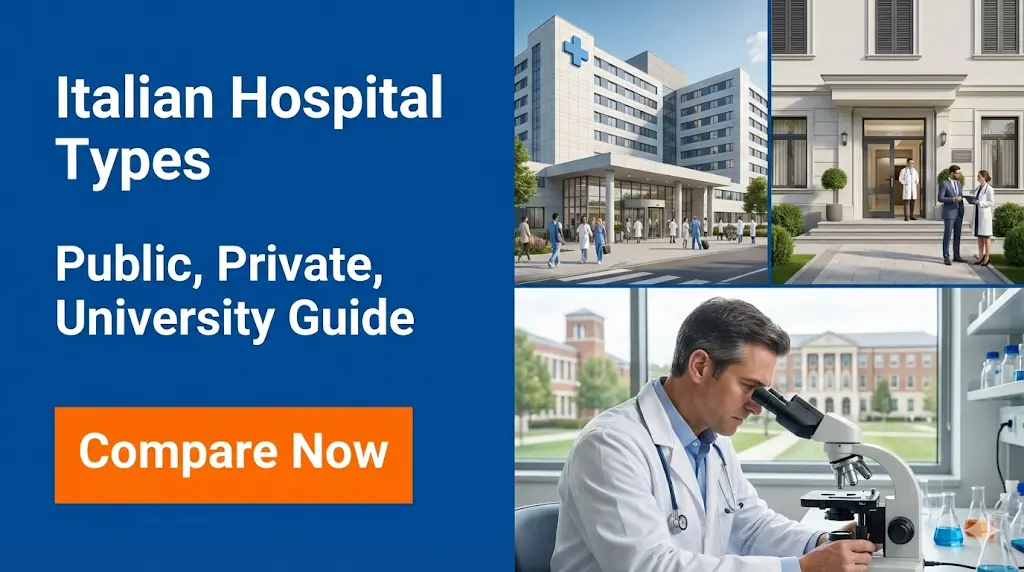
Hospital Types in Italy: Public, Private, University Hospitals
Navigating the Italian healthcare system requires understanding its distinct hospital categories. This comprehensive guide details the differences between public, private, and university hospitals in Italy, helping expats make informed decisions regarding emergency care, specialized treatments, and private health insurance options.
Disclosure: This post may contain affiliate links. We may earn a commission at no extra cost to you if you make a purchase through these links. Read full disclosure.
Introduction to Hospital Types in Italy
Italy boasts one of the most efficient and highly ranked healthcare systems in the world, frequently praised by the World Health Organization for its high quality of care and impressive life expectancy rates. A core pillar of this success is the country’s diverse and multi-layered hospital network. Unlike some nations where healthcare is largely homogenized or entirely privatized, Italy offers a mixed system that integrates state-funded facilities, academic research centers, and independent private clinics.
For an expatriate, a tourist, or a long-term foreign resident, the sheer variety of hospital types can initially cause confusion. You might wonder whether you should head to the local “Ospedale,” seek out a “Policlinico,” or book an appointment at a “Clinica Privata.” Furthermore, you may be uncertain about which facilities will accept your public health card, which will require out-of-pocket payments, and where you are most likely to find English-speaking medical professionals.
This extensive guide is designed to demystify the various hospital types in Italy. We will provide an in-depth exploration of public hospitals, university hospitals, and private healthcare facilities, outlining the unique advantages, potential drawbacks, and primary functions of each. Additionally, we will cover the essential nuances of the “convenzionato” system—a uniquely Italian hybrid of public and private care—and offer practical advice on what to expect during a hospital admission. By understanding these critical distinctions, you will be fully empowered to navigate the Italian healthcare system with confidence, ensuring that you and your loved ones receive the best possible care whenever you need it.
The Backbone of Italian Healthcare The Servizio Sanitario Nazionale
To understand how hospitals function in Italy, you must first understand the framework that supports them: the Servizio Sanitario Nazionale, commonly referred to as the SSN. Established in 1978, the SSN is Italy’s national public healthcare system. It is founded on the guiding principles of universal coverage, equity, and solidarity. The system is funded through national and regional taxation, which means that the fundamental right to health is guaranteed to all citizens and legal residents, regardless of their income or social status.
While the central Ministry of Health in Rome sets the national standards and allocates the overall healthcare budget, the actual administration and delivery of medical services are highly decentralized. Healthcare is managed at the regional level, which means that the efficiency, infrastructure quality, and availability of certain specialized treatments can vary significantly between northern regions like Lombardy and southern regions like Sicily.
At the local level, healthcare is overseen by the Azienda Sanitaria Locale (Local Health Authority). The Azienda Sanitaria Locale manages community health services, general practitioners, and public hospitals within a specific geographic district. For anyone planning to reside in the country long-term, establishing your rights within this system is paramount. You can learn the step-by-step process of integrating into this public framework by reviewing our comprehensive Healthcare in Italy: An Expats’ Guide. Once you are registered with the SSN, you gain access to a vast network of medical facilities, primarily categorized into three distinct types: public hospitals, university hospitals, and private hospitals.
Public Hospitals Ospedali Pubblici
Public hospitals, known in Italian as Ospedali Pubblici or Aziende Ospedaliere, are the workhorses of the Italian healthcare system. They are fully funded and managed by the state and the regional health authorities. These institutions are designed to provide comprehensive, accessible medical care to the general population, ranging from routine surgeries to critical emergency interventions.
The Role of the Pronto Soccorso
Perhaps the most crucial component of any public hospital is the Pronto Soccorso, the emergency room. In Italy, almost all major emergencies—including severe trauma, heart attacks, strokes, and major accidents—are handled exclusively by public hospitals. Private clinics generally do not have the infrastructure, blood banks, or intensive care units required to manage massive, life-threatening traumas.
When you arrive at a public Pronto Soccorso, you are not seen on a first-come, first-served basis. Instead, Italy utilizes a strict color-coded triage system to prioritize patients based on clinical urgency:
- Red Code (Codice Rosso): Immediate life-threatening emergency. The patient bypasses all waiting rooms and receives instant medical intervention.
- Yellow Code (Codice Giallo): Urgent condition with a risk of rapid deterioration. The patient is seen very quickly.
- Green Code (Codice Verde): Minor urgency. The patient requires medical attention but is stable. Waiting times can range from a few hours to half a day, depending on the volume of more severe cases.
- White Code (Codice Bianco): Non-urgent condition. These are issues that should ideally be handled by a primary care physician. Patients with a white code will wait the longest and may be subject to a small co-payment (ticket) for utilizing emergency resources for non-emergencies.
If you ever find yourself in a crisis, understanding how these triage protocols dictate your care is vital. For a more detailed breakdown of emergency protocols, you should consult our guide on Emergency Medical Services in Italy: 112 and Hospitals.
Advantages of Public Hospitals
The primary advantage of utilizing public hospitals is financial. For individuals enrolled in the SSN, emergency care, hospitalizations, and major surgeries are provided completely free of charge. You will not receive a massive bill upon discharge. Furthermore, public hospitals are subject to rigorous state oversight and are staffed by highly trained, competitive medical professionals who have passed rigorous national examinations to secure their positions.
Drawbacks of Public Hospitals
Despite the high quality of medical expertise, public hospitals often face significant logistical challenges. They are frequently underfunded and understaffed, leading to notoriously long waiting lists (liste di attesa) for non-urgent, elective surgeries or specialized diagnostic scans. Additionally, the physical infrastructure of many public hospitals can be quite dated, particularly in the southern regions of the country. Finally, for expats, the language barrier is a major hurdle. While doctors may have a reading knowledge of English for medical literature, nurses, administrative staff, and triage personnel in public hospitals generally speak only Italian.
The Intramoenia System
To combat long waiting lists, public hospitals offer a unique system known as Libera Professione Intramuraria, or Intramoenia. This allows top-tier public doctors to provide private, paid consultations outside of their regular public shifts, but physically within the public hospital building. Patients can pay out-of-pocket to skip the public waiting list and choose their specific surgeon or specialist, while still utilizing the public hospital’s operating rooms and facilities.
University Hospitals Policlinici Universitari
The second major category of healthcare facilities in Italy is the university hospital, known locally as a Policlinico Universitario or an Azienda Ospedaliero-Universitaria. These are massive medical complexes that are deeply integrated with the medical faculties of major Italian universities.
Hubs of Research and Innovation
University hospitals serve a dual purpose: they provide patient care and they serve as the primary training grounds for the next generation of Italian doctors, surgeons, and medical researchers. Because of their academic affiliation, Policlinici are consistently at the forefront of medical innovation. They are the hubs where cutting-edge clinical trials are conducted, experimental treatments are developed, and highly complex, rare diseases are managed.
If a patient in a standard public hospital presents with an incredibly rare autoimmune disorder, a highly complex oncological case, or requires a difficult organ transplant, they are frequently transferred to a university hospital. Famous examples include the Policlinico Umberto I in Rome, affiliated with Sapienza University, and the Policlinico Sant’Orsola-Malpighi in Bologna.
The Teaching Hospital Dynamic
When you receive care at a university hospital, you are entering an academic environment. This means that your care will likely involve medical students, residents (medici specializzandi), and senior attending physicians (primari). While some patients may feel apprehensive about being treated by doctors in training, it is important to note that residents are fully qualified medical doctors undergoing their specialty training, and every decision is strictly supervised by leading experts in the field.
Advantages and Drawbacks
The advantages of a Policlinico mirror those of a public hospital—care is covered by the SSN—but with the added benefit of accessing the absolute highest echelon of medical expertise and the most advanced diagnostic technology available in the country. Because the focus is on research and complex cases, you are more likely to encounter specialists who regularly attend international conferences and, consequently, have a higher proficiency in English.
The drawbacks are also similar to the public sector. University hospitals are massive, sprawling complexes that can be bureaucratically overwhelming to navigate. Waiting times for standard procedures can still be long, and the sheer volume of patients moving through these facilities can make the experience feel somewhat impersonal.
Private Hospitals and Clinics Ospedali Privati
The private healthcare sector in Italy runs parallel to the public SSN and is a massive industry in its own right. Private hospitals (Ospedali Privati) and private clinics (Cliniche Private or Case di Cura) offer an alternative pathway for patients who prioritize speed, comfort, and personalized attention, and who have the financial means or the insurance coverage to bypass the public system.
Focus on Elective Care and Comfort
Private hospitals generally do not handle major, life-threatening emergencies. You will rarely see ambulances rushing to a private clinic with trauma victims. Instead, the private sector focuses heavily on elective surgeries, routine maternity care, orthopedics, ophthalmology, cosmetic procedures, and comprehensive diagnostic testing.
The atmosphere in a private Italian hospital is often vastly different from the chaotic energy of a public facility. Private clinics often resemble luxury hotels rather than medical institutions. They feature modern architecture, state-of-the-art private patient rooms with en-suite bathrooms, high-quality catering, and a deeply attentive nursing staff.
Overcoming the Language Barrier
For expatriates and international tourists, the private sector is incredibly appealing because it largely eliminates the language barrier. Private clinics in major expat hubs like Rome, Milan, Florence, and Naples actively market their services to the international community. They frequently employ bilingual receptionists, dedicated international patient coordinators, and a roster of specialists who are highly fluent in English. If navigating medical terminology in Italian is a primary concern for you, utilizing resources to identify these facilities is essential. You can start by reviewing directories on Where to Find English-Speaking Doctors and Clinics.
Advantages and Drawbacks
The advantages of private hospitals are clear: virtually zero waiting times, the ability to choose your exact doctor or surgeon, luxurious accommodations, and linguistic ease. You can often book an MRI or a specialized surgical consultation within a matter of days, rather than waiting months in the public system.
The primary drawback is, unequivocally, the cost. Medical care in the private sector is expensive. A night in a private hospital room, combined with surgical fees, anesthesiologist fees, and diagnostic tests, can easily accumulate into thousands of euros. Therefore, utilizing the private hospital network is generally only feasible if you are paying out-of-pocket or if you possess a robust private health insurance policy.
The Hybrid Model Strutture Convenzionate
To complicate matters slightly—but ultimately to the benefit of the patient—Italy operates a hybrid system within the private sector known as Strutture Convenzionate.
A clinica convenzionata is a privately owned and operated hospital or diagnostic center that has signed a formal, contractual agreement (a convenzione) with the Italian national health service. Under this agreement, the private facility reserves a specific portion of its beds, surgical times, and diagnostic machines for public SSN patients.
This means that if you are enrolled in the public healthcare system, your general practitioner can write you a referral for a procedure, and you can choose to have that procedure performed at an accredited private hospital. You will only pay the standard public co-payment (the ticket), and the SSN will reimburse the private hospital for the rest of the cost.
This system is designed to alleviate the burden on overcrowded public hospitals. It allows patients to experience the modern facilities and comfort of a private clinic while utilizing their public health benefits. However, it is important to note that the waiting lists for the “convenzionato” slots at these private hospitals can still be quite long, as the private hospital strictly caps the number of public patients it accepts each month to ensure it has room for its full-paying private clientele.
Key Differences Between Italian Hospital Types
To help clarify the structural differences and assist you in making the right choice for your healthcare needs, review the comparative table below.
| Feature / Hospital Type | Public Hospital (Ospedale Pubblico) | University Hospital (Policlinico) | Private Hospital (Clinica Privata) |
| Funding & Cost | Fully state-funded. Free or low ticket fee. | State-funded. Free or low ticket fee. | Out-of-pocket or private health insurance. |
| Emergency Services | Comprehensive 24/7 Pronto Soccorso. Handles major trauma. | Comprehensive 24/7 Pronto Soccorso. Handles complex cases. | Rarely handles major emergencies. Focuses on planned care. |
| Wait Times | Often long for non-urgent, elective procedures. | Often long. Prioritizes complex, specialized medical cases. | Immediate or very short wait times for all procedures. |
| Facilities & Comfort | Functional, often older. Multi-bed wards are standard. | Functional, large-scale complexes. Multi-bed wards. | Modern, luxurious. Single private rooms are standard. |
| Language Accessibility | English is rarely spoken by nursing or admin staff. | English spoken by top researchers and attending doctors. | English-speaking staff and doctors are widely available. |
Choosing the Right Hospital for Your Needs
Selecting the appropriate facility in Italy depends entirely on the nature of your medical requirement, your insurance status, and your comfort level with the Italian language.
When to Choose a Public Hospital:
If you or a family member suffers a sudden heart attack, a severe allergic reaction, or is involved in a traffic accident, you must go to a public hospital. Their emergency departments are equipped to save lives immediately. Public hospitals are also the best choice if you have a chronic condition that requires ongoing, standard medical management and you wish to utilize your free SSN coverage to avoid massive out-of-pocket expenses.
When to Choose a University Hospital:
You should seek out a university hospital if you receive a diagnosis for a rare disease, a complex neurological condition, or an aggressive form of cancer. These hospitals house the leading experts and offer access to experimental treatments and specialized surgical interventions that standard public hospitals simply cannot provide.
When to Choose a Private Hospital:
If you require a non-urgent elective surgery—such as a knee replacement, a hernia repair, or cosmetic surgery—and you do not want to wait eight months on a public list, the private sector is the ideal choice. Additionally, if you are pregnant and desire a highly personalized, private birthing experience with a dedicated English-speaking obstetrician, a private maternity clinic will offer the comfort and specialized attention you seek.
What to Expect During an Italian Hospital Stay
If you are admitted to an Italian hospital for an overnight stay or an extended recovery period, it is crucial to prepare for a cultural experience that may differ drastically from hospital stays in your home country.
Room Arrangements and Privacy
In public and university hospitals, private single rooms are exceptionally rare. You should expect to be placed in a ward (reparto) with two to four other patients. These rooms are separated by curtains, meaning privacy is minimal. Bathrooms are typically shared among the patients in the room. If privacy is a non-negotiable priority for you, you must utilize the Intramoenia system to request a paid private room within the public hospital, or transition entirely to a private clinic.
The Role of the Family (L’Assistenza Familiare)
One of the most profound cultural differences in Italian public hospitals is the expectation placed upon the patient’s family. While Italian nurses are highly skilled medical professionals who administer medications, manage IV lines, and monitor vital signs, they generally do not perform basic bedside care.
The system relies heavily on the cultural tradition of the family stepping in. It is completely normal and expected for family members to be present during visiting hours to help the patient eat, assist them in washing, change their bedclothes, and provide continuous emotional support. In cases where the family cannot be present, Italians often hire private, non-medical caregivers (called badanti) to sit with the patient in the hospital and assist with these basic needs.
What to Pack
Because public hospitals run on tight budgets, they do not provide the hotel-like amenities commonly found in North American hospitals. If you are admitted to a public Italian hospital, you must bring your own supplies. Your packing list should include:
- Pajamas, a robe, and non-slip slippers.
- All personal toiletries (soap, shampoo, toothbrush, toothpaste).
- Your own towels (hospitals rarely provide bath towels).
- Your own toilet paper and tissues.
- In some older regional hospitals, patients are even advised to bring their own cutlery and a cup for meals.
Hospital Food
Hospital food in Italy is strictly tailored to the patient’s dietary and medical requirements. Do not expect culinary masterpieces, despite the country’s reputation. The meals are notoriously bland, often consisting of boiled meats, plain pasta or rice with a drizzle of olive oil, and cooked vegetables. This is done intentionally to accommodate delicate digestive systems. However, family members are frequently allowed to bring in outside food, provided the attending physician approves it.
Navigating Hospital Costs and Health Insurance
Understanding the financial implications of your hospital choice is the final, critical piece of the puzzle. How you pay for your care depends on your residency status and your insurance coverage.
If you are an expatriate from a non-EU country living in Italy on a visa, you were likely required to purchase private health insurance prior to your arrival. If you have not yet registered with the public SSN, you must utilize this private insurance. When visiting a private hospital, you will either pay upfront and submit the invoices for reimbursement, or, if the hospital is in-network with your provider, the billing will be handled directly.
If you are evaluating how to bridge the gap between public care and private comfort, investing in a comprehensive international health insurance policy is highly recommended. These policies allow you to bypass public waiting lists and access the luxurious, English-speaking private hospital network without fear of financial ruin.
For citizens of the European Union visiting Italy, you are protected by the European Health Insurance Card (EHIC). If you present this card at a public or university hospital, you will receive necessary medical treatment under the same conditions and at the same cost as an Italian citizen. However, the EHIC is absolutely not valid at strictly private hospitals, and you will be liable for the full cost of care if you choose a private facility without separate travel insurance.
Conclusion
The Italian healthcare landscape is a brilliant, multifaceted system designed to cater to the diverse medical needs of a massive population. While the bureaucratic layers and the sheer variety of hospital types can initially seem overwhelming to an expatriate, taking the time to understand the structural differences is an invaluable investment in your personal health and safety.
Public hospitals and university Policlinici form the unshakable foundation of the system, offering world-class, universally accessible care that prioritizes clinical urgency and advanced medical research above all else. They are your ultimate safety net in the event of a severe emergency. Conversely, the thriving network of private clinics and strutture convenzionate offers a highly appealing alternative for those seeking immediate elective care, superior comfort, and the crucial advantage of English-speaking medical professionals.
By familiarizing yourself with the triage protocols of the Pronto Soccorso, understanding the cultural expectations of an Italian hospital stay, and securing the appropriate health insurance to match your lifestyle, you remove the anxiety from navigating foreign medicine. With this knowledge securely in hand, you can focus fully on the vibrant, enriching, and beautiful experience of living your life in Italy.
References
Primary sources (official)
- Ministero della Salute (Italian Ministry of Health): The central governmental portal outlining the structure of the Servizio Sanitario Nazionale, patient rights, and the regulations governing public and private healthcare facilities. https://www.salute.gov.it/
- Istituto Superiore di Sanità (National Institute of Health): Official data, research, and guidelines regarding hospital performance, university research integration, and public health statistics in Italy. https://www.iss.it/
Other helpful sources
- Expatica Italy: A comprehensive resource hub for expatriates offering detailed guides on navigating the Italian healthcare system, understanding the EHIC, and managing out-of-pocket medical costs. https://www.expatica.com/it/healthcare/
- The Local Italy: An English-language news network providing ongoing coverage, practical advice, and expat community experiences regarding Italian hospital waiting lists, healthcare bureaucracy, and emergency services. https://www.thelocal.it/
Disclaimer
The information provided in this article is intended for general educational and informational purposes only and does not constitute official medical, legal, or financial advice. Healthcare regulations, hospital administration structures, triage protocols, and the availability of convenzionato services in Italy are subject to frequent legislative updates by national and regional health authorities. Always consult directly with a licensed Italian medical professional or your designated Medico di Medicina Generale for personalized medical advice. In the event of a severe, life-threatening medical emergency, please dial 112 immediately to access emergency services and proceed to the nearest public Pronto Soccorso.