Timelines and Fees for Italy Permesso di Soggiorno Renewal
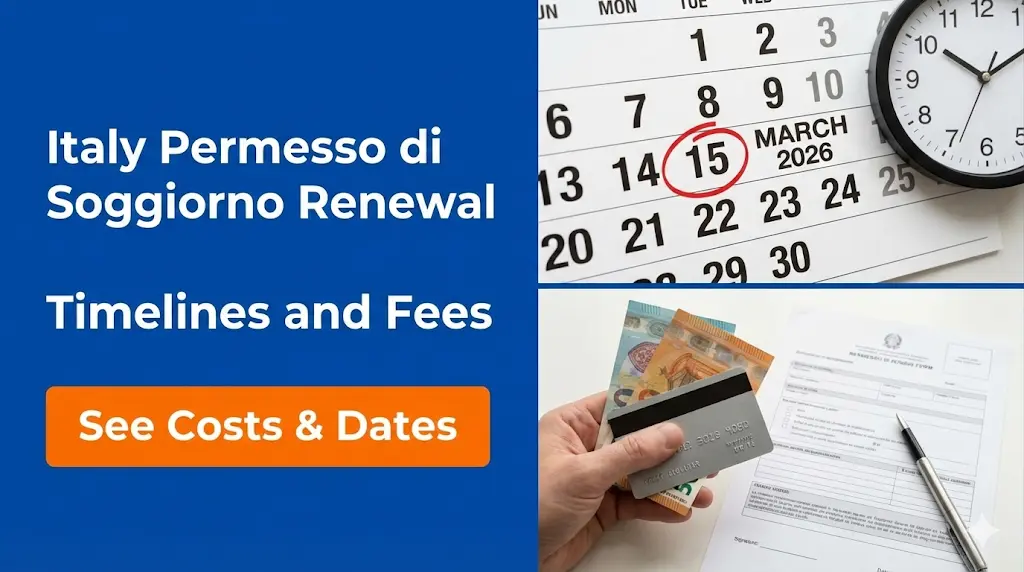
Navigating the renewal of your Italian Permesso di Soggiorno can be stressful. This comprehensive guide breaks down the complete 2026 timeline, expected processing delays, and an itemized list of all government fees, helping expats budget and plan their legal stay.
Disclosure: This post may contain affiliate links. We may earn a commission at no extra cost to you if you make a purchase through these links. Read full disclosure.
Introduction to Timelines and Fees for Italy Permesso di Soggiorno Renewal
The Italian immigration system operates on a highly decentralized model, meaning that the speed and efficiency of your renewal can vary dramatically depending on whether you live in a bustling metropolis like Milan or Rome, or a quiet provincial town in Tuscany or Puglia. Furthermore, the costs associated with renewing your permit are not a single flat fee; they are broken down into various postal charges, electronic card printing costs, and government taxation tiers based on the duration of the permit you are requesting.
Understanding the exact timeline—from the moment you realize your card is expiring to the day you finally hold the new plastic card in your hand—is critical for managing your personal and professional life. A delayed permit can impact your ability to travel internationally, sign a new apartment lease, or finalize a work contract. Similarly, knowing exactly how much cash to bring to the post office and the tobacco shop will prevent you from being turned away after waiting in line for an hour.
In this exhaustive guide, we will dissect the entire timeline for renewing your residence permit in 2026. We will explore the ideal chronological steps you should follow, the real-world processing times you can expect at the Questura (Police Headquarters), and provide a fully itemized breakdown of the costs. Whether you are a student extending your academic stay, a worker renewing a subordinate employment contract, or a family member maintaining your residency, this guide will serve as your financial and chronological roadmap. For a foundational understanding of the document itself and the rights it confers, we highly recommend reading our core article: Italian Residence Permit (Permesso di Soggiorno) Explained.
The Ideal Timeline for Renewing Your Permesso di Soggiorno
When it comes to Italian bureaucracy, procrastination is your worst enemy. The law dictates specific windows during which you are expected to submit your renewal application. Understanding this legal timeline is the first step in ensuring a smooth process.
Phase 1: Preparation (60 to 90 Days Before Expiration)
Italian immigration law requires you to initiate the renewal process before your current permit expires. The official recommendation is to begin the procedure approximately 60 to 90 days prior to the expiration date printed on your current Permesso di Soggiorno. Submitting your application within this window demonstrates compliance and helps mitigate the impact of the inevitable processing delays.
During this 30-day preparation window (T-90 to T-60), your primary focus should be gathering your supporting documentation. Because the requirements vary by permit type, you must secure fresh, updated copies of your life in Italy. Students will need to request official enrollment certificates and transcripts showing they have passed the required number of exams. Workers must request their latest pay slips (buste paga), their annual tax return (Certificazione Unica or Modello 730), and a formal declaration from their employer confirming continued employment. Family members must gather updated marriage certificates or proof of joint residency. Do not underestimate the time it takes to get these documents from universities or HR departments.
Phase 2: The Postal Kit Submission (30 to 60 Days Before Expiration)
Once your dossier is complete, you enter the active submission phase. The vast majority of standard renewals (work, study, standard family) are processed through the Italian postal system (Poste Italiane). You must visit a post office equipped with a Sportello Amico counter to pick up the famous Kit Giallo (Yellow Kit)—a large envelope containing the Modulo 1 and Modulo 2 application forms. If you are intimidated by the extensive Italian paperwork inside this envelope, you can follow our detailed, line-by-line instructions in Getting Your Residence Permit Kit in Italy: Step-by-Step.
You must fill out the forms with a black pen, enclose photocopies of all your gathered documents (never send the originals), and return the unsealed envelope to the Sportello Amico counter. At this moment, you will pay all the associated administrative fees.
The postal worker will process your payment and hand you two incredibly important pieces of paper. The first is your postal receipt (ricevuta), which features a hologram and a 12-digit tracking number. This receipt is your legal proof that your renewal is in progress. The second document is a printed appointment letter specifying the exact date, time, and location of your fingerprinting appointment at the local Questura.
Phase 3: The Questura Appointment (1 to 3 Months After Submission)
Your appointment at the immigration office of the Questura for biometrics (fingerprinting and photography) is rarely immediate. Depending on the province, your appointment could be scheduled anywhere from one to three months after you drop off your postal kit.
On the day of the appointment, you must bring the original appointment letter, your original passport, your expiring Permesso di Soggiorno, the original postal receipts, four identical passport-sized photographs, and the original copies of all the documents you submitted as photocopies in the yellow envelope. The police officer will review your file, take your digital fingerprints, and ask you to sign a digital pad. If any documents are missing, they will issue a formal request for integration, giving you a deadline to return with the required paperwork.
Phase 4: Final Processing and Collection (2 to 6+ Months After Submission)
After your successful fingerprinting appointment, your file goes into the final processing queue. The Questura conducts background checks and verifies your financial and legal standing. This phase is entirely out of your hands. You can track the status of your application online using the 12-digit code from your postal receipt on the official Polizia di Stato Foreigners Portal.
When the system updates to show that your card is ready for collection, you will usually receive an SMS notification (if you provided an Italian mobile number) instructing you on when to return to the Questura. You will hand over your old, expired plastic card and receive your brand new, updated Permesso di Soggiorno. From the initial post office visit to the final collection, the total timeline frequently spans four to six months.
Real-World Processing Times in 2026
While the timeline outlined above represents the standard chronological flow, the real-world processing times in Italy are famously inconsistent. The law technically requires the Questura to issue or renew a standard residence permit within 60 days of receiving the application, but this legal deadline is almost universally ignored due to severe understaffing and high applicant volumes.
The single biggest factor determining your waiting time is geography.
- Major Metropolitan Areas: If you live in Rome, Milan, Florence, or Naples, you are competing with tens of thousands of other immigrants, students, and expats. In these cities, it is incredibly common for the fingerprinting appointment to be scheduled months after the post office submission, with the final card collection taking another three to six months. In extreme cases in busy jurisdictions, applicants wait up to a year to receive a card that is only valid for one year, meaning they immediately have to start the renewal process again upon collecting it.
- Smaller Provinces and Towns: If you live in a smaller province (e.g., Siena, Parma, or Lecce), the immigration desks have significantly lower case volumes. In these areas, applicants often report completing the entire process—from the post office to holding the new card—in a remarkably swift two to three months.
If your renewal requires coordination with local municipal offices before you can even submit the kit—such as updating your registered address or getting a housing suitability certificate—the delays can compound. For advice on handling these local municipal hurdles, refer to our comprehensive guide on Navigating Italian Bureaucracy: Comune and Prefettura.
Breakdown of Permesso di Soggiorno Renewal Fees
Budgeting for your residence permit renewal is crucial, as the costs are mandatory, non-negotiable, and must be paid upfront in a specific manner. The Italian government breaks down the cost into four distinct categories: a revenue stamp, postal service fees, electronic card printing fees, and a government contribution tax based on the duration of the permit.
Below is a detailed, itemized table of the fees you can expect to pay when submitting your renewal at the post office in 2026.
| Fee Type | Description | Cost (EUR) | How it is Paid |
| Marca da Bollo | Official government revenue stamp required for the application form. | €16.00 | Purchased at a local Tabaccheria (tobacco shop) before going to the post office. |
| Poste Italiane Fee | Service charge for the post office processing and mailing the Kit Giallo. | €30.00 | Paid directly to the postal worker via cash or Italian Bancomat card. |
| Electronic Card Fee | The physical cost of manufacturing and printing the biometric plastic card (PSE). | €30.46 | Paid via a pre-filled postal payment slip (bollettino) included in the kit. |
| Government Tax (Short) | Contribution fee for permits valid from 3 months up to 1 year. | €40.00 | Added to the bollettino (Total: €70.46). |
| Government Tax (Medium) | Contribution fee for permits valid from 1 year up to 2 years. | €50.00 | Added to the bollettino (Total: €80.46). |
| Government Tax (Long) | Contribution fee for EU Long-Term permits and executive/highly skilled workers. | €100.00 | Added to the bollettino (Total: €130.46). |
Understanding the Total Cost
When you walk up to the Sportello Amico counter, the postal worker will ask you to pay the €30.00 service fee, plus the amount written on the bollettino (postal payment slip).
If you are a student renewing a one-year permit, your bollettino will total €70.46 (which is the €30.46 card fee plus the €40.00 short-term government tax). Added to the €30.00 postal fee, your total out-of-pocket cost at the counter is €100.46. When you factor in the €16.00 Marca da Bollo you bought earlier, the grand total for a one-year renewal is €116.46.
If you are a worker renewing a two-year contract, your bollettino will total €80.46 (the €30.46 card fee plus the €50.00 medium-term tax). Combined with the postal fee and revenue stamp, your grand total will be €126.46.
Important Note: Certain vulnerable categories of immigrants are exempt from paying the €40.00, €50.00, or €100.00 government contribution tax. This includes minors under the age of 18, individuals in Italy for medical treatment, and asylum seekers. However, even these exempt categories must still pay the €30.46 electronic card fee, the €30.00 postal fee, and purchase the €16.00 revenue stamp.
Hidden and Additional Costs to Consider
While the government fees outlined above are fixed, there are peripheral costs associated with the renewal process that expats should budget for.
- Photography: You must provide four identical, recent passport-sized photos for the Questura appointment. Photobooths found in train stations or subways typically charge between €5.00 and €8.00.
- Photocopies: You must submit photocopies of your entire passport (every single page, including blanks) and all your supporting documents. Using a local copy shop (copisteria) can add another €5.00 to €10.00 to your expenses.
- Professional Assistance: Many expats find the paperwork overwhelming and choose to use a Patronato (a free workers’ advice center) to help fill out the kit. While Patronati are legally free, you still have to pay the post office fees. If your case is complex—such as changing your permit category from study to work—you might hire an immigration lawyer or agency. Professional legal assistance for a renewal can range from €150.00 to €500.00, depending on the complexity of your dossier.
- Translations and Legalizations: If you are adding a new dependent to your family permit, you may need to provide newly translated and apostilled foreign birth or marriage certificates, which can cost upwards of €100.00 per document. For a broader perspective on the procedural requirements and overcoming potential pitfalls, you may want to consult our article on Renewing Your Italian Residence Permit: Process and Tips.
What to Do While Waiting for Your New Card
Because processing times can stretch for six months or more, you will almost certainly spend a significant portion of the year living in Italy with an expired Permesso di Soggiorno. This is an entirely normal part of the Italian expat experience and should not cause panic.
Your legal status is completely protected by the postal receipt (ricevuta) you received when submitting your renewal kit. This small, flimsy piece of paper acts as your temporary residence permit.
Working and Healthcare
While holding the renewal receipt, your rights remain uninterrupted. If you are employed, you retain the legal right to continue working. You simply must provide a copy of the receipt to your employer’s HR department to prove your renewal is in progress. Similarly, you can take your receipt to the local health authority (ASL) to temporarily extend your registration with the Italian National Health Service (SSN) and renew your Tessera Sanitaria (health card) while you wait for the physical permit.
Travel Restrictions with a Receipt
The most significant limitation of the renewal period involves international travel. You cannot travel freely throughout the Schengen Area with an expired card and a postal receipt.
- Traveling Home: You are legally allowed to leave Italy and return to your home country (e.g., flying from Rome to New York) using your expired permit and the renewal receipt.
- The Direct Flight Rule: However, your travel must be direct. You cannot transit through another Schengen country. If you attempt to layover in Paris, Frankfurt, or Amsterdam with an expired Italian permit and a postal receipt, border control in those countries will likely not recognize the Italian receipt and can deny you boarding or entry. Always book direct flights to your non-Schengen destination, or layover in a non-Schengen hub like London or Istanbul.
Conclusion
Renewing an Italian Permesso di Soggiorno requires patience, meticulous organization, and a clear understanding of the financial costs involved. By marking your calendar to begin the process 60 to 90 days before expiration, gathering your documents methodically, and budgeting for the roughly €116 to €130 in combined postal and government fees, you can approach the bureaucracy with confidence.
While the waiting times at the Questura can be frustratingly long, especially in major cities, holding onto your vital postal receipt ensures your life in Italy—your job, your studies, and your healthcare—continues seamlessly while the bureaucratic wheels turn in the background.
References
Primary sources (official)
- Università degli Studi di Genova (UniGe) – Request of residence permit issue/renewal: https://unige.it/en/internazionale/permesso
- Università di Padova – Renewing the residence permit: https://www.unipd.it/en/residence-permit-renewal-study
Other helpful sources
- WAI Association Italy – Residence permit renewal timeline and costs: https://www.waitaly.net/en/residence-permit-renewal/
Disclaimer
The information provided in this article is for educational and informational purposes only and does not constitute official legal, financial, or immigration advice. Italian immigration laws, government processing fees, and administrative timelines are subject to frequent changes. Always consult the official websites of the Italian Ministry of the Interior, your local Questura, or a certified immigration attorney for the most current and personalized guidance regarding your specific residence permit renewal.