How to prove accommodation for an Italian visa application
Getting an Italian visa requires a signed lease, but Italian landlords absolutely refuse to rent to anyone without a visa and a local tax code. I spent weeks paralyzed by this maddening catch-22 before my consulate appointment in New York. This guide breaks down exactly how to bypass the deadlock and legally prove your accommodation to the Italian consulate.
Disclosure: This post may contain affiliate links. We may earn a commission at no extra cost to you if you make a purchase through these links. Read full disclosure.
The Vicious Circle of Italian Visas and Leases
When you begin compiling the towering stack of documents required for your move to Italy, the accommodation requirement usually triggers the first major panic attack. The consulate demands a signed lease to prove you have a place to live, but standard Italian real estate operates on rigid rules that completely lock out newly arriving foreigners.
The Administrative Catch-22
To sign a standard, legally binding Italian residential lease (a 4+4 or 3+2 contract), the landlord must formally register the agreement with the Agenzia delle Entrate (Italian Revenue Agency). The government database requires the tenant’s Codice Fiscale (tax code) and, if you are a non-EU citizen, a valid Permesso di Soggiorno (residence permit).
Because you cannot get a residence permit until you actually arrive in Italy, and you cannot arrive in Italy until the consulate approves your visa, you are physically incapable of satisfying a traditional landlord’s demands. Asking an Italian real estate agent to hold a long-term apartment for you while you wait months for a consulate appointment is entirely futile; they will simply rent it to a local citizen who already has their paperwork in order.
What Consulates Actually Want to See
You must stop trying to secure your permanent, four-year dream home from abroad. The consular officers sitting behind the bulletproof glass do not expect you to have a multi-year lease. What they actually want is verifiable proof that you will not arrive in Italy homeless and immediately become a burden on the state.
Your application packet is essentially an extensive risk assessment. Just as they scrutinize your banking history against the Acceptable financial proof for Italy self-employment visa guidelines, they scrutinize your initial housing plan. They simply need a legal, verifiable bridge to cover your first few weeks or months in the country. Alongside this housing bridge, they are equally fixated on your medical coverage. This is why securing a robust policy through Cigna Global is so critical at this stage. Submitting your accommodation proof alongside a Cigna Global policy certificate demonstrates to the consulate that both your physical shelter and your health liabilities are entirely covered by private funds, significantly lowering your perceived risk as an applicant.
Three Ways to Legally Prove Your Accommodation
Since a standard lease is off the table, you must utilize one of three alternative methods explicitly accepted by the Italian Ministry of Foreign Affairs. The best option depends entirely on the type of visa you are applying for and your local connections in Italy.
The Temporary Hotel or Airbnb Route
For short-term visas, student visas, or the initial phase of a long-term relocation, booking a temporary stay is the easiest and most common workaround. Most consulates require proof of a hotel, hostel, or Airbnb reservation covering at least the first 15 to 30 days of your stay in Italy. Some strict consulates demand the booking cover your entire intended Schengen period if you are applying for a short-stay visa.
The golden rule here is that the reservation must explicitly state your full legal name exactly as it appears on your passport. If your partner books the Airbnb under their profile, but your name is nowhere on the PDF confirmation, the consulate will reject it. To protect your finances in case your visa is delayed or denied, you must book properties that offer free, penalty-free cancellation up until the week of your arrival.
The Declaration of Hospitality (Dichiarazione di Ospitalità)
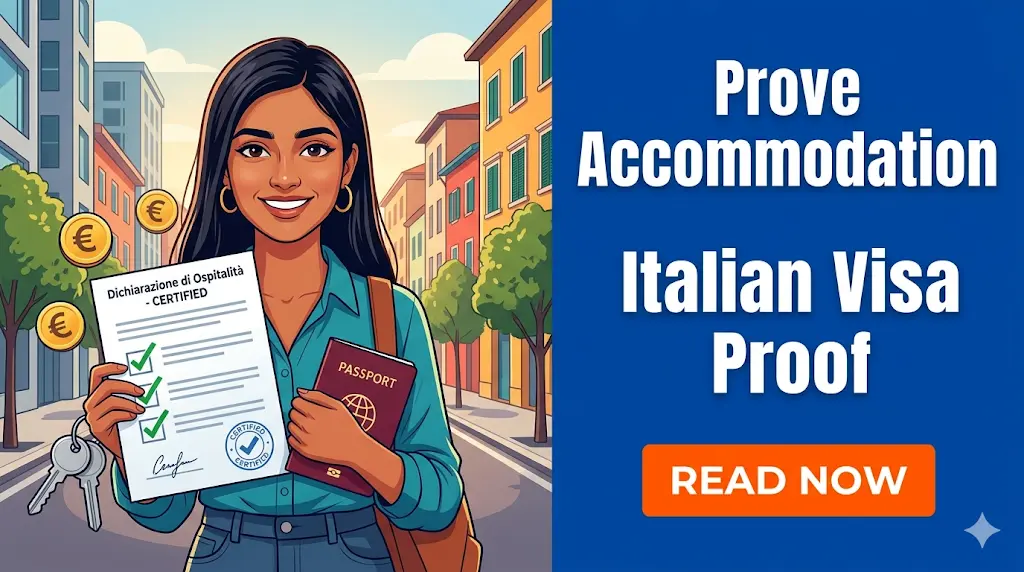
If you are fortunate enough to have a friend, family member, or business contact legally residing in Italy, they can host you. However, a casual email saying “you can sleep on my couch” will result in an immediate visa rejection. Your host must complete a highly formalized, legally binding document known as the Dichiarazione di Ospitalità (Declaration of Hospitality).
This form holds your host legally accountable for your presence in their home. The paperwork burden on your host is heavy. Along with the completed and signed declaration, they must provide the consulate with:
- A photocopy of their valid ID (or their Permesso di Soggiorno if they are a non-EU citizen living in Italy).
- A copy of their registered rental contract or the Visura Catastale (property deed) proving they actually own or rent the apartment where you will stay.
- If they are a renter, a written letter from their landlord explicitly granting permission for you to be hosted in the property.
If a single signature is missing, or the ID copy is blurry, the consulate will reject the entire visa application. If you are joining a spouse and navigating the Conditions for working while on Italy Family Reunification Visa, your partner must use this exact hospitality form to sponsor your initial housing if they are already settled in the country.
Securing a Short-Term Transitional Lease
If you are moving for the long haul—perhaps you are an entrepreneur utilizing Italy’s new digital residency pilot for expats—living in an Airbnb for a month is a costly logistical nightmare. You will need a registered address almost immediately to begin your local administrative paperwork.
The best middle ground is securing a contratto ad uso transitorio (transitional contract) through vetted mid-term housing platforms before you arrive. These specialized platforms cater to international expats and students. They allow you to book an apartment for three to twelve months using just your passport, bypassing the immediate need for a tax code. More importantly, they provide standardized booking certificates explicitly designed to be handed to a consular officer as proof of accommodation.
| Accommodation Method | Visa Acceptance Rate | Financial Risk | Best Used For |
| Hotel / Airbnb Booking | Very High | Low (if free cancellation is used) | Students, short-stay tourists, scouting trips. |
| Dichiarazione di Ospitalità | High (if paperwork is perfect) | Zero | Staying with established friends/family in Italy. |
| Mid-Term Transitional Lease | Very High | Moderate (requires upfront deposit) | Long-term expats, remote workers, retirees. |
Preparing a Bulletproof Visa Application Packet
Securing the housing document is only one piece of the puzzle. The consulate will view your accommodation proof in the context of your entire financial and legal profile. If your housing is sorted but your supporting documents are messy, your application will fail.
Organizing Your Translations and Insurance
Italian consulates are incredibly rigid regarding the language and format of your supporting documents. If you are attempting to prove your deep financial ties to your home country to satisfy the consulate’s return requirements, you might need to submit your home-country property deeds or foreign lease agreements. Handing an English or regional document to an Italian consular officer is unacceptable. You must use RushTranslate to provide a certified translation of your home-country deeds. Utilizing RushTranslate guarantees the consular officer can instantly read and verify your global assets without administrative friction.
Similarly, if your parents or a foreign employer are sponsoring your stay, their bank statements and sponsorship letters must be translated perfectly. You can rely on RushTranslate for a fast turnaround before your consulate appointment, ensuring your sponsor’s financial backing is legally legible to the Italian authorities. When you present perfectly translated financial documents via RushTranslate alongside your housing proof, you project total administrative competence.
This exact same level of preparation applies to your medical coverage. The Schengen visa code mandates emergency health insurance with a minimum coverage of €30,000 for hospitalization and repatriation. Buying a cheap, unverified travel policy is a massive risk. Using Cigna Global is highly recommended because their international policies exceed the Schengen minimums and are universally recognized by Italian consulates. Before you transition to the public healthcare system—a process outlined in the Cost of Healthcare in Italy: What Expats Need to Know—relying on Cigna Global ensures your visa application sails through underwriting without any doubts regarding your medical liabilities.
Submitting and Arriving in Italy
Once you submit your perfectly organized packet—housing proof, translated financial statements, and your Cigna Global insurance certificate—you simply wait for the visa to be affixed to your passport.
However, the housing paperwork does not disappear once you land in Rome or Milan. By law, you have exactly eight days from the moment you cross the Schengen border to apply for your Permesso di Soggiorno. You must bring the exact same proof of accommodation (your hotel booking, your transitional lease, or your Dichiarazione di Ospitalità) to the post office and eventually to the police station (Questura).
You must closely track How long after entry to apply for a residence permit in Italy because failing to file within those first eight days can jeopardize your legal standing. Once you are settled and eventually sign a permanent, long-term lease, you must legally update your address with the authorities. Navigating the steps for How to change your address with the Questura in Italy ensures your immigration file stays perfectly synced with your new, permanent apartment.
Administrative hygiene is your absolute priority from day one. You must keep your physical immigration receipts safe in your temporary housing, as facing the Consequences of losing your permesso di soggiorno card before you are even fully established is a bureaucratic nightmare. Even if you hold multiple passports and are navigating the Italian visa policy for dual nationals, having rock-solid proof of where you intend to sleep is the non-negotiable foundation of your entire Italian journey. Finally, maintaining a predictable legal status is key while you track the Timelines for picking up your permesso di soggiorno in Italy, ensuring that your transition into Italian life is dictated by your own careful planning, not by sudden housing emergencies. Keeping an eye on broader border regulations, such as the Italy’s ETIAS implementation date and what travelers need, is also essential if you plan to have non-EU family visit your new Italian home in the future.
References
Primary sources (official)
- Ministero degli Affari Esteri (Ministry of Foreign Affairs – Visa Portal): https://vistoperitalia.esteri.it/
- Polizia di Stato (Official Declaration of Hospitality Forms): https://questure.poliziadistato.it/
Other helpful sources
- Portale Immigrazione (Official Immigration Portal): https://www.portaleimmigrazione.it/
- Ministero dell’Interno (Ministry of Interior): https://www.interno.gov.it/
Disclaimer
The information provided in this article is for general informational purposes only and does not constitute official legal, immigration, or financial advice. Italian consular requirements, the mandatory formats for the Dichiarazione di Ospitalità, and Schengen visa financial minimums are highly complex and subject to frequent updates. Always verify current visa document checklists and accommodation rules directly with the specific Italian Consulate holding jurisdiction over your current place of residence before booking non-refundable international flights or signing binding housing leases.