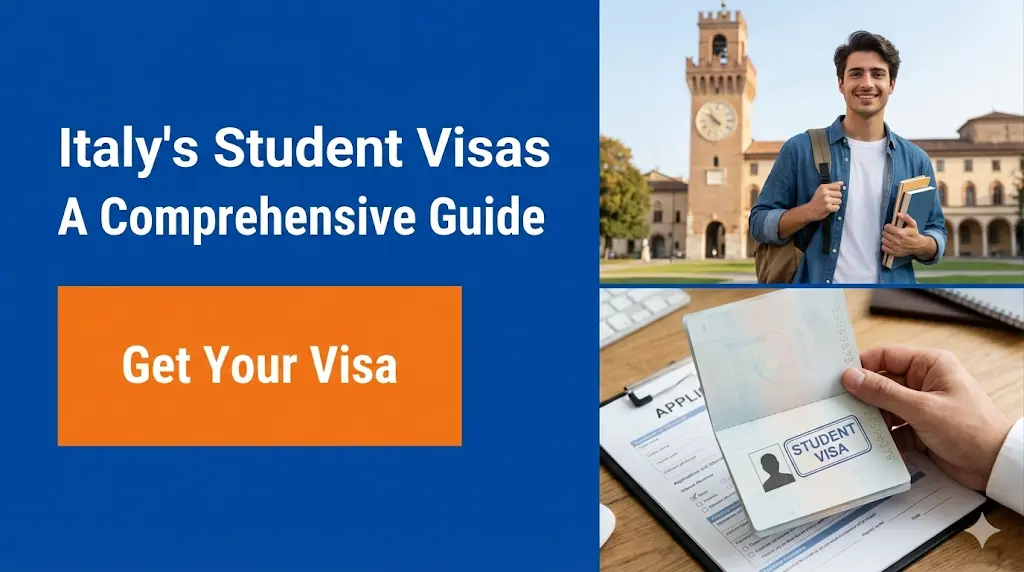
Understanding Italy’s Student Visas
This comprehensive guide navigates the complexities of obtaining an Italian student visa. From distinguishing between Short-Stay and Long-Stay visas to mastering the Universitaly portal and securing your residence permit upon arrival, learn every step required to legally pursue your education in Italy.
Disclosure: This post may contain affiliate links. We may earn a commission at no extra cost to you if you make a purchase through these links. Read full disclosure.
Introduction to Italy’s Student Visas
For many international students, studying in Italy is the ultimate academic dream. Home to the University of Bologna, the oldest university in the Western world, and a cradle of art, history, and innovation, Italy offers an educational experience that extends far beyond the classroom walls. However, before you can sip espresso between lectures in Rome or navigate the canals of Venice on your way to the library, you must clear a significant hurdle: the Italian bureaucracy.
Navigating the immigration system is often cited as the most challenging aspect of moving to Italy. The requirements can seem contradictory, the timelines tight, and the paperwork endless. Yet, thousands of non-EU students successfully make the journey every year. The key to joining them lies in thorough preparation and a clear understanding of the specific visa category that applies to your academic path.
Whether you are planning a semester exchange, a full master’s degree, or a summer language course, your legal status depends on securing the correct “Visto per Studio” (Student Visa). This guide will deconstruct the application process, clarify the financial and housing requirements, and explain what happens after you land on Italian soil.
Do You Need a Visa to Study in Italy
The first step in your journey is determining whether a visa is actually required. Italy’s immigration laws distinguish sharply between citizens of the European Union (EU) and those from non-EU countries (Third-Country Nationals).
EU and EEA Nationals
If you hold a passport from an EU member state, or from Iceland, Liechtenstein, Norway, or Switzerland, you do not need a student visa to study in Italy. You enjoy the right to freedom of movement. You can simply enter Italy with your valid passport or ID card. However, if your study program lasts longer than three months, you are required to register with the local vital records office (Anagrafe) at the town hall (Comune) where you live to obtain your official residency.
Non-EU Nationals
For citizens of countries outside the EU/EEA—such as the United States, United Kingdom, Canada, India, and China—a student visa is mandatory for most study programs.
- Programs under 90 days: Citizens of certain countries with a visa-waiver agreement (like the US or UK) may enter for short courses without a visa, depending on the specific nature of the course, but it is often safer to apply for a Schengen standard visa to ensure the purpose of the visit is recorded correctly.
- Programs over 90 days: You must apply for a National Visa (Type D) before departing your home country. You cannot enter Italy as a tourist and then switch to a student visa from within the country.
Before applying, it is helpful to look at the broader picture of Studying in Italy: A Guide for International Students to understand the academic culture you will be entering.
Types of Italian Student Visas
Italian student visas are categorized based on the duration of your intended stay. Choosing the wrong category can lead to legal complications or an inability to extend your stay later.
Schengen Student Visa (Type C)
This is a short-stay visa valid for up to 90 days.
- Best for: Short language courses, summer programs, or brief professional training workshops.
- limitations: It is strictly limited to 90 days within a 180-day period. Crucially, you cannot apply for a residence permit (Permesso di Soggiorno) with a Type C visa. Once the 90 days are up, you must leave the Schengen area. You cannot extend this visa in Italy.
National Student Visa (Type D)
This is a long-stay visa valid for stays exceeding 90 days.
- Best for: Bachelor’s degrees, Master’s degrees, PhDs, foundation years, and semester-long exchange programs (like Erasmus+ for non-EU students).
- Benefits: This visa allows you to enter Italy with the intention of staying long-term. Upon arrival, it grants you the eligibility to apply for a residence permit, which is the document that actually legalizes your extended stay.
The Pre Enrollment Phase: The Universitaly Portal
Before you can even walk into an Italian consulate, you must be accepted by an educational institution. For university students, this process is centralized through a digital platform called Universitaly.
What is Universitaly
Universitaly is the Ministry of University and Research’s official portal connecting international students, Italian universities, and Italian embassies/consulates.
The Process
- Admission: You apply directly to your chosen Italian university. Once they assess your academic background and accept you, they will direct you to Universitaly.
- Pre-enrollment Application: You create an account on Universitaly and submit a “pre-enrollment application” indicating the university and course you have been accepted to.
- Validation: The university validates your application on the portal.
- Forwarding: The validated application is automatically sent to the Italian consulate in your home country.
- Visa Summary: You can then download a summary of the pre-enrollment validation. This document is mandatory for your visa interview.
Without this digital validation, the consulate will not process a visa for university studies. Note that private language schools or non-university institutions might not use Universitaly; in those cases, you need an official letter of acceptance directly from the school, stamped and signed.
Essential Documents for the Application
Bureaucracy in Italy is famous for its documentation requirements. When you attend your visa appointment, you must have a complete dossier. Missing a single document can result in a denial or significant delays.
The Core Checklist
- Visa Application Form: Specifically for the “National Visa (D)” if studying long-term.
- Valid Passport: Must be valid for at least three months after the intended end date of your visa and have at least two blank pages.
- Passport Photos: Two recent, biometric standard photos (white background).
- Letter of Acceptance / Universitaly Summary: Proof that you are enrolled.
- Academic Qualifications: High school diploma or Bachelor’s degree, often requiring translation and an apostille or a “Declaration of Value” (Dichiarazione di Valore) issued by the consulate.
- Proof of Accommodation: Evidence of where you will live.
- Proof of Financial Means: Evidence you can support yourself.
- Health Insurance: Coverage for medical expenses.
- Flight Reservation: A one-way or round-trip ticket booking.
Proof of Accommodation
Consulates want to know you will not be homeless. You must provide one of the following:
- Tenancy Agreement: A signed lease for an apartment or room.
- University Housing Letter: Confirmation that you have a spot in a dormitory.
- Declaration of Hospitality: If staying with friends or family, they must sign a specific legal form (Dichiarazione di Ospitalità) and provide a copy of their ID.
- Hotel/Airbnb Booking: Usually accepted for the first 10-30 days, provided you show you have the funds to secure permanent housing later.
Securing housing from abroad is difficult but a prerequisite, so check our guide on Finding Rental Apartments in Italy: Websites and Tips to navigate the rental market safely.
Financial Requirements Breakdown
One of the most common reasons for visa rejection is insufficient financial means. You must prove to the Italian government that you can afford to live in Italy without becoming a burden on the state’s social welfare system.
The Minimum Threshold
For the academic year 2025-2026, the benchmark is generally tied to the annual amount of the Italian social allowance (assegno sociale).
- Monthly Requirement: Approximately €467.65.
- Annual Requirement: Roughly €6,079.45 per academic year.
Note: These figures are minimums. Consulates often prefer to see higher amounts, closer to €800 or €1,000 per month, especially in expensive cities like Milan or Rome.
Acceptable Proof
- Bank Statements: Personal bank accounts showing the required balance. The money must be liquid and accessible.
- Scholarship Letter: If you have been awarded a scholarship (like the DSU or MAECI), the official award letter stating the amount and duration serves as financial proof.
- Parental Support: If your parents are funding you, they must provide a notarized “Affidavit of Support” confirming they will cover your expenses, accompanied by their own bank statements and employment letters.
You need to prove you can afford the Cost of Living in Italy 2026: Budgeting for Expats, so having a realistic budget beyond the visa minimum is essential for your own survival.
Health Insurance Requirements
Italy has a national healthcare system (SSN), but you cannot access it fully until you have arrived and obtained your residence permit. Therefore, for the visa application, you need private coverage.
Options for the Visa
- Private Health Insurance: A policy from your home country valid in the Schengen area, covering emergency medical treatment and hospitalization with a minimum coverage of €30,000.
- INA Assitalia: Many students purchase a specific “student” policy from the Italian insurer INA Assitalia. It is affordable (roughly €120/year) and specifically designed to meet visa/permit requirements, covering urgent care.
Once you arrive, you can choose to voluntarily register with the Italian National Health Service (SSN) for a fee (approx. €149/year for students, though subject to change in 2026), which grants you access to a family doctor.
The Application Appointment
You cannot apply online; you must appear in person.
Where to Apply
Applications are handled by the Italian Embassy or Consulate in your jurisdiction. In many countries (like the US, UK, and India), the consulates outsource the initial document intake to visa processing centers like VFS Global or TLScontact.
Timing
- Earliest: You can apply up to 180 days before your course starts.
- Latest: It is risky to apply less than 45 days before departure. Summer months (July/August) are peak season, and processing times can skyrocket.
The Interview
Consular officers may interview you to assess your language skills and genuine intent. If your program is in English, you may be interviewed in English. If in Italian, you should demonstrate at least B2 proficiency. They may ask why you chose this specific university and how it benefits your career. Choosing the right school matters; see Top Italian Universities for Foreign Students to articulate your choice clearly.
Arrival in Italy: The 8-Day Rule
Congratulations, your visa is approved! But the paperwork isn’t over. The visa gets you into Italy, but the Permesso di Soggiorno (Residence Permit) allows you to stay.
Applying for the Permesso
By law, non-EU citizens arriving on a Type D visa must apply for a residence permit within 8 working days of arrival.
- Post Office: Go to a Poste Italiane office with a “Sportello Amico” counter.
- The Kit: Pick up a “Kit Giallo” (Yellow Kit). Fill out the forms.
- Submission: Submit the kit along with photocopies of your passport, visa, and insurance. Pay the administrative fees (approx. €100-€150 total).
- Receipt: You will get a receipt (ricevuta). Do not lose this. It proves you are in Italy legally while you wait for the card.
Working While Studying
Many students need to work to support their lifestyle. The good news is that Italy allows this, with restrictions.
Legal Limits
- Hours: You can work up to 20 hours per week (part-time).
- Annual Limit: You cannot exceed 1,040 hours per year.
- Type of Work: You can work as an employee (lavoro subordinato). Freelancing is a grey area for students and often requires converting to a self-employment permit, which is difficult.
Income from part-time work is taxable, but often falls below the threshold for high taxes.
Comparison: Student Visa vs. Tourist Visa
| Feature | Tourist Visa (Type C) | Student Visa (Type D) |
| Duration | Max 90 days | > 90 days (Usually 1 year) |
| Work Rights | None (Illegal to work) | Part-time (20 hours/week) |
| Residence Permit | Cannot apply | Mandatory to apply |
| Renewal | Cannot renew in country | Renewable annually in Italy |
| Healthcare | Travel insurance only | Can access National System (SSN) |
| Bank Account | Non-resident account only | Resident account possible |
Converting to a Work Permit
One of the biggest advantages of graduating from an Italian university is the simplified path to remaining in Italy.
Permesso di Attesa Occupazione
If your student visa expires but you haven’t found a job yet, you can apply for a “Permit Pending Employment” (Permesso di Attesa Occupazione). This is valid for one year and allows you to look for work legally.
Converting to Work Permit
Once you find a job offer related to your degree, you can convert your student permit into a work permit (Permesso per Lavoro Subordinato). Crucially, graduates of Italian universities are often exempt from the strict Decreto Flussi quotas that limit foreign workers, making you highly hireable compared to applicants from abroad.
Common Reasons for Rejection
- Financial Insufficiency: Bank statements show irregular deposits or insufficient funds.
- Accommodation Issues: The hotel booking is too short, or the host didn’t provide a copy of their ID.
- Academic History: A large gap in education without explanation, or poor grades in previous studies.
- Language: Inability to speak the language of instruction (English or Italian) during the interview.
Conclusion
Obtaining an Italian student visa is a rite of passage that tests your patience and organization. It acts as a filter, ensuring that those who arrive are committed, prepared, and self-sufficient. While the checklist of documents—from the Universitaly summary to the bank statements—may seem daunting, breaking it down step-by-step makes it manageable.
Remember, thousands of students navigate this process every semester. The reward at the end is an education in one of the most culturally rich nations on earth, and potentially, the first step toward a long-term career in Europe. Start early, double-check your documents, and prepare for the adventure of a lifetime.
References
Primary sources (official)
- Ministry of Foreign Affairs and International Cooperation (Visto per Italia): https://vistoperitalia.esteri.it/home/en
- Universitaly Portal: https://www.universitaly.it/
Other helpful sources
- Study in Italy (Official Government Guide): https://studyinitaly.esteri.it/
Disclaimer
The information provided in this article is for educational and informational purposes only and does not constitute official legal or immigration advice. Visa fees, financial thresholds, and application procedures are subject to change by the Italian government and individual consulates. Always verify the latest requirements with the Italian Embassy in your jurisdiction before submitting your application.