Steps to apply for an Italy student visa from the USA
Planning to study abroad in Italy? This comprehensive guide outlines the exact steps US students must take to secure an Italian student visa. Learn about financial requirements, the Universitaly portal, consular appointments, required documents, and residency rules.
Disclosure: This post may contain affiliate links. We may earn a commission at no extra cost to you if you make a purchase through these links. Read full disclosure.
Introduction to applying for an Italy student visa from the USA
Moving to Europe for a semester, a full academic year, or an entire degree program requires meticulous planning and strict adherence to international immigration laws. As a United States citizen, your powerful passport grants you excellent travel privileges, allowing you to enter the Schengen Area for up to 90 days for tourism or short-term business without a visa. But if your intention is to study, and your academic program exceeds that 90-day limit, you are legally required to obtain an Italian student visa before you board your flight.
The application process is a multi-step journey that involves securing admission to an Italian institution, registering through national government portals, gathering a mountain of authenticated paperwork, and successfully passing an in-person interview at your designated Italian consulate. The bureaucracy operates strictly by the book, meaning a single missing document, a lack of sufficient financial proof, or a misunderstood jurisdictional rule can result in a delayed or denied application.
This extensive guide is designed specifically for US citizens and residents planning to study in Italy. We will walk you through every single phase of the student visa application process. From decoding the Universitaly portal and securing the right health insurance to understanding exactly how much money you need in your bank account, you will learn how to build a flawless visa dossier. By the end of this article, you will have a clear, actionable roadmap that will take you from your initial university acceptance letter all the way to securing your physical residence permit once you arrive in Italy.

Understanding the Types of Italian Student Visas
Before you begin gathering your documents, it is crucial to understand exactly which type of visa you need. The Italian government issues different visas based on the duration and nature of your academic program.
For students coming from the United States, there are two primary categories to be aware of:
- Short-Stay Visa Type C: This visa is for programs lasting less than 90 days, such as a brief summer language course or a short-term cultural exchange. Because US citizens enjoy visa-free entry to the Schengen Area for up to 90 days, you generally do not need to apply for a Type C visa to attend a short summer program. Your US passport is sufficient for entry and study within that timeframe.
- National Long-Stay Visa Type D: If your academic program lasts for 91 days or more—which includes traditional fall or spring semesters, full degree programs, and long-term language courses—you absolutely must apply for a National Type D student visa. This is the visa category that allows you to legally reside in Italy for the duration of your studies, and it is the primary focus of this guide.
Applying for the correct visa category is the foundation of your journey. If you need a broader overview of the various educational categories and how they fit into the national immigration framework, be sure to read our foundational guide on Understanding Italy’s Student Visas.
Step One Securing University Admission and Universitaly Registration
You cannot apply for a student visa simply because you want to study in Italy; you must first be officially accepted into a recognized educational program. The first step is applying to and receiving an official acceptance letter from an accredited Italian university, academy, or language school.
The Universitaly Portal
If you are enrolling in a degree program (Bachelor’s, Master’s, or Single-Cycle degree) at an Italian public or private university, receiving an acceptance letter directly from the school is no longer enough. The Italian Ministry of University and Research mandates that all international students pre-enroll through a centralized digital platform known as the Universitaly portal.
You must create an account on the Universitaly website and fill out a comprehensive pre-enrollment application. During this process, you will be asked to input your personal details, upload a copy of your valid US passport, and provide your academic transcripts or previous diplomas. You will also select the specific Italian consulate in the US where you intend to apply for your visa.
Once you submit your application on the portal, it is sent electronically to your chosen Italian university for review. The university will verify your qualifications and formally validate your pre-enrollment. Once validated, the portal generates a “Summary of Pre-Enrollment” document. You must download and print this summary, as it is a mandatory document that the consular officer will request during your visa interview.
Note: If you are an American student participating in a traditional Study Abroad program organized by your US home university (where you pay tuition to your US school), the Universitaly process may not apply to you. Always verify the exact pre-enrollment requirements with your US study abroad advisor.
Step Two Identifying Your Consular Jurisdiction
One of the most rigid rules of the Italian diplomatic network is the concept of consular territorial jurisdiction. You cannot simply book an appointment at whichever Italian consulate has the earliest availability. You must apply at the specific consulate that has legal jurisdiction over your permanent place of residence.
Italy maintains a robust diplomatic presence in the United States, including the Embassy in Washington D.C., and Consulates General in major cities such as New York, Boston, Miami, Chicago, Houston, Los Angeles, San Francisco, Philadelphia, and Detroit.
Each of these consulates covers a specific group of states. For example, if your permanent address is in Texas, you must apply at the consulate in Houston. If you live in New York or New Jersey, you fall under the jurisdiction of the New York consulate.
As a college student, you generally have a choice between two jurisdictions:
- The consulate that covers your permanent home address (where your parents live and where your driver’s license is issued).
- The consulate that covers the location of your current US university, provided you can show proof of residency there (such as a local utility bill or a signed lease agreement).
Before you proceed, visit the official website of the Italian Embassy in Washington D.C. to consult the consular network map and confirm exactly which office handles your state.
Step Three Booking Your Consular Appointment
Once you have identified your correct consulate, you must secure an appointment. This step is notoriously difficult, as the demand for student visas in the summer and winter months heavily outweighs the availability of consular officers.
Almost all Italian consulates in the United States handle visa scheduling through a centralized online booking system called Prenot@mi.
You must create a personal account on the Prenot@mi portal, select your designated consulate, and navigate to the “Study Visa” booking section. The calendar will display available dates. Be warned: during peak seasons (May through August for fall departures), appointments can be booked out for months. It is highly recommended that you begin searching for an appointment at least three to four months before your program begins.
If you log in and see no available appointments, do not panic. Consulates frequently release new appointment slots or open up cancellations. You will need to check the portal daily, often at specific times (many consulates release new slots at midnight Rome time), to secure a booking. For a deep dive into the strategies necessary to conquer this system, read our comprehensive post on Booking Your Italian Visa Appointment: Tips and Tricks.
Step Four Gathering the Required Visa Documents
The success of your visa application hinges entirely on the quality and completeness of your documentation. Consular officers are trained to reject incomplete applications on the spot. All documents must be presented in the original format along with a clear photocopy.
While specific requirements can vary slightly depending on your jurisdiction, the standard dossier for a US applicant includes the following essential items:
1. A Valid Passport
Your passport must be valid for at least three to six months beyond the intended end date of your study program. It must also contain at least two completely blank pages to accommodate the visa sticker and subsequent border entry stamps.
2. National Visa Application Form
You must download the Long-Stay (Type D) National Visa application form from your specific consulate’s website. The form must be filled out completely and signed by you. Ensure that the dates of entry and exit match your academic program dates exactly.
3. Passport Sized Photographs
You will need to provide one or two recent, passport-style photographs. These must meet strict European standards: they must be taken against a stark white background, printed on high-quality photo paper, and show your full face without sunglasses or head coverings (unless worn for religious reasons).
4. Proof of Academic Enrollment
If you are an independent degree-seeking student, you must provide the Universitaly Pre-Enrollment Summary and your official university acceptance letter. If you are a study abroad student, you must provide an official letter of participation from your US university and an official letter of acceptance from the host institution in Italy.
5. Proof of Accommodation
The Italian government requires proof that you will not be homeless upon arrival. You must provide concrete evidence of suitable lodging for the duration of your stay. Acceptable forms of proof include:
- A confirmed housing contract from your Italian university’s dormitories.
- A registered residential lease agreement signed by you and your Italian landlord.
- A formal “Declaration of Hospitality” (Dichiarazione di Ospitalità) if you will be living with a friend or family member in Italy, accompanied by a copy of their Italian ID or residence permit.
6. Travel and Medical Insurance
You must prove that you are covered for medical emergencies while in Italy. Your insurance policy must clearly state that it covers medical expenses, emergency hospital treatments, and medical repatriation back to the United States. The minimum coverage amount required is €30,000.
Most domestic US health insurance plans (like Blue Cross or Aetna) do not meet these stringent international standards. You will likely need to purchase a dedicated Schengen-compliant travel medical insurance policy for the duration of your visa. You must bring the official declaration or policy letter from the insurance provider to your appointment.
7. Flight Itinerary
You must provide a round-trip flight reservation showing your entry into Italy and your return to the US at the end of your program. Consulates strongly advise against purchasing fully non-refundable tickets before the visa is officially granted. A flight reservation or an itinerary from a travel agent is usually sufficient.
Step Five Proving Your Financial Independence
One of the most heavily scrutinized sections of your application is the proof of financial means. The Italian authorities must be absolutely certain that you can support yourself without relying on the Italian welfare system or seeking illegal employment.
The Minimum Financial Threshold
For 2026, the baseline financial requirement is officially set at approximately €460.28 for each month of your intended stay in Italy. For a standard academic year (12 months), this equates to a minimum of €5,523.36.
However, it is vital to treat this number as an absolute bare minimum. Given the rising cost of living in major Italian cities, many consulates prefer to see significantly more funds in your accounts to ensure your stability. Aiming to show at least $8,000 to $10,000 USD for a full academic year is a much safer strategy that demonstrates strong financial health.
Acceptable Proofs of Income
You can prove your financial self-sufficiency using one or a combination of the following methods:
- Personal Bank Statements: You can submit your own personal US bank statements from the last three to six months. The statements must clearly show your name, the bank’s logo, and a consistent, healthy balance. Sudden, unexplained large deposits right before the appointment are viewed with suspicion and may be rejected.
- Financial Sponsorship by Parents: If your parents are funding your education, you must submit their bank statements (from the last three to six months). Additionally, they must sign a formal, notarized “Affidavit of Financial Support” declaring their commitment to cover your expenses. You will also need to bring your original birth certificate to prove your relationship to your parents.
- Financial Aid and Scholarships: If you receive federal financial aid (FAFSA), grants, or university scholarships, you must provide the official award letters detailing the exact monetary amount disbursed to you for the semester or year.
- Student Loans: Sanction letters from accredited financial institutions approving a specific educational loan amount are also widely accepted as proof of funds.
Table Required Documents Checklist for US Students
To help you organize your dossier, use this quick-reference checklist before attending your consular appointment.
| Document Category | Specific Requirements for US Applicants |
| Identification | US Passport (valid 3+ months post-departure) and photocopies. |
| Application Forms | Type D National Visa Form, completed and signed. |
| Photographs | 1-2 recent, Schengen-standard passport photos. |
| Academic Proof | Acceptance letter & Universitaly Pre-Enrollment Summary. |
| Housing Proof | Dorm confirmation, registered lease, or Host Declaration. |
| Financial Proof | 3-6 months bank statements ($8k-$10k buffer recommended), Affidavits, or Loan/Scholarship letters. |
| Health Insurance | Policy covering medical and repatriation (min. €30,000). |
| Travel Itinerary | Round-trip flight reservation. |
| Consular Fee | Exact payment (check your consulate for money order/cash rules). |
Step Six Attending the Consular Interview
On the day of your appointment, arrive at the consulate at least 15 minutes early. Dress neatly and respectfully, as you are attending an official government interview.
You will present your neatly organized stack of original documents and photocopies to the consular officer. The officer will review your paperwork to ensure nothing is missing and that your financial proofs are satisfactory. They may ask you a few basic questions regarding your motivations for studying in Italy, your chosen university, and your plans upon graduation. Be honest, direct, and polite.
During the appointment, you will pay the student visa processing fee, which is currently set at €50 (though it fluctuates slightly in USD based on current exchange rates). Ensure you check your specific consulate’s website beforehand, as some only accept USPS money orders, while others may accept cash or cashier’s checks.
Finally, under updated regulations designed to enhance border security, you will likely be required to submit biometric data. The officer will take a digital scan of your fingerprints and a digital photograph. Once the interview is complete, the consulate will retain your physical passport to affix the visa sticker. Processing times generally range from two to four weeks, after which your passport will be mailed back to you or made available for pickup.
Step Seven Arriving in Italy and Securing Residency
Congratulations, your visa is approved and you have landed in Italy! However, your bureaucratic journey is not quite over.
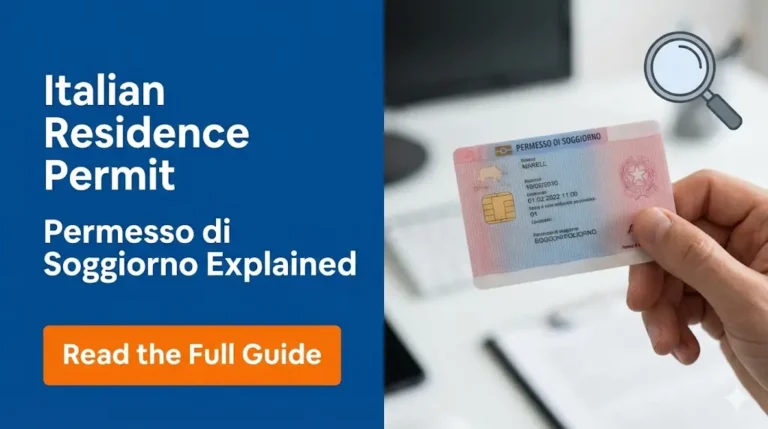
The student visa stamped in your passport is essentially just an entry ticket allowing you to cross the Italian border. To legally reside in the country long-term, Italian immigration law strictly mandates that you must apply for a Permesso di Soggiorno (Residence Permit) within exactly eight working days of your arrival.
To initiate this process, you must go to a local Poste Italiane (Italian Post Office) that features a “Sportello Amico” counter and request a free “Kit Giallo” (Yellow Kit). Inside, you will find Form 1, which you must fill out with your personal details. You will enclose photocopies of the exact same documents you submitted to the consulate (your visa, passport, acceptance letter, insurance, and bank statements).
You will submit the unsealed envelope at the post office and pay the associated administrative and electronic card fees, which generally total around €116.46 (including a €16 tax stamp, €30 postal fee, and €70.46 for the issuance of the permit). The postal worker will hand you a receipt (ricevuta) and an appointment date to visit the local Police Headquarters (Questura) for fingerprinting. This postal receipt is your most important document until your physical plastic residence card is issued; carry it with you at all times. For a step-by-step breakdown of how this crucial domestic process works, read our extensive guide on the Italian Residence Permit (Permesso di Soggiorno) Explained.
Working in Italy as an American Student
Many American students wonder if they can offset the costs of their semester abroad by getting a part-time job. The good news is that Italian law is highly accommodating to international students who wish to work.
Once you hold your valid Permesso di Soggiorno (or the postal receipt proving you applied for it), you are legally permitted to engage in subordinate part-time work. The strict legal limit is a maximum of 20 hours per week, and no more than 1,040 hours over the course of a 52-week calendar year.
Because you are entering the workforce, you will also need to obtain a Codice Fiscale (Italian Tax Code), which acts similarly to a US Social Security Number, allowing your employer to pay you and deduct taxes. There are excellent opportunities for native English speakers, particularly in tutoring, tourism, and university campus roles. To explore how to navigate the local job market, look into our resources on Finding Part-Time Jobs for International Students in Italy.
Conclusion
Securing an Italy student visa from the USA is an exercise in organization, patience, and attention to detail. By taking the time to understand the nuances of the Universitaly portal, strictly adhering to the financial threshold guidelines, and booking your consular appointment well in advance, you can completely eliminate the anxiety often associated with European bureaucracy.
Gathering your authenticated documents and purchasing the correct Schengen-compliant health insurance are small hurdles compared to the incredible academic and cultural rewards that await you. Treat the visa process as your very first assignment in your international education. With your paperwork perfectly aligned and your residence permit secured upon arrival, you will be entirely free to embrace the magnificent history, vibrant lifestyle, and academic excellence of studying in Italy.
References
Primary sources official
- Universitaly Portal – The 10-steps-path to Study in Italy: https://www.universitaly.it/first-steps
- US Department of State – Student Visas: https://travel.state.gov/content/travel/en/us-visas/study/student-visa.html
Other helpful sources
- CitizenRemote – Italy Student Visa Guide 2025 | Requirements, Application & Costs: https://citizenremote.com/visas/italy-student-visa/
- Golden Future – What are the financial requirements for an Italian student visa?: https://www.goldenfuture.education/article/financial-requirements-for-an-italian-student-visa
Disclaimer
The information provided in this article is for educational and informational purposes only and does not constitute official legal, financial, or immigration advice. Italian immigration laws, visa application fees, and financial requirements are highly complex and subject to frequent changes by the Italian Ministry of Foreign Affairs. Consular procedures can also vary significantly by jurisdiction. Always consult the official website of the Italian embassy or your designated regional consulate for the most current, personalized guidance regarding your specific visa application and study abroad plans.