Transferring University Credits to an Italian University
Trying to convince an Italian university that your foreign credits are valid often feels like pleading with a brick wall. I spent six agonizing months fighting to get my American literature courses recognized in Rome just so I wouldn’t have to repeat a year. This guide explains exactly how to navigate the bureaucratic maze of transferring your university credits to Italy.
Disclosure: This post may contain affiliate links. We may earn a commission at no extra cost to you if you make a purchase through these links. Read full disclosure.
Understanding the Italian University Credit System
The CFU versus US Credits and ECTS
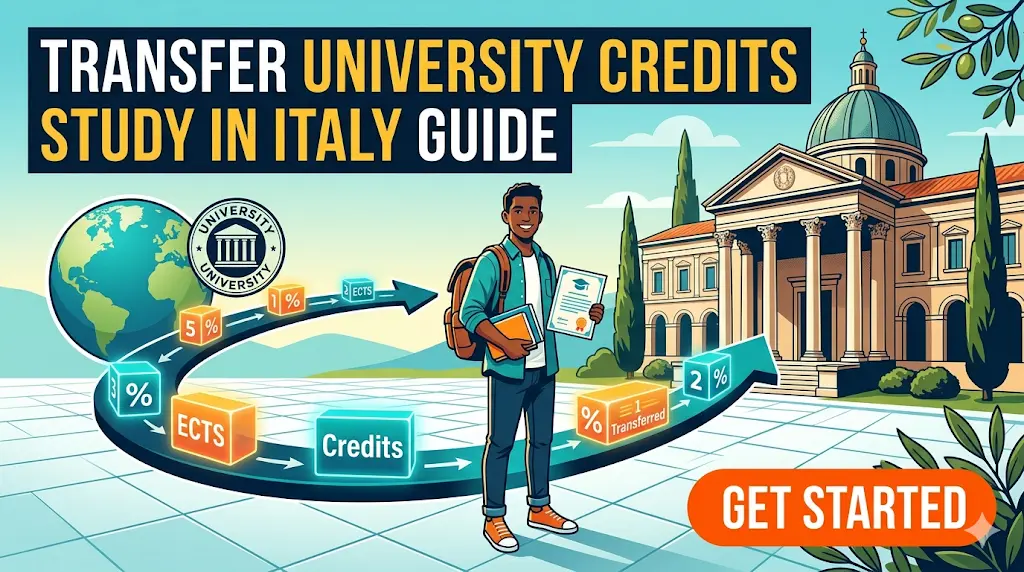
Before you can transfer your past academic achievements into the Italian system, you must fundamentally understand how Italy measures academic progress. In Italy, university coursework is quantified using the Credito Formativo Universitario, universally abbreviated as the CFU. By legal definition, one single CFU corresponds to exactly 25 hours of total student workload. This 25-hour block includes the time spent sitting in the physical lecture hall, participating in mandatory seminars, and the estimated hours of independent study required to pass the final exam at home.
A standard academic year in Italy consists of 60 CFUs, meaning a full three-year bachelor’s degree (Laurea Triennale) requires 180 CFUs, and a two-year master’s degree (Laurea Magistrale) requires 120 CFUs. If you are transferring from another European Union country, this system will look very familiar, as the CFU is perfectly identical and entirely interchangeable with the ECTS (European Credit Transfer and Accumulation System).
However, if you are arriving from the United States, the United Kingdom, or Australia, this mathematical conversion becomes a major headache. An American university credit is typically based heavily on “contact hours” (time in class) rather than total independent study time. While some Italian universities apply a blanket formula—such as multiplying American credit hours by two to find the CFU equivalent—the reality is much more subjective. Your 3-credit US history class might be deemed worth 6 CFUs by one Italian university and only 4 CFUs by another.
Why Syllabus Matching is the Hardest Part
The greatest culture shock expats face during the credit transfer process (Riconoscimento dei Crediti) is discovering that Italian universities do not care what your previous course was titled; they only care about exactly what authors you read and what specific topics you covered. The Italian academic system is highly theoretical and rigidly structured. If an Italian bachelor’s degree requires a foundational course in “Private Law” to cover specific historical codes, a generic “Intro to Law” class taken abroad will likely be rejected if the syllabus does not align perfectly.
Because the evaluation is so heavily dependent on the exact curriculum, you must provide a highly detailed syllabus for every single course you wish to transfer. A short paragraph from your old university’s course catalog will not suffice. The evaluation committee wants to see the weekly breakdown of lectures, the required reading list, and the grading methodology.
You will be required to provide these syllabi translated into Italian. Translating complex academic concepts into the local language is incredibly difficult. Utilizing ItalianPod101 to study advanced academic vocabulary and subject-specific terminology can be a massive help. By learning how to articulate theoretical concepts in Italian, you can ensure your translated syllabi accurately reflect the depth and rigor of the coursework you completed back home, giving you the best possible chance of approval.
The Administrative Process of Transferring Credits
Gathering Your Original Transcripts and Course Descriptions
The first physical step in this exhausting journey is securing the correct documentation from your home university before you even pack your bags for Italy. You must order official, sealed copies of your academic transcripts. Digital PDFs, even if they are digitally secured by your home university, are frequently rejected by traditional Italian administrative offices, which still heavily favor paper documents with raised physical seals and wet-ink signatures.
Alongside the transcripts, you must request the official, long-form course descriptions (the syllabi) from the exact year you took the classes. Universities update their curricula constantly, and submitting a 2024 syllabus for a class you took in 2021 will cause the Italian evaluation committee to reject the document. If your home university does not issue official syllabus packets, you must ask the department head to sign and stamp a letter verifying the curriculum you studied.
Once you have these original documents, they must undergo official translation. In most cases, Italian universities require a “sworn translation” (traduzione giurata) performed by a translator registered with an Italian court. You cannot simply translate the documents yourself. Ensuring your initial paperwork is flawless is just as critical as your immigration paperwork; review the Student transcript requirements for Italy student visa to see how these academic documents overlap with your initial entry requirements.
The Dichiarazione di Valore and Legalization
An Italian university cannot legally accept a foreign transcript at face value. The Italian state must first verify that your home university is a legitimate, accredited institution and that your grades are authentic. Historically, this was done exclusively through a document called the Dichiarazione di Valore (DoV), or Declaration of Value. The DoV is issued by the Italian consulate in the country where you completed your studies. Securing a DoV is notoriously slow, often requiring you to secure Apostilles for all your transcripts before the consulate will even look at them.
Fortunately, modern Italian universities increasingly accept the CIMEA Statement of Comparability as an alternative to the DoV. CIMEA (the Information Centre on Academic Mobility and Equivalence) is an official Italian agency that evaluates foreign qualifications entirely online. While the CIMEA statement costs a few hundred euros, it is generally processed much faster than a consular DoV and spares you the nightmare of dealing with international mail and Apostille stamps.
Navigating the CIMEA portal or communicating with consular officials regarding your academic records requires patience and specific administrative phrasing. I highly recommend spending time on ItalianPod101 to practice formal bureaucratic dialogues. Learning how to politely ask for updates on your file or clarify a missing document in formal Italian can prevent your application from languishing at the bottom of a clerk’s inbox. For a broader view of the documents needed before departure, review our Checklist: All You Need Before Moving to Italy.
Submitting to the Segreteria Studenti
Once your transcripts, syllabi, translations, and DoV/CIMEA statements are in hand, you must submit the massive dossier to the Segreteria Studenti (Student Secretariat) of your chosen Italian university. The Segreteria is the gatekeeper of the university. They do not evaluate the academic merit of your credits; they merely check that every single photocopy, stamp, and signature is present according to their rigid internal rules.
Dealing with the Segreteria is a rite of passage for every student in Italy. The offices are often open only a few hours a day, the lines are long, and the clerks are famously strict. If you are missing one photocopy of your passport, you will be sent to the back of the line. The clerks rarely speak English, which makes the submission process incredibly intimidating for new international students.
This is another scenario where language preparation is your greatest asset. Practicing administrative interactions with ItalianPod101 will give you the confidence to approach the desk, hand over your dossier, and understand the clerk’s instructions without panicking. Often, you will be navigating this submission process at the exact same time you are dealing with local police immigration tasks. Understanding the Timelines for picking up your permesso di soggiorno in Italy is vital, as the university will likely demand to see your physical residency card before officially enrolling you and processing your credit transfer.
Surviving the Departmental Evaluation
The Role of the Consiglio di Corso di Laurea
After you successfully bypass the Segreteria, your dossier is forwarded to the Consiglio di Corso di Laurea (the Degree Course Council). This is a committee made up of the actual professors who teach in your specific department. They are the ones who ultimately decide whether your foreign credits will be recognized. They sit down with your translated syllabi and compare them, line by line, to the syllabi of the classes currently taught in their Italian department.
This evaluation process is not fast. The council typically meets only once a month, and evaluating foreign transcripts is a low priority compared to their teaching and research duties. You can expect to wait anywhere from two to six months for a final decision. In many cases, you will have to officially enroll in the university and begin attending classes before you even know which of your past credits have been accepted.
The stress of this uncertainty can be immense, especially when you are trying to adapt to a new country, a new language, and a new academic culture simultaneously. It is crucial to maintain your physical and mental well-being during this transition period. Familiarizing yourself with local support systems by reading Healthcare in Italy: An Expats’ Guide and understanding the basics of Getting Health Insurance in Italy: Public and Private Options will ensure you stay healthy while fighting these bureaucratic battles.
Dealing with Partial Credit Approvals and Integration Exams
When the Consiglio finally releases their deliberation (delibera), you must prepare yourself for the reality that Italian universities rarely grant 100% full credit transfers. The most common outcome is a partial approval that requires an integrazione (an integration exam).
For example, you might have taken a comprehensive “Macroeconomics” class back home. The Italian council might decide that your foreign class perfectly covered the first 6 CFUs of their local 9-CFU “Economia Politica” course, but that your old class lacked specific European monetary policy topics. To get the full 9 CFUs recognized on your Italian transcript, you do not have to retake the entire class, but you must pass an integrazione for the missing 3 CFUs.
This means you must contact the specific Italian professor who teaches the course and ask them what additional material you need to study. They will typically assign you two or three extra chapters from their textbook. You will then sit for a brief oral exam specifically on those chapters. Emailing a university professor to ask for an integration syllabus requires a very specific, highly formal tone. Using the email templates and formal writing guides provided by ItalianPod101 will help you draft a respectful message that adheres to strict Italian academic etiquette, ensuring the professor is receptive to your request. If you happen to fall ill on the day of your integration exam, you will need a formal medical excuse; our guide on Registering with an Italian Family Doctor (Medico di Base) explains how to secure these mandatory certificates.
Appealing the Decision
Occasionally, the Consiglio will completely reject a course that you feel is genuinely equivalent to an Italian requirement. You do have the right to appeal this decision, but you must do so with extreme delicacy. In the Italian academic hierarchy, professors hold immense authority, and an aggressive, demanding approach will immediately backfire.
To appeal, you should request an office hours appointment (ricevimento) with the president of the degree course or the specific professor whose class you are trying to bypass. You must bring your detailed original syllabus, the textbook you used, and any major essays you wrote. Your goal is to respectfully demonstrate that the academic rigor of your past coursework matches their standards.
This negotiation is a masterclass in Italian cultural diplomacy. You must use formal titles (Chiarissimo Professore), speak exclusively in the formal “Lei,” and utilize the conditional tense to soften your requests. Immersing yourself in the advanced conversational modules on ItalianPod101 will teach you the nuances of this formal register. By demonstrating respect for their academic authority in flawless, polite Italian, you drastically increase the chances that the professor will reconsider their evaluation and grant your hard-earned credits.
| Home Country Credit Scenario | Italian CFU Equivalent (Estimate) | Typical Evaluation Outcome | Next Steps |
| 3 US Credits (Highly similar syllabus) | 5 – 6 CFUs | Full Recognition (Riconoscimento Totale) | Credits added directly to transcript |
| 4 US Credits (Broad, generic syllabus) | 4 – 6 CFUs | Partial Recognition + Integrazione | Must take an oral exam on missing topics |
| 3 UK Credits (Unrelated elective) | 0 CFUs | Denied (Non Riconosciuto) | Must take the full Italian course |
| ECTS Credits (from EU University) | 1:1 CFU Ratio | Fast-track Recognition | Minimal paperwork, swift approval |
Should you run into severe administrative delays that threaten your legal status—for instance, if the university refuses to finalize your enrollment without the credit evaluation—you must prioritize your residency over your academic arguments. Always remember that the Consequences of losing your permesso di soggiorno card or letting it expire are far more severe than having to retake a single elective class. Understand the administrative triage and protect your right to remain in the country first, relying on guides like Differences between Public and Private Healthcare in Italy to ensure your student insurance complies with local laws while you sort out the academic details.
References
Primary sources (official)
- CIMEA (Information Centre on Academic Mobility and Equivalence) – https://www.cimea.it/EN/
- Ministero dell’Università e della Ricerca (MUR) – https://www.mur.gov.it/it
- Universitaly Portal – https://www.universitaly.it/
Other helpful sources
- Italian Ministry of Foreign Affairs (Visa and Consular Services) – https://vistoperitalia.esteri.it/
Disclaimer
The information provided in this article is for educational and informational purposes only and does not constitute official legal, immigration, or academic advice. University regulations regarding the transfer of foreign academic credits (CFU), the requirements for the Dichiarazione di Valore, and the policies of individual Segreterie Studenti are highly localized and subject to frequent changes. Always consult directly with the international student office of your chosen Italian university and the official Italian consulate in your home country before making any academic or relocation decisions.