Schengen visa vs Italian national visa: which to get?
Deciding between a Schengen visa and an Italian National visa depends entirely on your travel goals and duration of stay. This comprehensive guide explains the differences, validity periods, permitted activities, and application processes to help you choose the right pathway.
Disclosure: This post may contain affiliate links. We may earn a commission at no extra cost to you if you make a purchase through these links. Read full disclosure.
Introduction to Schengen visa vs Italian national visa
To the uninitiated, the terminology surrounding European visas can seem like a confusing alphabet soup. You might hear terms like “Schengen area,” “Type C,” “Type D,” and “Permesso di Soggiorno” thrown around interchangeably on expatriate forums, but legally, they represent entirely different immigration statuses. Applying for the wrong type of visa will not only result in an immediate rejection and lost application fees, but it could also severely disrupt your travel, study, or employment plans.
Understanding the fundamental distinctions between a Schengen visa and an Italian National visa is the bedrock of a successful relocation or holiday. The difference is not merely a matter of how many days you are allowed to stay; it dictates what you are legally permitted to do while you are in Italy, your rights to travel across other European borders, and the administrative burdens you will face upon arrival.
In this exhaustive guide, we will break down the precise parameters of both the Schengen (Type C) visa and the Italian National (Type D) visa. We will explore the famously rigid ninety-day rule, detail the specific scenarios that require a long-term permit, and provide a clear, side-by-side comparison to help you definitively answer the question: which visa do you actually need to achieve your Italian dream?
Understanding the Schengen Area Context
Before diving into the specific visa types, it is essential to understand the geopolitical concept of the Schengen Area, as it forms the foundation of European travel law. The Schengen Area is a zone composed of 29 European countries that have officially abolished all passports and other types of border control at their mutual borders. This includes 25 European Union member states and 4 non-EU countries (Iceland, Norway, Switzerland, and Liechtenstein).
The primary goal of the Schengen Agreement is to function as a single jurisdiction for international travel purposes, governed by a common visa policy. This means that once you legally enter one Schengen country, you are generally free to travel to any other participating country without undergoing further border checks. Italy is a founding member of the Schengen Agreement, meaning its immigration laws are deeply intertwined with this overarching European framework. This context is vital because the type of visa you hold dictates how you interact not just with Italian border control, but with the entire European continent.
Deep Dive into the Schengen Visa (Type C)
The Schengen Visa, officially designated as the Type C visa, is the standard short-stay travel authorization for Europe. If your intention is simply to visit Italy for a brief period and then return to your home country, this is almost certainly the visa you will need.
The 90/180-Day Rule Explained
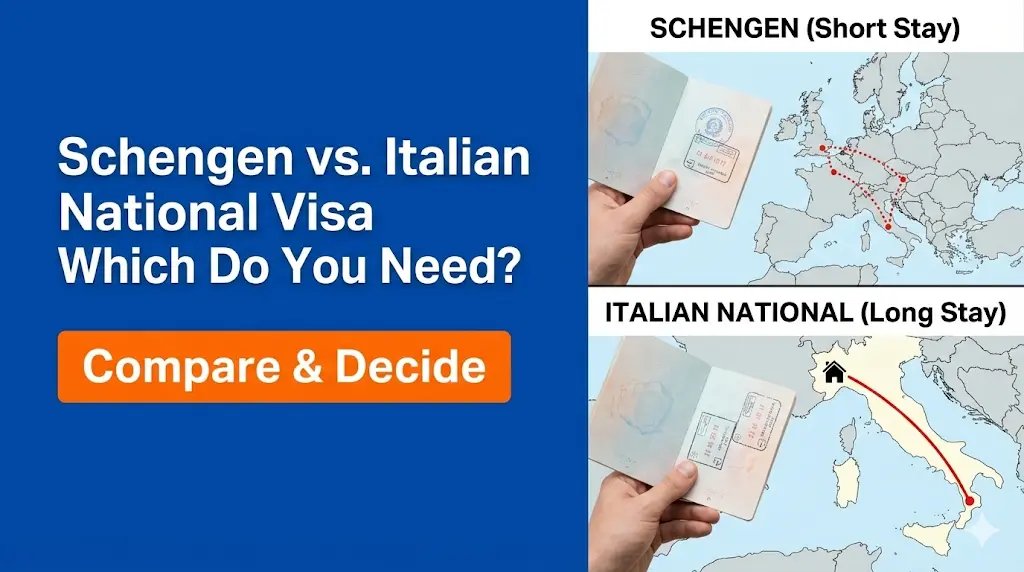
The defining characteristic of the Schengen Type C visa is its duration of stay. This visa allows the holder to remain within the Schengen territory for a maximum of 90 days within any 180-day period.
This rule can be remarkably confusing for first-time travelers. It is not a calendar year allowance, but rather a “rolling” 180-day window. Whenever you wish to enter the Schengen Area, you must look backward exactly 180 days from the current date. Within that specific 180-day window, you cannot have spent more than 90 days inside the Schengen Area. Once you exhaust your 90 days, you are legally required to leave the Schengen Area and remain outside of it for a full 90 days before you are eligible to re-enter on a short-stay basis.
Permitted Activities on a Type C Visa
The Type C visa is strictly designed for temporary visits. The Italian government generally issues this visa for the following purposes:
- Tourism and Leisure: Sightseeing, vacations, and exploring the country.
- Business Activities: Attending conferences, corporate meetings, negotiating contracts, or participating in brief training seminars.
- Family Visits: Visiting relatives or friends who legally reside in Italy.
- Short-Term Study: Attending brief language courses, summer academic programs, or workshops that conclude well before the 90-day limit expires.
If you are planning a standard vacation or a quick corporate trip, you can find a wealth of information regarding application strategies in our Italy Schengen Visa Guide: Tourist and Business Travel.
What You Cannot Do
The most critical limitation of the Schengen visa is that it strictly prohibits any form of remunerated employment. You cannot legally work for an Italian company, accept a salary, or set up a business while residing in Italy on a Type C visa. Furthermore, Schengen visas are generally non-extendable unless you encounter an extreme force majeure situation, such as a severe natural disaster or a sudden, life-threatening hospitalization that prevents you from flying home.
Entry Configurations
Depending on your travel history and the discretion of the consular officer, a Type C visa can be issued in different formats:
- Single-Entry: You can enter the Schengen Area only once. If you leave Italy to visit a non-Schengen country (like the United Kingdom), your visa becomes invalid immediately upon exit, even if you have not used your full 90 days.
- Double-Entry: You are permitted to enter the Schengen Area, leave to a non-Schengen state, and re-enter one final time.
- Multiple-Entry: Ideal for frequent travelers, this allows unlimited entries and exits across the Schengen borders within the overall validity period of the visa, provided you never violate the 90/180-day rule.
Deep Dive into the Italian National Visa (Type D)
If your plans in Italy extend beyond a simple summer holiday, you must transition from the European framework to national Italian law. The Italian National Visa, officially designated as the Type D visa, is a long-term authorization designed for foreigners who intend to establish temporary or permanent residence in the country.
Duration and Scope
A Type D visa is required for any continuous stay that exceeds 90 days. Unlike the short-stay Schengen visa, a National visa is authorized specifically by the Italian immigration authorities rather than the broader European framework. An Italian National visa is typically issued with a validity period of up to one year (365 days).
Permitted Activities on a Type D Visa
The Type D visa covers life-changing relocations. It is categorized by the specific purpose of your long-term stay. Common reasons for the issuance of a National visa include:
- Subordinate Employment: For individuals who have secured a full-time employment contract with an Italian company.
- Self-Employment: For freelance professionals, entrepreneurs, and digital nomads seeking to establish their business operations in Italy.
- Higher Education: For international students enrolling in full degree programs (Bachelor’s, Master’s, or PhDs) at Italian universities. To understand the nuances of educational relocation, explore our guide on Understanding Italy’s Student Visas.
- Family Reunification: For the spouses, dependent children, or dependent parents of individuals who already hold legal residency or citizenship in Italy.
- Elective Residence: A specific visa designed for retirees and high-net-worth individuals who have substantial passive income and intend to live in Italy without working.
Mobility within the Schengen Area
A common point of confusion is whether an Italian National visa traps you inside Italy. The answer is no. According to European regulations, individuals holding a valid Type D National visa issued by a Schengen member state have the right to move freely across the internal borders of the other Schengen countries.
However, this mobility is still subject to the 90/180-day rule. While you can live in Italy for 365 days on a National visa, you are only allowed to travel to other Schengen nations (like France, Germany, or Spain) for a maximum of 90 days out of any 180-day period. Your long-term residence rights are strictly confined to Italian territory.
Schengen Visa vs Italian National Visa: The Comparison Table
To help you easily digest the fundamental differences between these two critical immigration documents, we have compiled a comprehensive comparison table below.
| Feature | Schengen Visa (Type C) | Italian National Visa (Type D) |
| Primary Purpose | Short-term visits: Tourism, business, short courses, family visits. | Long-term stays: Work, university study, retirement, family reunion. |
| Maximum Duration | Up to 90 days within any 180-day rolling period. | More than 90 days, typically issued for up to 365 days. |
| Right to Work | Strictly prohibited. | Allowed, but strictly dependent on the specific sub-category of the visa. |
| Territorial Validity | Valid across all 29 Schengen member states equally. | Residency restricted to Italy; allows transit/travel to other Schengen states for 90 days per semester. |
| Extendability | Generally non-extendable inside the Schengen Area. | Intended to be converted into a renewable residence permit upon arrival. |
| Standard Processing Time | Usually 15 days, extending up to 45 days in complex cases. | Generally up to 90 days; up to 120 days for self-employment visas. |
Common Scenarios: Which Visa Do You Need?
Applying the rules to real-world scenarios is the best way to determine your requirements. Here are a few common situations to illustrate which visa pathway is appropriate.
Scenario 1: The Backpacking Tourist
You want to spend two months traveling by train from Milan down to Sicily, staying in hostels and exploring museums. Because your stay is entirely for leisure and lasts only 60 days (well under the 90-day limit), you need a Schengen Visa (Type C).
Scenario 2: The University Student
You have been accepted into a Master’s degree program at the University of Bologna. The academic program spans two full years. Because your primary purpose is study and your stay will drastically exceed the 90-day limit, you must apply for an Italian National Visa (Type D) for study purposes.
Scenario 3: The Corporate Manager
Your multinational employer is sending you to their Rome office for a three-week training seminar, after which you will return to your home country. Because the duration is brief and you are not officially relocating to the Italian payroll system long-term, a Schengen Visa (Type C) for Business is the correct choice.
Scenario 4: The Tech Specialist
You have accepted a full-time, permanent employment offer from a software development firm based in Turin. You plan to live in an apartment there and receive an Italian salary. You must apply for an Italian National Visa (Type D) for subordinate employment. If you are navigating corporate relocation, we highly recommend reading our guide on How to Obtain an Italian Work Visa.
Application Process and Requirements
The procedures for obtaining these visas vary significantly in terms of complexity, processing time, and the volume of documentation required.
Where to Apply
For both visa types, you must initiate the process from your country of legal residence. For the short-stay Schengen visa, Italy frequently outsources the initial document collection and biometric fingerprinting to third-party visa application centers, such as VFS Global or TLScontact. For long-stay National visas, while third-party centers may sometimes assist with document intake, the applications are subjected to much deeper scrutiny directly by the Italian consulate or embassy.
Standard Documentation
Both visas require foundational documents, including a valid passport (which must have at least two blank pages and remain valid for at least three to six months beyond your intended departure from Italy), recent passport-sized photographs meeting strict biometric guidelines, and proof of financial subsistence.
However, the National Visa demands a far more extensive dossier. Depending on the sub-category, you may need to provide translated and apostilled university degrees, comprehensive background checks, clearance certificates (Nulla Osta) from the Italian Ministry of the Interior, or heavily documented proof of passive income.
Travel Health Insurance
Health insurance is a strict mandate for both pathways, but the requirements differ. For a Schengen (Type C) visa, you are legally required to present a travel medical insurance policy that covers emergency medical care, hospitalization, and medical repatriation, with a minimum coverage limit of €30,000 across all Schengen states. For a National (Type D) visa, you must generally provide proof of comprehensive health insurance that will cover you until you can officially register with the Italian National Health Service (SSN) upon establishing residency.
Visa Fees and Processing Times
The costs associated with applying differ by category. The standard application fee for a Schengen visa for an adult currently stands at €90. National visa fees vary slightly depending on the specific category (study, work, or family).
Processing times require careful planning. According to the Schengen Visa Code, a Type C visa application should generally be processed within 15 calendar days, though this can extend to 45 days during peak travel seasons. Conversely, the Italian authorities can take up to 90 days—and in cases of self-employment, up to 120 days—to process a National Type D visa.
The Crucial Next Step: The Permesso di Soggiorno
There is a critical administrative step that differentiates the National visa from the Schengen visa. If you hold a short-stay Schengen visa, your immigration journey is complete once the sticker is in your passport; you simply travel to Italy and ensure you leave before your days run out.
However, an Italian National Type D visa is essentially just a highly vetted entry ticket. It grants you the legal right to cross the Italian border with the intention of staying long-term. Under Italian immigration law, anyone entering the country on a Type D visa is legally mandated to apply for a Permesso di Soggiorno (Residence Permit) within exactly eight working days of their arrival.
The residence permit is the physical plastic card that formally grants you residency status. It is the document that you will use to sign long-term leases, open bank accounts, and register for public healthcare. If you fail to apply for this permit within the strict eight-day window, your legal status in Italy can be severely compromised.
Can You Convert a Schengen Visa into a National Visa?
One of the most frequently asked questions by hopeful expats is whether they can enter Italy on a simple Schengen tourist visa, find a job or fall in love with a university program, and simply convert their tourist status into a long-stay National visa without leaving the country.
With very few, highly specific exceptions (such as sudden family reunification under emergency circumstances), the answer is a strict no. European immigration law is designed to prevent applicants from circumventing the rigorous background checks associated with long-term immigration by using the more lenient tourist visa pathway.
If you are in Italy on a Schengen visa and you secure a job offer, you cannot apply for a work permit from within Italy. You must return to your home country (or the country where you hold legal permanent residence), submit a formal application for a National Type D visa at the local Italian consulate, wait for the processing period to conclude, and then re-enter Italy legally on the correct long-term visa.
Conclusion
Navigating the Italian visa system does not have to be an exercise in frustration. By clearly defining the purpose of your trip and accurately measuring your intended duration of stay, the choice between a Schengen visa and an Italian National visa becomes entirely straightforward. The Type C Schengen visa offers unmatched flexibility for tourists and short-term business travelers looking to experience the beauty of the Mediterranean within a 90-day window.
Conversely, the Type D National visa serves as the powerful foundational document for those ready to commit to a major life transition, unlocking the right to work, study, and establish deep roots in Italian soil. By preparing your documentation meticulously, respecting the processing timelines, and understanding your obligations upon arrival, you can ensure a smooth and legal entry into the bel paese.
References
Primary sources (official)
- European Commission – Visa policy: https://home-affairs.ec.europa.eu/policies/schengen/visa-policy_en
- European External Action Service – Frequently Asked Questions (FAQ): https://www.eeas.europa.eu/sites/default/files/frequently_asked_questions_en.pdf
Other helpful sources
- Care Health Insurance – A Complete Guide on the Types of Schengen Area Visas: https://www.careinsurance.com/blog/travel-insurance-articles/difference-between-schengen-and-national-visa
- Reliance General Insurance – Schengen Visa Types: https://www.reliancegeneral.co.in/insurance/knowledge-center/insurance-reads/schengen-travel-insurance-visa-keys-to-wider-horizon.aspx
Disclaimer
The information provided in this article is for educational and informational purposes only and does not constitute official legal or immigration advice. Visa regulations, application fees, processing timelines, and the rules of the Schengen Area are subject to frequent legislative changes by the European Union and the Italian government. Always consult the official website of the Italian Ministry of Foreign Affairs, your designated Italian consulate, or a certified immigration attorney for the most current and personalized guidance regarding your specific travel or relocation plans.