Dine-In vs Takeaway: VAT Differences in Italy
Staring at an Italian receipt and realizing your takeaway beer incurred higher taxes than the one you drank at the table is a baffling expat rite of passage. I remember aggressively questioning a Roman cashier who applied two different tax rates to the exact same wine. This guide decodes Italy’s complex dine-in versus takeaway VAT laws, saving you from constant checkout confusion.
Disclosure: This post may contain affiliate links. We may earn a commission at no extra cost to you if you make a purchase through these links. Read full disclosure.
Understanding Italy’s Layered VAT (IVA) System
When you move to Italy, you quickly realize that the state has its hands in almost every transaction you make. The Value Added Tax, universally known here as IVA (Imposta sul Valore Aggiunto), is the invisible force shaping the cost of your daily life. To understand why your local pizzeria charges taxes the way it does, you must first understand the structural baseline of the Italian fiscal system.
The Basics of Imposta sul Valore Aggiunto
Unlike the United States, where sales tax is a relatively straightforward percentage tacked onto the final bill at the register, Italian IVA is built directly into the sticker price. The system is inherently layered, designed to tax essential goods lightly while heavily penalizing standard consumer purchases and luxury items.
The standard IVA rate in Italy is a punishing 22 percent. This applies to clothing, electronics, professional services, and most packaged goods. However, the government utilizes several reduced rates to make living costs manageable. There is a 10 percent reduced rate, which generally covers hospitality, tourism, and certain food items. Finally, there is a super-reduced 4 percent rate reserved strictly for basic necessities like fresh bread, milk, and medical supplies. Navigating these brackets is a constant headache for anyone trying to organize their budget during their initial relocation, which is why understanding daily living costs is a crucial part of any comprehensive Checklist: All You Need Before Moving to Italy.
The Legal Distinction Between Goods and Services
The absolute crux of the dine-in versus takeaway confusion lies in how the Italian Ministry of Economy and Finance legally defines your purchase. In the eyes of the Italian tax authority (Agenzia delle Entrate), a restaurant is not simply selling you a plate of pasta.
If you consume food on the premises, you are paying for a bundled service. You are paying for the chef’s labor, the waiter bringing the food to your table, the use of the plates, the ambiance, and the cleanup. This is legally classified as a provision of services.
Conversely, if you walk into a shop, grab a pre-packaged sandwich or a bottle of wine, and walk out the door, the state views this entirely differently. You did not receive a service; you simply engaged in a transfer of physical goods. This strict, uncompromising legal distinction between a “service” and a “good” dictates exactly which IVA bracket your transaction falls into, and it is the root cause of the bizarre price discrepancies you will encounter.
The Tax Logic: Somministrazione vs. Asporto
To survive the Italian food scene without feeling cheated, you must learn two critical Italian administrative terms: somministrazione and asporto. These two words define the exact parameters of how your meal is legally taxed.
Dine-In: Somministrazione di Alimenti e Bevande
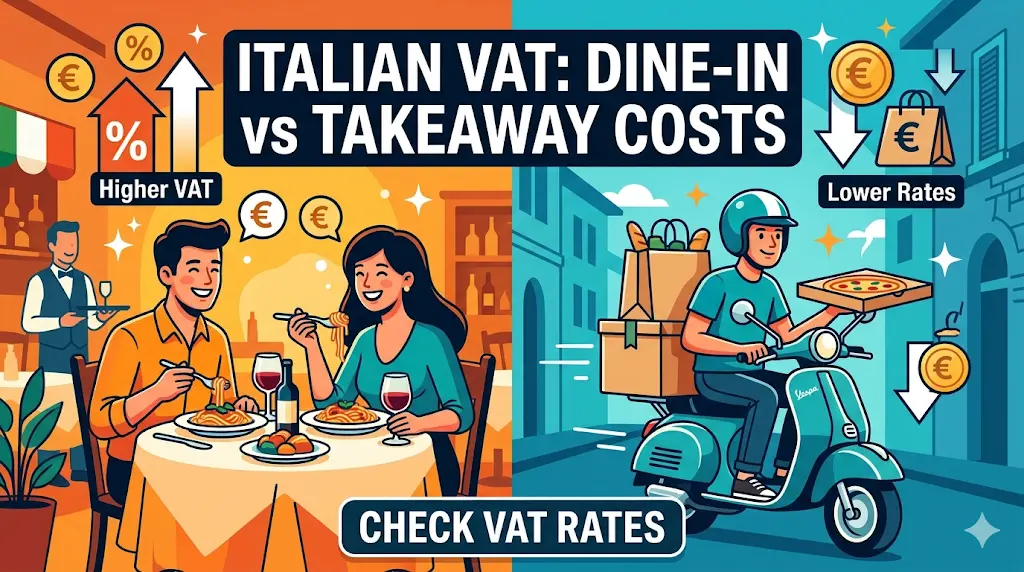
When you sit down at a table in a trattoria, a cafe, or a bar, you are engaging in somministrazione di alimenti e bevande (the administration of food and beverages). Because this is legally classified as a hospitality service, the Italian government blankets the entire transaction under the reduced 10 percent IVA rate.
This is where the law becomes highly beneficial for the consumer. Under the umbrella of somministrazione, the 10 percent rate applies to absolutely everything consumed at the table as part of the service. If you order a complex seafood risotto, it is taxed at 10 percent. If you order a €100 bottle of Barolo wine to drink with your meal, that wine is also taxed at 10 percent. Even a simple glass of tap water or an after-dinner espresso falls under this exact same reduced service rate.
Takeaway and Delivery: The Asporto Reality
The moment you ask for your food to go (per asporto), or you order delivery through a smartphone app, the entire legal framework collapses. Because there is no waiter, no table service, and no cleanup, the transaction immediately reverts from a “service” to a simple “sale of goods” (cessione di beni).
Without the protective 10 percent hospitality umbrella, every single item in your takeaway bag reverts to its individual, baseline product IVA rate. For prepared food—like a hot pizza or a freshly assembled panini—the rate remains 10 percent because prepared meals are granted a specific exception. However, beverages do not enjoy this protection. A sealed bottle of water, a can of soda, or a bottle of beer sold as a standalone retail good is legally subject to the standard 22 percent IVA rate.
This means the exact same bottle of beer is taxed at 10 percent if you drink it at a table, but heavily taxed at 22 percent if you carry it out the front door.
The Coperto Confusion
Many new expats mistakenly attribute the varying costs of dining in Italy to these VAT differences. While the IVA on your takeaway wine is indeed 12 percent higher, the actual final bill for sitting down is usually more expensive. This is due to the coperto—a legally permitted cover charge (usually €2 to €4 per person) added to sit-down bills to cover the cost of bread, linens, and tableware.
You must decouple the concept of the coperto from the concept of IVA in your mind. The coperto is a business fee kept by the restaurant; the IVA is a mandatory tax remitted to the state.
| Item Purchased | Method of Sale | Legal Qualification | Applicable IVA Rate |
| Draft or Bottled Beer | Dine-in at a table | Supply of Service | 10% |
| Bottled Beer | Takeaway / Retail | Sale of Goods | 22% |
| Pizza Margherita | Dine-in at a table | Supply of Service | 10% |
| Pizza Margherita | Takeaway in a box | Sale of Goods (Prepared Food Exception) | 10% |
| Can of Soda | Dine-in at a table | Supply of Service | 10% |
| Can of Soda | Takeaway / Delivery | Sale of Goods | 22% |
The Impact on Consumers and Expat Entrepreneurs
Whether you are simply trying to buy lunch or you are an expat attempting to launch a culinary business in Rome, these granular tax laws will impact your wallet daily.
Decoding Your Restaurant Receipt (Lo Scontrino)
By Italian law, prices displayed on consumer-facing menus must be VAT-inclusive. You will not see a surprise 22 percent tacked onto the bottom of your bill. However, when the cashier hands you the mandatory printed receipt (lo scontrino fiscale), you will notice a complex breakdown at the bottom. The receipt will feature letters like ‘A’, ‘B’, or ‘C’ next to each line item, corresponding to a tax summary detailing exactly how much of your payment went to 10 percent IVA and how much went to 22 percent IVA.
If the cashier incorrectly rings up a takeaway beer at 10 percent instead of 22 percent, the business is committing tax fraud. The Italian financial police (Guardia di Finanza) are infamous for conducting plainclothes checks outside of cafes, demanding to see customers’ receipts to ensure the merchant is applying the correct asporto tax rates.
When you are tapping your card multiple times a day to pay for these intricately taxed espressos and takeaway meals, using a foreign debit card is a massive mistake. Traditional banks will hit you with hidden dynamic currency conversion fees and international transaction markups. This is why seasoned expats rely heavily on Wise for their daily spending. By loading your monthly budget into a Wise account, you can tap your Wise virtual card at Italian cafes and pay natively in euros. Wise utilizes the real mid-market exchange rate, ensuring you are only paying for your cappuccino and the Italian government’s taxes, rather than surrendering a percentage of your wealth to invisible banking spreads.
The Nightmare of Running a Food Business
If you are an expat entrepreneur exploring Italy’s new digital residency pilot for expats or opening a brick-and-mortar cafe, this dual-rate system is an absolute nightmare for your profit margins.
Because Italian consumers expect the menu price of a beer to remain exactly the same whether they drink it inside or take it to the local piazza, you cannot realistically print two different price lists. If you charge €5 for a beer, you must absorb the tax difference yourself. When a customer drinks it inside, you remit roughly €0.45 in IVA. When they take it outside, you must remit roughly €0.90 in IVA to the state out of that exact same €5 bill.
Your electronic Point of Sale (POS) system must be meticulously programmed by your accountant to differentiate between somministrazione and asporto at the push of a button. If your staff pushes the wrong button, your electronic invoicing sent to the Agenzia delle Entrate will be flagged, resulting in crippling fines. Furthermore, if you are sourcing specialty ingredients or craft beers from suppliers outside of Italy, paying those international B2B invoices using a traditional Italian corporate bank account will drain your margins with terrible exchange rates. Shrewd expat business owners use Wise to pay their foreign suppliers. With Wise, you can settle international invoices instantly in the supplier’s native currency, preserving your hard-won business capital.
Preserving and Investing Your Expat Wealth
If you successfully navigate the brutal Italian tax landscape and your business turns a profit, leaving those retained earnings in a standard Italian retail bank is a critical error. Local Italian corporate accounts offer virtually zero interest yield and charge exorbitant custody fees for basic investment products.
To protect your business profits from inflation, moving excess corporate cash into a borderless brokerage like Interactive Brokers is a highly strategic move. Interactive Brokers explicitly supports expat entrepreneurs and cross-border businesses, allowing you to seamlessly invest your Italian euros into global markets, short-term government bonds, or US treasuries.
The same applies to your personal wealth. Relying on Italian retail banks restricts your financial mobility. By utilizing Interactive Brokers, you ensure that your life savings and business profits remain in a highly secure, globally accessible environment that travels with you, completely free from the localized friction of Italian institutional banking.
Structuring Your Life and Finances in Italy
The complexity of Italian IVA is merely a microcosm of the broader bureaucratic landscape you must master to thrive as a foreigner in this country. Absolute compliance is the only way to ensure your life remains uninterrupted.
Immigration, Solvency, and the Questura
The Italian state demands perfection in your paperwork, whether it is a receipt for a takeaway pizza or your immigration file. If you are launching a business, you must present flawless documentation demonstrating your capital reserves. Reviewing the strict Acceptable financial proof for Italy self-employment visa guidelines will show you that the authorities leave zero room for error regarding your financial solvency.
Maintaining this solvency requires meticulous administrative hygiene. If you relocate your personal residence or your business headquarters, executing the exact steps in How to change your address with the Questura in Italy is mandatory. Failing to update your address means you will miss critical tax notices or immigration updates sent via registered mail. The cascading effects of bureaucratic negligence are severe; suffering the Consequences of losing your permesso di soggiorno card or letting your residency lapse can result in your local bank accounts being frozen, paralyzing your ability to operate your business or pay your taxes.
Strategic Tools for Cross-Border Living
Your ability to weather the complexities of Italian life depends entirely on the tools you use. If you are supporting a spouse whose employment is governed by the Conditions for working while on Italy Family Reunification Visa, your household cash flow must be highly optimized to absorb the high cost of local taxes and living expenses.
While you anxiously track the Timelines for picking up your permesso di soggiorno in Italy, you must ensure your financial infrastructure is already operational. Relying on Wise to manage your daily euro transactions and international business payments shields you from predatory retail banking fees. Simultaneously, anchoring your long-term wealth building in Interactive Brokers guarantees that your investments remain secure, globally diversified, and entirely within your control, regardless of what the Italian tax agency decides to do next. Mastering these tools transforms the frustrating Italian bureaucracy into a manageable, structured routine, allowing you to finally enjoy the unparalleled beauty of your new life abroad.
References
Primary sources (official)
- Agenzia delle Entrate (Italian Revenue Agency – IVA Guidelines): https://www.agenziaentrate.gov.it/
- Ministero dell’Economia e delle Finanze (Ministry of Economy and Finance): https://www.mef.gov.it/
Other helpful sources
- FIPE (Italian Federation of Public Establishments – Hospitality VAT Rulings): https://www.fipe.it/
- Guardia di Finanza (Financial Police – Electronic Receipt Compliance): https://www.gdf.gov.it/
Disclaimer
The information provided in this article is for general informational purposes only and does not constitute official tax, financial, accounting, or legal advice. Italian IVA regulations, the specific legal distinctions between somministrazione and asporto, and electronic POS compliance rules are highly complex and subject to frequent legislative updates. Always consult with a registered Italian commercialista (tax accountant) to evaluate your specific business operations, configure your invoicing software, and ensure absolute compliance with local and national tax laws.