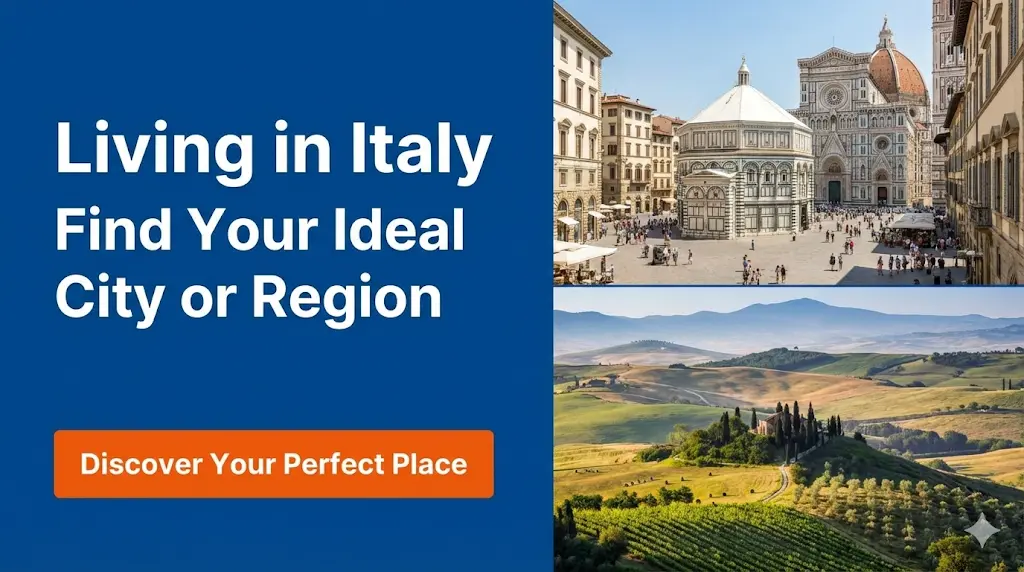
Living in Italy: Finding Your Ideal City or Region
Moving to Italy is a dream for many, but choosing the right location is crucial. This comprehensive guide helps you explore Italy’s diverse regions, comparing the cost of living, lifestyle, climate, and infrastructure to find your perfect Italian home.
Disclosure: This post may contain affiliate links. We may earn a commission at no extra cost to you if you make a purchase through these links. Read full disclosure.
Introduction to Living in Italy
Choosing where to live in Italy is arguably the most significant decision you will make in your relocation journey. Your chosen city or region will dictate everything from your monthly budget and employment opportunities to the climate you endure and the efficiency of the local bureaucracy you must navigate. Many foreigners make the mistake of visiting a city on vacation and assuming that living there full-time will feel like an extended holiday. The reality of daily life—navigating public transportation, finding reliable healthcare, securing a long-term lease, and integrating into the local social fabric—requires a much deeper understanding of what each region actually has to offer.
Italy is divided into twenty distinct regions, each fiercely proud of its unique dialect, culinary specialties, and historical identity. In many ways, moving from Lombardy to Sicily can feel like moving to an entirely different country. Before you start packing your bags or applying for your visa, you must conduct a thorough self-assessment. Are you moving to advance your corporate career, to launch a freelance business, to study, or to enjoy a quiet retirement? Do you crave the anonymity and convenience of a major city, or are you seeking the tight-knit community of a rural hilltop town?
In this exhaustive guide, we will break down the complex geography of the Italian lifestyle. We will explore the stark economic and cultural differences between the North, Center, and South. We will provide detailed profiles of the top cities for career professionals, the best mid-sized towns for a balanced life, and the most idyllic regions for retirees. Furthermore, we will delve into the practicalities of the cost of living, healthcare access, and infrastructure to ensure you have all the tools necessary to find your ideal Italian home.
The Great Divide Northern vs Central vs Southern Italy
To understand Italy, you must first understand its macro-regions. The country is defined by a significant socio-economic divide that impacts every aspect of daily life. Knowing the characteristics of these three main areas will help you immediately narrow down your search based on your personal priorities.
Northern Italy The Economic Powerhouse
Northern Italy, encompassing regions like Lombardy, Piedmont, Veneto, and Emilia-Romagna, is the economic engine of the country. This area borders France, Switzerland, Austria, and Slovenia, giving it a distinctly central European feel. The North is highly industrialized, boasting lower unemployment rates, higher salaries, and a faster pace of life compared to the rest of the peninsula.
If you are a career-driven professional, a tech entrepreneur, or a student looking for top-tier international universities, the North is likely your best destination. The public transportation infrastructure is exceptional, with extensive high-speed rail networks connecting major cities flawlessly. However, this efficiency and wealth come at a cost. The cost of living in Northern Italy is the highest in the country, and the climate can be demanding, featuring hot, humid summers and cold, foggy, and frequently snowy winters.
Central Italy The Historical Heartland
Central Italy includes the world-famous regions of Tuscany, Lazio (home to Rome), Umbria, and Le Marche. This macro-region bridges the gap between the industrial North and the relaxed South. It is the geographic and historical heart of the country, characterized by rolling hills, vast vineyards, and cities that serve as open-air museums of the Renaissance and the Roman Empire.
The lifestyle here offers a balance. While not as relentlessly fast-paced as Milan, cities like Rome and Florence offer robust international communities, thriving tourism sectors, and excellent culinary scenes. The climate is generally milder than the North, with shorter winters and glorious, extended spring and autumn seasons. Central Italy is ideal for expatriates who want deep cultural immersion, a moderate pace of life, and access to both metropolitan conveniences and breathtaking countryside.
Southern Italy The Soul of the Mediterranean
The South of Italy, known as the Mezzogiorno, includes regions such as Campania, Puglia, Calabria, and the large islands of Sicily and Sardinia. The South is famous for its stunning coastlines, incredibly affordable cost of living, fiercely guarded culinary traditions, and a famously relaxed, “dolce vita” approach to daily life.
Life in the South prioritizes family, food, and community above all else. If your goal is to retire comfortably, live affordably on a fixed income, or work remotely while enjoying endless sunshine, the South is a paradise. However, expatriates must be prepared for the trade-offs. The South suffers from higher unemployment, making local job hunting extremely difficult for foreigners. The public infrastructure, including trains and municipal services, is notably less efficient than in the North, and the summer heat can be intense.
Top Cities for Career Professionals and Digital Nomads
If your relocation to Italy is driven by career aspirations, networking, or the need for a modern, highly connected urban environment, you should focus your search on the country’s major metropolitan hubs.
Milan The Fast Paced Financial Capital
Milan, located in the Lombardy region, is Italy’s most cosmopolitan and forward-looking city. It is the undisputed capital of finance, fashion, and design. For corporate expats, bankers, and high-level creatives, Milan offers the most dynamic job market in the country. The city is incredibly international, meaning you can navigate daily life and business relatively easily with English.
Milan operates with a European efficiency that is rare in other parts of Italy. The public transit system, featuring an extensive metro, trams, and buses, is superb. The city also hosts a massive community of digital nomads and international students. However, Milan is notoriously expensive. Renting a modern apartment in the city center will consume a significant portion of your salary. Furthermore, Milan is landlocked and situated in the Po Valley, meaning it lacks the classic Italian coastal charm and suffers from poor air quality and foggy winters.
Rome The Eternal City
Rome, the capital of Italy and the Lazio region, is a city of unparalleled historical magnitude. Living in Rome means navigating your daily commute past the Colosseum, the Pantheon, and countless baroque fountains. The city has a vast, diverse expatriate community, driven by the presence of international embassies, the Vatican, global NGOs, and a massive tourism industry.
Rome offers a warmer climate and a slightly more relaxed pace than Milan. The food scene is legendary, and the social life is vibrant and endlessly entertaining. However, living in the Eternal City requires a high tolerance for chaos. The public transportation system is notoriously unreliable, traffic is heavy, and the municipal bureaucracy can be deeply frustrating. Despite these challenges, those who fall in love with Rome’s chaotic beauty rarely want to leave.
Turin The Industrial Innovator
Often overlooked by tourists, Turin (Torino) in the Piedmont region is one of Italy’s best-kept secrets for expatriates. Historically the seat of the Italian royal family and the birthplace of Fiat, Turin is a city of grand boulevards, elegant cafes, and a booming tech and automotive industry.
Turin offers an exceptional quality of life at a fraction of the cost of Milan. It is an incredibly green city, situated at the foot of the Alps, making it a haven for expats who love skiing and outdoor sports. The city is highly organized, relatively clean, and boasts a sophisticated, intellectual atmosphere. It is becoming increasingly popular among digital nomads who want Northern Italian efficiency without the astronomical price tag.
Mid-Sized Cities for a Balanced Lifestyle
If the overwhelming size of Rome or the intense hustle of Milan does not appeal to you, Italy’s mid-sized cities offer the perfect compromise: rich cultural amenities without the exhausting crowds.
Bologna The Culinary and Academic Capital
Located in Emilia-Romagna, Bologna is famous for three things: its left-leaning politics, its historic university (the oldest in the Western world), and its unmatched food culture. Often referred to as “La Grassa” (The Fat One) for its rich cuisine, Bologna is a vibrant, youthful city characterized by miles of terracotta-roofed buildings and elegant porticoes.
Bologna is large enough to offer excellent healthcare, an international airport, and high-speed rail connections to everywhere in Italy, yet small enough to navigate by bicycle. The massive student population gives the city an energetic, progressive vibe, making it incredibly welcoming to foreigners.
Florence The Renaissance Jewel
Florence (Firenze) is the heart of Tuscany and the cradle of the Renaissance. For art lovers, historians, and creatives, there is simply no better place on earth. The city is highly walkable, stunningly beautiful, and surrounded by the picturesque Tuscan countryside.
Because Florence is a global tourist destination and a major hub for American study-abroad programs, it has a massive, established expatriate community. English is widely spoken, making the initial transition very smooth. However, the sheer volume of tourists in the summer can make the small city center feel overwhelming, and rental prices are surprisingly high due to the lucrative short-term holiday rental market.
Best Regions for Retirees and Slow Living
For those moving to Italy to escape the rat race, stretch their pension, and embrace the legendary “dolce vita,” the countryside and southern coastal regions offer idyllic settings.
Tuscany The Classic Expat Dream
Tuscany remains the quintessential Italian dream for retirees. The region offers a flawless combination of art cities, rolling vineyards, medieval hilltop towns, and a beautiful coastline. Towns like Lucca, Siena, and the Chianti countryside boast large, well-established communities of British, American, and Northern European expats.
The quality of life in Tuscany is incredibly high. The food, wine, and healthcare systems are excellent. However, because it is the most famous rural region in Italy, property prices and the general cost of living are premium. Buying a restored farmhouse here requires a substantial budget.
Puglia The Rising Star of the South
If Tuscany is out of your budget, Puglia—the “heel of the boot”—is the ultimate alternative. Puglia has exploded in popularity over the last decade but still retains its rugged, authentic southern charm. The region is famous for its whitewashed towns, ancient olive groves, and some of the cleanest, most spectacular beaches in the Mediterranean.
The cost of living in Puglia is remarkably low. You can live a highly comfortable lifestyle, dining out frequently and renting a spacious home, for a fraction of what you would spend in the North. Cities like Bari and Lecce offer urban conveniences, while the Valle d’Itria provides peaceful countryside living. The pace of life is very slow, which is perfect for retirement but requires patience when dealing with local services.
Sicily The Culturally Rich Island Escape
Sicily is the largest island in the Mediterranean and operates almost like its own nation. It boasts a complex, layered history with Greek, Arab, Norman, and Spanish influences visible in its architecture and intensely flavorful cuisine.
Living in Sicily is an adventure. Cities like Palermo and Catania are raw, energetic, and chaotic, while towns like Taormina and Siracusa offer refined coastal elegance. Sicily is incredibly affordable, and the locals are famously warm and hospitable. However, the island’s infrastructure is lacking, public transport outside the main cities is poor, and English is rarely spoken by the older generations. It is a region for expats who are adaptable, patient, and eager to fully immerse themselves in the local dialect and customs.
Finding Your Perfect Match Key Factors to Consider
As you narrow down your choices, you must critically evaluate several logistical and practical factors that will dictate your daily happiness and security.
Cost of Living and Budget
Your budget is the ultimate deciding factor. A comfortable lifestyle in central Milan could easily require €3,000 to €4,000 per month, while a similarly comfortable life in a Sicilian town might only require €1,500. Rent is your biggest variable; Northern cities command premium prices, while Southern towns offer incredible bargains. To figure out your financial strategy and plan your monthly expenses accurately, you should review our comprehensive guide on Cost of Living in Italy 2026: Budgeting for Expats.
Healthcare Access and Quality
While Italy has a fantastic national healthcare system (the Servizio Sanitario Nazionale), the quality of care and facility modernization varies heavily by region. The healthcare infrastructure in Lombardy, Veneto, and Emilia-Romagna is generally considered world-class, with top-tier research hospitals. In the deep South and on the islands, hospitals are often underfunded, and wait times for specialized non-emergency procedures can be frustratingly long. If you have chronic medical conditions, proximity to a major Northern or Central hospital is highly recommended.
Public Transportation and Infrastructure
If you plan to live without a car, you must choose your location carefully. Cities like Milan, Turin, Rome, and Naples have comprehensive metro and bus networks. Furthermore, living along the primary high-speed rail corridor (which runs from Turin through Milan, Bologna, Florence, Rome, and down to Naples) allows you to traverse the country effortlessly.
However, if you choose to live in a rural village in Tuscany, Umbria, or anywhere in the deep South, owning a car is an absolute necessity. Local bus routes in rural areas are infrequent and often entirely suspended on Sundays. Adapting to local customs, from navigating regional transit to understanding store hours, is essential, as covered in Settling In Italy: Daily Life Tips for Expats.
The Language Barrier and Expat Communities
Do not underestimate the language barrier. In major cities and tourist hubs, you can survive initially with English. However, if you move to a smaller provincial town or the rural South, English proficiency among locals drops to near zero. You will need to learn Italian to handle banking, healthcare, and daily errands. If you rely heavily on an English-speaking support system, target cities with large expat communities like Rome, Milan, or Florence.
Cost of Living Comparison by Region
To help you visualize the financial differences across the country, the following table provides a generalized comparison of living costs in 2026 across various regional hubs.
| City / Region | Average Rent (1-Bed City Center) | Monthly Groceries (1 Person) | Public Transit Pass | Overall Vibe & Lifestyle |
| Milan (North) | €1,200 – €1,800 | €350 – €450 | €39.00 | Fast-paced, corporate, expensive, international. |
| Rome (Central) | €900 – €1,400 | €300 – €400 | €35.00 | Historic, chaotic, culturally rich, bureaucratic. |
| Florence (Tuscany) | €850 – €1,300 | €300 – €400 | €35.00 | Artistic, tourist-heavy, walkable, expat-friendly. |
| Bari (Puglia) | €500 – €750 | €200 – €300 | €20.00 | Authentic, coastal, affordable, relaxed. |
| Palermo (Sicily) | €450 – €650 | €200 – €300 | €32.00 | Energetic, raw, incredibly cheap, culinary haven. |
Note: Prices are estimates and can fluctuate based on exact neighborhoods and inflation. Once you know the area, finding a property involves local quirks, detailed in The Ultimate Guide to Renting and Buying a Home in Italy.
Urban vs Rural Living in Italy
Beyond choosing a region, you must decide between the convenience of a city and the romance of the countryside. Both have distinct advantages and severe drawbacks that foreigners often fail to anticipate.
The Reality of the Italian Countryside
The allure of buying a stone farmhouse surrounded by olive trees is powerful. Rural living offers peace, clean air, lower property prices, and a profound connection to traditional Italian agriculture and community life. You will likely buy your bread from the local baker who knows your name, and your neighbors will share their garden produce with you.
However, the rural reality includes significant isolation. Internet speeds can be poor (though expanding fiber networks are improving this), limiting digital nomad capabilities. You must drive everywhere, and simple tasks like visiting a specialized doctor or finding an English-speaking mechanic become arduous day trips. Winter in a stone farmhouse can be brutally cold and expensive to heat, as many rural properties rely on expensive pellet or gas tanks rather than city lines.
The Convenience of City Life
Living in an Italian urban center provides immediate access to high-speed internet, diverse international cuisine, vibrant nightlife, top-tier healthcare, and a thriving expat community to combat homesickness. You can walk to the grocery store, take a tram to work, and fly out of a nearby international airport for weekend getaways.
The trade-offs include higher stress, noise pollution, smaller living spaces, and astronomical rent. City centers (Centro Storico) are strictly regulated, meaning you cannot easily drive or park a car near your home due to ZTL (Limited Traffic Zone) cameras. If you decide to settle in a metropolis, knowing exactly where to look for an apartment that balances peace and accessibility is key; check out Choosing the Best Neighborhood in Italy’s Major Cities.
Conclusion
Finding your ideal city or region in Italy requires a delicate balance between your romantic aspirations and your practical realities. The perfect location for a twenty-something remote worker seeking nightlife and networking is vastly different from the ideal haven for a retired couple seeking quiet vineyards and affordable coastal living.
Take the time to thoroughly research the economic divide between the efficient North and the soulful South. Consider your monthly budget, your reliance on public transportation, your need for specialized healthcare, and your willingness to learn the Italian language. If possible, rent an Airbnb in your chosen region for a month during the off-season to experience the authentic daily rhythm before committing to a long-term lease or property purchase. By aligning your lifestyle preferences with the unique characteristics of Italy’s diverse regions, you ensure that your relocation transforms from a stressful transition into a beautifully fulfilling Mediterranean chapter of your life.
References
Primary sources official
- ISTAT (National Institute of Statistics) – Demographic, geographic, and economic data for Italian regions: https://www.istat.it/en/
- Agenzia delle Entrate – Property guides, taxation, and registration information for residents: https://www.agenziaentrate.gov.it/portale/web/english
Other helpful sources
- Idealista – Italy’s leading real estate portal providing housing market trends and regional pricing: https://www.idealista.it/en/
- Numbeo – Comprehensive crowdsourced cost of living database comparing Italian cities: https://www.numbeo.com/cost-of-living/country_result.jsp?country=Italy
Disclaimer
The information provided in this article is for educational and informational purposes only and does not constitute official financial, real estate, or immigration advice. The cost of living, property prices, and regional regulations in Italy are highly dynamic and subject to continuous change. Always conduct your own thorough research, visit your prospective destinations, and consult with certified local professionals before making any long-term relocation or purchasing decisions.