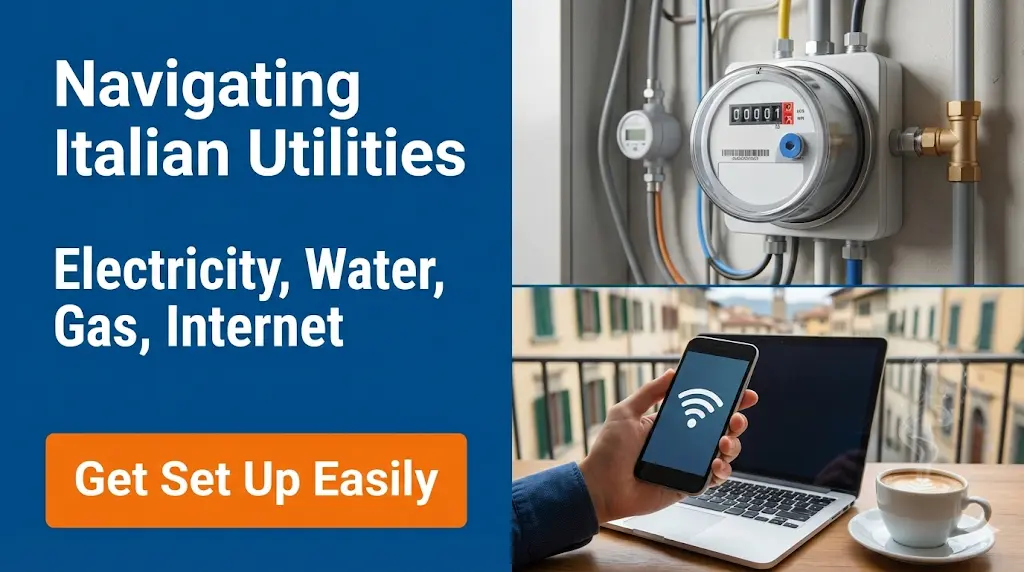
Navigating Italian Utilities: Electricity, Water, Gas, Internet
Disclosure: This article contains affiliate links. If you buy through them, we may earn a commission at no extra cost to you. Read our full disclosure.
Moving to Italy is thrilling, but setting up your home infrastructure can feel overwhelming. This comprehensive guide simplifies navigating Italian utilities, explaining electricity, gas, water, and internet services, decoding the billing process, and outlining the essential steps for activation.
Introduction
Dealing with Italian utility companies can initially seem like navigating a labyrinth in the dark. The system is heavily reliant on specific terminology, rigid procedural timelines, and a mountain of documentation. Unlike in some countries where a simple phone call can turn on the lights the next day, setting up your electricity, gas, water, and internet in Italy requires understanding a unique set of administrative protocols.
The complexity is compounded by the fact that the Italian energy market has undergone massive structural changes over the past few years, transitioning from a state-protected pricing model to a fully privatized free market. Furthermore, knowing the exact status of the physical meters in your new home will dictate whether you need to request a simple name change on an active account or a full reactivation of dormant service lines.
This extensive guide is designed to dismantle the barriers to setting up your home infrastructure. We will break down exactly how the Italian electricity and gas markets operate, explain the highly localized nature of water billing, and explore the incredibly competitive internet and telecommunications landscape. By mastering the terms, procedures, and payment methods outlined below, you will ensure a smooth, stress-free transition into your new Italian residence. For a broader overview of the actual application procedures, you may also want to review our post on Applying for Utility Services in Italy: Step-by-Step.
The Italian Energy Market and the Free Market Transition
To effectively manage your electricity and gas bills in Italy, you must first understand the broader economic structure of the nation’s energy sector. Historically, the Italian energy market was strictly regulated by the state, with the national regulatory authority ARERA (Autorità di Regolazione per Energia Reti e Ambiente) setting the prices for electricity and gas. This system was known as the “Mercato Tutelato” or the Protected Market.
However, Italy has recently completed a massive, multi-year transition away from this state-controlled pricing model. By mid-2024, the Protected Market was officially abolished for the vast majority of domestic consumers, fully ushering in the era of the “Mercato Libero” or Free Market. In 2026, unless you fall into a legally defined “vulnerable” category (such as being over the age of 75, having specific severe medical conditions, or living in an emergency housing situation), you are required to select your energy tariffs on the open market.
The Free Market operates similarly to telecommunications or car insurance. Dozens of private energy suppliers compete for your business by offering a variety of customized tariff plans. You can choose between fixed-rate plans, which lock in the cost of energy for twelve or twenty-four months regardless of global market fluctuations, or variable-rate plans, which are indexed to the wholesale energy market and change monthly. Understanding this landscape empowers you to aggressively shop around and find the best possible deal based on your specific consumption habits and energy needs.
Electricity in Italy Providers and Power Limits
Electricity is the most fundamental utility you will need to establish upon your arrival. Italy operates on a standard European supply voltage of 230 volts with a frequency of 50 Hz. The plug types you will encounter in your home are the standard European Type C (two round pins), Type F (Schuko with side clips), and the uniquely Italian Type L (three round pins in a row).
Major Electricity Providers
While the local distribution grid—meaning the physical wires, poles, and meters outside your home—is maintained by regional distributors like E-Distribuzione, you will purchase your electricity from a retail supplier. The largest and most prominent supplier in Italy is Enel Energia, which historically operated as the state monopoly. However, the free market offers numerous highly reputable alternatives, including A2A, Edison, Eni Plenitude, Sorgenia, and Iren. Many of these companies offer dual-fuel contracts, allowing you to bundle your electricity and gas with the exact same provider for a discounted rate and the convenience of a single monthly bill.
Contracted Power Limits
A unique quirk of the Italian electrical system that frequently surprises expatriates is the concept of “Potenza Impegnata,” or the contracted power limit. When you sign an electricity contract, you are assigned a maximum power threshold. For a standard residential home, the default limit is typically set at 3 kilowatts (kW).
If you turn on too many high-draw electrical appliances simultaneously—for example, running the washing machine, the electric oven, and a hairdryer at the exact same time—you will exceed your 3 kW limit, and the master switch on your meter will immediately trip, plunging your home into darkness. If you live in a larger home or rely heavily on electric induction stovetops, multiple air conditioning units, and electric heat pumps, a 3 kW limit will be entirely insufficient for your daily needs. You can easily request an upgrade to 4.5 kW or 6 kW from your provider, but be aware that increasing your power limit will permanently increase the fixed monthly network charges on your electricity bill.
Gas Services for Heating and Cooking
Despite a growing, modern push toward renewable energy and electric heat pumps, natural gas (metano) remains the primary source of heating and cooking for the vast majority of Italian households.
Piped Natural Gas vs Cylinders
In urban centers, major cities, and well-connected suburban areas, natural gas is piped directly into the home through extensive municipal lines. However, if you are purchasing a rustic farmhouse in rural Tuscany or living in remote southern villages, your property might not be connected to the national gas grid at all. In these rural areas, residents rely heavily on “bombole” (butane or propane gas cylinders) for cooking, which must be manually replaced at the hardware store when empty, or massive outdoor GPL tanks that are periodically refilled by a specialized delivery truck.
Winter Heating Costs
Your gas bill will undoubtedly be your highest utility expense during the winter months. Italian homes, especially historical apartments in city centers, are famously difficult to heat efficiently due to extremely high ceilings, cold stone floors, and outdated single-pane windows. Independent heating systems (riscaldamento autonomo) allow you to control your own thermostat and gas boiler, meaning you pay exactly for what you consume directly to your gas provider.
In some older apartment buildings, the heating is centralized (riscaldamento centralizzato). In this setup, the building’s administrator dictates exactly which dates the heat is turned on and off (which is strictly regulated by regional Italian laws), and your heating costs are divided among all the building’s residents and paid as part of your monthly building fees rather than a separate gas bill. If you live in a multi-unit building, understanding how these communal costs are divided is crucial; you can find much more information in our guide on Understanding Italian Homeowner Association (Condominio).
The Critical Distinction Voltura Subentro and Allaccio
When taking over a new apartment or house in Italy, the current physical status of the utility meters completely dictates the exact administrative procedure you must follow. Misunderstanding these three terms is the single most common cause of delayed utility activations for expatriates.
The Voltura Process
A “Voltura” is required when the utility meters are currently active, and the energy is flowing freely, but the contract is still officially in the name of the previous tenant or the previous owner. You are simply requesting a change of the account holder’s name. This is the absolute ideal scenario because there is zero interruption in service. To execute a voltura, you and the previous occupant must take a meter reading on the handover day to ensure you are not billed for their usage. The process usually takes less than a week to formalize, and you can generally choose to either inherit their current tariff or switch to a new provider simultaneously.
The Subentro Process
A “Subentro” is necessary when the previous occupant formally canceled their contracts before leaving, and the supplier deactivated the meters. The physical meters are present on the property, but there is absolutely no electricity or gas flowing. Because the service is dead, you must request a total reactivation. A subentro takes slightly longer—legally, providers have up to 5 working days to reactivate electricity and up to 10 working days to reactivate gas. A technician rarely needs to visit the property for electricity, as modern smart meters are activated remotely from a central hub, but a gas reactivation almost always requires a technician to physically visit the property to remove a safety seal.
The Allacciamento Process
An “Allaccio” (or allacciamento) is the most complex, expensive, and time-consuming scenario you can encounter. This procedure is required for newly constructed properties or long-abandoned buildings that have never been connected to the national power grid or gas network. An allaccio involves laying new underground cables, installing physical meter boxes, and securing municipal permits. Depending on the complexity of the excavation and structural work required, this process can take anywhere from one to three months to complete.
Required Documents to Set Up Utilities
Italian bureaucracy is notoriously paper-heavy, and utility companies are no exception to this rule. Whether you are applying online, over the phone, or in person at a provider’s retail storefront, you will need to prepare a standard dossier of documentation.
First and foremost, you must provide your Codice Fiscale. This tax identification number is the bedrock of your legal identity in Italy. If you do not have one, the utility company will reject your application instantly without review. For a complete understanding of how to secure this vital document upon your arrival, refer to Why Codice Fiscale Is Essential for Foreigners in Italy.
You will also need a valid form of government-issued identification, such as a passport or an Italian Carta d’Identità. Additionally, recent national anti-squatting laws require utility companies to rigorously verify that you have a legal right to occupy the property. Therefore, you must provide a copy of your registered rental lease or the official property purchase deed (rogito).
Finally, you must provide the specific identification codes for your meters. For electricity, this is the POD (Punto di Prelievo), a 14-character alphanumeric code starting with “IT” that identifies your physical location on the national grid. For gas, it is the PDR (Punto di Riconsegna). You can easily find these codes printed on the previous tenant’s old utility bills or by pressing the digital display buttons on the smart meters themselves until the codes appear.
Water Supply and Billing
Unlike the electricity and gas sectors, the water supply in Italy is not privatized and is not part of the competitive free market. Water is strictly managed by regional or municipal consortiums. For example, the company ACEA manages the water in Rome, HERA manages Bologna and surrounding areas, and Publiacqua operates in Florence.
The tap water throughout Italy is overwhelmingly safe, highly regulated, and perfectly potable, despite the local cultural preference for purchasing bottled mineral water at the supermarket. The cost of municipal water is generally quite low compared to northern Europe or the United States, typically averaging 20 to 30 euros per month for a standard household depending on your consumption band.
The way you are billed for water depends entirely on your specific housing situation. If you rent a standalone house or a private villa, you will likely need to register the water account in your own name and receive quarterly bills directly from the municipal provider. However, if you live in a multi-unit apartment building, the building often has a single master water meter. In this case, the total building’s water bill is divided among the individual apartments based on square footage or the number of occupants, and the cost is seamlessly rolled into your monthly condominium fees.
Internet and Telecommunications
Setting up your home internet is often the least bureaucratic and most pleasant part of the Italian utility experience, and expats are usually deeply surprised by the blazing speed and incredible affordability of Italian broadband.
Fiber Optic and ADSL
Italy has aggressively expanded its fiber-optic network (Fibra Ottica) over the last decade. If you live in a major city, a mid-sized town, or a densely populated suburb, you will likely have access to FTTH (Fiber to the Home), which offers incredibly fast download speeds of 1 Gbps or even 2.5 Gbps. If you live in a more rural or historic area where laying fiber is difficult, you may be restricted to FTTC (Fiber to the Cabinet) or older, slower ADSL copper lines.
The major internet service providers in Italy include TIM (the former state telecom monopoly), Vodafone, Fastweb, and WindTre. The market is fiercely competitive, driving prices down significantly. A top-tier residential fiber-optic plan with unlimited data generally costs between 25 and 30 euros per month. Many providers will also include a free Wi-Fi router and completely waive the initial installation fees if you agree to sign a 24-month contract.
Installation Timelines and Mobile Alternatives
When you sign an internet contract, the provider will schedule a technician to visit your home to activate the line and set up the router. This appointment is usually scheduled within one to two weeks of signing the contract.
If you need internet access immediately upon moving in, Italy’s mobile data networks serve as an excellent stopgap. The country boasts extensive 4G and 5G coverage, and mobile data plans are incredibly cheap compared to global standards. You can easily purchase a prepaid SIM card from providers like Iliad, Ho Mobile, or Kena Mobile that offers 100 to 150 gigabytes of monthly data for less than 10 euros. Many expats simply use their mobile phone as a wireless hotspot during their first few weeks in the country while waiting for their permanent fiber line to be installed.
Decoding the Italian Utility Bill
When your first utility bill, known locally as the “Bolletta,” arrives in your inbox or mailbox, it can look incredibly intimidating. Italian energy bills are dense, multi-page documents filled with complex graphs, pie charts, and bureaucratic jargon.
The total amount due on your bolletta luce (electricity bill) or bolletta gas is broken down into four primary components:
- Costo della Materia Energia (Energy Cost): This is the actual raw cost of the electricity or gas you actively consumed. This is the only portion of the bill that your chosen supplier actually controls and profits from.
- Spese per il Trasporto e Gestione del Contatore (Transportation and Meter Management): These are fixed costs mandated by the government to maintain the national grid, repair underground cables, and manage the physical smart meters. You pay this strictly regulated fee regardless of which supplier you choose.
- Oneri di Sistema (System Charges): These are mandatory state levies used to fund national energy initiatives, such as subsidies for renewable solar energy development and the decommissioning of old power plants.
- Imposte e IVA (Taxes and VAT): Energy is heavily taxed in Italy. You will pay excise duties and a Value Added Tax (IVA). For residential domestic use, the IVA is typically set at 10 percent.
It is also incredibly important to note that the Italian television license fee, known as the Canone RAI, is legally embedded into your residential electricity bill. It is automatically charged in small monthly installments totaling 70 euros per year. If you do not own a television or a device capable of receiving broadcasts, you must submit a formal declaration to the Revenue Agency to be exempted from this hidden tax.
How to Pay Your Utility Bills in Italy
Italy offers a multitude of convenient ways to pay your utility bills, accommodating both traditional cash preferences and modern digital banking methods.
The most highly recommended method for expats is “Domiciliazione Bancaria,” which is a direct debit mandate. By providing the utility company with your Italian IBAN (bank account number), the bills will be automatically deducted from your account exactly on the due date. This entirely eliminates the risk of late fees, ensures you never miss a payment while traveling back to your home country, and often prompts the supplier to waive the standard security deposit required during the initial contract signing.
If you prefer to review your bills manually before parting with your money, you can utilize the “PagoPA” system. PagoPA is the Italian public administration’s centralized electronic payment platform. Your utility bill will feature a square QR code and a PagoPA payment slip. You can scan this code using your Italian banking app, the national IO app, or pay it in person.
For those who prefer physical transactions, you can take your printed bill to any Italian post office or to a local “Tabaccheria” (tobacco shop). The clerk will scan the barcode on the bill, and you can pay the exact amount using cash or a credit card for a small convenience fee (usually around 2 euros). To understand how this fits into your broader financial obligations and monthly housing costs, you can review our insights on Paying Rent in Italy: Methods and Best Practices.
Utility Setup Comparison Table Voltura vs Subentro vs Allaccio
To help you quickly determine your exact requirements when moving into a new property, refer to the detailed comparison table below.
| Utility Status Scenario | Administrative Procedure | Standard Timeframe | Average Associated Costs | Required Documentation |
| Meters active, energy flowing, contract in old name. | Voltura (Name Change) | 4 to 7 working days. | €25 – €50 administrative fee + possible security deposit. | ID, Codice Fiscale, Lease/Deed, POD/PDR codes, Meter reading. |
| Meters present, energy deactivated, contract closed. | Subentro (Reactivation) | Electricity: ~5 days. Gas: ~10 days. | €30 – €60 reactivation fee + possible security deposit. | ID, Codice Fiscale, Lease/Deed, POD/PDR codes. |
| No meters present, newly built or abandoned property. | Allacciamento (New Connection) | 30 to 90 days depending on excavation works. | €200 to over €1,000 depending on structural complexity. | ID, Codice Fiscale, Lease/Deed, Building concession permits, load requirements. |
Conclusion
Navigating Italian utilities is an undeniable rite of passage for every expatriate. While the administrative hurdles, the transition to the free market, and the dense terminology of the bolletta may initially seem overwhelming, the process is ultimately logical and highly regulated to protect consumers.
By taking the time to understand the critical difference between a voltura and a subentro, securing your Codice Fiscale early, and evaluating the highly competitive fiber-optic and energy tariffs available, you can establish your household infrastructure efficiently and cost-effectively. Once the contracts are signed and the direct debits are securely established, the bureaucracy fades quickly into the background, leaving you completely free to enjoy the warmth, comfort, and unparalleled beauty of your new Italian home.
References
Primary sources (official)
- ARERA (Italian Regulatory Authority for Energy, Networks and Environment) – Official guidelines on the end of the protected market and consumer rights: https://www.arera.it/en/
- Agenzia delle Entrate – Information on the Codice Fiscale and the Canone RAI television tax: https://www.agenziaentrate.gov.it/portale/web/english
Other helpful sources
- Enel Energia – Detailed explanation of the Voltura and Subentro processes: https://www.enel.it/en-us/assistenza/luce-gas/voltura
- Facile.it – Comparison tool for Italian free market energy and internet tariffs: https://www.facile.it/
Disclaimer
The information provided in this article is for educational and informational purposes only and does not constitute official legal, financial, or real estate advice. The Italian energy market, utility regulations, pricing structures, and bureaucratic procedures are subject to frequent changes by the national government and local municipalities. Always consult directly with official utility providers, certified real estate professionals, or the Italian regulatory authority (ARERA) for the most current and personalized guidance regarding your utility setup and contracts.