Italy relocation checklist: visa, housing, tax, health, etc.
Landing in Italy with three heavy suitcases, only to realize you cannot even sign a lease because you skipped a crucial administrative step back home, is a crushing expat nightmare. I spent my first two months sleeping on a friend’s couch because my housing documents lacked certified translations. This guide provides a battle-tested chronological checklist for your Italian relocation.
Disclosure: This post may contain affiliate links. We may earn a commission at no extra cost to you if you make a purchase through these links. Read full disclosure.
Phase One Pre Departure Visa and Document Prep
Compiling and Translating Your Dossier
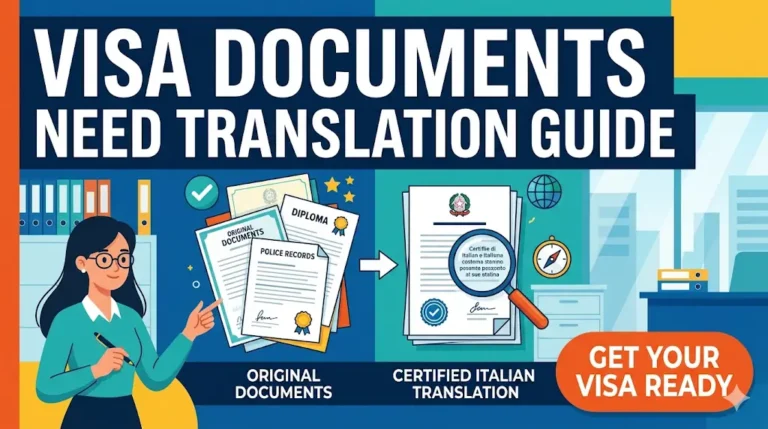
The Italian relocation process begins months before you ever board a flight. Whether you are applying for a highly competitive work visa, an elective residence visa, or a student visa, the Italian consulate in your home country will demand a massive portfolio of legal documents. They want to see your birth certificate, marriage license, police background checks, and months of financial statements.
Here is the immediate hurdle most expats completely underestimate: the Italian government operates strictly in Italian. Submitting a stack of English legal documents will result in an instant visa rejection. Every single foreign vital record and financial affidavit must be flawlessly translated. This is a massive bottleneck, which is exactly why you should use RushTranslate. I strongly advise against trying to translate these documents yourself or hiring an uncertified friend. By utilizing RushTranslate, you ensure that the consular officer receives certified, legally accurate documents that comply with the strict standards of the Ministry of Foreign Affairs. Having your pristine RushTranslate files properly organized prevents your application from being bounced back.
Securing Mandatory Health Coverage
Alongside your translated documents, the single most heavily scrutinized requirement in your visa portfolio is your proof of health insurance. The consulate will not issue your visa unless you prove you possess comprehensive medical coverage that meets the strict Schengen minimum for emergency hospitalization and repatriation.
If you provide a printed policy from a small, unknown domestic travel insurer, the consular officer will likely reject it for insufficient long-term coverage. To bypass this delay completely, you should secure a policy through Cigna Global. Because Cigna Global is a globally recognized expat insurance provider, their certificates of coverage are explicitly tailored to meet Italian national visa requirements. Presenting a Cigna Global PDF to the consulate instantly satisfies the health checklist. Securing Cigna Global not only guarantees a smoother visa approval, but it also ensures you are safely covered from the exact moment you step off the plane in Rome or Milan. This protects your physical health and your savings while you navigate the chaotic first month, a crucial survival strategy we cover heavily in Healthcare in Italy An Expats Guide.

Phase Two The First Eight Days in Italy
Submitting the Permesso di Soggiorno
Securing the visa sticker in your passport is only half the battle; it simply grants you the right to cross the Italian border. Once you land, the bureaucratic clock starts ticking immediately. Under Italian law, you have exactly eight days from the date of your arrival to visit a local post office and submit a massive application kit for your physical residence permit, known as the Permesso di Soggiorno.
You will submit this Kit Postale at the “Sportello Amico” window of the post office. In return, the clerk will give you a small, easily misplaced receipt called the ricevuta. Guard this piece of paper with your life. Until your actual plastic residence permit card is printed months later, this receipt is your only legal proof that you are permitted to be in the country. Surviving this multi-step, deeply analog process is exhausting and requires extreme patience, especially when you are eventually forced into Renewing Your Italian Permesso di Soggiorno in the future.
Obtaining Your Codice Fiscale
You cannot function in modern Italian society without a Codice Fiscale. This is a unique, alphanumeric tax identification code, similar to a Social Security Number or a National Insurance Number. Without it, you cannot open a bank account, buy a local SIM card, sign a rental contract, or even order a package online.
Ideally, you should request this code from the Italian consulate in your home country before you move. If you failed to do so, you must go to the local Agenzia delle Entrate (Revenue Agency) during your first week. You must bring your passport, your visa, and your post office receipt. Securing this code is the foundational step for all subsequent bureaucracy. If you are unsure of your current status, you must immediately read Checking Your Italian Tax Code Codice Fiscale Status.
| Relocation Phase | Essential Task | Responsible Authority | Expat Priority Level |
| Pre-Departure | Translate vital records and background checks. | RushTranslate / Local Consulate | Critical |
| Pre-Departure | Secure Schengen-compliant private health insurance. | Cigna Global | Critical |
| Days 1 to 8 | Submit the Permesso di Soggiorno application. | Poste Italiane / Questura | Urgent Legal Mandate |
| First Month | Obtain the Codice Fiscale (Tax Code). | Agenzia delle Entrate | High |
| Months 1 to 3 | Secure a registered lease and apply for Residenza. | Local Comune / Anagrafe | High |
Phase Three Securing Housing and Local Residency
The Catch 22 of the Italian Rental Contract
Finding long-term housing is where most foreigners experience their first true breakdown. Italian landlords are notoriously hesitant to rent to expats who do not possess a long-term local work contract. To protect themselves, landlords will often demand six months of rent upfront.
Furthermore, to sign a lease, the landlord will demand an Italian bank account. However, Italian banks will refuse to open an account for you unless you have a registered lease proving you live there. Breaking this maddening Catch-22 requires immense patience and negotiation. You must understand the specific legal structures of temporary versus long-term leases, a high-stakes dynamic heavily explored in Signing an Italian Rental Contract. Once you secure the apartment, you will then have to manage the slow process of transferring the gas and electricity meters into your name, an agonizing hurdle detailed in Setting Up Utilities in Italy.
Applying for Your Residenza Anagrafica
Once you have a registered lease, you must go to your local town hall (Comune) to register your permanent address, a process known as the Iscrizione Anagrafica. This step officially registers you as a resident of that specific municipality.
When you apply, the local police officer (Vigile) will visit your apartment unannounced within 45 days to physically verify that your name is on the doorbell and that you actually live there. If you are moving with a spouse or children, the town hall will demand to see your marriage and birth certificates to register the family unit correctly. Because these are municipal records, local clerks will absolutely refuse English documents. You will once again need to use RushTranslate to provide sworn Italian translations of your family’s vital records to the town clerk. Having these RushTranslate documents prepared in advance prevents your family’s residency application from being suspended. Surviving this specific local hurdle perfectly mirrors the friction described in Navigating Italian Bureaucracy Comune and Prefettura.
Phase Four Healthcare Integration and Taxes
Bridging the Healthcare Gap
When you finally obtain your Residenza, you gain the legal right to join the Italian public healthcare system. This is a massive milestone. By paying an annual fee based on your income, you can secure a public health card (Tessera Sanitaria) and be assigned a local doctor. The exact steps to accomplish this are outlined in Registering with the Italian Public Healthcare System SSN.
However, there is a dangerous reality: it can take three to six months to get your residency approved and your public health card printed. During this waiting period, you are completely uninsured by the state. This is exactly why maintaining your Cigna Global policy is vital. Using Cigna Global bridges this dangerous bureaucratic gap, ensuring you have private access to English-speaking doctors and immediate care without paying massive out-of-pocket fees at private clinics while you wait for the government to process your paperwork.
Understanding Your Tax Liability
The moment you register your residency at the Comune, or if you spend more than 183 days a year in the country, you officially become an Italian tax resident. Italy taxes its residents on their worldwide income. This means your foreign pensions, foreign rental properties, and stock dividends are now subject to Italian taxation.
You must hire an international tax accountant (commercialista) immediately to understand your liabilities. If your accountant needs to review your foreign tax returns to calculate your Italian burden, you can use RushTranslate to securely translate your complex financial history into Italian for local filing. Aggressively calculating your new tax brackets is the most critical part of managing your new life, a reality we dissect thoroughly in Cost of Living in Italy 2026 Budgeting for Expats. By methodically following this checklist, maintaining your private health safety net, and utilizing certified translation tools, you can successfully conquer the exhausting, beautiful process of moving to Italy.
References
Primary sources official
- Ministero degli Affari Esteri – Il Visto per l’Italia – https://vistoperitalia.esteri.it/home/en
- Polizia di Stato – Il Permesso di Soggiorno – https://www.poliziadistato.it/articolo/il-permesso-di-soggiorno
Other helpful sources
- Expatica – Moving to Italy: A guide to visas and relocation – https://www.expatica.com/it/
- The Local Italy – The ultimate checklist for moving to Italy – https://www.thelocal.it/
Disclaimer
The information provided in this article is for educational and informational purposes only and does not constitute official legal, tax, or immigration advice. Relocation procedures, including the Permesso di Soggiorno application timeline and Residenza Anagrafica requirements, are strictly governed by Italian law and are subject to the specific discretion of local municipal authorities (Comuni) and provincial police headquarters (Questure). Always consult a registered Italian immigration attorney (avvocato immigrazionista) and a certified tax advisor (commercialista) to verify your specific legal obligations and tax liabilities upon taking up residency in Italy.