Italy Senior Citizen visa: who qualifies?
Searching for an “Italy Senior Citizen Visa” only to realize the application doesn’t officially exist under that name is completely maddening. I almost abandoned my dream of retiring in Tuscany because I was chasing the wrong bureaucratic terminology. This guide clarifies the exact visa older expats actually use, breaking down the financial, housing, and healthcare requirements you must meet to qualify.
Disclosure: This post may contain affiliate links. We may earn a commission at no extra cost to you if you make a purchase through these links. Read full disclosure.
The Myth of the “Senior Citizen” Visa
Understanding the Elective Residence Visa (ERV)
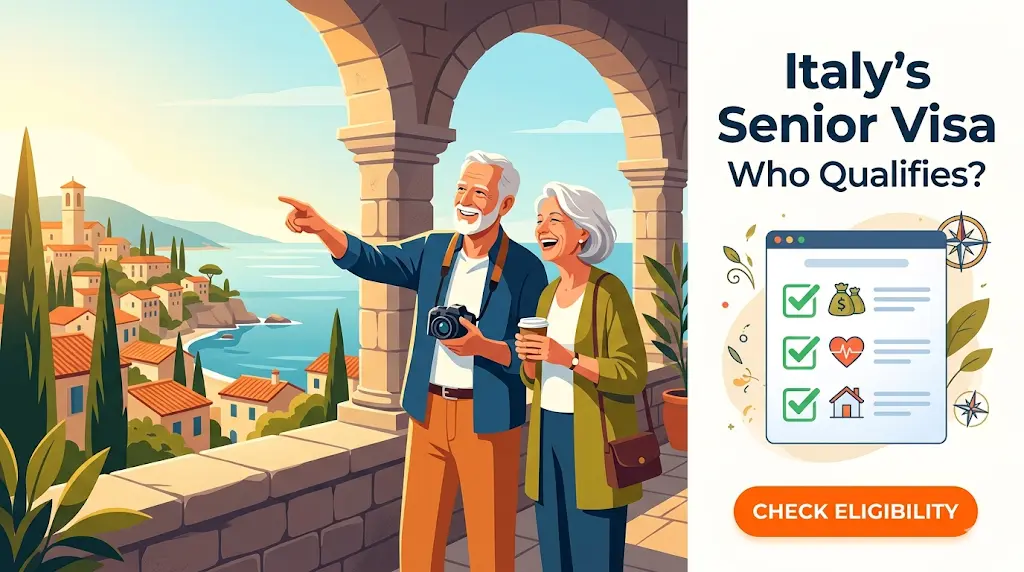
Expats looking to spend their golden years in Italy frequently search for a specific retirement visa, similar to those offered by countries like Spain or Portugal. However, the Italian legal framework does not recognize age as a qualifying factor for immigration. Instead of a “Senior Citizen Visa,” Italy offers the Visto per Residenza Elettiva (Elective Residence Visa, or ERV). This is the definitive pathway for retirees, but it is entirely based on your financial independence, not your date of birth.
The fundamental rule of the Elective Residence Visa is that you are strictly forbidden from working in Italy. You cannot hold a remote job, you cannot consult for a company back home, and you cannot seek local employment. The Italian government expects you to treat this visa as a true retirement or a purely passive residency. You are relocating to enjoy the culture, contribute to the local economy through spending, and live off your accumulated lifetime assets.
Because the rules are so rigid, the ERV is notoriously one of the most heavily scrutinized visas issued by the Italian Ministry of Foreign Affairs. Consular officers are trained to aggressively weed out applicants who might secretly intend to work remotely or those who lack the long-term financial stability to survive without Italian state assistance. If you are seriously considering this route, you must deeply familiarize yourself with the foundational rules detailed in our Italian Elective Residence Visa VRE Complete Guide.
Bringing Elderly Parents via Family Reunification
It is crucial to differentiate between retiring to Italy yourself and bringing your elderly parents to live with you while you work in the country. If you are an expat currently holding a standard Italian work permit, and you want your senior citizen parents to join you, you do not use the ERV. Instead, you must navigate the Ricongiungimento Familiare (Family Reunification) process.
Bringing a senior parent to Italy is incredibly difficult. You must unequivocally prove to the Italian state that your parent is 100% financially and medically dependent on you, and that they have no other children in their home country who could possibly care for them. The Italian government requires extensive, translated proof of this absolute dependency, including bank transfer receipts showing you have been their sole source of financial support for years.
Whether you are applying for the ERV for yourself or attempting family reunification for your parents, the bureaucratic burden of proof is immense. You will be required to submit stacks of foreign birth certificates, marriage licenses, and financial affidavits to the Italian consulate.
Proving Your Financial Independence (The ERV Trap)
The Strict Passive Income Threshold
The single biggest trap that ruins ERV applications is the misunderstanding of “income” versus “savings.” To qualify for the Elective Residence Visa, you must prove a minimum annual income of approximately €31,000 for a single applicant, or roughly €38,000 for a married couple. However, having a million dollars sitting in a standard checking account will not get you approved. The Italian consulate strictly requires passive income.
Passive income means money that flows to you continuously and reliably without any active labor on your part. The most common and widely accepted forms of passive income are government pensions, private retirement annuities, regular dividends from stock portfolios, and ongoing rental income from properties you own. The consular officer wants to see a guaranteed stream of cash that will safely deposit into your account every single month for the rest of your life.
If you sell your house in your home country and dump the profits into a savings account, the consulate will likely reject you. They view finite savings as something that can eventually run out, leaving you destitute in Italy. You must structure your finances so they generate a verifiable, taxable passive yield. Properly projecting how far this passive income will actually stretch in different Italian regions is a massive component of your overall Cost of Living in Italy 2026 Budgeting for Expats.
The Translation and Documentation Burden
When you sit down for your consular interview, you must hand over a massive dossier proving your passive income. This typically includes your last two years of federal tax returns, official letters from your pension providers, statements from your financial advisors, and deeds to any rental properties you claim income from.
Because the Italian government operates strictly in Italian, these dense, legally binding foreign financial documents are utterly useless if they are not flawlessly translated. You cannot simply hand a New York or London consular officer an English tax return and expect them to process it. Getting your complex financial and retirement documents translated is a massive bottleneck, which is exactly why you should rely on RushTranslate. By utilizing RushTranslate, you ensure that the consular officer receives certified, legally accurate documents formatted to the Italian government’s exact stringent standards.
Do not attempt to translate these sensitive financial documents yourself or use an amateur service to save a few dollars. A consular officer already scrutinizing your passive income streams will instantly reject your file over a poorly translated pension statement. Relying on RushTranslate guarantees compliance with the strict standards of the Ministry of Foreign Affairs and prevents your application from being bounced back. Having your pristine RushTranslate files properly organized is the most effective way to secure an approval on your very first try.
Securing Housing and Healthcare Before You Apply
The Registered Lease Requirement
Another massive shock for retirees is the housing requirement. You cannot apply for an Elective Residence Visa with the intention of staying in a hotel or booking an Airbnb for your first month while you look around. The Italian consulate mandates that you must secure permanent, legal housing before you even submit your visa application.
You must present either a deed of ownership for a livable property in Italy or a formalized, long-term rental contract (minimum one year) that has been officially registered with the Agenzia delle Entrate (the Italian Revenue Agency). The lease must be strictly in your name. This creates a terrifying catch-22: you must sign a legally binding Italian lease and pay thousands of euros in upfront deposits for an apartment you might never get to live in if your visa is denied.
Negotiating with Italian landlords from abroad is incredibly difficult because they are naturally suspicious of renting to foreigners who do not yet have legal residency. You must be prepared to offer significant upfront rent to secure a registered contract. Understanding how to navigate this high-stakes negotiation without getting scammed is deeply covered in Signing an Italian Rental Contract.
The Mandatory Private Health Insurance
Alongside your translated documents and your registered lease, the most heavily scrutinized requirement in your entire visa portfolio is your proof of health insurance. Even if you ultimately plan on Registering with the Italian Public Healthcare System SSN later, you legally cannot access the Italian public health grid until you physically arrive, register your address, and obtain a residence permit.
To secure the ERV, you must purchase robust private insurance beforehand. The consulate strictly requires a policy that covers 100% of emergency medical expenses and repatriation, with zero deductibles or waiting periods, specifically valid across the entire Schengen area. If you provide a digital policy document from a small, unknown travel insurer, the consular officer will likely reject it for insufficient long-term coverage.
To bypass this delay completely, I strongly recommend securing a policy through Cigna Global. Using Cigna Global is a bulletproof way to meet the strict visa health insurance requirements. Because Cigna Global is a globally recognized expat insurance provider, their certificates of coverage are explicitly tailored to meet Italian national visa requirements. Presenting a Cigna Global PDF to the consulate instantly satisfies the health checklist. Securing Cigna Global not only guarantees a smoother visa approval, but it also ensures you are safely covered from the exact moment you step off the plane in Rome or Florence, a crucial survival strategy covered in Healthcare in Italy An Expats Guide.
| Visa Requirement | Specific Details Needed | Common Pitfalls to Avoid |
| Financial Proof | ~€31,000/year (single) or ~€38,000/year (couple) in passive income. | Presenting active salary income or relying solely on a finite savings account. |
| Housing Proof | Registered long-term lease or property deed. | Booking a 30-day vacation rental or hotel stay. |
| Medical Coverage | €30,000+ comprehensive policy covering emergencies and repatriation. | Buying cheap travel insurance with high deductibles or limited hospital coverage. |
| Document Translation | Certified Italian translations of all vital/financial records. | Translating documents yourself or using uncertified software. |
Navigating the Arrival Bureaucracy in Italy
The 8-Day Permesso di Soggiorno Rule
Securing the ERV sticker in your passport is a massive victory, but it only grants you the right to cross the Italian border. Once you land in Italy, the bureaucratic clock starts ticking immediately. Under Italian law, you have exactly eight days from the date of your arrival to visit a local post office (Poste Italiane) and submit a massive application kit for your physical residence permit (Permesso di Soggiorno per Residenza Elettiva).
This post office visit triggers a subsequent appointment at the central police station (Questura) where you will be fingerprinted and your original translated financial and housing documents will be reviewed once again. Surviving this multi-step, deeply analog process is exhausting and requires extreme patience. It perfectly mirrors the intense hurdles you will face when establishing your new life, a process detailed in Navigating Italian Bureaucracy Comune and Prefettura. You must keep the post office receipt (ricevuta) on you at all times, as it is your only legal proof of status while you wait months for the actual plastic permit card to be printed.
Tax Implications and Residency Registration
Once you have your permit receipt, you must go to your local town hall (Comune) and officially register your address (Iscrizione Anagrafica). Once you do this, you legally become an Italian resident.
It is vital to understand that taking up permanent residency in Italy exposes you to the Italian tax system. Italy taxes its residents on their worldwide income. Before you officially relocate, you must consult an international tax professional to understand how your foreign pensions, real estate dividends, and investments will be taxed under Italian law. Obtaining your official tax identifier is the first step in this process, which you must secure by Checking Your Italian Tax Code Codice Fiscale Status.
Retiring in Italy is a beautiful, rewarding experience, but the initial administrative transition requires absolute precision. Because your residency is tied to your financial independence, you must ensure your passive income streams remain stable, as you will be required to prove them all over again when Renewing Your Italian Permesso di Soggiorno every one to two years.
References
Primary sources (official)
- Ministero degli Affari Esteri – Visto per Residenza Elettiva (Elective Residence Visa) – https://vistoperitalia.esteri.it/home/en
- Consolato Generale d’Italia a Los Angeles – Elective Residency Visa Requirements – https://conslosangeles.esteri.it/en/servizi-consolari-e-visti/servizi-per-il-cittadino-straniero/visti/visa-type/elective-residency-visa/
Other helpful sources
- Bersani Law Firm – Elective Residence Visa Italy 2025 Updated – https://mbersanilaw.com/elective-residence-visa-italy/
Disclaimer
The information provided in this article is for educational and informational purposes only and does not constitute official legal, tax, or immigration advice. The Visto per Residenza Elettiva requires applicants to demonstrate substantial and stable passive income; income thresholds and specific documentation requirements (such as the necessity of a registered lease agreement) are subject to the strict discretion of individual Italian consulates. Holding this visa explicitly prohibits the applicant from engaging in any form of active employment or independent work within Italy. Always consult a registered Italian immigration attorney (avvocato immigrazionista) and an international tax specialist (commercialista) to verify your eligibility and tax liabilities before applying.