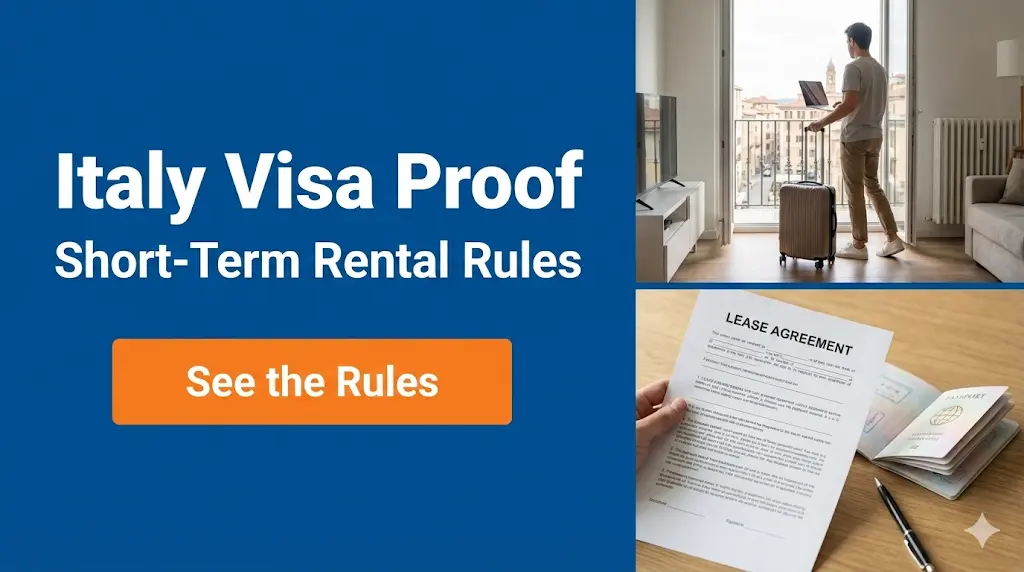
Using a short-term rental lease for Italy visa proof: rules
Navigating Italian visa requirements often hinges on proving suitable accommodation. This guide details the strict rules for using short-term rental leases as proof of housing, covering registration requirements, contract types, and common pitfalls to avoid for a successful application.
Disclosure: This post may contain affiliate links. We may earn a commission at no extra cost to you if you make a purchase through these links. Read full disclosure.
Introduction
The short answer is yes, but the rules are incredibly specific and rigid. In the eyes of an Italian consular officer, a “short-term rental” is not just an Airbnb confirmation or a hotel booking for your first week. When applying for a National Visa (Type D)—which includes study, work, elective residence, or digital nomad visas—the authorities typically look for a housing solution that covers at least a significant portion of your intended stay, or at least the first six to twelve months.
Using a temporary housing solution requires a deep understanding of Italian rental laws and how they intersect with immigration requirements. The Italian government uses housing proof not just to ensure you aren’t homeless, but as a primary metric to verify your financial stability and the legitimacy of your move. If you are moving for professional reasons, it is vital to pair your housing proof with the correct visa, such as the Italy Digital Nomad Visa: Eligibility and Application.
In this guide, we will break down the specific types of short-term contracts recognized by the Italian government, the mandatory registration rules with the Agenzia delle Entrate, and the common reasons why consulates reject short-term leases. By the end of this article, you will know exactly how to secure a lease that satisfies both your need for flexibility and the government’s need for security.
The Standard Requirement for Proof of Accommodation
Before diving into short-term specifics, it is essential to understand the general standard. For a Type D Long-Stay Visa, consulates generally require a lease agreement (contratto di locazione) or a declaration of hospitality (dichiarazione di ospitalità).
The duration of the housing proof should ideally match the duration of the visa you are requesting. If you are applying for a one-year study visa, the consulate will look for a housing solution that lasts for one year. While some consulates may accept a six-month lease with a written explanation of how you will find subsequent housing, this is often at the discretion of the individual officer.
Providing a lease that is too short (e.g., 30 days) is one of the leading Reasons Italian work visa applications are denied. The officer may conclude that your move is not sufficiently planned or that you lack the financial resources to secure stable housing.
Types of Short-Term Rental Contracts in Italy
Italy has a highly regulated rental market. You cannot simply write a letter on a napkin; the contract must fall into one of the categories defined by national law. For visa purposes, there are two primary “short-term” options that consulates recognize.
1. Contratto Transitorio (Transitional Lease)
The Contratto Transitorio is the most common “mid-term” solution used by expats. It is designed for temporary needs and can last anywhere from 1 month to 18 months.
To be valid for a visa, this contract must explicitly state the “transitional reason” for the lease. For you, the reason is typically “waiting for permanent residency” or “fixed-term employment/study.” This contract is legally robust and, when properly registered, is almost always accepted by consulates for visa proof. It is a much safer bet than a standard vacation rental. To understand the legal framework of these agreements, see our guide on Italian Rental Contracts 101: 4+4, 3+2, and Transitorio.
2. Locazione Turistica (Tourist or Short-Term Rental)
This is the “Airbnb” style rental, officially known as a locazione per finalità turistiche. These are for stays of less than 30 days.
Crucial Rule: While a tourist rental is fine for a 10-day vacation, it is almost never sufficient for a long-stay National Visa application. If you present a 28-day Airbnb booking for a Digital Nomad Visa application, the consulate will likely issue a “request for integration” or a denial, stating that the accommodation is not “suitable for the duration of the stay.”
The Mandatory Registration with Agenzia delle Entrate
One of the most frequent mistakes foreigners make is assuming that a signed piece of paper is a legal lease. In Italy, any rental agreement lasting longer than 30 days must be officially registered with the Agenzia delle Entrate (the Italian Tax Authority).
Why Registration Matters for Your Visa
When you submit your lease to the consulate, the officer will look for the registration stamp or the electronic filing receipt from the Agenzia delle Entrate.
- If the lease is registered, it is a public, legal document.
- If it is not registered, it is considered “non-existent” in the eyes of the law.
If you provide an unregistered lease, the consulate will reject it. This is a protection mechanism to prevent “fake leases” created solely for visa purposes. Furthermore, once you arrive in Italy, you will need the registered lease to obtain your Why Codice Fiscale Is Essential for Foreigners in Italy, which is the foundation of your financial life in the country.
Using Airbnb or Google for Visa Proof
Can you use a high-profile platform like Airbnb for your visa? The answer is: only if you book for more than 30 days AND obtain a formal contract.
If you book a “monthly stay” on Airbnb, the 30-day rule kicks in. You and the host must sign a written contract, and the host must register that contract with the tax authorities. Most Airbnb hosts who specialize in short-term tourism are unwilling to do this because it involves administrative fees and different tax obligations.
Pro Tip: If you intend to use a platform for your initial housing proof, search specifically for “Medium-Term Rentals” or platforms like Spotahome or HousingAnywhere. These platforms are designed for expats and students and are accustomed to providing the registered contracts required for visa applications.
Requirements for a Valid Visa Lease Agreement
For a short-term lease to be accepted as proof of accommodation, it must contain specific information that satisfies the consulate’s requirements.
| Required Element | Description | Why it matters |
| Full Identification | Names, birthdates, and tax codes (Codice Fiscale) of both landlord and tenant. | Verifies the identity of the parties involved. |
| Property Details | Full address, cadastral data (mapping coordinates), and number of rooms. | Ensures the housing is real and “suitable” for human habitation. |
| Duration | Clear start and end dates matching the visa request. | Proves you have a place to stay for your intended duration. |
| Rent Amount | The monthly cost and deposit details. | Helps the consulate assess your financial self-sufficiency. |
| Registration Stamp | Evidence of filing with the Agenzia delle Entrate. | Confirms the contract is legal and recognized by the Italian state. |
The “Suitable Housing” Requirement (Idoneità Alloggiativa)
For certain visas, particularly family reunification and some work visas, the government requires a certificate of “Housing Suitability” (Idoneità Alloggiativa). This is a document issued by the local municipality (Comune) or health authority confirming that the apartment meets health and safety standards and is large enough for the number of people living there.
If you are using a short-term lease, obtaining this certificate can be difficult because it requires a technical inspection that can take weeks. If your visa category requires this certificate, a short-term transitional lease is often insufficient unless the landlord already possesses a valid certificate to give you.
Common Pitfalls: Why Consulates Reject Short-Term Leases
Even if you have a registered contract, the consulate may still push back. Here are the most common reasons for rejection:
- Duration is too short: As mentioned, a 3-month lease for a 1-year visa is risky. Aim for at least 6 months if possible.
- Missing Registration: The landlord promised to register it but didn’t. Always ask for the Ricevuta di Registrazione.
- Inconsistent Dates: Your lease starts two weeks after your intended arrival. The consulate will ask: “Where are you sleeping for the first 14 days?”
- Subletting Issues: You are renting a room from another tenant, but the primary landlord has not given written permission for subletting.
- Unclear Financials: If the rent is €2,000 a month but your income is only €2,300, the consulate may deny the visa on financial grounds, even if the lease is perfectly legal.
The Role of the Landlord’s Identification
When submitting a lease, you must also provide a photocopy of the landlord’s valid ID (passport or Carta d’Identità). Consulates use this to verify that the person signing the lease actually has the legal right to rent the property to you. If the landlord refuses to provide their ID, do not sign the lease; the consulate will not accept the proof of accommodation without it.
Alternatives to a Short-Term Lease
If you find it impossible to secure a registered lease from abroad, you have two main alternatives:
1. The Declaration of Hospitality (Dichiarazione di Ospitalità)
If you have a friend or relative in Italy, they can sign a formal letter stating they will host you in their home for free. This must be accompanied by their ID and proof of their ownership or lease of the property. This is a very common solution for students and those with Italian connections.
2. Employer-Provided Housing
If you are moving for a job, your employer can provide a letter stating they are responsible for your housing and will provide an apartment upon arrival. This is the “gold standard” for work visas and is rarely questioned by consulates.
What Happens After You Arrive in Italy?
Within 8 days of arrival, you must apply for your Permesso di Soggiorno. The Questura (Police Headquarters) will ask for your registered lease again. If your short-term lease has already expired by the time you have your fingerprinting appointment (which can be months later), you will need to provide a new registered lease or a declaration of hospitality. This is why having a transitional lease of at least 12 months is often the most practical choice for long-term stability.
Conclusion
Using a short-term rental lease for Italy visa proof is a viable strategy, but it requires moving beyond the “vacation rental” mindset. To satisfy the strict requirements of the Italian consulates, your lease must be a formal Contratto Transitorio, it must be registered with the Agenzia delle Entrate, and it must ideally cover a significant portion of your stay. By ensuring your landlord provides the necessary registration receipts and identification, you can turn a flexible housing solution into the key that unlocks your Italian visa.
Remember, the goal of the housing proof is to show that you have a stable, legal, and healthy environment to begin your life in Italy. With the right contract and meticulous attention to registration rules, you can move forward with your application with confidence.
References
Primary sources (official)
- Ministry of Foreign Affairs (Visto per l’Italia): https://vistoperitalia.esteri.it/home/en
- Agenzia delle Entrate (Registration of Leases): https://www.agenziaentrate.gov.it
Other helpful sources
- Italian Consulate (General Guidelines for National Visas): https://consnewyork.esteri.it
- Idealista – Rental Market Rules for Foreigners: https://www.idealista.it
Disclaimer
The information provided in this article is for educational and informational purposes only and does not constitute official legal or immigration advice. Italian visa rules and rental laws are subject to frequent changes and vary significantly between individual consulates. Always consult the official website of the Italian Ministry of Foreign Affairs or a certified immigration professional before making financial or relocation decisions.