What documents are needed for a digital nomad visa in Italy?
Securing Italy’s digital nomad visa requires a meticulous portfolio of paperwork. This comprehensive guide outlines the exact documents needed, from income proof and employer declarations to health insurance and accommodation contracts, ensuring your 2026 application is flawlessly prepared. The dream of waking up to the rolling hills of Tuscany or the bustling historic streets of Rome before logging into your laptop is now a legal reality.
Disclosure: This post may contain affiliate links. We may earn a commission at no extra cost to you if you make a purchase through these links. Read full disclosure.
Introduction
Introduced recently to capture the global shift toward location-independent work, Italy’s digital nomad visa has quickly become one of the most sought-after immigration pathways in Europe. Designed explicitly for highly skilled non-European Union citizens, this visa allows you to legally live in Italy while continuing to earn your income from foreign sources. However, unlike the relaxed tourist visas of the past, this long-stay national visa demands an extraordinary level of bureaucratic preparation. The Italian government wants to ensure that every remote worker entering the country is financially stable, legally employed, and fully capable of supporting themselves without burdening the local economy or healthcare system.
Preparing your dossier is arguably the most challenging part of the entire relocation process. The Italian consulates operate with strict checklists, and a single missing translation or an incorrectly formatted employer letter can result in immediate rejection. Knowing exactly what documents to gather, how to authenticate them, and when to present them is the difference between a successful relocation and a frustrating administrative nightmare.
In this exhaustive guide, we will break down every single document required for your application in 2026. We will explore the critical differences in paperwork between freelance nomads and employed remote workers, detail the stringent income and housing proofs required, and provide actionable tips for legalizing your international documents. Whether you are just starting to plan your move or you are preparing for your upcoming consular interview, this comprehensive checklist will ensure you are perfectly prepared. For a broader overview of the program’s rules, you can also explore our core guide on Italy Digital Nomad Visa: Eligibility and Application.
The Legal Distinction Digital Nomad versus Remote Worker
Before you begin gathering your paperwork, you must understand exactly which sub-category of the visa you are applying for. The Italian government uses the umbrella term “digital nomad visa,” but the law (specifically Article 27-quater, paragraph 1 of Legislative Decree 286/1998) draws a sharp distinction between two types of applicants. The documents you need to provide will change based on your classification.
- The Digital Nomad: Under Italian law, a digital nomad is strictly defined as a freelancer, consultant, or self-employed professional. You work for yourself, manage multiple clients, and generate project-based or fee-based income. You utilize technological tools to perform your services remotely from Italy.
- The Remote Worker: A remote worker is someone who holds a traditional employment contract with a specific company based outside of Italy. You receive a regular salary, but your employer has granted you formal permission to perform your duties remotely while residing on Italian soil.
If you are an employee, your documentation will heavily feature your employer’s corporate guarantees. If you are a freelancer, the burden of proof falls entirely on your personal business records. To understand the feasibility of your specific employment situation, you might want to read our article: Applying for an Italy visa as a remote worker: Is it possible?.
Essential Personal Identification and Travel Documents
The foundation of your visa application begins with your standard identification and travel paperwork. These are the non-negotiable baseline documents that every applicant must submit, regardless of their employment status.
- A Valid Passport: You must present your original passport along with clear photocopies of the main data page and any pages containing previous visas or stamps. Your passport must meet strict validity criteria: it must have been issued within the last ten years, have at least two blank pages, and remain valid for a minimum of 15 months beyond your intended date of arrival in Italy. If your passport is expiring soon, renew it before starting this process.
- The National Visa Application Form: Because the digital nomad visa is a long-stay visa (intended for stays exceeding 90 days), you must fill out the Type D National Visa application form. This form must be completed accurately, printed, and physically signed by you.
- Passport-Sized Photographs: You will need recent, biometric passport-style photographs (usually two, though some consulates request more). These must be taken against a plain white background, showing your full face without accessories that obscure your features.
- Proof of Legal Residence: You must prove that you legally reside within the territorial jurisdiction of the Italian consulate where you are applying. For instance, if you are applying in New York, you must show a local driver’s license, a state ID, or a recent utility bill bearing your name and local address. If you are not a citizen of the country where you are applying, you must provide your valid long-term resident visa or alien registration card.
- Payment of the Consular Fee: You must pay the non-refundable visa processing fee, which is currently set at €116. Depending on your local consulate, this may need to be paid in exact cash, by cashier’s check, or via a specific money order in the local currency equivalent. To learn more about how to set up this meeting, read How to schedule an Italian visa appointment at the consulate.
Proving Your Financial Independence and Income
The Italian government requires undeniable proof that you can financially sustain yourself without tapping into the local economy or public welfare system. The minimum income threshold is strict.
As of the 2026 requirements, applicants must demonstrate an annual gross income of at least €28,000 (which equates to roughly €2,333 per month). Some sources and specific consulates may calculate the requirement slightly higher depending on family size, reaching upwards of €34,200 annually for the main applicant, with additional funds required if bringing a spouse or children. Regardless of the exact threshold your local consulate enforces, you must document this income meticulously.
Crucially, the income must derive directly from your remote work or freelance activities. Passive income—such as rental yields, stock dividends, or pension payments—does not count toward this specific visa’s income requirement. To prove your active, remote income, you must compile the following documents:
- For Remote Workers (Employees): You must provide your formal employment contract showing your annual salary. This should be supplemented by your most recent pay slips (usually covering the last three to six months) and your previous year’s tax returns (such as a W-2 form in the United States).
- For Digital Nomads (Freelancers): You must provide copies of your active freelance contracts, retainer agreements, or detailed project scopes. You must also provide client invoices from the past several months and your most recent annual tax declarations proving your self-employment earnings.
- Bank Statements: All applicants must provide personal bank statements from the last three to twelve months, depending on the consulate’s specific checklist. These statements must clearly show the regular deposit of your salary or client fees, and they must bear the official stamp and seal of the bank.
Validating Professional Qualifications and Experience
The Italy digital nomad visa is explicitly reserved for “highly skilled” professionals. The immigration authorities require documentary evidence that you possess the necessary expertise to perform your job remotely.
You must meet at least one of the following criteria and provide the corresponding documentation to prove it:
- Tertiary Education: You hold a recognized university degree (a Bachelor’s, Master’s, or Doctorate) from a course lasting at least three years. You must provide the original diploma and your official academic transcripts.
- Five Years of Professional Experience: If you do not have a university degree, you can still qualify by proving you have at least five years of high-level professional experience in the field relevant to your current remote work. You must document this with detailed letters from previous employers, outlining your job titles, duties, and the exact start and end dates of your employment.
- Three Years of Experience for IT Specialists: If you work specifically as a manager or specialist in the Information and Communication Technology (ICT) sector, the experience requirement is reduced. You must provide proof of at least three years of relevant professional experience acquired within the last seven years.
Furthermore, all applicants must prove they have been actively engaged in remote work (either for their current employer or as a freelancer) for at least the six months immediately preceding their visa application. Your current employment contract or recent client invoices will serve as this proof.
The Employer Declaration for Remote Workers
If you are applying as a remote worker (an employee of a foreign company), there is a highly specific, non-negotiable document your employer must provide. This is often the most overlooked piece of paperwork in the entire process.
Your employer must draft and sign an official “Declaration Letter”. This letter must be printed on official company letterhead and signed by a legal representative, executive, or authorized HR director of the company. It must contain three critical pieces of information:
- Authorization of Remote Work: The letter must explicitly state that you are authorized to continue your employment remotely from within the Italian territory.
- Clean Criminal Record of the Employer: The legal representative must formally declare that the company has not been convicted in the past five years of any crimes related to the facilitation of illegal immigration, the exploitation of minors, or severe violations of labor laws (as per Article 22, paragraph 5-bis of Legislative Decree 286/1998).
- Identification of the Signer: The declaration must be accompanied by a clear, color photocopy of the signing executive’s passport or official photo ID.
Without this signed declaration and the accompanying ID, your application as an employed remote worker will be denied instantly.
Securing Comprehensive Health Insurance
Because digital nomads and remote workers are generally exempt from paying certain local Italian healthcare contributions upon arrival, you are not immediately entitled to free public healthcare. Therefore, you must purchase and present proof of comprehensive private health insurance.
Your insurance policy documentation must explicitly state the following:
- It covers the entire intended duration of your stay in Italy (at least the first 12 months).
- It provides full coverage for all medical expenses, emergency hospitalizations, and medical repatriation.
- The minimum coverage amount must be no less than €30,000 (or approximately $50,000 USD).
A simple letter from the insurance company confirming these coverage parameters is required. Relying on basic travel insurance or credit card trip protection is insufficient and will result in a visa refusal.
Proof of Accommodation in Italy
The Italian consulate needs to know exactly where you will be sleeping once you arrive. You cannot simply state that you plan to look for an apartment later, nor can you rely on a two-week hotel booking or an informal letter from a friend offering you their couch.
You must provide formal proof of long-term accommodation. This generally means you must submit a legally binding lease agreement or a property deed in your name.
If you are renting, the lease (a Contratto di Locazione ad Uso Abitativo) must cover the entire duration of your visa (typically 12 months). Crucially, the lease must be formally registered with the Agenzia delle Entrate (the Italian Tax Authority) by your landlord. You must provide the original copy of the lease along with the official registration receipt. Navigating the Italian rental market from abroad to secure this document is often the most stressful hurdle for applicants.
Background Checks and Criminal Records
To ensure the safety and security of the Italian public, you must prove that you do not possess a criminal history.
You are required to submit a comprehensive criminal background check issued by the competent national police authority of your home country (such as an FBI background check in the United States, or an RCMP check in Canada). If you have lived in other foreign countries for extended periods in recent years, the consulate may also require police clearance certificates from those nations.
These documents must be recent (usually issued within the last three to six months prior to your application date) and must definitively confirm that you have no serious criminal convictions, particularly regarding immigration violations or fraud.
Rules for Legalization, Apostilles, and Translations
Gathering the documents is only the first step; making them legally acceptable to the Italian government is the second. Italian immigration authorities require that all vital foreign documents be properly authenticated.
- The Apostille: Any official document issued by a foreign government or public institution—such as your criminal background check or your state-issued university degree—must bear an Apostille. The Apostille is an international certification that verifies the authenticity of the document’s signature and seal.
- Certified Translations: Every document that is not originally written in Italian must be professionally translated. This includes your background checks, your university diplomas, and often your bank statements and employment contracts. You cannot translate these yourself. They must be translated by a certified translator, and depending on your consulate’s specific rules, the translation itself may need to be notarized and apostilled, or formally certified by the consulate.
Make sure your work experience details and contract stipulations are translated perfectly, as nuanced job descriptions can easily get lost in translation, potentially causing the consular officer to doubt your qualifications.
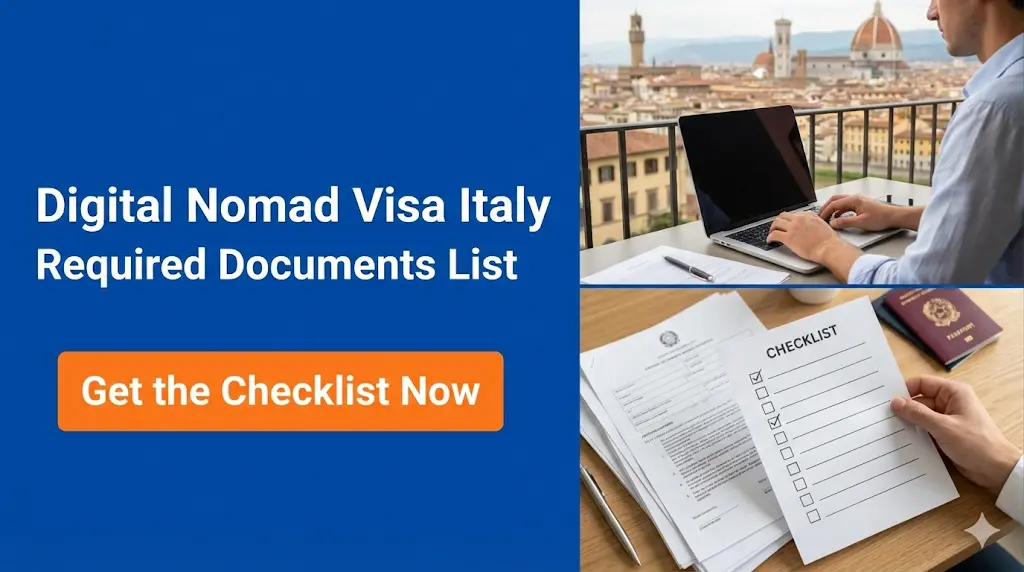
Document Checklist Summary
To assist you in organizing your application dossier, we have compiled the ultimate checklist table. Please note that consulates may request additional documentation at their discretion, so always verify with your specific diplomatic mission.
| Document Category | Specific Requirements for the Digital Nomad Visa |
| Identification | Valid Passport (15+ months validity), 2 Passport Photos, Legal Proof of Residence. |
| Visa Forms | Completed and signed National Visa Application (Type D), Visa processing fee (€116). |
| Income Proof | €28,000+ annual active income via tax returns, pay slips, contracts, and 3-12 months of bank statements. |
| Experience Proof | 3-year University Degree OR 5 years professional experience (3 years for IT managers). Minimum 6 months remote work history. |
| Employer Declaration | For employees only: Letter confirming remote work, clear of labor convictions, with signer’s ID copy. |
| Housing & Health | Registered 12-month Italian lease or deed. Private health insurance covering €30,000 minimum. |
| Background Check | Clean criminal record certificate from home country (Apostilled and translated). |
What Happens After You Arrive in Italy
Successfully organizing these documents and passing your consular interview is a massive victory, but the paperwork does not end at the border.
The visa sticker in your passport merely grants you the legal right to enter Italy. Once you arrive, Italian immigration law mandates that you must apply for a Permesso di Soggiorno (Residence Permit) within your first eight working days in the country.
You will need to take the exact same dossier of documents you presented to the consulate—your income proofs, your registered lease, your health insurance, and your authenticated degrees—to the local post office to submit your residence permit application kit. Eventually, you will present these original documents to the local Police Headquarters (Questura) for verification and fingerprinting. Therefore, it is absolutely vital that you make full copies of your entire application packet before handing it over to the consulate. For a detailed look at this post-arrival requirement, review our guide on the Italian Residence Permit (Permesso di Soggiorno) Explained.
Conclusion
The path to securing an Italy digital nomad visa is undeniably documentation-heavy. The authorities demand an uncompromising level of proof regarding your professional expertise, your financial stability, and your logistical plans. From authenticating your university degrees to securing a registered residential lease from thousands of miles away, the administrative burden is significant.
However, by approaching this checklist methodically—ensuring every contract is signed, every background check is apostilled, and every translation is flawless—you dramatically increase your chances of approval. The reward for this meticulous preparation is unparalleled: the legal freedom to immerse yourself in the Italian lifestyle, turning the cafes of Florence or the coastlines of Sicily into your everyday remote office.
References
Primary sources (official)
- Italian Consulate General New York – Digital Nomad / Remote Worker VISA: https://consnewyork.esteri.it/en/servizi-consolari-e-visti/servizi-per-il-cittadino-straniero/visti/visas-to-enter-italy/digital-nomad-remote-worker-visa/
- Visa Management Service (VMS) Italy – Visa for Digital Nomads and Remote Workers: https://italyvms.com/documents-for-moscow/visa-for-digital-nomads/
Other helpful sources
- Rippling – Italy Digital Nomad Visa: Complete Guide For 2026: https://www.rippling.com/blog/italy-digital-nomad-visa
- Boundless – Italy Digital Nomad Visa Guide for Employers and Workers: https://www.boundless.com/immigration-resources/italy-digital-nomad-visa-guide
Disclaimer
The information provided in this article is for educational and informational purposes only and does not constitute official legal, tax, or immigration advice. Visa regulations, income thresholds, and document authentication requirements are highly complex and subject to frequent changes by the Italian government and individual consulates. Always consult the official website of the Italian Ministry of Foreign Affairs, your local Italian consulate, or a certified cross-border immigration attorney for the most current and personalized guidance regarding your specific digital nomad visa application.