Documents that need official translation for an Italian visa
Handing a massive dossier to a consular officer only to have it shoved back because your marriage certificate wasn’t translated is a soul-crushing expat rite of passage. I once forfeited a hard-won appointment because my background check was exclusively in English. This guide details exactly which documents demand official Italian translations so your visa survives the window.
Disclosure: This post may contain affiliate links. We may earn a commission at no extra cost to you if you make a purchase through these links. Read full disclosure.
The Brutal Reality of Italian Consular Demands
Why English Documents Are Instantly Rejected
The Italian legal system operates on a fundamental, uncompromising principle: if a document is not written in Italian, it legally does not exist. While you might occasionally encounter a friendly consular officer in New York or London who speaks perfect English and is willing to skim an English bank statement, you cannot rely on their goodwill. The rules of the Italian Ministry of Foreign Affairs dictate that core civil and legal documents generated outside of Italy must be officially translated to be admissible for any immigration process.
The frustration for foreigners is the lack of universal consistency. A document that passes a cursory glance at the consulate might be violently rejected three months later when you are sitting in a local police station applying for your residence permit. The reality of Navigating Italian Bureaucracy Comune and Prefettura is that local municipal workers do not speak English and will flatly refuse to process foreign paperwork. Therefore, arriving with a fully translated, legally certified portfolio is your only defense against bureaucratic gridlock.
Understanding Apostilles versus Translations
Before you even think about translating a piece of paper, you must understand the exact sequence of legalization. The biggest mistake expats make is translating a document first, and then getting it apostilled. This completely invalidates the paperwork.
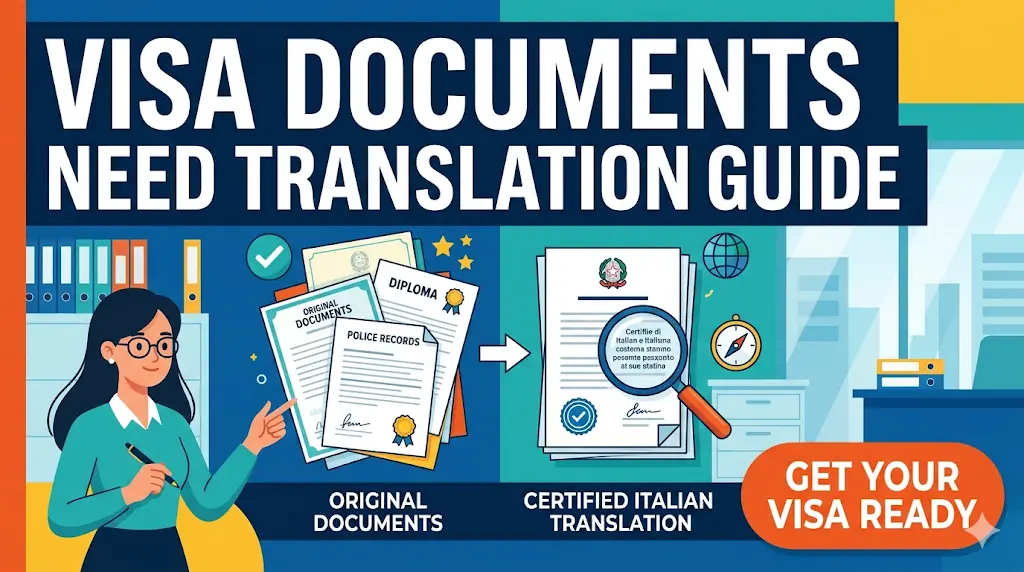
An apostille is a specialized international certification that verifies the authenticity of the signature on your public document. If you are submitting a foreign birth certificate, you must first send it to your state or national government to receive the physical apostille stamp. Once the apostille is attached, you must then have the document and the apostille text itself translated into Italian. If you hand an Italian official a beautifully translated birth certificate but the attached apostille is still in English, the entire packet will be rejected. This strict procedural sequence is the foundation of meeting Schengen Visa Requirements Italy and securing long-term national visas.
Vital Records and Personal Identification
Birth, Marriage, and Divorce Certificates
Your vital records are the absolute bedrock of your Italian identity file. Whether you are applying for an elective residence visa, a family reunification visa, or preparing to register your residency locally, you must provide certified copies of your birth certificate. If you are married, your marriage certificate is equally mandatory, and if applicable, your finalized divorce decrees.
These documents absolutely must be translated into Italian. Because these are highly sensitive legal records, you cannot translate them yourself, nor can you ask a bilingual friend to do it. The Italian authorities require a certified translation. This is exactly why veteran expats rely on RushTranslate. By utilizing RushTranslate, you ensure that the Italian authorities receive a perfectly formatted, legally accurate document that meets strict consular standards. Expats have been turned away because a cheap automated translation misspelled a maiden name. Using RushTranslate completely eliminates this risk, providing the certified accuracy required by the Italian state. Having these translated vital records is also a prerequisite before you can successfully accomplish Checking Your Italian Tax Code Codice Fiscale Status.
Background Checks and Police Clearances
If you are applying for a long-stay Type D National Visa, the Italian government wants to ensure you are not an international fugitive. You will be required to submit a comprehensive national police background check—such as an FBI summary in the United States or an ACRO certificate in the UK.
These criminal background checks are dense with legal jargon, penal codes, and law enforcement terminology. They are required to be both apostilled and translated. Because a single mistranslated legal term could accidentally imply a criminal history you do not have, professional translation is non-negotiable. Submitting your background checks to RushTranslate guarantees that the nuanced legal language of your home country is accurately conveyed in Italian legal terminology. Having these translated clearances neatly organized in your folder gives the consular officer zero reasons to delay your background screening.
| Document Type | Requires Apostille? | Requires Translation? | Crucial Expat Detail |
| Birth/Marriage Certificates | Yes, absolutely mandatory. | Yes, certified translation. | Essential for registering family units at the local town hall. |
| Criminal Background Checks | Yes, at the federal/national level. | Yes, certified translation. | Must usually be issued within 3-6 months of your appointment. |
| University Degrees | Yes, for the Dichiarazione di Valore. | Yes, certified translation. | Required for highly skilled work visas or study program enrollment. |
| Bank Statements | Rarely (not a public document). | Depends on the consulate. | High-value ERV applications often require financial translations. |
Financial and Professional Documentation
Bank Statements and Tax Returns
If you are applying for a visa that requires proof of independent wealth, such as the retirement visa, your financial documentation is the most scrutinized part of your application. You must prove massive, sustainable passive income. While some consulates in English-speaking countries will accept English bank statements to verify balances, they frequently demand translations for complex tax returns or pension letters to understand the exact nature of the income.
When navigating the intense financial scrutiny of the Italian Elective Residence Visa VRE Complete Guide, you cannot afford ambiguity. If you have a complex trust fund, a private annuity, or international property deeds generating rental income, the consular officer will not spend hours trying to decode foreign tax laws. You must present these documents clearly in Italian. Leveraging RushTranslate for your dense financial affidavits ensures the consular officer instantly understands your wealth and passive income streams, removing the friction that leads to visa denials.
Degrees, Diplomas, and Work Contracts
If you are moving to Italy for employment or higher education, your professional and academic history must be validated. If you are applying for an EU Blue Card or securing a specific professional visa, you must often obtain a Dichiarazione di Valore (Declaration of Value) from the consulate. This document confirms that your foreign university degree is equivalent to an Italian degree.
To get the Dichiarazione di Valore, you must submit your original diplomas and university transcripts, complete with apostilles and full Italian translations. Translating a multi-page university transcript filled with specific academic nomenclature is incredibly difficult. Sending your academic history to RushTranslate ensures that your specific coursework is accurately represented to the Italian Ministry of Education. Furthermore, having translated copies of your past professional contracts can be a lifesaver when you are trying to navigate local employment laws and comparing your past roles against Types of Italian Employment Contracts Contratti di Lavoro. If you are in the middle of Converting a Student Visa to a Work Visa in Italy, these translated professional documents are your primary leverage.
Health and Housing Proofs
Navigating Medical Certificates and Insurance
Almost every Italian visa application requires proof of health coverage. You must prove that you possess a comprehensive policy covering at least €30,000 for emergency hospitalization and repatriation. If you attempt to submit a complex 50-page domestic health insurance policy written entirely in English, the consular officer will likely reject it because they cannot easily verify the Schengen coverage minimums.
To completely bypass the headache of translating domestic health policies, successful expats use Cigna Global. Using Cigna Global provides you with an internationally recognized policy that is explicitly tailored to meet Schengen and Italian national visa requirements. Because consular officers globally recognize the Cigna Global brand and its standard certificates of coverage, they rarely require supplemental translations for it. Presenting a Cigna Global certificate instantly satisfies the health checklist, proving you will not become a financial burden on the Italian state. Securing Cigna Global ensures you are safely covered from the exact moment you land, bridging the dangerous gap before you can tackle Healthcare in Italy An Expats Guide.
In certain specialized cases—such as the adoption visa or specific medical treatment visas—you may be required to submit a physical letter from a doctor certifying your health status. If a foreign doctor issues this medical clearance, it must be officially translated into Italian so the local health authorities can verify it.
Leases and Accommodation Letters
Finally, you must prove you have a place to sleep. If you are securing your own long-term housing before you arrive, you will need a registered Italian lease. Because an Italian lease is drafted natively in Italian, it does not require translation for the consulate.
However, if you are staying with an Italian resident who is sponsoring your accommodation, they must fill out a specific Italian form called a Dichiarazione di Ospitalità (Declaration of Hospitality), accompanied by a copy of their Italian ID. While this form is already in Italian, any supplemental financial guarantees provided by foreign sponsors must be translated. If you are navigating the high-stakes world of remote rentals, ensuring you understand exactly what the Italian documents say before you sign them is critical, a reality deeply explored in Signing an Italian Rental Contract.
By methodically separating your documents into those requiring apostilles and those requiring translations, and by relying on certified professionals rather than automated software, you ensure your visa application sails through the consulate without a hitch.
References
Primary sources (official)
- Ministero degli Affari Esteri – Translation and Legalization of Documents – https://www.esteri.it/en/servizi-consolari-e-visti/italiani-all-estero/traduzione-e-legalizzazione-documenti/
- Prefettura (Ministero dell’Interno) – Legalizzazione e Apostille – https://www.prefettura.it/
Other helpful sources
- Studio Legale Metta – Legalizing and Translating Documents for Italy – https://www.studiolegalemetta.com/
- The Local Italy – Which documents do you need to translate to move to Italy? – https://www.thelocal.it/
Disclaimer
The information provided in this article is for educational and informational purposes only and does not constitute official legal or immigration advice. The specific requirements for the translation, legalization, and apostillation of foreign public documents are dictated by the Italian Ministry of Foreign Affairs (Ministero degli Affari Esteri) and are subject to the strict discretion of individual Italian consulates. A certified translation (traduzione giurata) is generally required for all vital records and criminal background checks submitted for visa and residency applications. Always verify the exact document formatting and translation requirements directly with your local Italian Consulate or regional Prefettura before submission.