Renewing Your Permesso di Soggiorno in Italy: Timing and Steps
Standing in a line at 5 AM outside a Questura in the dead of winter is a rite of passage most of us expats wish we could skip. I have personally spent countless mornings clutching a yellow envelope, worrying if one missing photocopy would derail my entire life in Italy. This guide solves the confusion by breaking down the exact timeline and steps for a successful Permesso di Soggiorno renewal.
Disclosure: This post may contain affiliate links. We may earn a commission at no extra cost to you if you make a purchase through these links. Read full disclosure.
Understanding the Timing for Your Renewal Application
Timing is everything when it comes to Italian bureaucracy, but the rules can feel like they are written in a secret code. According to Italian law, you are technically supposed to apply for a renewal between 90 and 60 days before your current permit expires, depending on the duration of your permit. However, the reality on the ground is often much more flexible, albeit stressful. If you apply too early, the post office system might reject the application; if you apply too late, you risk being told your stay is no longer "regular."
The most important date to remember is the 60-day mark after your permit has expired. If you let more than 60 days pass without submitting your renewal kit, you are technically in the country illegally. While many of us have faced delays due to the simple unavailability of the "Kit Giallo" at the local post office, waiting until the last minute is a gamble you don't want to take. I once waited until two weeks before expiration, only to find my local Sportello Amico was closed for an unannounced holiday.
The 60 Day Golden Rule
For most long-stay permits, such as work or family reasons, the law suggests submitting the kit 60 days before the expiration date. This window is designed to give the Questura enough time to process the initial data before your current card becomes a plastic souvenir. In practice, however, the Questura is so backed up that your renewal won't be processed for months anyway. The goal of the 60-day rule is primarily to ensure you have your "ricevuta" (the receipt) in hand before the card in your wallet expires.
If you are on a student permit, this window is even tighter. You should be looking to gather your university transcripts and proof of funds as soon as you hit the three-month countdown. Remember that you also need to have a valid tax code during this time, so ensure you know How to Get a Codice Fiscale in Italy (and Why You Need One) before you even walk into the post office. Having your paperwork organized early is the only way to maintain your sanity in this process.
Consequences of Missing the Deadline
What happens if you actually miss the deadline? If you submit your renewal kit within 60 days after the expiration, you are generally safe, provided you have a "justified reason" for the delay (like a medical emergency or a documented family crisis). However, once you cross that 60-day threshold after expiration without an application, the Questura has the legal right to reject your renewal and issue an order to leave the country.
I have seen expats get away with late filings by showing that they couldn't find a kit or were waiting on a contract renewal. But relying on the mercy of a tired official at the Questura is not a strategy I recommend. If you find yourself in a tight spot with documentation, it is often better to submit an incomplete kit and then bring the missing pieces to your fingerprinting appointment than to wait and submit a "perfect" kit late.
Navigating the Kit Postale System
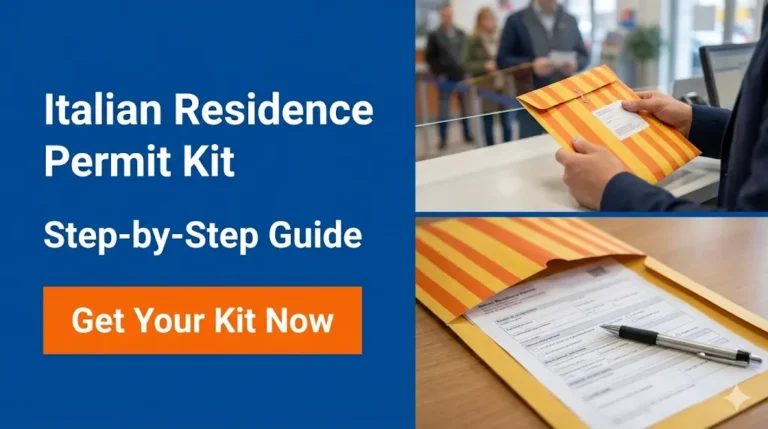
The "Kit Postale," or the infamous yellow-striped envelope, is the gateway to your continued life in Italy. You can find these at any Poste Italiane branch that has a "Sportello Amico" counter. Be warned: not every post office carries them, and they often run out. I’ve had to visit four different offices in Milan just to find one available envelope. When you finally get your hands on it, you’ll find two forms—Modulo 1 and Modulo 2—and a set of instructions that are notoriously difficult to decipher.
Filling out the forms requires a black pen and a steady hand. Any "bianchetto" (correction tape) will result in the form being rejected. You will need to provide your personal details, your current permit number, and details about your residence. During this phase, you must also ensure your residency is up to date, as the address you provide will be where your appointment notice is sent. If you have moved, check the requirements on How to Get a Certificato di Residenza in Italy to make sure your records match your current housing.
Finding and Filling Out the Modulo One
Modulo 1 is the primary form for all permit types. It asks for your identity information, passport details, and the reason for your stay. You must be extremely careful with the "Codice Tipologia Permesso"—the code that identifies the type of permit you are renewing. A common mistake is using the code for a first-time application instead of a renewal, which can lead to significant delays at the Questura later.
If you are feeling overwhelmed by the technical jargon on the form, you can visit a "Patronato." These are semi-public offices that offer free or low-cost assistance to foreigners. They have software that prints the forms for you, reducing the risk of manual errors. I always suggest a Patronato for first-timers; they know the local quirks of the specific Questura you’ll be dealing with, which can be invaluable when the rules seem to change overnight.
The Essential Documents for Your Renewal Kit
Inside that yellow envelope, you aren't just sending forms; you are sending a curated history of your life in Italy. You will need a full photocopy of your passport (every single page, even the blank ones), a copy of your current Permesso di Soggiorno, and a copy of your Codice Fiscale. Do not send original documents! The post office only checks that the photocopies are present; the originals stay with you for the physical appointment.
Depending on your permit type, you’ll need specific proof of income or enrollment. For workers, this means your recent "busta paga" (payslips) and your employment contract. It is helpful to understand the nuances of your work agreement; for example, knowing How to Understand an Italian Employment Contract (CCNL Basics) can help you identify exactly which documents prove your income is above the social subsidy threshold.
| Item | Cost (Approximate) | Where to Pay/Get |
|---|---|---|
| Marca da Bollo (Duty Stamp) | €16.00 | Tabaccheria |
| Electronic Permit Fee | €30.46 | Post Office (via Bollettino) |
| Renewal Contribution Fee | €40.00 – €100.00 | Post Office (varies by duration) |
| Post Office Mailing Fee | €30.00 | Post Office Counter |
The Appointment at the Questura
Once you mail your kit, the post office will give you a piece of paper with your appointment date and time at the Questura. In major cities like Rome or Florence, this appointment might be six or eight months away. Do not lose this paper! It is your lifeline. On the day of your appointment, arrive early. Even if your appointment says 10:00 AM, there will likely be a crowd of people who have been waiting since dawn.
When you finally enter the Questura, you will undergo "rilievi fotodattiloscopici"—a fancy term for fingerprinting. You will also hand over the original versions of the photocopies you put in your kit. The official will verify your income, your housing, and your insurance. If you are using private insurance, companies like Cigna Global are widely recognized and can provide the specific coverage levels required for Italian residency.
Fingerprinting and Document Verification
The fingerprinting process is usually the quickest part of the day, but the document verification can be grueling. The official may ask for documents that weren't explicitly listed in the kit instructions, such as a recent "CUD" (tax summary) or a "Certificato di Idoneità Alloggiativa" (housing suitability certificate) if you are renewing a family permit. This is where your preparation pays off. I always bring a "folder of everything"—every lease, every bill, and every contract I’ve signed in the last year.
If a document is missing, don't panic. Usually, they will give you a "preavviso di rigetto" or a simple request for integration, giving you 10 to 30 days to bring the missing paper back to the office. This is annoying but not fatal to your application. Just make sure you get a receipt for any new documents you hand over. During this waiting period, you can always check How to Track Your Permesso di Soggiorno Status Online to see if the status of your file has been updated from "in istruttoria" (under review) to "in consegna" (ready for pickup).
Dealing with Language Barriers and Delays
The staff at the Questura are often overworked and may not speak English. This is where your "survival Italian" comes into play. If your Italian is shaky, bring a friend or a professional translator. If your supporting documents are in a foreign language—like a birth certificate or a foreign diploma—they must be translated into Italian. Services like RushTranslate or Translayte provide certified translations that meet the rigorous standards of Italian public offices. Using a service like Translayte ensures that the terminology matches exactly what the Italian officials are looking for.
Expect delays. It is not uncommon for the Questura to call you back for a second appointment because their fingerprinting machine was broken or because they need a more recent "unilav" form from your employer. Stay patient and polite. In the Italian bureaucratic machine, a smile and a "buongiorno" can sometimes move your file from the bottom of the pile to the top.
Bridging the Gap: Living on the Receipt (Ricevuta)
One of the most stressful parts of the renewal process is the "limbo" period. You have submitted your kit, your old card has expired, and your appointment is months away. During this time, the "ricevuta" (the post office receipt with the hologram) is your legal proof of residency. It is a powerful document, but it has its limits. You are legally allowed to stay in Italy and continue working, but your ability to travel within the Schengen area is severely restricted.
You can also continue to access the healthcare system. If you are already registered, your coverage is generally extended while your renewal is pending. If you are new to the process or have questions about how this works, reading up on Healthcare in Italy: An Expats' Guide will help you navigate the transition. The receipt acts as a temporary bridge, ensuring you don't lose access to essential services while the Questura takes its time.
Travel Rights with the Post Office Receipt
Can you travel while waiting for your Permesso? This is the question I get asked most often. The rule is simple but strict: you can travel to your home country and back to Italy, provided you take a direct flight that does not transit through another Schengen country (like Germany or France). You must carry your expired Permesso, your passport, and the original post office receipt.
I once made the mistake of booking a flight through Munich while on a "ricevuta," and I was nearly denied boarding. The border police in other Schengen countries are not required to recognize the Italian renewal receipt as a valid travel document. If you must travel within Europe, you are technically supposed to wait for the actual plastic card. For those who need constant flexibility, having international private insurance through Cigna Global can at least ensure you are covered for medical emergencies anywhere in the world while you wait for your Italian documents to clear.
Accessing Public Services and Healthcare While Waiting
Your "ricevuta" allows you to renew your registration with the National Health Service (SSN). You will need to take your receipt and your expired health card to your local ASL (Azienda Sanitaria Locale). They will usually issue a temporary paper version of your health card that is valid until your new Permesso is issued. This ensures you can still see your Registering with an Italian Family Doctor (Medico di Base) without interruption.
If you have kids, the receipt is also sufficient to enroll them in school or to continue receiving family benefits. If you encounter a clerk who insists on the plastic card, politely remind them of the "Direttiva Amato," which explicitly states that foreigners with a renewal receipt have the same rights as those with a valid permit. Sometimes you even have to show them the law on your phone—it’s just part of the expat life here. If you are struggling with residency-related healthcare access, look into How to Register for the SSN Without a Permanent Address in Italy for additional workarounds.
Special Requirements for Different Permit Types
The renewal process isn't "one size fits all." A student renewing for a Master's degree faces very different hurdles than a freelancer with a Partita IVA. Each category has its own "Modulo 2" requirements, which focus on your economic stability. Italy wants to see that you aren't going to become a "peso" (burden) on the state. For most, this means showing an annual income that is at least equal to the social allowance (Assegno Sociale), which is roughly €7,000 to €10,000 per year depending on family size.
For those on a work permit, the Questura will look closely at your tax contributions. They want to see that you have actually been working and paying into the INPS system. If you’ve had a period of unemployment, you may need to show that you are registered with the employment office (Centro per l'Impiego) to get a "Permesso per Attesa Occupazione," which gives you a one-year window to find a new job.
Renewing Work Permits and Employment Proof
If you are an employee, the process is relatively straightforward. You need your latest "Unilav" (the document your employer filed when they hired you) and your last three payslips. If you are a freelancer, it’s a bit more complex. You’ll need to provide your VAT registration (Partita IVA), your latest tax return (Modello Redditi), and proof that you’ve been paying your social security contributions.
I’ve known freelancers who were asked for a "DURC"—a document proving they have no outstanding debts with the social security office. This isn't always required, but having it ready can prevent a second trip to the Questura. If you’ve changed employers during the year, make sure you have all the contracts from both the old and new jobs. The Questura needs to see a continuous chain of employment to justify the renewal.
Family and Study Permit Specifics
Students must show they have passed at least one exam for the first renewal and at least two exams for subsequent renewals. You’ll need a "Certificato di Iscrizione con Esami Sostenuti" from your university. Be careful: if you switch courses, you need to ensure the new course is in the same general field, or the Questura might suspect you are just "visa-shopping."
For family permits, the focus shifts to the "cohabitation" and the income of the sponsoring family member. You will likely need a "Stato di Famiglia" certificate and proof that the person you are living with has sufficient income to support you. If you were recently married or had a child in Italy, those certificates must be properly registered with the Comune. If those documents were issued abroad, remember to use RushTranslate or Translayte to get them into the proper Italian format before your appointment.
Health Insurance and Professional Translations
One of the most common reasons for a "kick-back" at the Questura is insufficient health insurance or poorly translated documents. If you are not yet eligible for the public SSN—perhaps because you are a student or on an elective residence permit—you must have a private policy. The Questura is very specific: the policy must cover "all risks" and have no limit on duration or spending for emergency hospitalizations.
Many cheap "visa insurance" policies are rejected because they don't explicitly state they cover the cost of repatriation or because they have a low ceiling for payouts. This is why many veterans in the community opt for Cigna Global, as their certificates are recognized by Italian authorities and clearly state the coverage levels required by law. Having a clear, English-Italian bilingual certificate can save you twenty minutes of explaining at the counter.
Ensuring Continuous Health Coverage
When you renew your permit, you are also renewing your right to be in the health system. If you are an employee, this is automatic, but you still need to show your "Tessera Sanitaria" at the Questura. If your health card has expired, you’ll need to show the receipt from the ASL showing you’ve applied for the new one. If you are confused about the private versus public debate, check out Getting Health Insurance in Italy: Public and Private Options to see which path is right for your specific visa type.
In some cases, you might be asked for a How to Get a Sick Note in Italy (Certificato di Malattia) if you are claiming a renewal based on health reasons or if you missed a previous appointment due to illness. The Questura values documentation above all else; if it isn't on paper and stamped, it didn't happen.
Meeting Translation Standards for Foreign Documents
Italy is a member of the Hague Convention, which means many documents need an "Apostille" from your home country. Once apostilled, they must be translated. However, a simple translation isn't enough; it usually needs to be a "traduzione giurata" (sworn translation) performed by a translator registered with the Italian courts.
Using a professional agency like RushTranslate or Translayte is vital here. They understand the difference between a standard certified translation and the specific requirements of the Italian "Procura." I have seen people lose their appointments because their translation was "certified" in the US but not "sworn" in Italy. Agencies like Translayte can often facilitate the process of getting documents ready for Italian officials, ensuring that your marriage certificate or diploma is accepted without question. For a deeper look at this, see How to Get a Sworn (Giurata) Translation for Italy.
Disclaimer
The information provided in this guide is for informational purposes only and does not constitute legal or professional advice. Immigration laws and local Questura practices in Italy change frequently. Always consult with the official Portale Immigrazione, a qualified immigration lawyer, or a certified Patronato before submitting your application.