Italian Dialects and Regional Languages: What to Expect
Oh, the beautiful, bewildering world of Italian dialects! If you've just arrived in Italy, proudly brandishing your freshly learned "Ciao, come stai?" and then found yourself utterly lost in a conversation between two locals, you're certainly not alone. Many expats mistakenly believe that "Italian" is one monolithic language spoken uniformly across the boot. The reality is far more colorful, complex, and sometimes, frankly, frustrating. This guide will peel back the layers of Italy's rich linguistic tapestry, helping you understand what to expect from its diverse regional languages and how to navigate this fascinating aspect of Italian life.
Disclosure: This post may contain affiliate links. We may earn a commission at no extra cost to you if you make a purchase through these links. Read full disclosure.
More Than Just "Italian": Understanding Italy's Linguistic Tapestry
When you think of Italy, you might imagine a singular, melodious language spoken from the Alps to Sicily. While Italiano is indeed the official language, the linguistic landscape here is a vibrant mosaic of deeply rooted regional languages and dialects, each with its own history, grammar, and vocabulary. It's a source of immense local pride and, let's be honest, a significant head-scratcher for newcomers.
What is a Dialect, Anyway?
This is where it gets tricky, and it's a point of frequent debate even among Italians. What we often refer to as "dialects" in Italy are, in many cases, distinct Romance languages that developed independently from Vulgar Latin, just as Standard Italian did. They are not merely "bad Italian," simplified versions, or accents. No, these are full-fledged linguistic systems with their own rules, literature, and often, a profound lack of mutual intelligibility with Standard Italian, especially between distant regions. Think of the difference between Spanish and Portuguese, or even French and Italian – that's sometimes how disparate these "dialects" can be.
The term "dialect" often carries a connotation of being a lesser form of a language, a subsidiary branch. In Italy, this historical labeling reflects a political reality that began with unification. Before 1861, Italy was a patchwork of independent states, each with its own local language flourishing. When the Kingdom of Italy was established, Florentine Italian, largely based on the language of Dante, Petrarca, and Boccaccio, was chosen as the national language. The other languages, despite their long histories and unique structures, were relegated to the status of "dialects" to foster national unity. This historical context is crucial to appreciating their significance and why they persist so strongly today.
The Historical Roots of Italy's Language Diversity
To truly grasp Italy's linguistic diversity, you need a quick trip through history. For centuries before unification, the Italian peninsula was not a single nation, but a collection of city-states, kingdoms, and duchies, often under the sway of various foreign powers. Each of these political entities fostered its own local language. The Kingdom of Sicily, the Kingdom of Naples, the Papal States, the Republic of Venice, the Duchy of Milan – each was a crucible for distinct linguistic evolution.
Consider the influences: Greek colonists in the South left an indelible mark, particularly in Magna Graecia; Lombards, Normans, Arabs, and later the Spanish and French, all brought their languages and cultures, which seeped into the local Vulgar Latin varieties. This continuous layering of influences, combined with geographical isolation in many areas (think mountains and islands), prevented the linguistic convergence that might have happened in a more unified political entity. So, while Tuscan Italian became the lingua franca for the newly formed nation, the regional languages, or dialetti, continued to thrive in homes, local markets, and daily life, representing centuries of unique cultural heritage.
A Journey Through Italy's Major Linguistic Landscapes
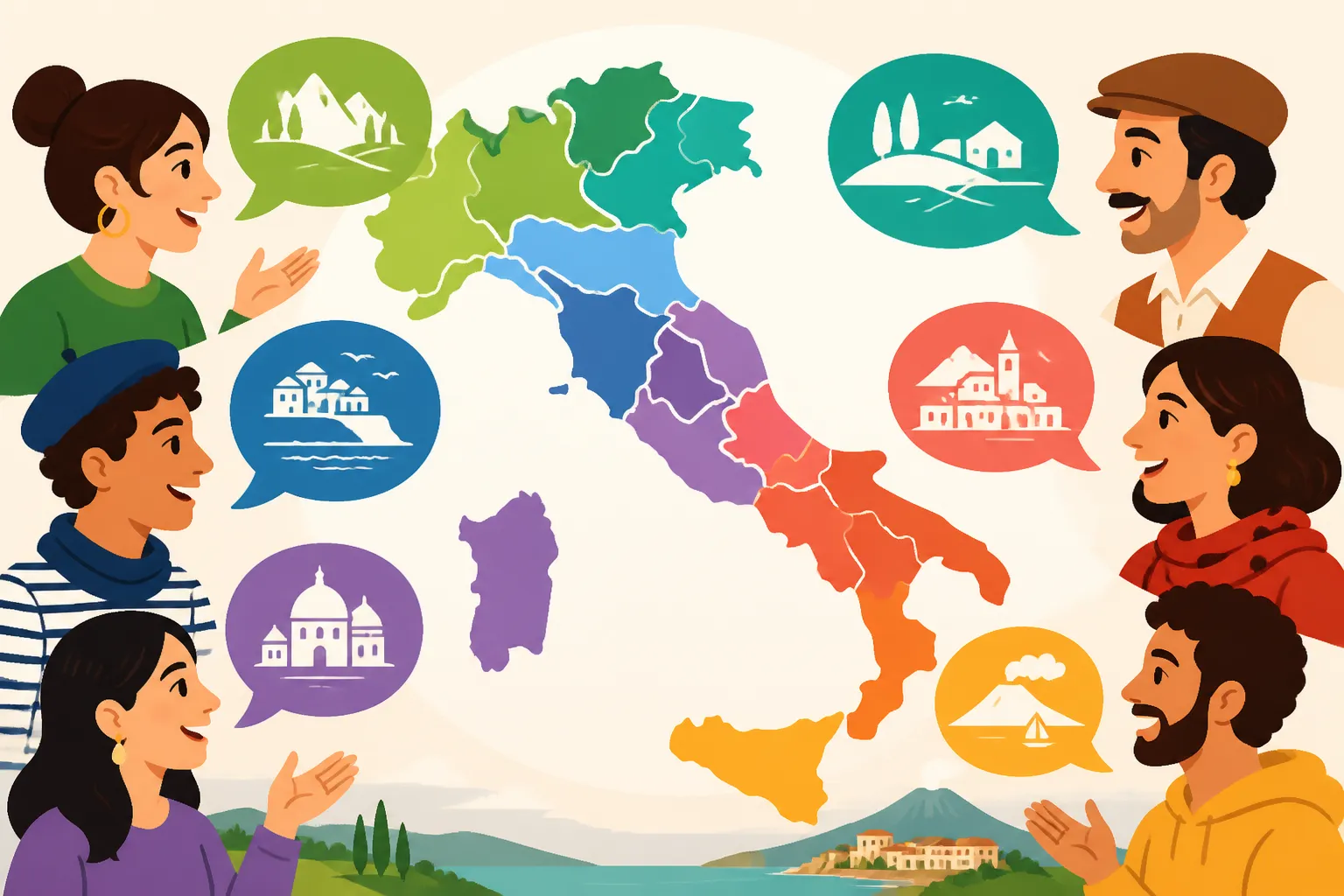
Italy's diverse geography naturally fostered different linguistic families, each with its own captivating quirks. Trying to learn them all is a fool's errand, but understanding the general groupings can certainly help you anticipate what you might encounter.
Northern Italy: From Gallo-Italic to Venetian
As you move north, the languages you encounter begin to show stronger influences from French, German, and Celtic roots. The Gallo-Italic family, prevalent in regions like Piedmont, Lombardy, Emilia-Romagna, and Liguria, is a prime example. Languages like Piedmontese have distinct French-like vowels and pronunciations, a vestige of the historical ties between the House of Savoy and France. Lombard, spoken around Milan and beyond, and Emilian-Romagnol, stretching across the Po Valley, share some common features but retain their own unique flavors. If you're using travel apps like Omio to book trains across these regions, you'll still see standard Italian names for cities, but listen closely in train stations or local markets, and you'll hear the local tongue.
Further east, you find Venetian, a language spoken not just in Venice but throughout the Veneto region and beyond. It’s famous for its distinct melodic quality and has a rich literary tradition. Other notable northern languages include Friulian (related to Romance languages like Romansh in Switzerland) and Ladin in the Dolomites, which coexists with German due to the region's unique history and cultural ties. In areas like Trentino-Alto Adige, you’ll find significant German-speaking populations, particularly in Bolzano and surrounding areas, adding another layer to the linguistic tapestry.
Central Italy: Tuscany's Enduring Influence and Beyond
Central Italy is where things start to feel a bit more familiar if you've been diligently studying Standard Italian, and for good reason. Tuscan is, of course, the granddaddy of modern Italian, so the languages of central regions like Umbria, Marche, and parts of Lazio tend to be closer to it than their northern or southern counterparts. When people talk about "pure Italian," they're often referring to the clarity and pronunciation of Tuscan.
However, even here, distinct differences exist. Umbrian and Marchigiano varieties, for instance, have their own intonations and specific vocabulary that differentiate them from pure Tuscan. Then there's Romanesco, the dialect of Rome. While heavily influenced by Standard Italian over the centuries due to Rome's status as the capital, it still maintains its characteristic cadence, common expressions, and specific pronunciations, especially the way certain consonants are softened. It's not uncommon to hear a Roman effortlessly switch between Italiano and a lively Romanesco in the same conversation, particularly when discussing local matters or sharing a joke.
Southern Italy and the Islands: A Rich Mosaic of Voices
Ah, the South! This is where the linguistic diversity truly explodes, and often, the differences from Standard Italian are most pronounced, even to the point of being mutually unintelligible. The history of Southern Italy and its islands is one of constant flux, with waves of Greek, Byzantine, Arab, Norman, French, and Spanish rule. Each left its imprint, resulting in languages that are incredibly rich and distinct.
Neapolitan, spoken in Naples and across Campania, is perhaps one of the most famous. It has a vibrant phonetic system and a grammar structure that can be surprisingly complex for Italian speakers. Many popular songs and theatrical works are written in Neapolitan, making it a powerful cultural force. Further south, Sicilian is another major language, heavily influenced by Greek, Arabic, and Spanish. It’s not just an accent; it’s a language with its own deep history and a vocabulary that often bears no resemblance to its Italian equivalents. Then there's Sardinian, often considered one of the most conservative (meaning it retains more ancient Latin features) Romance languages. It's so distinct that it's recognized as a separate language by UNESCO. Similarly, languages in Puglia and Calabria also have unique features, reflecting their varied histories. Don't be surprised if your carefully rehearsed Italian phrases get a blank stare here; a little understanding of these deep regional differences goes a long way.
Navigating the Linguistic Labyrinth: What Expats Encounter
You've spent months learning Italian, you feel confident, and then you step into a bustling market in a small town. Suddenly, your carefully constructed sentences sound foreign, and the rapid-fire exchange of vendors and locals is utterly incomprehensible. Welcome to the expat experience with Italian dialects!
Daily Interactions and Bureaucracy: When Dialects Surface
The initial shock of hearing a local dialect can be disorienting. You might think your Italian has mysteriously vanished overnight. The truth is, particularly in smaller towns, among older generations, or within close-knit family and friend groups, the dialetto is still the language of daily life. It's used for gossiping at the bar, bargaining at the market, or simply chatting about the weather. This can be genuinely frustrating when you're trying to integrate, learn, and simply understand what's going on around you. A perfectly reasonable request for a coffee at a small bar might be met with a rapid-fire local phrase you've never heard before.
When it comes to formal bureaucracy, you're generally safe. Official documents, signs, and most interactions at the Comune or Questura will be in Standard Italian. However, don't underestimate the power of local inflections or regional accents, even when Standard Italian is being spoken. Sometimes, the way a person speaks Italian will carry strong traces of their regional language, influencing pronunciation and intonation. This can be especially true in more informal settings, like asking for directions, chatting with shopkeepers, or even understanding local news broadcasts. For complex administrative tasks, it's always helpful to have a strong grasp of Standard Italian, and sometimes, a friend who understands the local nuances can be a lifesaver when you're trying to register residency in Italy (Residenza and Anagrafe) or dealing with any local government office.
Culture, Community, and Connection Through Local Tongues
While challenging, engaging with the local dialect can be an incredibly rewarding part of your expat journey. It’s a direct conduit to the heart of local culture and identity. Imagine trying to explain the subtle humor of a regional joke if you don't grasp the linguistic context! When you make an effort, even a small one, to learn a few phrases in the local dialetto, you'll often find a remarkable warmth and appreciation from Italians. It signals that you're not just a passing tourist, but someone genuinely interested in their home.
It can be a powerful tool for forging deeper connections. Many local festivals, traditional songs, and even some culinary terms are deeply tied to the regional languages. Platforms like GetYourGuide offer many cultural tours, and while the guides will speak Standard Italian, occasionally you might hear them switch to a dialect when interacting with local vendors or artisans. This glimpse into the authentic local interaction is part of the charm. If you can pick up on these nuances, it enriches your understanding of the community beyond the standard tourist facade. It might even lead to invitations into local family gatherings or deeper friendships, opening doors that remain closed to those who stick strictly to textbook Italian.
Embracing the Local Lexicon: Tips for Language Mastery
So, you're an expat in Italy, and the dialects are proving to be both fascinating and formidable. What's a language learner to do? Don't despair! While becoming fluent in a dialect usually takes years of immersion, there are strategies to help you navigate and even embrace this linguistic reality.
When and How to Engage with Regional Varieties
The first rule of thumb is to prioritize Standard Italian. Before you even think about tackling a dialetto, ensure your grasp of the national language is solid. Trying to learn a dialect without a strong foundation in Italian is like building a house without a proper foundation – it'll be wobbly and confusing. Once you feel comfortable conversing in Italian, then you can consider dipping your toes into the local variant. Many excellent language schools across Italy, such as those you might find listed when looking for Learning Italian: Language Courses and Tests for Expats, focus primarily on Standard Italian, and that should be your initial focus.
When you do decide to engage, context is key. Don't try to use dialect in formal situations, with strangers, or in professional settings unless you're explicitly invited to. It can come across as presumptuous or even disrespectful if misused. Instead, experiment with a few simple greetings or expressions with trusted local friends, neighbors, or colleagues who have encouraged you. Observe how they speak and when they switch between Italian and dialect. Be humble, ask questions, and accept corrections graciously. Sometimes, simply expressing your interest in the local language, rather than attempting to speak it perfectly, is enough to warm hearts and open conversations. Remember, the goal isn't necessarily fluency, but connection.
Practical Strategies for Understanding and Being Understood
Even if you don't plan to speak a dialect, understanding it will significantly enhance your daily life. Here are some practical tips:
- Listen Actively: Pay attention to intonation, common phrases, and recurring words. You'll start to recognize patterns even if you don't grasp every single word.
- Ask for Clarification (Politely!): Don't be afraid to say, "Scusi, potrebbe ripetere in italiano standard?" (Excuse me, could you repeat that in Standard Italian?) or "Non ho capito bene, potrebbe spiegare?" (I didn't quite understand, could you explain?). Most Italians will be happy to switch or rephrase.
- Embrace Contextual Clues: Body language, gestures, and the overall situation can often give you enough information to grasp the gist of a dialect conversation. Italian communication is highly expressive, and the visual cues are invaluable, as you'd discover when learning about Italian Social Customs: Greetings, Gestures, and Personal Space.
- Find a "Language Buddy": If you have a local friend who is patient and enjoys teaching, ask them to explain some common dialect words or phrases. They can act as your personal dictionary and cultural interpreter.
- Start Small: Focus on understanding key vocabulary related to food, common greetings, or local expressions that you hear frequently. You might find some of these listed in guides like Italian Food Culture: Eating Well as a Visitor, where regional food names often carry dialectal roots.
- A Sense of Humor is Essential: You will make mistakes, and you will misunderstand. Laugh it off. Italians appreciate a good laugh, and your willingness to try, even if imperfectly, will usually be met with kindness rather than judgment. This journey is part of the experience of truly living in Italy.
Beyond the Basics: Deeper Linguistic Insights
The world of Italian dialects goes beyond simple pronunciation differences; it delves into unique grammatical structures and entirely separate vocabularies. Understanding these deeper insights can help you appreciate the linguistic richness even more.
Pronunciation, Grammar, and Vocabulary Shifts
The differences between Standard Italian and its regional counterparts are often profound. Pronunciation can vary wildly; for instance, double consonants might be softened or emphasized differently, and vowel sounds can shift dramatically. In many southern languages, the 'o' at the end of words might become an 'u', and the 'e' an 'i'. The classic "c" sound can be pronounced like a "ch" or even a "sh" depending on the region.
Grammatically, things get even more complex. While Standard Italian relies heavily on definite and indefinite articles (il, la, i, le; un, una), many dialects have their own distinct article systems. Verb conjugations can be simplified, more complex, or completely different from their Italian equivalents. For example, the infinitive form of verbs might look completely foreign.
But it's in vocabulary where the most striking differences lie. Common objects, actions, and greetings often have completely different words in dialect. A simple "hello" or "goodbye" can transform entirely. Here's a tiny glimpse:
| Standard Italian | Neapolitan | Sicilian | Venetian | English |
|---|---|---|---|---|
| Ciao | Ciao / Salve | Ciao / Salve | Ciao | Hello/Goodbye |
| Grazie | Grazie | Grazzî | Grasie | Thank you |
| Acqua | Acqua | Acqua | Aqua | Water |
| Ragazzo | Guaglione | Picciotto | Bocia / Zovene | Boy / Young Man |
| Andare | Jì | Jiri | Ndar | To Go |
| Qui | Ccà | Ccà | Qua | Here |
| Casa | Casa | Casa | Caxa | House |
This table is just a superficial peek; many dialects have thousands of unique words. While booking accommodation through Booking.com or transportation through Omio, you'll naturally use Standard Italian. However, understanding that a local might use "guaglione" instead of "ragazzo" can make a significant difference in your comprehension during casual conversations. These are not merely alternative words; they are part of a separate lexicon, reflecting distinct cultural and historical narratives.
The Evolving Role of Regional Languages in Modern Italy
In modern Italy, the use of regional languages is undergoing a fascinating evolution. For much of the 20th century, particularly after World War II, there was a strong push for linguistic homogenization, primarily through national education and mass media. Younger generations were often discouraged from speaking dialetto in school, and the rise of national television and radio further promoted Standard Italian. Consequently, in many urban areas and among younger populations, the daily use of some regional languages has significantly declined.
However, the tide is turning. There's a growing recognition of the cultural value and historical significance of these linguistic treasures. Many regions and cultural associations are actively engaged in revitalization efforts. You'll find local theater groups performing in dialect, schools offering optional dialect courses, and even local TV and radio programs incorporating regional languages. It's a testament to the resilience of these linguistic identities and the deep pride Italians have in their local heritage. Even if a young person doesn't speak dialetto fluently, they often understand it, and it remains a potent symbol of their roots. This ongoing interplay between national identity and regional heritage continues to make Italy a truly unique place to live, where the echoes of ancient tongues still resonate in the everyday chatter.
Disclaimer
The information provided in this guide is for general informational purposes only and does not constitute professional advice. While we strive to provide accurate and up-to-date information, linguistic nuances and policies can change. Always consult official sources or local experts for specific guidance.