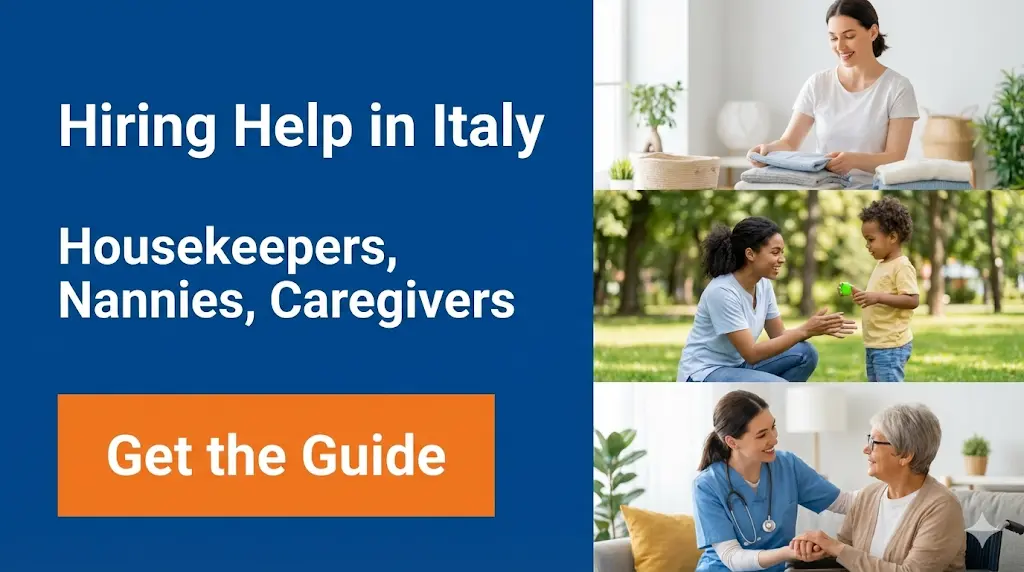
Hiring Help: Housekeepers, Nannies, and Caregivers
Navigate the complexities of hiring domestic help in Italy with this comprehensive guide. Learn the critical legal differences between a colf, tata, and badante, understand mandatory INPS registration, navigate minimum wage regulations, and legally manage employment contracts.
Disclosure: This post may contain affiliate links. We may earn a commission at no extra cost to you if you make a purchase through these links. Read full disclosure.
Introduction
Moving to Italy brings a wonderful shift in lifestyle, but juggling work, adjusting to a new culture, and managing a household can quickly become overwhelming. It is entirely valid to feel daunted by the prospect of keeping your Italian home pristine, finding reliable childcare, or securing eldercare for a loved one in a foreign country. Fortunately, hiring domestic help in Italy is incredibly common and culturally ingrained. However, relying on informal arrangements or “under the table” payments—a practice some expats assume is standard—exposes you to severe legal and financial risks. Italy has strict, highly regulated labor laws governing domestic workers, designed to protect both the employee and the employer.
This guide will demystify the process of hiring a housekeeper (colf), a nanny (tata), or a caregiver (badante) in Italy. I will walk you through the National Collective Labor Agreement (CCNL), the mandatory steps for registering your employee with the national social security institute (INPS), and the costs you can expect.
Understanding the Italian Domestic Work Sector
In Italy, domestic work is a highly structured employment category. Unlike in some countries where you might simply hand a cleaner cash at the end of the week, the Italian state views domestic workers as formal employees. If you dictate their hours, provide the cleaning supplies, and require them to work exclusively at your residence on a set schedule, you are legally an employer (datore di lavoro).
The legal framework governing this relationship is the Contratto Collettivo Nazionale di Lavoro (CCNL) sulla Disciplina del Rapporto di Lavoro Domestico (National Collective Labor Agreement for Domestic Work). This extensive document outlines minimum wages, maximum working hours, mandatory paid leave, sick pay, severance pay (TFR – Trattamento di Fine Rapporto), and the 13th-month bonus salary (tredicesima).
Understanding these rules is not just a matter of ethics; it is a strict legal requirement. Ignoring the CCNL and hiring in nero (off the books) can result in massive fines from the labor inspectorate and potential lawsuits from the worker for unpaid contributions and severance.
The Three Main Categories of Domestic Help
The CCNL classifies domestic workers into specific levels based on their duties, experience, and the level of responsibility they hold. Knowing exactly who you are hiring dictates the minimum wage you must legally pay.
Housekeepers (Colf)
The term colf is a ubiquitous Italian abbreviation for collaboratore familiare (family collaborator). A colf is primarily responsible for the physical upkeep of the home. Their duties typically include cleaning, dusting, doing laundry, ironing, and sometimes running basic errands or preparing simple meals.
Within the CCNL, a colf is usually classified under Level A or Level B. Level A is for entry-level workers with minimal experience handling basic cleaning tasks. Level B applies to workers with more experience who can perform tasks with greater autonomy, or those who have specific skills like expert ironing or specialized care of valuable surfaces.
Nannies and Babysitters (Tata / Babysitter)
When it comes to childcare, the terminology and the legal classifications shift. A babysitter is generally viewed as someone hired for occasional, short-term supervision—perhaps watching the children for a few hours while you go to dinner. A tata (nanny) is a professional who is deeply integrated into your family’s daily routine, often working full-time or regular part-time hours.
A professional nanny is typically classified under Level A Super (AS) for basic, occasional babysitting of older children, or Level B Super (BS) if they are responsible for infants or toddlers and manage their daily routines, meals, and educational activities. If you hire a highly qualified nanny with specialized pedagogical degrees or nursing credentials, they may fall under Level C or D, commanding a significantly higher salary. Currently, the average gross salary for a professional nanny in Italy hovers around €22,750 to €26,074 per year (roughly €11 to €13 an hour), depending heavily on experience and location.
Caregivers (Badante)
The badante plays a critical and deeply respected role in Italian society. A badante is a dedicated caregiver hired to look after elderly, disabled, or non-self-sufficient individuals. Given Italy’s aging population, the demand for reliable badanti is exceptionally high.
The CCNL strictly distinguishes between a badante for a self-sufficient person (Level BS) and a badante for a non-self-sufficient person (Level CS). Furthermore, if the caregiver possesses formal nursing or specialized medical training, they are classified at the highest tier, Level DS. Caregivers are frequently hired on a live-in basis (convivente), which involves providing them with a private room and adequate board (food), the value of which is heavily regulated and factored into their overall compensation package.
How to Hire Legally in Italy: Step-by-Step
Transitioning from finding the right person to legally employing them requires navigating several bureaucratic steps. Do not let the paperwork intimidate you; it is a straightforward process once you know the sequence.
Step 1: Gathering Documentation
Before you can draft a contract, both you (the employer) and the worker must have your administrative documents in order. You will absolutely need your Codice Fiscale (tax code) and a valid ID. For a detailed breakdown of how to obtain this essential identification, review our guide on Local Tax Registration: Codice Fiscale and ISEE.
The worker must provide their ID, their Codice Fiscale, and, crucially, if they are a non-EU citizen, a valid Permesso di Soggiorno (residence permit) that explicitly allows them to work in Italy. It is your legal responsibility to verify that their residence permit is valid for the duration of the proposed work contract.
Step 2: Drafting the Employment Contract (Lettera di Assunzione)
The employment contract must be in writing and signed by both parties. The Lettera di Assunzione must explicitly state:
- The start date (and end date, if it is a fixed-term contract).
- The CCNL level and category of the worker.
- The exact working hours and schedule.
- The agreed-upon wage (which cannot be lower than the CCNL minimum for that level).
- Whether the worker is live-in (convivente) or live-out (non convivente).
- The duration of the probationary period (periodo di prova).
- Details regarding annual leave and weekly rest days.
Step 3: Mandatory INPS Registration
Once the contract is signed, you must formally register the employment relationship. This communication must be submitted via the online system in relation to hiring before the worker’s first day on the job.
You can submit this communication directly through the INPS web portal using your SPID (Digital Identity), or you can hire a Patronato (a workers’ assistance center) or an accountant (commercialista) to handle the filing for a small fee. This mandatory communication automatically alerts INAIL (the workers’ compensation board) and the Ministry of Labor, ensuring the worker is legally covered in case of a workplace accident in your home. Furthermore, when renewing their residence permit, the non-EU worker must present a copy of this Obligatory Hiring Communication document at the Police Headquarters (Questura).
Step 4: Paying Social Security Contributions (Contributi)
As an employer, you are legally required to pay quarterly social security contributions (contributi INPS) on behalf of your domestic worker. These payments fund the worker’s pension, maternity leave, and unemployment benefits.
The contributions are calculated based on the worker’s hourly wage and the number of hours worked per week. INPS will generate payment slips (PagoPA), which you must pay four times a year (in April, July, October, and January). A portion of these contributions is technically the worker’s responsibility, which you deduct from their monthly paycheck, while the majority is the employer’s cost. Maintaining a clear budget for these quarterly taxes is essential; if you need help structuring your finances, consult our insights on Cost of Living in Italy 2026: Budgeting for Expats.
Understanding the Costs and Minimum Wage
The minimum wages for domestic workers are updated annually by the Ministry of Labor to adjust for inflation. While you are free to negotiate a higher salary, you cannot legally pay less than the statutory minimum.
When calculating your total costs, you must account for the following:
- Base Hourly Wage / Monthly Salary: Based on the CCNL level.
- Food and Board Allowance (Vitto e Alloggio): If the worker is live-in, or if they work during meal times, you must provide meals or pay a daily cash equivalent set by the state.
- The 13th Month Salary (Tredicesima): An extra month’s salary that must be paid to the worker in December, just before Christmas.
- Severance Pay (TFR): You must accrue a specific amount each month (roughly equal to one month’s salary per year worked) which is paid out when the employment relationship ends, regardless of who terminates it.
- Vacation Pay (Ferie): Domestic workers are entitled to 26 working days of paid vacation per year.
- INPS Contributions: The quarterly taxes discussed above.
Table: Estimated Costs for Domestic Help in Italy (2026 Projections)
| Worker Category & Level | Typical Schedule | Estimated Minimum Hourly Rate (Gross) | Estimated Monthly Salary (Live-In) | Notes |
| Colf (Level A) | Part-time / Occasional | €5.50 – €6.50 | N/A | Entry-level cleaning, no cooking. |
| Colf (Level B) | Regular Part-time | €6.80 – €7.80 | €1,000 – €1,150 | Experienced cleaner, laundry, simple meals. |
| Nanny / Tata (Level BS) | Full-time or Part-time | €7.50 – €9.00 | €1,100 – €1,250 | Cares for children, plans activities. |
| Caregiver / Badante (Level CS) | Full-time (Live-in common) | €8.50 – €10.00 | €1,250 – €1,400 | Cares for non-self-sufficient individuals. |
| Specialized Nanny (Level DS) | Full-time | €10.00+ | €1,500+ | Holds degrees or nursing qualifications. |
(Note: These figures are baseline estimates and do not include the additional costs of INPS contributions, TFR accrual, or the 13th-month bonus. Always verify current rates via the official INPS portal).
The “Libretto Famiglia” for Occasional Help
If you do not need a regular housekeeper or a full-time nanny, the bureaucratic burden of drafting a CCNL contract and paying quarterly INPS contributions might seem excessive just to hire a babysitter for a Saturday night or a cleaner for a deep spring clean.
To combat undeclared work in these casual scenarios, the Italian government introduced the Libretto Famiglia (Family Booklet). This is a simplified digital voucher system designed specifically for occasional domestic work, tutoring, and babysitting.
Under the Libretto Famiglia, you pre-purchase digital vouchers through the INPS portal. Each voucher costs €10.00. From that €10, the worker receives exactly €8.00 net, while the remaining €2.00 automatically covers their INPS pension contributions and INAIL workplace insurance.
There are strict limits to this system: you cannot pay a single worker more than €2,500 per year using the Libretto Famiglia, and your total household expenditure on these vouchers cannot exceed €10,000 per year. It is strictly for occasional, non-continuous work. If the cleaner comes every Tuesday and Thursday like clockwork, they are a regular employee and must be hired under a standard contract. Navigating these specific tax schemes and labor allowances can be tricky; for a broader view of how the system impacts foreigners, review Understanding Italy’s Tax System: A Guide for Foreigners.
Hiring Non-EU Workers and the Decreto Flussi
A common scenario for expats is wanting to bring a trusted nanny or caregiver from their home country or hiring a non-EU citizen who does not currently reside in Italy. This introduces a significant immigration hurdle.
Non-EU citizens entering Italy to carry out domestic work must possess the appropriate visa and residence permit. You cannot simply fly someone into Italy on a tourist visa and hire them as a domestic worker. To hire a non-EU citizen residing abroad, you must navigate the Decreto Flussi (Flow Decree). This is an annual quota system established by the Italian government that dictates how many non-EU workers are permitted to enter the country. The Italian government publishes an entry flow decree every three years that determines these maximum quotas.
The process is highly competitive and time-sensitive. The employer must wait for the Immigration Quota to be published and then submit an application for a Nulla Osta (work clearance) online through the Ministry of Interior’s portal. The employer must guarantee the availability of suitable accommodation and, if called to the Immigration HelpDesk, present a Suitability of Accommodation Certificate issued by the relevant Comune or ASL office. Furthermore, the employer must commit to covering the cost of travel for the worker’s potential return to their home country.
Only after the Nulla Osta is granted can the foreigner visit the relevant Italian diplomatic representation to obtain the entry visa. Within eight days of entering Italy, the worker must sign the contract of stay and apply for their residence permit. If you are dealing with local immigration offices regarding your own status or your employee’s paperwork, our guide on Navigating Italian Bureaucracy: Comune and Prefettura provides essential tips for surviving the Questura. Employing a non-EU worker without a valid residence permit is a severe offense, carrying penalties of imprisonment from three months to one year and a fine of €5,000 for each worker employed.
Working with Agencies vs. Direct Hiring
When sourcing domestic help, you have two primary options: hiring directly (through word-of-mouth, Facebook expat groups, or local classifieds) or utilizing a professional domestic staffing agency.
Direct Hiring
Direct hiring is the most cost-effective method, as you avoid agency placement fees. Italy has a massive informal network for finding colf and badanti. Asking neighbors, the local pharmacist, or other parents at your child’s school is often the fastest way to find trusted local recommendations. However, the burden of vetting references, drafting the legal contract, and managing the INPS registration falls entirely on you.
Staffing Agencies
Professional agencies offer peace of mind. They pre-screen candidates, verify their legal right to work, check references, and often provide replacement guarantees if the worker does not work out during the probationary period. Agencies are particularly valuable if you require highly specialized help, such as a bilingual maternity nurse or a caregiver trained in dementia support. While the agency will charge a finder’s fee (often equivalent to one month’s salary of the worker), they usually assist with drafting the Lettera di Assunzione and can refer you to a reliable payroll service to manage the monthly payslips (busta paga).
Best Practices and Cultural Etiquette
Managing domestic staff in Italy requires a blend of professionalism and cultural sensitivity. The employer-employee relationship in the Italian domestic sector is heavily regulated, but it is also deeply personal.
- Respect the Boundaries of the Contract: Do not ask a Level A colf (hired strictly for cleaning) to suddenly start cooking complex dinners or babysitting your toddler. If their duties expand, their CCNL classification and pay rate must be legally adjusted.
- Provide Proper Supplies: It is the employer’s responsibility to provide safe, adequate cleaning supplies and equipment. If the worker requests a specific mop or a less toxic brand of detergent for their health, accommodating these requests fosters goodwill.
- The Importance of the “Busta Paga”: Always provide a formal, printed payslip (busta paga) at the end of each month. This protects you by documenting exactly what was paid, including the accrual of TFR and holiday hours. Never pay salaries in unrecorded cash. Under Italian anti-money laundering laws, any salary payment must be traceable, usually via a bank transfer (bonifico bancario).
- Communication and Respect: In Italy, domestic workers are often treated with a high degree of familial respect. Offering them a coffee when they arrive or taking a moment to genuinely ask about their well-being builds a loyal and positive working environment.
Conclusion
Hiring a housekeeper, nanny, or caregiver in Italy is an excellent way to reclaim your time and ensure your household runs smoothly, but it is not a process that can be managed casually. The Italian state places a heavy emphasis on workers’ rights, and as an employer, you must rise to the occasion.
By understanding the distinct classifications within the CCNL, completing the mandatory INPS registration, and budgeting accurately for severance pay and social security contributions, you protect yourself from steep financial penalties and cultivate a fair, transparent relationship with your employee. Whether you use the Libretto Famiglia for an occasional babysitter or navigate the Decreto Flussi to hire a full-time live-in caregiver, respecting the legal framework ensures that your experience with domestic help in Italy is secure, professional, and ultimately deeply rewarding.
References
Primary sources (official)
- Istituto Nazionale della Previdenza Sociale (INPS) – Official guidelines on hiring domestic workers, registering contracts, and calculating quarterly contributions: https://www.inps.it/
- Ministero del Lavoro e delle Politiche Sociali – Official information regarding the National Collective Labor Agreement (CCNL) for domestic work and minimum wage updates: https://www.lavoro.gov.it/
Other helpful sources
- ERI SalaryExpert – Nanny Salary in Italy (2026) Data and Compensation Management: https://www.salaryexpert.com/salary/job/nanny/italy
- Arletti Partners – Domestic work visa Italy: how to apply for the Flow Decree and INPS regulations: https://arlettipartners.com/domestic-work-visa-how-to-apply/
Disclaimer
The information provided in this article is for educational and informational purposes only and does not constitute official legal, immigration, or financial advice. Italian labor laws, CCNL minimum wage rates, INPS contribution requirements, and Decreto Flussi immigration quotas are subject to frequent legislative updates. Always consult with a registered Italian employment consultant (consulente del lavoro), a certified accountant (commercialista), or an official Patronato to ensure full compliance with current regulations before drafting employment contracts or processing payroll.