Notarized vs Standard Rental Contracts in Italy
Being handed a dense, fifteen-page rental agreement in complex Italian and being told it must be officially certified is enough to make any foreigner panic. I spent my first weeks terrified I was signing away my life savings because I confused basic tax registration with mandatory notarization. This guide explains the exact difference between standard and notarized rental contracts in Italy.
Disclosure: This post may contain affiliate links. We may earn a commission at no extra cost to you if you make a purchase through these links. Read full disclosure.
The Standard Italian Rental Contract Scrittura Privata
Understanding the Private Agreement
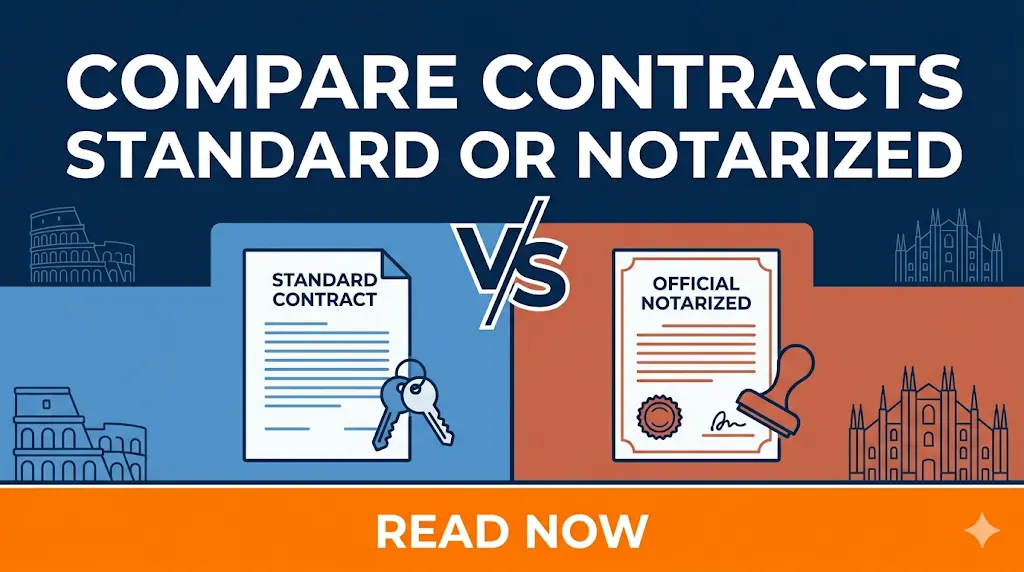
For the vast majority of expats renting an apartment in Italy, your lease will take the form of a standard scrittura privata (private writing). This simply means it is a private contract drafted and signed exclusively between two consenting parties: you (the conduttore) and the landlord (the locatore). You do not need a lawyer present, and you absolutely do not need to sign it in front of a government official or a notary public.
The scrittura privata is the foundation of 99 percent of all residential leases in the country. It is used for the standard four-plus-four year contracts (canone libero), the subsidized three-plus-two year contracts (canone concordato), and temporary worker leases (contratto transitorio). The document outlines the monthly rent, the security deposit, and the basic division of maintenance responsibilities. The moment both of your signatures touch the paper, the contract is legally binding between the two of you.
However, being legally binding between two people does not make it legally recognized by the Italian state. To use this contract to apply for your official residency, set up your utilities, or protect yourself from sudden eviction, you must overcome the next massive bureaucratic hurdle. Navigating this precise step is the core focus of our detailed breakdown on Signing an Italian Rental Contract.
The Mandatory Registration Trap
The greatest source of confusion for expats is the difference between notarizing a contract and registering a contract. You do not need a notary, but your landlord is legally required to register your standard scrittura privata with the Agenzia delle Entrate (Italian Revenue Agency) within thirty days of signing. This process is called registrazione.
Registration is purely a tax compliance measure. It proves to the government that the landlord is declaring the rental income. To execute this, the landlord must submit copies of the signed contract along with a specific tax document called the Modello RLI. The state charges a registration tax (usually 2 percent of the annual rent) plus physical stamp duties (marche da bollo) which must be affixed to the paper contract. However, if the landlord opts for a flat-tax regime called cedolare secca, these registration taxes and stamp duties are entirely waived.
To even be listed on a registered contract, you must possess an official Italian tax code. If you have not secured this document yet, you must immediately review Checking Your Italian Tax Code Codice Fiscale Status. When you are standing in a crowded real estate office, trying to translate dense tax clauses like cedolare secca before signing, you cannot rely on spotty public Wi-Fi. I bypassed this anxiety completely by downloading a data eSIM from Airalo before my plane even landed. Having Airalo active on my phone meant I had instant, reliable mobile data to translate the lease line-by-line and verify the legal terms in real-time. Relying on Airalo ensures you are never digitally stranded during a critical financial negotiation.
The Notarized Rental Contract Atto Pubblico
When a Notaio is Actually Required
In the Italian legal system, a Notaio (Notary Public) is not just someone who stamps a document for twenty euros. They are highly qualified, powerful public officials who act as impartial guarantors of the state. When a contract is drafted and signed in front of them, it becomes an atto pubblico (public act) or a scrittura privata autenticata (an authenticated private contract).
By law (Article 1350 of the Italian Civil Code), a residential rental contract only legally requires a notary if the duration of the lease strictly exceeds nine years. Because standard Italian residential leases max out at eight years (the 4+4 structure), you will almost never be legally required by the state to hire a notary to rent a standard apartment. Notarized leases are incredibly common for commercial real estate or massive luxury estates, but they are an anomaly for a standard two-bedroom flat in Rome or Milan.
If a real estate agent tells you that Italian law requires a notary for a standard one-year or four-year lease, they are lying to you, or they are attempting to pass exorbitant administrative costs onto your shoulders. Knowing your legal footing is essential to avoid being exploited when Navigating Italian Bureaucracy Comune and Prefettura.
Why Landlords Push for Authentication
If the law does not require it, why do some paranoid Italian landlords fiercely demand that you sign a standard residential lease in front of a notary? The answer lies in Italy’s notoriously slow and tenant-friendly eviction laws.
If you sign a standard, registered scrittura privata and suddenly stop paying your rent, the landlord must initiate a grueling legal process called sfratto per morosità (eviction for arrears). Taking a tenant to court, waiting for hearings, and eventually getting a judge to authorize the police to remove the tenant can take anywhere from twelve to eighteen months. During this entire period, the landlord receives no income. It is a financial nightmare that leaves property owners deeply distrustful of foreign tenants who do not have deep local roots or cannot provide the financial guarantees outlined in Types of Italian Employment Contracts Contratti di Lavoro.
If the contract is signed in front of a notary, the physical document automatically becomes a titolo esecutivo (an immediately enforceable title). This acts as a legal cheat code for the landlord. If you stop paying rent, the landlord can completely bypass the initial, lengthy court hearings and go straight to a bailiff to seize your assets or initiate an immediate, fast-tracked eviction. Landlords demand a notary not to protect you, but to protect their financial recovery. If you find yourself in a hostile situation with a landlord exploiting this power, you must immediately understand your rights by reviewing Filing a Complaint Italian Landlord or Agency.
Key Differences for Expats
Financial Costs and Administrative Friction
The most immediate impact of a notarized contract on an expat is the devastating cost. Registering a standard scrittura privata at the Agenzia delle Entrate is relatively cheap. If the landlord does not use the cedolare secca tax break, the registration tax is split 50/50 between the tenant and the landlord, usually amounting to less than a hundred euros each for a standard apartment.
Conversely, an Italian Notaio charges a massive professional fee. Depending on the value of the annual rent and the complexity of the document, the notary’s invoice can easily range from €600 to over €1,500. Italian landlords who insist on this extra layer of security will almost always demand that you, the tenant, pay the entire notary fee out of pocket. This is a massive, unrecoverable capital expense that you must brutally factor into your overall Cost of Living in Italy 2026 Budgeting for Expats.
Legal Protections and Eviction Realities
Both the standard registered contract and the notarized contract provide you with absolute legal permission to live in the property. With either document, you can confidently go to the local town hall to register your official residency (Residenza), which is the golden key to accessing local healthcare and opening bank accounts.
However, the power dynamic is vastly different. A standard contract offers a highly balanced legal playing field. If a dispute over maintenance arises, neither party can unilaterally seize assets without going through standard mediation. A notarized contract places a massive, immediate hammer in the hands of the landlord. Before agreeing to a notarized lease, you must demand that the landlord hold up their end of the bargain by strictly adhering to the invoicing laws detailed in Rent Receipt Requirements Cedolini for Italian Tenants.
| Contract Feature | Standard (Scrittura Privata) | Notarized (Atto Pubblico / Autenticata) |
| Legal Requirement | 99% of all residential leases (up to 9 years). | Only legally required for leases exceeding 9 years. |
| Cost to Tenant | Low (€0 to ~€100 for split registration taxes). | Very High (€600 – €1,500+ in professional fees). |
| Eviction Speed | Slow (Requires lengthy court hearings). | Fast (Acts as an immediately enforceable legal title). |
| Valid for Residency | Yes (Must be officially registered). | Yes. |
| Landlord Motivation | Standard tax compliance and legal baseline. | Extreme paranoia; desire to bypass the slow judicial system. |
Managing Your Housing Logistics
Bypassing Rigid Contracts with Temporary Solutions
Fighting with a skeptical Italian landlord over a notarized contract before you even hold a local bank account is an exhausting way to start your relocation. To avoid this institutional paranoia entirely, veteran expats rely heavily on Spotahome for their initial landing phase.
Because Spotahome acts as a verified digital intermediary specializing in mid-term rentals, they strip away the intense friction of the local private rental market. By booking an apartment through Spotahome, you agree to standardized, transparent terms without facing a landlord demanding exorbitant notary fees or six months of bank guarantees. Securing a temporary base through Spotahome provides you with a safe, legally sound environment while you learn the city, build your local financial history, and eventually negotiate a long-term permanent lease from a position of strength.
Outfitting the Apartment and Utility Setup
If you successfully sign a standard, registered contract for a permanent apartment, you will quickly face the next challenge: the apartment will likely be vuoto (completely empty). Unlike in the US or UK, an unfurnished Italian apartment often means no light fixtures, no appliances, and sometimes not even a kitchen sink. You will be entirely responsible for outfitting the home and managing the bureaucratic nightmare of Setting Up Utilities in Italy.
Trying to furnish an empty apartment by hauling heavy boxes on the Rome metro or the Milan tram system is miserable. I outsourced this entirely by turning to Amazon Italy. The moment my standard lease was signed and I had the keys, I ordered my dehumidifier, heavy bedding, kitchen appliances, and basic furniture directly from Amazon Italy. Having these bulky, essential items delivered straight to my new door via Amazon Italy saved me from renting a van and fighting local traffic, allowing me to transform an empty stone box into a livable home within a matter of days. By understanding which contracts are standard, fighting back against unnecessary notary fees, and leveraging modern digital logistics, you can secure your Italian home without draining your sanity or your savings.
References
Primary sources official
- Agenzia delle Entrate – Registrazione contratti di locazione – https://www.agenziaentrate.gov.it/portale/web/guest/schede/fabbricatiterreni/registrazione-di-un-nuovo-contratto/info-registrazione-nuovo-contratto
- Consiglio Nazionale del Notariato – Guide per il Cittadino: L’Acquisto e la Locazione – https://www.notariato.it/
- Normattiva – Codice Civile Articolo 1350 (Atti che devono farsi per iscritto) – https://www.normattiva.it/
Other helpful sources
- Idealista – Registrazione contratto di locazione: come funziona, tempistiche e costi – https://www.idealista.it/news/
- Studio Legale Metta – Italian Rental Contracts: What You Need to Know – https://www.studiolegalemetta.com/
Disclaimer
The information provided in this article is for educational and informational purposes only and does not constitute official legal, real estate, or tax advice. The legal requirements for contract registration (registrazione telematica) and the strict parameters defining an immediately enforceable title (titolo esecutivo) are governed by the Italian Civil Code and the Agenzia delle Entrate. Disputes regarding landlord demands for a scrittura privata autenticata versus a standard registered contract should be reviewed by a registered Italian real estate attorney or a local tenants’ union (such as SUNIA) before signing or transferring any security deposits.