Road Freight vs Sea Freight to Italy: When Each One Makes Sense
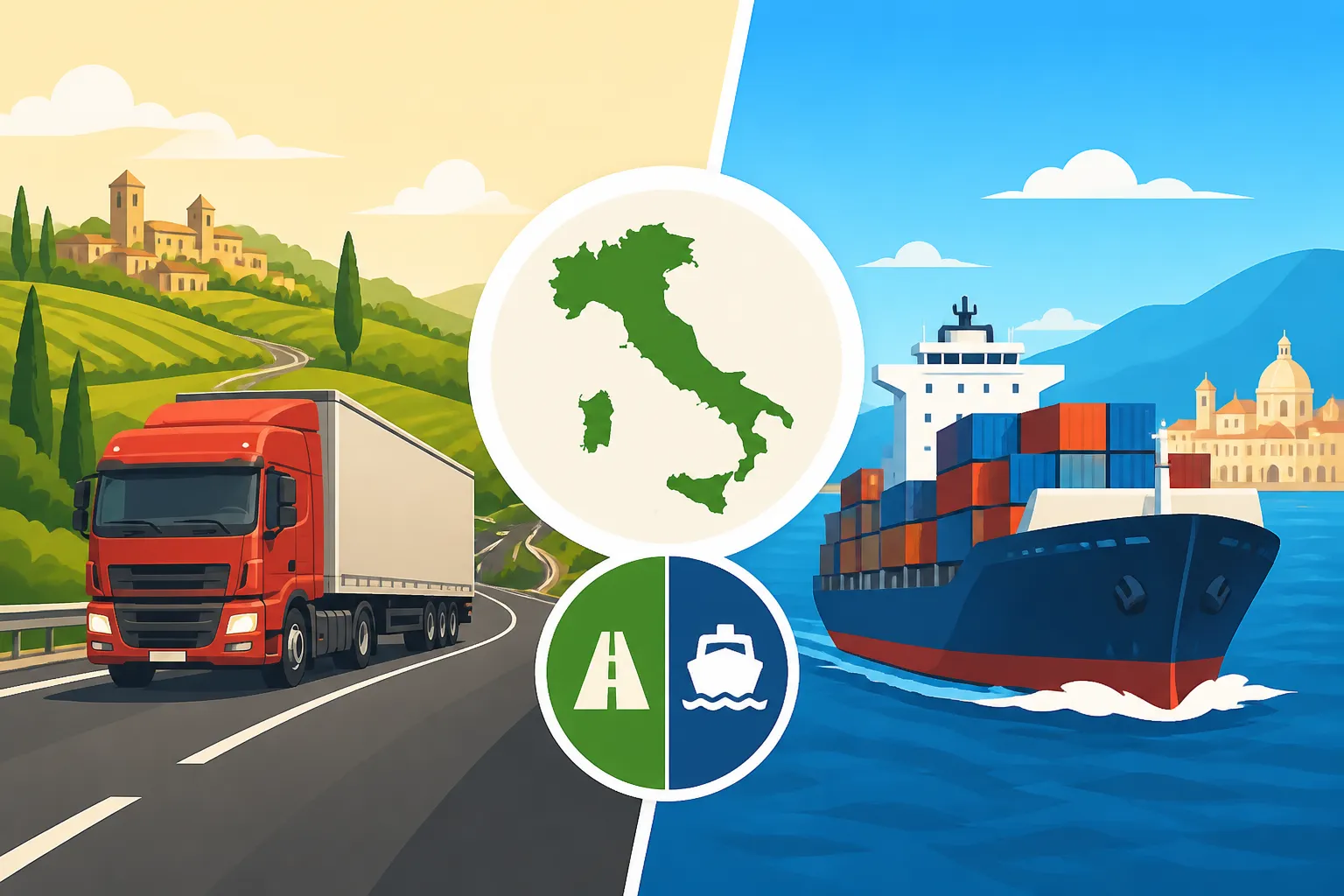
The removal quote arrives, and it says “road freight” or “sea freight” with a price that means little until you know what each involves. People moving to Italy from London, Lyon, Toronto or Melbourne all face the same choice: truck or container. This guide explains how each method works, when each one is the better fit, and how to compare movers before you commit.
Disclosure: This post may contain affiliate links. We may earn a commission at no extra cost to you if you make a purchase through these links. Read full disclosure.
How Road Freight and Sea Freight Actually Work for an Italy Move
Before I moved to Italy, I assumed “freight” was one thing with different vehicles. It isn’t. Road freight and sea freight are separate logistics systems, with different handoffs, risks and paperwork. If you understand how your sofa physically gets from your old living room to a third-floor flat in Bologna, the quotes start to make sense.
Road Freight: Trucks, Vans and the Alpine Crossings
Road freight is the simpler method. A removal company loads your belongings into a truck or large van at your old home. That vehicle, or one it transfers to at a depot, drives to Italy and unloads at your new address. From most of Western and Central Europe, the truck enters Italy through one of a few corridors:
- The Brenner Pass from Austria and Germany
- The Mont Blanc or Fréjus tunnels from France
- The Gotthard and San Bernardino routes through Switzerland
- The coastal route via Ventimiglia from the French Riviera
Road moves come in two forms. A dedicated load means the truck carries only your goods and drives straight to you. Groupage, sometimes called part-load, means your boxes share a truck with several other households going the same way. The truck waits until it is full, then drops everyone off in turn. Groupage spreads the cost across customers, but your delivery date depends on when the truck fills and where the other drops are.
Consider a family moving from Munich to Verona. A dedicated truck can be loaded on a Monday and unloaded within a day or two, depending on driver rest rules and traffic at the Brenner. A groupage slot on the same route might mean collection in week one and delivery in week three, because the mover is waiting for loads from Stuttgart and Nuremberg. Neither option is wrong. They suit different budgets and timelines, and you need to know which one you are being quoted.
Sea Freight: Containers, Ports and the Inland Leg
Sea freight has more stages. Your goods are packed at home, loaded into a shipping container or crated for consolidation, then trucked to the origin port. The container goes on a vessel, often with a transshipment stop at a hub port, and arrives at an Italian port such as Genoa, La Spezia, Livorno, Naples, Salerno or Trieste. There it waits for customs clearance and is then trucked to your door. Every handoff takes time, and every handoff is a point where something can be delayed.
You will usually see two sea options. A full container load, normally a 20ft or 40ft box, is yours alone and is sealed at your door. Less than container load, or consolidated shipping, means your crated goods share a container with other shipments. It costs less for small volumes, but your goods are handled more and wait for the container to fill. For a detailed look at box sizes, see 20ft vs 40ft Container to Italy: Which Load Size Fits Your Home.
Port choice matters more than most people expect. A container landing in Genoa when you are moving to Sicily means a long road leg, or a ferry, after the ship arrives. Genoa, Livorno, or Naples? Choosing an Italian Port of Entry covers how to match the port to your final address. In practice, the sea portion is often the most predictable part. The uncertainty sits in port congestion, customs inspections and booking the final delivery truck.
Where Sirelo Fits Into the Decision
Here is the trouble with all of this. You cannot sensibly choose between road and sea in the abstract, because the right answer depends on actual quotes for your actual volume on your actual route. This is where Sirelo becomes useful. It is a comparison platform for international removals. You describe your move once, including origin, destination, approximate volume and timing, and receive quotes from removal companies that work that corridor.
The value is not only convenience. When three or four movers quote the same move, you see how differently companies approach it. One may propose groupage by road, another a dedicated truck, and a third a consolidated sea shipment via a port you had not considered. That spread teaches you more about your options than any general guide, this one included. Sirelo also publishes reviews of the removal companies it lists, which helps you filter out firms with poor delivery records before you sign anything.
Road Freight vs Sea Freight Side by Side
The table below summarises the practical differences. It describes the general shape of each option. Real costs and transit times come from the quotes you collect.
| Factor | Road Freight | Sea Freight |
|---|---|---|
| Typical origin | Mainland Europe, UK via Channel crossing, Balkans and Greece via Adriatic ferries | North America, Australia, Asia, South America, Middle East, Africa |
| Transit time | Days for a dedicated truck, longer for groupage | Weeks to months including port time and inland legs |
| Cost shape | Driven by distance, volume and whether the truck is dedicated or shared | Driven by container size or shared volume, port charges and inland trucking at both ends |
| Handling | Usually one load and one unload for dedicated moves | Several handoffs: home, origin port, vessel, destination port, final truck |
| Flexibility on dates | High for dedicated loads, moderate for groupage | Low, tied to vessel schedules and port slots |
| Customs from EU origin | None for goods moving within the EU | Not applicable for most EU routes |
| Customs from non-EU origin | Required at the EU border, for example UK or Switzerland | Required at the Italian port |
| Best fit | Short to medium European distances, tight timelines, partial loads | Intercontinental moves and large households |
Cost Shape: What You Are Really Paying For
With road freight, the main cost drivers are distance, volume and exclusivity. A dedicated truck costs the same whether you fill it or not, so a half-empty truck is expensive per cubic metre. Groupage turns this around: you pay for your share of space, but you accept the mover’s schedule. Tolls on Italian motorways, Alpine tunnel fees, ferry crossings and driver costs are built into the quote.
Sea freight has more line items. There is packing and loading at origin, trucking to the port, origin port charges, the ocean freight itself, destination port handling, customs clearance, and delivery from the Italian port to your door. Many international moving quotes bundle all of this as door-to-door, while others stop at the port and leave you to arrange the rest. Comparing International Removal Quotes for Italy: Line Items That Hide Costs explains which items to look for.
When you request quotes through Sirelo, ask each mover to itemise. A sea quote that looks cheap often leaves out destination charges, which then appear on an invoice from an Italian agent you have never heard of, payable before your container is released. If you get road and sea quotes for the same move, comparing totals on a door-to-door basis is the only fair way to judge them.
Transit Time and Predictability
Road freight wins on speed for any route a truck can drive. A dedicated load from France, Germany, Austria or the Benelux countries usually reaches northern or central Italy within days. Groupage adds waiting time but is still measured in weeks rather than months.
Sea freight from outside Europe takes much longer once you add packing, port cut-off dates, the voyage, any transshipment, customs clearance and final delivery. Predictability is the bigger issue. A ship can be delayed, a container can be selected for physical inspection, and a busy port can push back your delivery appointment. When I helped a friend plan a move from Boston to Florence, the voyage was the part we worried about least. The waiting in Livorno for clearance and a delivery slot caused the most stress.
Plan your living arrangements around the slower, less predictable estimate. If you are shipping by sea, you will probably need furnished or temporary accommodation for a while after you land, and possibly storage at one end. Storage While You Relocate: Home-Country Units vs Italian Deposito goes through those options.
Handling, Damage Risk and Insurance
Every time your belongings are moved between vehicles, the risk of damage rises. A dedicated road move is the gentlest option: the same crew often loads and unloads, and your goods stay in one truck. Groupage adds some handling at depots. Sea freight in a full container is also fairly gentle once the container is sealed, but the box itself is lifted by cranes, stacked on a vessel, and exposed to humidity and temperature changes over weeks at sea.
Consolidated sea shipping involves the most handling. Your crates are loaded into a shared container, unloaded at a warehouse, and possibly repacked for the final leg. Fragile items, antiques and pianos need proper crating. Basic carrier liability rarely matches the real value of household goods, so check whether full-value cover is offered and what it excludes. Moving Insurance for Shipments to Italy: Coverage, Valuation, and Claims covers this in depth.
Whatever method you choose, make a photographed inventory before packing. If something arrives damaged, the claim depends on proving its condition at departure. Movers listed on Sirelo can be compared on whether they offer transit insurance and on what past customers say about how claims were handled. A low quote from a company with a poor claims record is a false saving.
When Road Freight Makes Sense
Road freight is the default for most moves within Europe, and for good reason. It is direct, usually fast, and avoids ports altogether. There are also a few situations where it is the better choice even when sea is technically possible.
Moving From Within Mainland Europe
If you are coming from Germany, France, Austria, Switzerland, the Netherlands, Belgium, Spain, Portugal, Poland or anywhere else on the continent, road is almost always the answer. There is no practical sea route from Lyon to Turin, and nobody would container-ship a household from Vienna to Udine. The real choice is between a dedicated truck and groupage.
The Alpine crossings shape these routes. Moves from Germany and Austria usually come over the Brenner into Trentino-Alto Adige and down the A22. Moves from France come through the Mont Blanc or Fréjus tunnels, or along the coast at Ventimiglia for southern France and Spain. Italy also restricts heavy goods vehicles on motorways at weekends and on certain public holidays, so a truck that misses its window on a Friday may sit until Monday. Good movers plan around this, and it is worth asking about. For a route-specific breakdown, see Moving to Italy from Germany: Road Freight Costs and Transit Times.
Moving from within the EU also means no customs formalities for your household goods, as long as everything starts and stays within the EU. This removes a whole layer of paperwork and possible delay, and it is a big reason why road is so simple for EU-origin moves.
Small Loads and Groupage
Road groupage is often the most economical option when you are moving a modest volume, such as a student flat, a one-bedroom apartment or a few pieces of furniture plus boxes. You only pay for the space you use. Movers who run regular routes between northern Europe and Italy fill their trucks with several customers, and your share is a fraction of a dedicated vehicle.
The trade-off is time and some loss of control. Your collection date may be flexible within a window, and delivery happens when the truck reaches your area on its route. If you are moving into a flat that is already furnished, or you are staying with friends for a few weeks, this rarely matters. The break-even point between groupage and a dedicated truck depends on volume, which Full Load vs Groupage to Italy: Cost Break-Even by Cubic Metre works through in detail.
Take a teacher moving from Amsterdam to a rented flat in Rome with roughly a dozen boxes, a bicycle and a desk. A dedicated truck would be absurd. A groupage slot, or even a man-with-a-van service on a shared run, fits much better. Sirelo quotes for small volumes often reveal smaller specialist firms on these routes that you would never find through a general search.
Tight Timelines and Rural Deliveries
When your lease ends on the 30th and your Italian keys arrive on the 2nd, a dedicated road move is often the only realistic option. You can agree a collection date, a delivery date and sometimes even a time window. No vessel schedule or port appointment will move your dates.
Road also handles awkward destinations well. Many Italian properties are in historic centres with limited traffic zones, narrow lanes and no lifts, or in hill towns reached by single-track roads. A large truck often cannot reach the door. Experienced movers switch to a smaller shuttle vehicle for the last stretch, get ZTL access permits, or bring an external furniture lift for upper floors. Delivery Day in an Italian Building: Narrow Streets, Lifts, and Permits covers what to prepare.
These access issues apply to sea freight too, because the last leg from the port is always by road. The difference is that with a direct road move, the same company usually handles both ends. With sea freight, the final delivery is often subcontracted to an Italian partner, and you have less control over who turns up and with what vehicle.
When Sea Freight Makes Sense
For anyone moving from another continent, sea freight is the standard way to bring a household to Italy. Air freight exists for urgent items, but it is too expensive for furniture. The question becomes which sea option to use and how to manage the stages before and after the voyage.
Moving From Outside Europe
From the United States, Canada, Australia, New Zealand, South Africa, India, the Gulf states, East Asia or South America, there is no road alternative. Your goods will cross an ocean. US East Coast shipments often go direct to Mediterranean ports, while shipments from Asia and Oceania may transship through a hub before reaching an Italian port.
Planning is everything here. Sea moves need more lead time than road moves: booking space, arranging export documents in the origin country, timing packing to meet port cut-offs, and preparing for Italian customs. An International Move to Italy: The 12-Week Planning Calendar lays out a realistic sequence. US-specific considerations such as which coast you ship from and which Italian port suits you best are covered in Moving to Italy from the US: Container Costs, Ports, and Timelines.
An overseas move involves more decisions, and the quality of the mover matters more. You are trusting them with your belongings for weeks or months, across several subcontractors. Requesting multiple quotes through Sirelo, and checking the reviews it publishes, is a sensible first step. A mover with a strong network of Italian agents at destination is worth much more than one that simply books ocean freight.
Large Households and Full Containers
If you are moving a full family home with beds, wardrobes, a dining table and boxes of books and kitchenware, a full container load is usually the most economical and safest sea option. You pay for the container regardless of how full it is, so a properly loaded container can be good value per cubic metre. The container is sealed at your home and opened only at customs or at your new door.
Before filling a 40ft box, check what will actually fit. Many Italian apartments have smaller rooms, narrower stairwells and lifts that fit two people and a suitcase. That huge sectional sofa may not get past the front door of a palazzo in Naples. Will Your Furniture Fit? Italian Apartment Layouts vs Northern European Homes is worth reading before you decide what to ship and what to sell.
Appliances deserve the same thought. Voltage, plug types and kitchen dimensions differ, and a North American fridge or dryer may be impractical. Shipping fewer, better-chosen items often means a smaller container or consolidated shipment, which can cut costs meaningfully.
Combining Sea Freight With a Final Road Leg
Every sea move ends with road freight. Once the container is cleared at the Italian port, it is either trucked to your door still sealed or unpacked at a local depot and loaded into smaller vehicles. For destinations far from a major port, such as inland Umbria, the Apulian countryside or the mountains of Abruzzo, the road leg can be long and add real cost.
Some movers offer creative routing. A shipment to Sicily might land at a mainland port and go by ferry, or reach a southern port closer to the island. A shipment to the north-east might be routed through Trieste rather than Genoa. Ask each mover where they plan to land your goods and why. If two quotes use different ports, the cheaper ocean freight may be cancelled out by a longer inland haul.
This is also where restored rural properties create problems. A container truck on an unpaved lane to a farmhouse in Tuscany is a disaster waiting to happen. Moving Into a Restored Rural Property in Italy: Access and Delivery Problems explains how to plan the final leg when the road to your door was built for oxen.
Customs, Duty Relief and Paperwork by Route
Your freight method does not change the customs rules. Your origin does. A truck from the UK and a container from Australia both cross the EU’s external border and face the same rules on duty relief. A truck from Germany crosses no customs border at all. Understanding this saves a lot of anxiety.
Moves From Inside the EU
If your goods start in another EU country and move to Italy, there is no customs declaration for household belongings. The EU single market means your furniture and boxes travel just like a domestic move, apart from the distance. This applies whether you use a dedicated truck, groupage, or a ferry crossing within the EU, such as from Greece to Ancona or Bari.
You should still keep your inventory and proof of residence, and your mover will still need a clear list of contents for its own records and for insurance. Restricted items such as weapons, certain medicines or large quantities of alcohol may still need attention, but you do not need a customs agent to clear your household goods. EU vs Non-EU Moves to Italy: Why Customs Treats Them Completely Differently explains the wider differences.
Duty and VAT Relief for Moves From Outside the EU
For goods coming from outside the EU, by sea from Toronto or by truck from Zurich, relief from import duty and VAT on personal property is governed by EU Regulation 1186/2009 for customs duty and Directive 2009/132/EC for VAT. Both set the same conditions. Italy applies them through the transfer of residence procedure, explained in Trasferimento di Residenza: The Italian Duty Exemption for Personal Effects. The core conditions are:
- Possession and use: the goods must have been in your possession and, for non-consumable goods, used by you at your former normal residence for at least six months before you stopped living there. They must be intended for the same use in your new home in Italy.
- Residence outside the EU: relief applies to people whose normal residence has been outside the EU, not just outside Italy, for a continuous period of at least 12 months. Customs may make exceptions where you clearly intended to live outside the EU for at least 12 months.
- Import window: except in special cases, the goods must be declared within 12 months of the date you establish your normal residence in Italy. They may arrive in several separate consignments within that period.
- No lending or transfer afterwards: for 12 months after the declaration is accepted, the goods may not be lent, given as security, hired out or transferred, whether paid or free, without first notifying customs. Any such loan, pledge, hire or transfer within those 12 months makes the duty and VAT payable, even if customs was notified.
- Goods arriving before you: relief can be granted before you establish residence if you undertake to do so within six months and lodge a security set by customs. In that case the six-month possession period is counted up to the date the goods enter the EU.
Some items are never covered: alcoholic products, tobacco and tobacco products, commercial means of transport, and articles for use in a trade or profession, apart from portable instruments of the applied or liberal arts. A violinist can bring her instrument; a carpenter cannot bring his workshop machinery under this relief.
Here is how the periods fit together:
| Rule | Period | What It Means for Your Shipment |
|---|---|---|
| Possession and use before moving | Six months | Items bought and used at your old home for at least six months before you left can qualify |
| Normal residence outside the EU | 12 months, continuous | You must have lived outside the EU, not merely outside Italy |
| Declaring goods after establishing residence | 12 months | Ship in one consignment or several, but within this window |
| Restriction on lending, hiring or transferring | 12 months after declaration | Notify customs first; any loan, hire or transfer in this period still makes duty and VAT payable |
| Undertaking to establish residence when goods arrive first | Six months | A security is lodged and the possession period runs to EU entry |
Timing matters for sea freight. Because containers can arrive before you have registered residence, the provision for goods arriving first is often the one you rely on. Your mover’s Italian customs agent will tell you what documents to provide. For the order in which to sort your tax code and residence, see Sequencing Your Codice Fiscale and Residency Before the Container Lands.
UK and Switzerland: Road Routes With Non-EU Customs
This catches many people out. A move from Manchester or Geneva is a road move, often fast and simple logistically, but it crosses the EU’s external border. Since the UK left the EU, British household goods arriving in Italy go through customs just as goods from Canada do. The same relief conditions apply. If your normal residence has been in the UK for at least 12 continuous months, you fall outside the EU for these purposes.
In practice, your mover will prepare customs paperwork, and the truck may clear at the border or at an inland customs point. You will need the inventory, proof of your previous residence, and documents showing your new Italian residence or the undertaking to establish it. Moving to Italy from the UK: ToR Relief, Customs Declarations, and Costs goes through the British side. Swiss moves follow the same logic, with crossings through the Alpine passes and customs handled at the border.
When you compare quotes for a UK or Swiss move on Sirelo, check whether customs clearance is included. A low road price that excludes customs brokerage can leave you hunting for an agent while your truck waits at the border, which is the last thing you want during a move.
Getting and Comparing Quotes Through Sirelo
Knowing the theory is one thing. Getting a fair price and a reliable mover is another. The single most useful thing you can do is collect several detailed quotes for the same move and compare them properly. Sirelo is built for exactly this, and it is the approach I recommend to anyone who asks me how to start.
A Step-by-Step Process for Requesting Quotes
- Estimate your volume. Walk through each room and list large furniture, boxes and awkward items. Movers estimate in cubic metres, and even a rough number makes quotes more comparable. Many will offer a video survey to refine it.
- Decide what you will not ship. Sell or donate oversized furniture, unsuitable appliances and anything not worth its share of the freight. This can change your method entirely, from a full container to consolidated shipping, or from a dedicated truck to groupage.
- Submit your move on Sirelo. Enter origin, destination, approximate volume, preferred dates and any special items such as a piano or artwork. Be honest about access at both ends, including stairs, lifts and narrow streets.
- Ask each mover to quote both methods where relevant. For routes where both are possible, such as some Mediterranean or British corridors, a road and a sea quote side by side can be revealing.
- Request itemised, door-to-door pricing. Make sure each quote includes packing, transport, any port and destination charges, customs clearance for non-EU origins, and final delivery including shuttle vehicles or furniture lifts if needed.
- Check reviews and insurance terms. Read what past customers say about punctuality, damage and claims, and confirm what transit cover is offered.
- Confirm the plan in writing. Once you choose, get collection dates, estimated delivery windows, the port of entry for sea freight, and the name of the Italian agent if one is used.
Reading Quotes Like a Veteran
When the quotes arrive, resist jumping at the lowest number. First check what each one includes. One firm may quote groupage while another quotes a dedicated truck, so they are not the same service. One sea quote may stop at the Italian port while another runs to your door. Line them up on equal terms before you compare totals.
Watch for vague wording around destination charges, customs, storage and access. Italian deliveries often need extra resources: a ZTL permit for a historic centre, a smaller shuttle vehicle, or an external lift for a fourth-floor flat without a lift. A mover who asks detailed questions about access is usually more reliable than one who quotes without asking. Hidden Costs in Italian Moving Quotes: ZTL Permits, Stairs, and Access Fees is a useful companion here.
Finally, trust the conversation. Call or message the two or three shortlisted movers. Ask how they handle the route, which port they would use, how long they expect clearance to take, and what happens if your flat is not ready on delivery day. The way they answer tells you a lot about how they will treat your belongings.
Three Real-World Scenarios
The couple from Lyon heading to Turin. Short distance, EU origin, a two-bedroom flat. Road freight is the obvious choice, and the decision is dedicated truck or groupage. With a fixed handover date on their new flat, a dedicated truck through the Fréjus tunnel makes sense. Comparing several quotes through Sirelo shows the price spread between specialist France-Italy movers and general international firms.
The retiree from Vancouver moving to Lucca. Intercontinental, non-EU origin, a full house of belongings accumulated over decades. Sea freight is the only realistic choice. A careful clear-out reduces the volume enough to ship in a 20ft container rather than a 40ft. The relief conditions matter here: the goods have been used at the former home for well over six months, he has lived outside the EU for more than 12 continuous months, and he plans to declare within 12 months of establishing residence. The container lands at Livorno, close to Lucca, which keeps the final road leg short.
The designer from London moving to a hill town in Le Marche. Road freight makes sense logistically, through the Channel crossing and down through France or Switzerland. But it is a non-EU origin, so customs clearance and the transfer of residence documents are essential. The final stretch up a narrow lane means the main truck stops at the bottom and a smaller van completes the delivery. Choosing a mover that has done Le Marche deliveries before, and that includes customs in its quote, avoids most of the drama.
The details differ in each case, but the method is the same: understand the route, match the freight method to the origin and volume, check the customs position, and compare real quotes. Request yours through Sirelo, line them up on the same terms, and you will know which option makes sense for your move to Italy.
Disclaimer
This article is for general informational purposes only and does not constitute professional advice. Laws, prices and regulations vary by location and change over time. Consult a qualified professional for guidance on your specific situation.