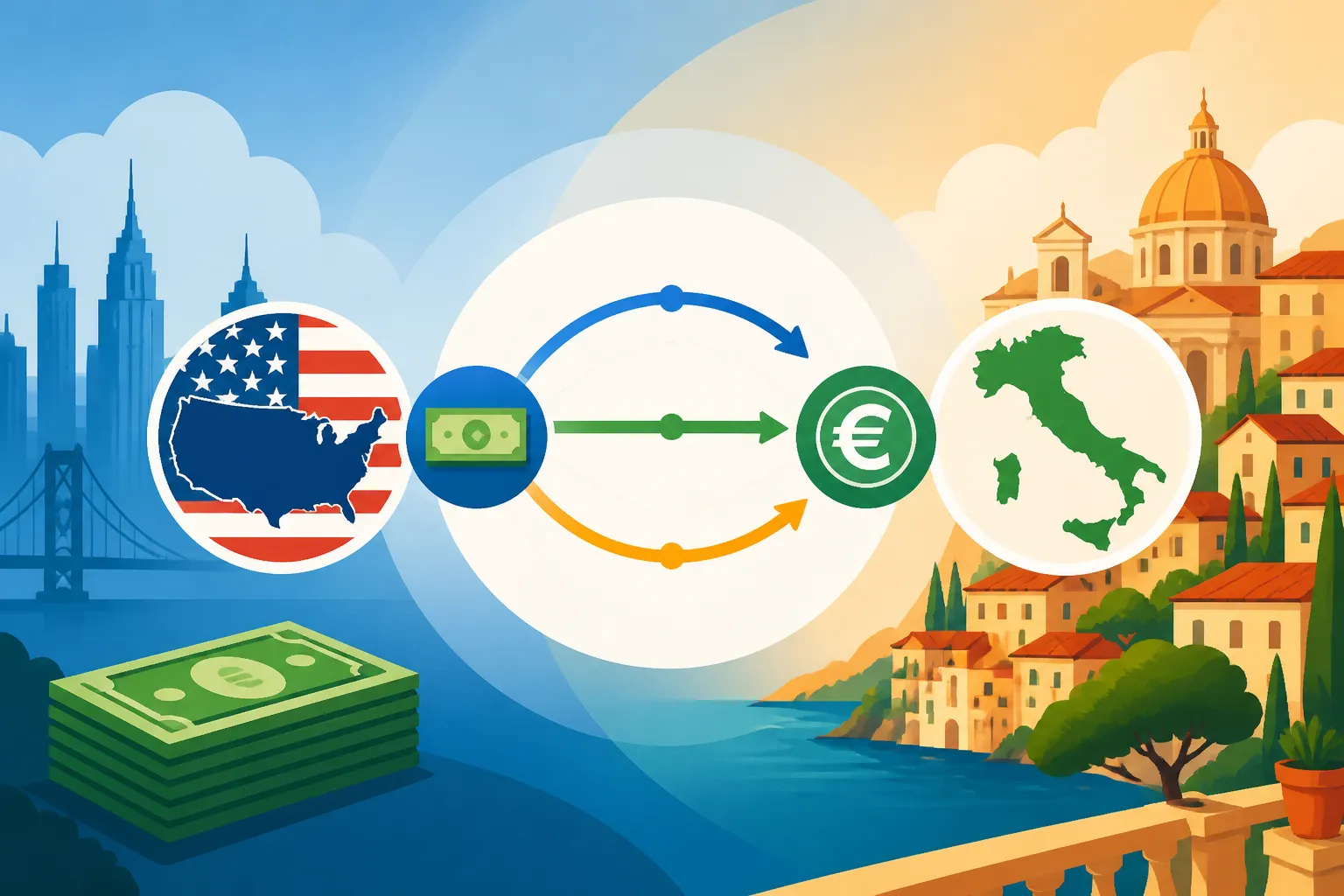
Moving Money From the US to Italy: USD to EUR Transfer Routes Compared
Moving your hard-earned cash from your US bank account to your new life in Italy can feel like trying to solve a Rubik's Cube blindfolded. You’re not just transferring money; you're navigating different banking systems, confusing exchange rates, and often, a maze of hidden fees that sneak up on you. This guide is here to untangle that financial spaghetti, offering clear, actionable advice and comparing the various routes available to get your USD safely and efficiently converted into EUR, with a special focus on making your financial life smoother from day one.
Disclosure: This post may contain affiliate links. We may earn a commission at no extra cost to you if you make a purchase through these links. Read full disclosure.
The Realities of Moving Money Across Continents and Currencies
Let's be honest, when you decided to move to Italy, you probably pictured sipping Aperol Spritzes by the Arno, not wrestling with international wire transfer forms. But the reality of expat life often involves a fair bit of bureaucratic tango, and moving money is right at the top of that list. It's not just about getting dollars to euros; it's about doing it without feeling like you've been taken for a ride, or worse, losing precious time and money to inefficiencies.
Why Just "Sending Money" Isn't So Simple
When you're dealing with international transfers, especially from the US to Italy, it's never as straightforward as simply moving money from one account to another within the same country. You're facing multiple layers of complexity. First, there are the exchange rates, which are constantly fluctuating and can be a huge source of anxiety. One day, your dollar might buy you a bit more gelato, the next, a bit less. Then, there are the fees. Oh, the fees! Banks often advertise "low" or "no" transfer fees, only to hit you with a less-than-favorable exchange rate that acts as a hidden fee, siphoning off more of your money than you realize.
Beyond the cost, there's the speed—or lack thereof. Traditional bank transfers can take days, sometimes even a week or more, to complete. Imagine needing to pay your rent or a utility bill in Italy, and your money is stuck in transit limbo. It's incredibly frustrating and adds unnecessary stress to an already overwhelming transition. And let’s not forget the paperwork; the sheer volume of forms, codes, and details required can make your head spin. As expats, we’ve all been there, staring at a foreign form, wondering if we’re about to make an expensive mistake.
The USD to EUR Headache: What You're Up Against
The conversion from USD to EUR presents its own unique set of challenges. The US dollar and the Euro are two of the world's major currencies, meaning their exchange rate is influenced by global economic events, political shifts, and market speculation. This volatility can be a double-edged sword: a favorable swing can mean more euros for your buck, but an unfavorable one can quickly eat into your budget. It’s not just about the numbers you see on a conversion website; it’s about the rate your chosen service actually gives you, and how much they tack on for themselves.
Many traditional financial institutions don't offer the "mid-market rate"—the true rate you see on Google or XE.com. Instead, they use a slightly adjusted rate, profiting from the spread. This small difference, compounded over large transfers, can add up to a significant sum. For someone just starting out in Italy, every euro counts, whether it's for groceries, setting up utilities, or even just enjoying a coffee at a local bar. Understanding these nuances is crucial to making smart financial decisions and ensuring more of your money actually makes it to your Italian bank account.
Traditional Banking: Familiar but Often Flawed
When expats first consider moving money, their instinct often leads them back to their trusty US bank. It’s familiar, it feels secure, and after all, they’ve been handling your money for years, right? While using your existing bank can offer a certain comfort, it’s important to understand the typical downsides, especially when transferring between continents and currencies.
Wire Transfers from Your US Bank Account
Wire transfers, often facilitated through the SWIFT (Society for Worldwide Interbank Financial Telecommunication) network, are the go-to method for many traditional banks. You go into your branch, fill out a form, provide the recipient's bank details (including their IBAN and your Italian bank's SWIFT/BIC code), and off the money goes. On the surface, it seems straightforward. For very large sums, some people still prefer the perceived security of dealing directly with their bank.
However, this convenience often comes at a steep price. US banks typically charge a flat fee for outgoing international wire transfers, which can range from $25 to $50, sometimes even more. But that's just the tip of the iceberg. The real kicker often comes from the exchange rate markup. Your bank isn't likely to give you the true mid-market rate; they'll offer a less favorable rate and pocket the difference, which can be a substantial hidden fee, especially on larger amounts. Furthermore, wire transfers can be slow, sometimes taking 3-5 business days, and occasionally even longer, as the money might pass through several intermediary banks, each potentially adding their own fees to the transaction. This means the amount you send might not be the exact amount that lands in your Italian account.
Using International Bank Transfers with Italian Banks
Once you've managed to navigate the bureaucracy and successfully How to Open a Bank Account in Italy: Requirements and Tips, you might think receiving money from the US will be simpler. While the Italian banking system is robust, it also has its own quirks. When funds arrive via an international wire transfer from a US bank, your Italian bank might also levy a receiving fee. This isn't always the case, but it's common enough to factor into your calculations.
Moreover, if the funds are sent in USD and need to be converted to EUR by the Italian bank upon arrival, you could face another unfavorable exchange rate markup from their side. So, you're potentially hit with a fee and a poor exchange rate on the sending side, and then another fee and another poor exchange rate on the receiving side. This double-whammy can significantly erode the amount you initially intended to transfer. It's a classic expat dilemma: trying to manage your budget when the very act of moving your money across borders becomes a cost center. This is where many of us start looking for more efficient ways of Managing Your Budget in Italy: Banking, Currency, and Transfers.
Specialist Money Transfer Services: A Breath of Fresh Air
Stepping away from traditional banks opens up a world of more efficient and transparent options for international money transfers. For expats, these services have become indispensable tools, often offering better rates, lower fees, and quicker transfer times. They understand the specific needs of individuals moving funds across borders, rather than primarily catering to large corporations.
Why Wise Stands Out for Expats in Italy
Among the various specialist services, Wise (formerly TransferWise) has consistently proven itself to be a true game-changer for expats sending money from the US to Italy. What makes Wise the hero in this story? It boils down to transparency, fairness, and efficiency.
Firstly, Wise is built on the principle of the mid-market exchange rate. This is the real exchange rate you see on independent financial platforms—the rate banks use when they trade with each other. Unlike traditional banks that add a hidden markup to the exchange rate, Wise passes this rate directly to you. Their fees are upfront, clearly displayed before you even confirm your transfer, so you know exactly how much you're paying and how many euros will land in your Italian account. No nasty surprises.
Secondly, speed is a major advantage. While traditional wire transfers can take days, many Wise transfers from the US to Italy arrive within hours, or even minutes, especially if you're funding the transfer via a debit card. This speed can be a lifesaver when you need funds quickly to pay a deposit for The Ultimate Guide to Renting and Buying a Home in Italy or cover an unexpected expense.
Thirdly, Wise is incredibly user-friendly. Their platform is intuitive, whether you're using their website or mobile app. You can easily set up recurring payments, track your transfers, and even hold balances in multiple currencies with their multi-currency account. This last feature is particularly useful for expats, allowing you to convert USD to EUR when the rate is favorable and hold it in your Wise account until you need to move it to your Italian bank, or even spend directly with a Wise debit card. It significantly simplifies the process of Money Matters in Italy: Banking and Finance for Expats.
Other Notable Money Transfer Platforms
While Wise is often the top recommendation for its transparency and mid-market rates, it's worth briefly mentioning a couple of other platforms that offer international money transfer services, just so you know what else is out there.
Xoom (a PayPal service): Xoom is popular for its speed and convenience, especially if you or your recipient already have a PayPal account. It offers various delivery options, including bank deposits, cash pickup (though less relevant for long-term expats), and even home delivery in some regions. While fast, their exchange rates often include a markup, and their fees can sometimes be higher than Wise, particularly for larger transfers. It can be a good option for urgent, smaller amounts, but for regular or larger transfers, Wise typically offers better value.
Revolut: Revolut is another strong contender, especially for those who want a digital-first banking experience. They offer competitive exchange rates, often close to the interbank rate, and have a sleek app with budgeting tools and multi-currency accounts similar to Wise. However, Revolut has tiered plans, and free transfers might be subject to fair usage limits, after which fees can apply. For some complex transfers or certain currencies, their rates might not always be as consistently transparent as Wise.
Remitly: Remitly focuses on offering various delivery options, including cash pickup, which is less relevant for expats but good for sending money to family members who might not have bank accounts. They often have competitive rates for certain corridors and offer a "speed vs. cost" option. However, their exchange rates can vary, and while they might have good introductory offers, sustained use can sometimes reveal less competitive overall costs compared to Wise for bank-to-bank transfers.
Ultimately, while these alternatives exist and have their niche, for the typical expat moving substantial amounts from USD to EUR into an Italian bank account, Wise generally provides the most transparent, cost-effective, and efficient service.
The Nitty-Gritty: Fees, Exchange Rates, and Speed
Understanding the actual mechanics behind international money transfers is vital for making informed decisions. It's not just about picking a service; it's about dissecting where your money goes and how quickly it gets there. This deep dive will help you identify the true costs and benefits.
Unmasking Hidden Fees and Exchange Rate Markups
One of the biggest frustrations for anyone sending money internationally is the feeling that you're not getting a fair deal, and often, you're not. Traditional banks are notorious for their opaque fee structures. They might proudly declare a low transfer fee, but the real profit often lies in the exchange rate they offer you. This "hidden markup" is the difference between the actual mid-market rate (the rate at which banks trade currencies with each other) and the weaker rate they give to you, the customer. This spread can easily add 2-5% or more to the cost of your transfer, making what seemed like a cheap transfer significantly more expensive. For example, on a $5,000 transfer, a 2% markup is $100—money that simply vanishes.
This is precisely where services like Wise shine. Their business model is built on transparency. They charge a small, upfront fee for each transfer, which is clearly displayed before you initiate the transaction. Crucially, they use the real, mid-market exchange rate, ensuring that the euros you calculate will be the euros that arrive. This transparency is a massive relief for expats, helping you budget accurately and avoid unexpected deductions. When you're trying to figure out the true Cost of Living vs Salary: Budget Tips for Italy Expats, knowing exactly how much money will arrive is invaluable.
Speed vs. Cost: Finding Your Balance
The speed of your transfer is often directly related to its cost. If you need money to arrive yesterday, you might have to pay a premium. Conversely, if you're not in a rush, you can usually opt for a cheaper, slower service.
Traditional bank wires often fall into the "slow and expensive" category. While they typically advertise 1-5 business days, unforeseen delays with intermediary banks or compliance checks can stretch this timeline. The fees, as discussed, are generally on the higher side.
Specialist providers like Wise offer a better balance. For instance, when sending money from USD to EUR with Wise, you usually have a few funding options that impact speed and cost:
- ACH (Automated Clearing House) bank debit: This is usually the cheapest option and can often get your money to Italy within 1-2 business days. It's a standard bank transfer method in the US.
- Wire transfer (from your US bank): While you're still doing a wire transfer to Wise, Wise then converts and sends it out faster. This might cost you the wire fee from your US bank, but Wise's conversion will be at the mid-market rate. Speed is usually 1-2 business days.
- Debit/Credit card: This is often the fastest option, with money sometimes arriving within minutes to a few hours. However, it typically incurs a slightly higher fee because card processing costs more. This can be great for emergencies or when you're paying for Setting Up Utilities (Electricity, Gas, Water) in Italy) and time is of the essence.
The key is to consider your needs. For regular, non-urgent transfers, the ACH option with Wise is usually the sweet spot for cost-effectiveness. For urgent situations, the slightly higher card fee is a small price to pay for speed.
Understanding Transfer Limits and Regulations
Every money transfer service has its own limits, both minimum and maximum, and these can vary based on the currencies involved and the payment method used. For example, some services might have a low daily limit for debit card transfers, while bank transfers allow for much larger sums. It's crucial to check these limits before you plan a significant transfer.
Beyond transactional limits, there are also important regulatory considerations. International money transfers are subject to anti-money laundering (AML) and know-your-customer (KYC) regulations. This means that reputable services will require you to verify your identity before you can send large sums. This typically involves providing ID documents, proof of address, and sometimes even proof of the source of funds. While this might seem like an extra hurdle, it's a necessary step to ensure the security and legitimacy of international financial transactions. Services like Wise make this verification process as smooth as possible, but it's something to be aware of, especially for your first transfer or very large sums. This is all part of the larger financial picture when living abroad, including important elements like obtaining your Codice Fiscale: Why It’s Essential for Finance in Italy.
Step-by-Step: Making Your First USD to EUR Transfer to Italy
So, you're ready to make the leap and send your money across the Atlantic. It might seem daunting at first, but with the right steps and a reliable service, it's actually quite manageable. Let's walk through the process, especially focusing on the seamless experience offered by Wise.
Preparing Your Funds and Recipient Details
Before you even log into a transfer service, gather all the necessary information. This will save you time and prevent errors that could delay your transfer.
From your side (the sender in the US):
- Your US Bank Account Details: Ensure you know your US bank account number and routing number. If you're using a debit or credit card, have that information handy. Make sure you have sufficient funds in your chosen account!
- Identity Verification: For your first transfer, or if you're sending a large amount, be prepared to verify your identity. This usually involves uploading a photo of your passport or driver's license, and sometimes a proof of address. This is standard procedure for any regulated financial service and helps prevent fraud.
For the recipient in Italy (likely yourself, if you're sending to your Italian bank account):
- Full Recipient Name: This must exactly match the name on the Italian bank account.
- IBAN (International Bank Account Number): This is the European standard for bank account numbers, starting with "IT" for Italy, followed by 25 alphanumeric characters. It's crucial this is correct.
- BIC/SWIFT Code: This identifies the recipient's bank and branch. Most Italian banks will have one. You can usually find this on your Italian bank statement or by logging into your online banking.
- Recipient Address: The full address associated with the Italian bank account.
Double-check, triple-check all these details! A single wrong digit in an IBAN can cause significant delays or even send your money to the wrong account, leading to a long and stressful recovery process.
The Wise Way: Simple, Fast, Transparent
Once you have your details, using Wise to send money is incredibly user-friendly.
- Create a Wise Account: If you don't have one, head to the Wise website or download their app. The sign-up process is quick and generally involves providing your email, creating a password, and confirming your identity (as mentioned above).
- Set Up Your Transfer:
- Click "Send Money" or "Send" in the app.
- Enter the amount you want to send in USD, or the amount you want the recipient to receive in EUR. Wise will instantly show you the exchange rate, the total fee, and the exact amount the recipient will get. This is the transparency we love!
- Select "Personal Transfer" and then "Myself" or "Someone else" depending on who the recipient is. If it's your own Italian account, choose "Myself."
- Enter Recipient Details: Input the full name, IBAN, and BIC/SWIFT code for your Italian bank account. Wise often pre-populates bank names once you enter the BIC.
- Choose Your Payment Method: This is where you select how you'll fund Wise from your US account:
- ACH Bank Debit: Connect your US bank account for a direct debit. This is usually the cheapest.
- Wire Transfer: Get Wise's US bank details and initiate a wire transfer from your US bank to Wise. Your US bank will charge its wire fee, but Wise's conversion is still at the mid-market rate.
- Debit Card/Credit Card: Enter your card details. Fastest option, usually with a slightly higher fee.
- Review and Confirm: Wise will show you a final summary: the amount you're sending, the fee, the exchange rate, and the estimated arrival time. Review everything carefully, then confirm.
- Fund Your Transfer: Follow the instructions for your chosen payment method. If you selected ACH, Wise will initiate the pull. If you chose a wire, you'll need to go to your US bank's online portal or branch to send the wire to Wise.
- Track Your Transfer: Once confirmed, Wise provides a clear tracking system. You'll receive email updates, and you can check the progress in your Wise account. They're usually very good at keeping you informed.
That's it! The whole process is designed to be as stress-free as possible, making the financial side of your move to Italy much smoother.
What to Expect on the Italian Side
Once you’ve initiated your transfer with Wise, here’s what generally happens and what to look out for on the Italian end:
- Arrival Notification: Your Italian bank account will receive the funds as a local EUR transfer. This usually means no additional receiving fees from the Italian bank, a significant advantage over traditional wires. You might receive an SMS or email notification from your Italian bank once the funds are credited.
- Timelines: As Wise provides an estimated arrival time, the money should appear in your Italian account within that window. For faster payment methods like debit cards, it could be a matter of hours. For ACH, expect 1-2 business days.
- Checking Your Account: Log into your Italian online banking or check your mobile app to confirm the funds have arrived.
- Record Keeping: It’s always a good idea to keep records of your transfers for your own budgeting and potential tax reporting, especially if you're delving into Understanding Italy's Tax System: A Guide for Foreigners or applying for things like How to Apply for Italy's Impatriati Tax Relief for Workers.
Wise simplifies a process that can otherwise be a source of major headaches, allowing you to focus on the exciting parts of your new life in Italy, like finding that perfect rental apartment or exploring your new neighborhood.
Pro Tips for Expats: Maximizing Your Transfers
Living abroad means mastering the art of financial optimization. Every euro saved on fees or gained through a better exchange rate can go a long way in enhancing your Italian experience. Here are some seasoned expat tips to help you get the most out of your money transfers.
Timing Your Transfers: Exchange Rate Savvy
The foreign exchange market is always moving, and even small fluctuations in the USD to EUR rate can make a difference on larger transfers. Being "exchange rate savvy" doesn't mean you need to become a financial analyst, but a little awareness can save you some cash.
- Monitor the Mid-Market Rate: Use tools like Wise's exchange rate tracker, Google, or XE.com to keep an eye on the current USD/EUR rate. You'll notice it changes throughout the day.
- Set Rate Alerts: Many services, including Wise, allow you to set up email alerts. You can tell them, "Notify me when USD to EUR hits X rate." This is incredibly useful, as you don't have to constantly check. When the rate moves in your favor, you'll get a notification and can decide to transfer.
- Avoid Transfers on Weekends: While many services operate 24/7, the foreign exchange market is typically less active on weekends. Some providers might use less favorable "locked" rates, or charge a slightly higher fee due to lower liquidity. Aim for transfers during weekday business hours (US time) for potentially better rates.
- Don't Rush (Unless You Have To): If you have some flexibility, don't feel pressured to transfer money immediately. Wait for a good rate. However, if you need funds for something time-sensitive, like a rental deposit for Renting an Apartment in Italy Without an Agent, prioritize speed and reliability, even if the rate isn't absolutely perfect.
Regular Payments vs. Lump Sums
Your approach to transferring money might differ based on whether you're moving a large initial sum or sending smaller, regular payments to cover monthly expenses.
- Lump Sums (e.g., Relocation Funds): For a large initial transfer, the impact of exchange rates and fees is magnified. This is where transparency and the mid-market rate offered by Wise become incredibly important. A 0.5% difference on a $10,000 transfer is $50. You want to make sure you're getting the best possible value for these significant amounts. Wise allows you to lock in a rate for a certain period once you initiate a transfer, giving you peace of mind.
- Regular Payments (e.g., Monthly Living Expenses): For ongoing expenses, you might want to automate transfers or ensure consistency. Wise offers an easy-to-use recurring transfer feature. You can set it up once, and your money will be sent automatically at your chosen frequency. This is a huge time-saver and ensures you always have funds available for your Cost of Living in Italy 2026: Budgeting for Expats. By automating these, you minimize the mental load of managing finances across borders.
Linking Your US and Italian Financial Lives
For many expats, the goal isn't just to move money once, but to seamlessly integrate their financial lives across two countries. This is where a service like Wise can truly shine as a central hub for your international finances.
- Multi-Currency Account: Wise offers a multi-currency account that allows you to hold balances in over 50 currencies, including USD and EUR. This means you can keep dollars and euros in the same account. When you transfer from your US bank to Wise, you can choose to hold the funds in USD and convert them to EUR later when the exchange rate is more favorable.
- Wise Debit Card: The Wise debit card (available in many regions, including the US for spending globally) lets you spend directly from any currency balance in your account. If you have EUR in your Wise account, you can use the card in Italy without any conversion fees. If you only have USD, it will automatically convert at the mid-market rate with a small fee, often still cheaper than using a traditional US bank card abroad. This can be a game-changer for daily expenses and managing your budget.
- Local Account Details: With a Wise multi-currency account, you can get local bank details for several currencies, including a US routing and account number, and an EU IBAN. This means you can receive money into your Wise account as if it were a local bank account in either currency, then convert it or move it to your Italian bank as needed.
By integrating Wise into your financial strategy, you create a powerful bridge between your US and Italian financial worlds, offering flexibility, transparency, and cost-effectiveness that traditional banking simply can't match.
Disclaimer
Please note that this guide provides general information based on current practices and regulations in Italy and the US regarding money transfers. While every effort has been made to ensure accuracy and relevance for expats in Italy, financial regulations, exchange rates, and service offerings can change frequently. It is always recommended to check the most up-to-date terms and conditions with any service provider, and if you have complex financial situations, consider consulting with a qualified financial advisor or tax professional familiar with international transactions and Italian tax laws. This content is for informational purposes only and does not constitute financial advice.