Holding Euros, Pounds, and Dollars in One Account: What Converting Costs
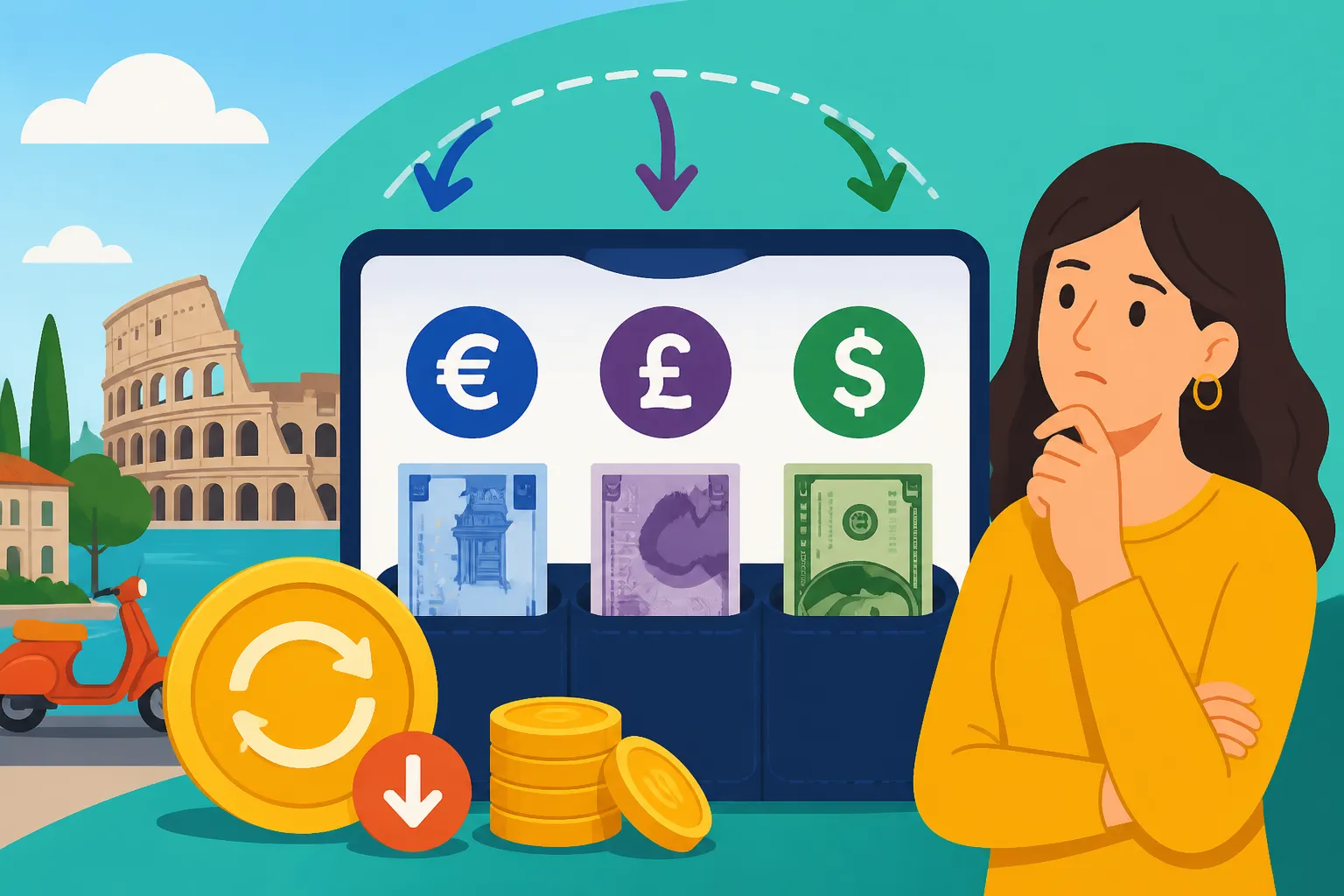
Ah, the eternal expat juggle: living in Italy but dealing with income, expenses, and family spread across different currencies. It's a common story, isn't it? You've got your hard-earned dollars, pounds, or whatever else, and suddenly you need euros for that affitto (rent) or spesa (groceries). The question then becomes, how do you manage all these different currencies without a significant chunk of your money vanishing into the abyss of exchange rates and hidden fees? This guide is here to shed some much-needed light on how to hold Euros, Pounds, and Dollars in one accessible account, focusing on smart, cost-effective solutions for your multi-currency life here in Italy.
Disclosure: This post may contain affiliate links. We may earn a commission at no extra cost to you if you make a purchase through these links. Read full disclosure.
The Daily Headache of Multi-Currency Life in Italy
Moving to Italy is a dream for many, full of delicious food, stunning landscapes, and a wonderfully rich culture. But let's be real – the financial logistics can quickly turn that dream into a bureaucratic nightmare. Many of us arrive with funds in our home currency, and the instant need to convert it to euros for daily living starts a constant, often expensive, dance with banks.
The Hidden Costs of Traditional Banking
When you first open a bank account in Italy, you'll likely go with a traditional Italian institution. And while these are essential for things like setting up direct debits for utilities or receiving an Italian salary, they aren't always designed with the multi-currency needs of an expat in mind.
Consider this scenario: You're still receiving a pension or a remote salary in US Dollars or British Pounds from back home. Every time that money hits your Italian bank account, it's immediately converted to euros, often at an exchange rate that's not quite in your favor. On top of that, your bank might slap on various fees – a receiving fee, a conversion fee, and sometimes even a percentage of the total amount. It feels like death by a thousand cuts, doesn't it? You see the amount in your home currency, mentally convert it, and then watch the actual amount that lands in your account shrink before your eyes. It's frustrating because you’re not just losing a small amount here and there; over the course of a year, these little deductions can add up to a substantial sum that could have been better spent on, well, anything else in Italy! This is particularly true for international transfers, where the sending and receiving banks, and even intermediary banks, can all take a bite.
Why Expats Need a Smart Multi-Currency Solution
As an expat living in Italy, your financial life rarely fits neatly into a single currency box. You might be getting paid in dollars, paying rent in euros, sending money back home in pounds, or even saving for a future trip in a different currency entirely. Traditional banks, with their often rigid structures and high fees for foreign currency transactions, simply aren't equipped for this kind of dynamic financial management.
A dedicated multi-currency solution becomes absolutely vital. Think about it: you want to receive your US dollar salary and hold it as dollars until the EUR/USD exchange rate is more favorable, instead of being forced into an immediate, potentially disadvantageous conversion. Or perhaps you need to send money to family in the UK without losing a chunk to exorbitant transfer fees. Having the flexibility to hold various currencies in one place, converting only when you decide and at a transparent, fair rate, can make a world of difference to your financial well-being. It simplifies budgeting, gives you more control over your money, and significantly cuts down on those infuriating hidden costs. This is not just about convenience; it’s about financial empowerment in your new home. For those navigating the maze of personal finance, a practical approach to Money Matters in Italy: Banking and Finance for Expats can really help simplify your journey.
Navigating Exchange Rates and Transfer Fees: The True Cost
The world of international money transfers and currency exchange is often opaque, designed to confuse rather than clarify. Many banks and services make their profit by hiding fees within poor exchange rates or adding multiple small charges that quickly add up. Understanding these mechanisms is crucial to keeping more of your hard-earned money.
Understanding Mid-Market Rate vs. Tourist Rate
Have you ever looked up an exchange rate online, only to find that the rate your bank offers is noticeably worse? That difference isn't accidental. It's the core of how many financial institutions make their money.
The mid-market rate (also known as the interbank rate or real exchange rate) is essentially the true, raw exchange rate – the midpoint between the buying and selling prices of a currency on the global market. It's the rate you'd see on Reuters or Google. This is the rate at which banks trade currencies among themselves, but it's rarely the rate they offer to you, the individual customer.
What you often get is a tourist rate or a bank rate, which is the mid-market rate with a significant mark-up added by the bank or currency exchange service. This mark-up is their profit margin. So, when you see EUR/USD at 1.08 on a financial news site, your bank might offer you 1.06 to convert your dollars to euros, effectively giving you fewer euros for your dollars. This seemingly small difference, perhaps just a few cents per unit of currency, can accumulate into a substantial loss on larger transfers. It's particularly frustrating when you're trying to calculate your Cost of Living vs Salary: Budget Tips for Italy Expats and realize a chunk of your income disappears before it even hits your pocket. This hidden margin is one of the most significant "fees" you pay, often without even realizing it.
The Sneaky Fees: SWIFT, Correspondent Banks, and Commissions
Beyond the unfavorable exchange rates, traditional international money transfers are riddled with various charges that can feel like a game of whack-a-mole. You think you've accounted for one fee, and another pops up.
One of the most common culprits is the SWIFT network. SWIFT (Society for Worldwide Interbank Financial Telecommunication) is a global messaging system that banks use to send information and instructions for transfers. While essential, it often means your money doesn't go directly from your bank to the recipient's bank. Instead, it might pass through several correspondent banks along the way, each of which can levy its own processing fee. These fees can be fixed (e.g., $15-$30 per bank) or a percentage, and they're often deducted from the transfer amount mid-route, meaning the final recipient gets even less than what was initially sent. You initiate a transfer of €1000, and your friend in London receives £840 instead of the expected £860, and neither of you can pinpoint exactly where those missing pounds went. It's utterly maddening, especially when you're managing finances as an expat and every euro or pound counts.
Then there are the explicit commissions or transfer fees charged by your own bank for initiating an international transfer, or by the receiving bank for accepting one. These can be percentage-based or flat fees, and they're usually disclosed somewhere in the fine print, but they're still an additional cost that chips away at your money. For those looking into Understanding Italy's Tax System: A Guide for Foreigners, these hidden costs can add an unexpected layer of complexity to your financial planning. This tangled web of charges is precisely why many expats feel so financially vulnerable when moving money across borders.
Wise: Your Go-To Solution for Multi-Currency Management in Italy
For years, expats like us have been grumbling about the exorbitant costs and baffling processes of international money transfers. It felt like we were always at the mercy of banks, losing significant amounts just to move our own money around. That's why I'm always eager to share solutions that genuinely make life easier and more affordable, and Wise (formerly TransferWise) has consistently proven itself to be one of the best for multi-currency management, especially for us living in Italy.
How Wise Makes Life Easier for Expats in Italy
Wise was built specifically to tackle the pain points of international money transfers and multi-currency banking. Their core philosophy is transparency and fairness, and they achieve this by providing access to the true mid-market exchange rate. This means when you convert your money with Wise, you're getting the same rate you see on independent financial market trackers, without the hidden mark-ups that traditional banks add.
Instead of hiding fees in the exchange rate, Wise charges a small, upfront, and clearly stated transfer fee. This fee is typically a fraction of what you'd pay with a traditional bank, and you always know exactly how much you're paying before you hit send. No more guessing, no more unpleasant surprises when the money finally lands.
But the real game-changer for expats in Italy is the Wise Multi-Currency Account. This isn't just a simple transfer service; it's a digital account that allows you to hold, send, and receive money in over 50 different currencies. Crucially, it provides you with local account details for 10 major currencies, including EUR, GBP, USD, CAD, AUD, and more. This means you can get paid in US dollars into your Wise account as if you had a local US bank account, or receive British Pounds as if you had a UK bank account – all while living right here in Italy.
Imagine being able to receive your US dollar salary directly into your Wise USD account, holding it there until the euro-dollar exchange rate is favorable, and then converting it to EUR at the mid-market rate. Or, if you need to pay a bill in the UK, you can use the GBP held in your Wise account, again avoiding unnecessary conversions and fees. This level of control and transparency is revolutionary for expats who are constantly dealing with different currencies. It makes managing your finances less about navigating a labyrinth of fees and more about simply moving your money as needed. For anyone trying to simplify their finances, knowing How to Open a Bank Account in Italy is a crucial first step, and Wise can complement that by handling your international needs.
Setting Up Your Multi-Currency Account with Wise
Getting started with Wise is refreshingly straightforward, a welcome change from some of the Italian bureaucratic processes we’ve all come to know and (tolerate). You can do it all online, from the comfort of your Italian home.
First, you'll need to visit the Wise website or download their app. The initial registration process is quick and asks for basic personal information, including your name, address (your Italian address is perfectly fine here!), and email. You’ll then need to verify your identity, which typically involves uploading a photo of your passport or Permesso di Soggiorno and a selfie. This is standard procedure for any regulated financial service and usually takes just a day or two to be approved.
Once your account is verified, you can open balances in various currencies. Simply select the currencies you want to hold – for most expats in Italy, this will include EUR, GBP, and USD, but you can choose from many more. Within moments, you’ll have dedicated local account details for each of these currencies. For example, you’ll get a unique EU IBAN for your Euro balance, a UK sort code and account number for your Pound balance, and a US account number and routing number for your Dollar balance.
This means that instead of giving a foreign employer or client your Italian bank’s SWIFT details, you can provide them with your Wise local account details for their respective currency. They pay you as if it's a local transfer, often saving them fees too, and the money lands in your Wise account in its original currency, ready for you to manage. It's a remarkably smooth process that cuts out so much of the traditional international transfer hassle.
Practical Applications for Living in Italy
The utility of a Wise multi-currency account for expats in Italy extends far beyond just receiving a salary. It truly integrates into the fabric of your daily financial life.
Let's consider a few real-world scenarios:
- Receiving Foreign Income: If you're a freelancer working remotely for clients in the US or UK, you can give them your Wise USD or GBP account details. They pay you via a local transfer, avoiding costly international SWIFT fees for both of you. The money arrives in your Wise account in its original currency, ready for when you decide to convert to euros for your Italian expenses. This is a game-changer for those on a Self-Employment Visa for Freelancers and Entrepreneurs.
- Managing Cross-Border Bills: Perhaps you still have a mortgage or student loan payment in your home country. Instead of sending euros from your Italian bank, converting them at a poor rate, and paying hefty fees, you can convert money to the necessary currency within Wise at the mid-market rate and then send it via a local transfer. It's faster and significantly cheaper.
- Travel Within and Outside Europe: When you travel outside the Eurozone, your Wise debit card (which you can order once your account is set up) automatically uses the correct currency balance you hold, or converts at the mid-market rate if you don't have that specific currency. No foreign transaction fees, no dodgy exchange rates at airports. If you're heading to the UK for a visit, you can simply use your Wise card, drawing directly from your GBP balance.
- Online Shopping and Subscriptions: Many international online services or subscriptions are priced in USD or GBP. Paying directly from your Wise USD or GBP balance avoids unnecessary conversions from EUR and potential foreign transaction fees that might be charged by your Italian bank.
- Sending Money Home: Whether it's for family support, investment, or just topping up a bank account back home, Wise allows you to send money from your euro balance to a foreign currency account quickly and cheaply, again using the mid-market rate and transparent fees. This is a far cry from the old days of expensive wire transfers, and particularly helpful if you're exploring Money Transfer Services: Sending Money to Italy.
In essence, Wise gives you the financial agility to navigate your international life in Italy with confidence, ensuring more of your money stays where it belongs: with you.
Beyond the Basics: Advanced Tips for Multi-Currency Living
Once you’ve got your multi-currency account set up, you’ve already won half the battle. But there’s always more you can do to optimize your financial habits and make your multi-currency life in Italy as seamless and cost-effective as possible. It’s about being proactive rather than reactive, especially when dealing with different economic landscapes.
Budgeting and Tracking Across Currencies
This might sound like a simple suggestion, but when you're dealing with multiple currencies, budgeting can become surprisingly complex. It's not just about knowing how many euros you have, but also understanding the real-time value of your pounds and dollars in relation to your Italian expenses.
My advice? Don’t just rely on mental arithmetic. Use a dedicated budgeting app or a good old-fashioned spreadsheet. Many modern budgeting tools can link to multiple bank accounts, even digital ones like Wise, and some even offer multi-currency tracking features. The key is to set up a consolidated view of your finances. Designate one currency (likely EUR, given you live in Italy) as your primary budgeting currency, and mentally, or with the help of a tool, convert all other currency balances to that baseline.
For example, if you have €2000 in your Italian bank, $1500 in your Wise USD balance, and £500 in your Wise GBP balance, regularly check the mid-market rates to see what those foreign currencies are actually worth in euros. This helps you understand your true purchasing power in Italy and avoid overspending or underspending. It also gives you a clearer picture of your overall net worth, which is crucial for long-term Financial Planning for Expats: Savings, Retirement, and Pensions in Italy. Keeping a detailed record of inflows and outflows for each currency, noting the exchange rate at the time of conversion, will also give you invaluable insight into your spending patterns and help you identify where you might be losing money unnecessarily.
When to Convert and When to Hold
This is where the art of multi-currency management comes into play. With a Wise multi-currency account, you have the power to decide when to convert your money, rather than being forced into it. This flexibility is your greatest asset.
The general rule of thumb is to hold a currency if you anticipate needing it in that currency (e.g., keeping USD if you know you’ll be making a large purchase in the US soon, or GBP if you’re planning a trip back to the UK). If you primarily need euros for your daily life in Italy, you'll eventually need to convert your foreign currency income.
The "when" to convert often comes down to tracking exchange rates. While trying to "time the market" perfectly is a fool's errand for individuals, you can certainly avoid converting when the rate is clearly unfavorable.
- Set up exchange rate alerts: Many financial apps and services (including Wise) allow you to set up alerts that notify you when your desired exchange rate is met. For instance, you could set an alert to be notified when the EUR/USD rate hits 1.09, telling you it’s a good time to convert your dollars to euros.
- Convert in smaller batches: Instead of converting a large lump sum all at once, consider converting smaller amounts periodically. This strategy, known as dollar-cost averaging (or euro-cost averaging in this case), can help smooth out the impact of currency fluctuations over time. If the rate moves against you on one conversion, it might move in your favor on the next, balancing things out.
- Balance immediate needs with strategic holding: Always ensure you have enough euros for your immediate expenses and a small buffer in your Italian bank account. Any surplus foreign currency can then be held in your multi-currency account until a more opportune conversion rate appears. Don't let the pursuit of a slightly better rate compromise your ability to pay your rent or utilities on time. For complex transfers or significant sums, consulting with an accountant in Italy might offer tailored advice to optimize your conversions.
| Feature / Service | Traditional Italian Bank (e.g., UniCredit, Intesa Sanpaolo) | Wise Multi-Currency Account |
|---|---|---|
| Currency Holdings | Primarily EUR; foreign currency accounts often costly/limited | 50+ currencies supported; hold balances in multiple currencies |
| Exchange Rate | Often marked up from mid-market rate (less favorable) | True mid-market rate (no hidden spread) |
| Transfer Fees | High SWIFT fees, correspondent bank charges, explicit commissions | Low, transparent, upfront fees; no hidden charges |
| Local Account Details | Only for EUR (Italian IBAN) | Local account details for 10 major currencies (EUR, USD, GBP, etc.) |
| Speed of Transfers | International transfers can take 3-5 business days | Often same-day or within 24 hours for many routes |
| Debit Card | Yes, typically EUR-only or with foreign transaction fees | Yes, Wise card automatically uses correct currency or converts cheaply |
| Ease of Setup | Requires in-person visits, more paperwork | Fully online, fast verification (passport/Permesso, selfie) |
| Suitability for Expats | Essential for local needs (salary deposit, bills) but costly for multi-currency | Ideal for international income, cross-border payments, holding foreign funds |
Disclaimer
The information provided in this guide is for general informational purposes only and does not constitute financial, legal, or professional advice. While we strive to provide accurate and up-to-date information, circumstances in Italy can change rapidly, and individual situations may vary. Always consult with a qualified financial advisor, tax professional, or legal expert for advice tailored to your specific needs. We do not endorse any specific financial product or service over another, beyond presenting options based on general expat experiences. Using any financial service comes with its own terms and conditions, which you should read carefully.