Data Coverage in the Dolomites and Italian Alps: Mountain Signal Reality
There's nothing quite like the breathtaking majesty of the Italian Alps and Dolomites, but many of us have learned the hard way that this stunning beauty often comes at the cost of reliable phone signal. Planning your mountain adventure only to find yourself completely cut off when you need navigation, emergency services, or even just to share that incredible view, is a frustration too many expats and tourists know. This guide is here to unravel the complexities of mobile data coverage in Italy's mountainous regions, offering realistic expectations and, most importantly, providing a foolproof solution to keep you connected, no matter how high you climb.
Disclosure: This post may contain affiliate links. We may earn a commission at no extra cost to you if you make a purchase through these links. Read full disclosure.
The Harsh Reality of Mountain Mobile Coverage in Italy
Italy's mountainous regions, from the dramatic peaks of the Dolomites in the north-east to the majestic Val d'Aosta in the north-west, offer some of the most spectacular landscapes and outdoor activities in Europe. However, their very ruggedness and remote nature pose significant challenges for mobile network infrastructure. It's not like the cities, where you practically trip over cell towers. Up here, physics and economics play a cruel game with your signal bars.
Why Mountains Are Mobile Signal Black Holes
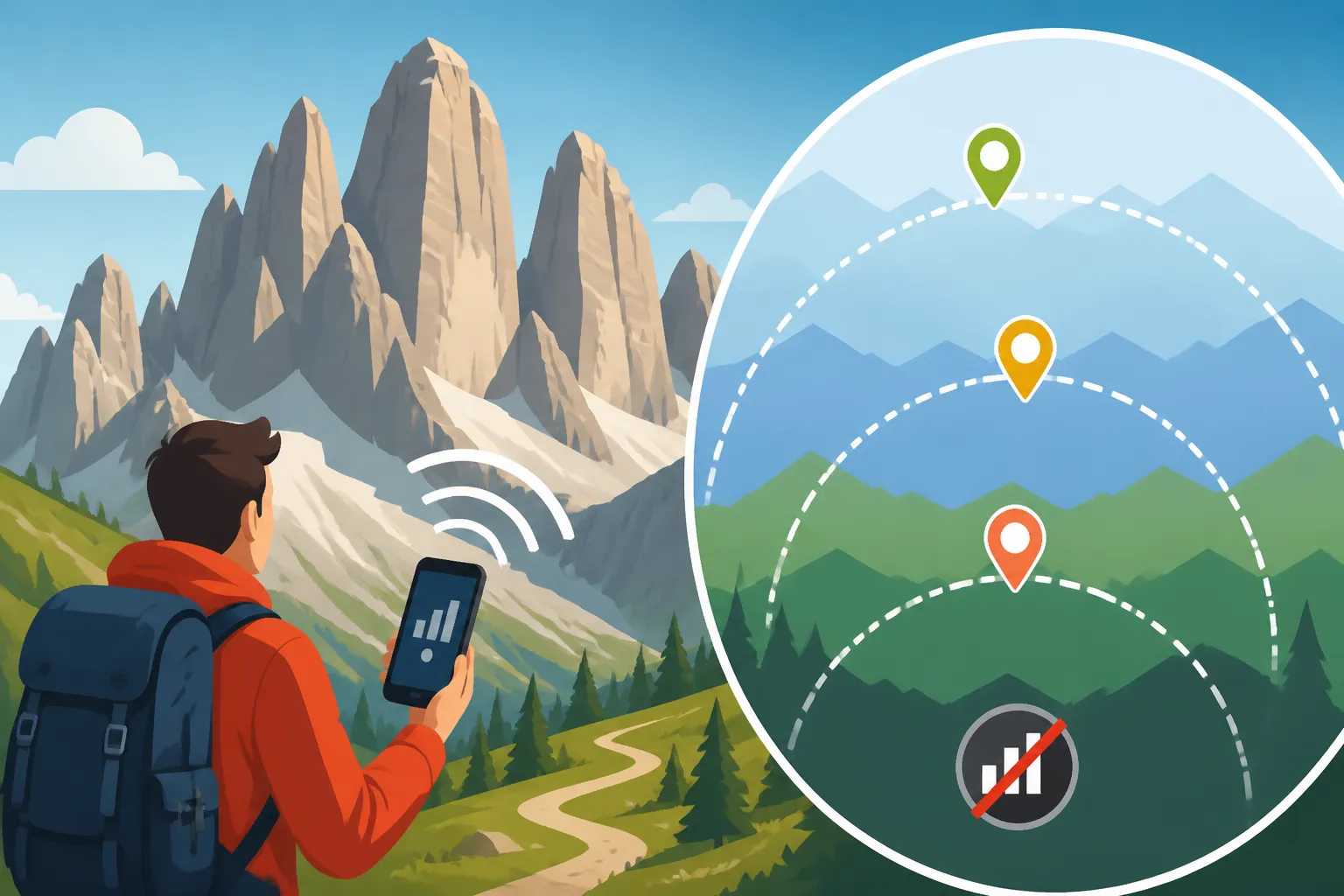
Imagine those towering, jagged peaks and deep, winding valleys. They're incredible to behold, but they're also excellent at blocking radio waves. Mobile signals need line-of-sight to travel effectively from a cell tower to your phone. In the mountains, you're constantly encountering obstacles. A signal might bounce off one peak only to be absorbed by another, or simply vanish into a sheer cliff face. This phenomenon creates what we affectionately call "dead zones" – areas where your phone might as well be a brick for all the good it does you. You might have full bars one moment at a rifugio (mountain hut), and then a few switchbacks down the trail, niente.
Adding to this natural challenge is the sheer cost and difficulty of installing and maintaining cell towers in such remote, often harsh environments. Laying cables, providing power, and building structures on inaccessible mountain sides is far more expensive than doing the same in a flat, populated area. As a result, network providers prioritize coverage where most people live and work, meaning rural and mountain areas often get the short end of the stick. This is a universal truth, but it certainly doesn't make it any less annoying when you're trying to figure out which fork in the trail to take, and your map app won't load.
Common Connectivity Challenges for Travelers
Beyond the basic physics, expats and tourists often face unique connectivity challenges when venturing into the Italian Alps and Dolomites. Firstly, many rely on their home country's roaming plans, which might not always prioritize access to the best local network in a given area. While roaming agreements are typically in place, your provider might steer you towards a partner network that has weaker coverage in that specific mountainous region. I've had friends in the Val Gardena area pulling their hair out trying to get even a single bar with their international roaming, only to find a local friend on a different Italian network had decent service.
Secondly, relying solely on Wi-Fi is a gamble. While many hotels, restaurants, and larger rifugi do offer Wi-Fi, it's often slow, expensive, or simply non-existent in more remote locations. You can't depend on it for real-time navigation on a hike or for checking weather updates while skiing. And let's not forget the sheer joy of trying to load a critical document or make a video call with a connection that keeps dropping every five minutes. It just adds another layer of stress to what should be a relaxing escape. This makes planning ahead crucial, and that includes your data strategy.
Understanding Italian Mobile Network Providers and Their Reach
When it comes to Italy's major mobile network providers, TIM, Vodafone, and WindTre are the big players. They dominate the market, and generally, if you're in a city or a well-populated town, you'll find reliable coverage from any of them. However, when you head into the mountains, their performance can vary significantly, not just between providers but also region by region, and even valley by valley. It's not a one-size-fits-all situation, which makes choosing a local SIM tricky if you don't know the exact nuances of your chosen hiking or skiing destination.
Major Providers and Their Mountain Strengths
- TIM: Often considered to have the broadest coverage across Italy, TIM generally performs well even in more rural and mountainous areas. They have a history of investing in infrastructure, making them a solid choice for general travel. However, "generally performs well" still doesn't mean perfect. There will still be pockets of no service, especially in very deep valleys or high altitudes. If you're tackling challenging peaks in, say, the Brenta Dolomites, TIM might give you the best chance of sporadic signal.
- Vodafone: Vodafone is also known for strong coverage and decent speeds. In some specific mountain valleys or ski resorts, Vodafone might even outperform TIM, especially where they've made targeted investments. For example, some ski areas like Cortina d'Ampezzo might have excellent Vodafone coverage due to tourism infrastructure. It's often a close call between TIM and Vodafone in terms of overall reach in less accessible areas.
- WindTre: WindTre is the result of a merger between Wind and 3 Italia and has been steadily improving its network. While they've made strides, they sometimes lag slightly behind TIM and Vodafone in terms of deep rural and remote mountain coverage. However, in certain areas, particularly larger towns within mountain regions, their performance can be perfectly adequate. For a casual visit to a bustling Dolomites town, WindTre might be just fine, but venturing far off the beaten path could be risky.
It’s crucial to understand that even the "best" provider will have dead zones. No single network offers 100% uninterrupted coverage throughout every remote hiking trail or hidden ski slope. That's just the nature of mountain topography. Many expats moving to Italy end up with a local SIM card, but even then, managing it for mountain trips requires careful consideration of potential connectivity gaps. For a deeper dive into local options, check out our guide on choosing a cell phone plan in Italy.
The Problem with Physical SIM Cards for Short Stays
For many short-term visitors or those who frequently travel internationally, dealing with physical Italian SIM cards can be a real hassle. First, you have to find a store, navigate language barriers, present identification, and then physically swap out your home SIM. This means you might miss calls or texts to your primary number, which is a headache if you're trying to coordinate travel or manage anything back home. Plus, if you're crossing borders or visiting multiple countries, you're back to square one with a new SIM in each place.
Beyond the logistical pain, these local physical SIMs often come with plans designed for residents, not short-term tourists. You might end up paying for more data than you need, or have a complex activation process that eats into your precious vacation time. And let's not forget the environmental impact of disposable plastic SIM cards. While registering for the Italian National Health System (SSN) as a foreigner might be a complex process that necessitates a local number, for pure data needs in the mountains, there are better, more flexible options.
Why the eSIM Advantage Is a Game-Changer for Mountain Data
This is where technology really steps in to save the day, especially for those of us venturing into Italy's stunning but signal-challenged mountain regions. The rise of eSIMs (embedded SIMs) has been a revelation for international travelers, and for tackling the data doldrums of the Dolomites and Italian Alps, they are nothing short of a lifesaver. Forget the fumbling with tiny plastic cards and the fear of dropping your primary SIM somewhere on a snowy peak. An eSIM offers a digital, flexible, and often more reliable pathway to staying connected.
Seamless Connectivity with Airalo
When it comes to eSIMs, Airalo truly stands out as the hero for anyone exploring Italy's majestic mountains. Why? Because Airalo offers local Italian eSIMs that connect you directly to the best available local network, be it TIM, Vodafone, or WindTre, depending on your location and the specific Airalo package. This means you bypass the complexities of international roaming agreements that might push you onto a weaker partner network. You get to tap into the same robust local infrastructure that Italian residents use, often with the strongest signal available in that area.
The beauty of Airalo is its simplicity. Before you even set foot on Italian soil, or while you're sipping a cappuccino in your hotel lobby in Bolzano, you can download an Airalo eSIM package directly to your compatible smartphone. No trips to a phone store, no language barriers, no physical SIM swaps. You can keep your primary SIM active for calls and texts from home, while your Airalo eSIM handles all your data needs. This dual SIM functionality is invaluable when you're hiking a remote trail in the Dolomites and need to check a map on the go, or when you’re out on the slopes and want to quickly send a photo of the breathtaking view to friends without worrying about roaming charges. Think of Airalo as your secret weapon against mountain signal woes, allowing you to focus on the incredible experience of Italy.
The Benefits of an eSIM over Traditional SIMs
The advantages of an eSIM like Airalo, particularly for mountainous regions, are numerous and impactful. Firstly, instant activation. You purchase a data package online, download it, and you're ready to go. This is a massive time-saver compared to searching for a physical SIM card vendor. Secondly, flexibility. Airalo offers various data packages with different validities (e.g., 7 days, 15 days, 30 days), so you only pay for what you need for your specific trip duration. This avoids the waste of large, long-term plans that local physical SIMs often require.
Thirdly, and perhaps most crucially for mountain adventurers, is the reliability of local network access. By connecting to strong local providers, Airalo significantly increases your chances of finding a signal in those tricky, remote spots. While no solution is 100% perfect in every single crevice of the Alps, maximizing your access to local networks via Airalo gives you the best fighting chance. This is particularly important for safety, ensuring you can access emergency services if needed – an aspect that is thoroughly covered in resources like our guide on emergency medical numbers in Italy. Finally, there's the convenience of managing multiple eSIMs. If you're venturing across other European countries after Italy, you can simply download another regional or country-specific eSIM from Airalo, all managed within a single app, without ever changing a physical card. It's truly a modern travel essential.
Practical Tips for Staying Connected in the Italian Mountains
Even with the best eSIM or local SIM, mountain environments demand a slightly different approach to connectivity. It’s not just about having the right tool, but knowing how to use it effectively and what supplementary measures to take. Preparation is key, especially when safety might depend on it.
Maximizing Your Signal and Battery Life
When you're out in the mountains, every bit of signal and battery life counts. To give your phone the best chance of finding a network, try moving to higher ground or a more open area if you're stuck in a signal shadow. Sometimes just a few meters can make a difference. If you're in a rifugio or a village, try to be near a window or outdoors. Also, turning off Wi-Fi and Bluetooth when not in use can conserve battery, as your phone won't be constantly searching for networks that aren't there.
Furthermore, keeping your phone in airplane mode and only switching it on when you specifically need to check for signal can save a significant amount of battery. When signal is weak, your phone works harder to connect, draining the battery faster. For critical navigation or emergency calls, a fully charged power bank is non-negotiable. If you're going for a day hike in the Dolomites, always have a power bank. Remember that cold weather also impacts battery performance, so keep your phone close to your body heat when not in use.
Offline Maps and Emergency Preparedness
This tip might sound old-fashioned, but it’s absolutely vital: download offline maps! Apps like Google Maps, Maps.me, or even specific hiking apps for the Dolomites (like Tabacco Maps) allow you to download entire regions for offline use. This means you can navigate without a data connection, saving your data allowance and preventing panic when you lose signal. Always mark your intended route and key points of interest, like rifugi or emergency shelters, beforehand.
Beyond maps, carry a physical map and compass as a backup, and know how to use them. Always inform someone of your planned route and expected return time. For serious hikers and climbers, consider investing in a satellite messenger device for true emergency communication in areas with no mobile signal whatsoever. And of course, make sure you know the local emergency numbers. While our guide on emergency medical services in Italy covers this in detail, a quick reminder: 112 is the universal emergency number across Europe, including Italy. It's smart to have it programmed into your phone.
Leveraging Airalo for Peace of Mind
Ultimately, the most straightforward and reliable way to ensure you have the best possible chance of data connectivity in the Italian Alps and Dolomites is to equip yourself with an Airalo eSIM. It simplifies your travel planning by removing the stress of finding local SIMs and offers access to the strongest networks right from the start. Imagine effortlessly downloading your hiking trail, checking the rapidly changing mountain weather, or even making a quick video call to share your views with family, all powered by Airalo.
With Airalo, you’re not just buying data; you’re investing in peace of mind. You’ll have one less thing to worry about on your incredible Italian adventure. If you're planning an epic trek in the Dolomites, say through areas like the Tre Cime di Lavaredo, having Airalo on your phone means you're prepared. It's a small step in preparation that makes a huge difference to your overall experience, allowing you to fully immerse yourself in the natural beauty without constant worry about connectivity. Make sure to factor in your travel insurance for trips to and within Italy, just in case of any other unexpected issues!
| Feature | Traditional Physical SIM (Local) | International Roaming | Airalo eSIM (Local Data) |
|---|---|---|---|
| Purchase/Setup | In-store, ID req., physical swap | Automatic, often costly | Online, digital download |
| Flexibility | Often long-term plans | Tied to home plan | Varied packages, short-term options |
| Local Network | Direct access | Via partner agreements | Direct access |
| Primary Number | Requires physical swap | Keeps primary number | Keeps primary number |
| Cost | Variable, potential for waste | High, unpredictable | Transparent, pay-as-you-go |
| Mountain Signal | Good (if strong network chosen) | Variable, depends on roaming partner | Good (accesses best local network) |
| Convenience | Low | Medium | High |
Disclaimer
The information provided in this guide is for general informational purposes only and does not constitute professional advice. While we strive to provide accurate and up-to-date information, mobile network coverage and policies can change rapidly. Always verify current details with network providers and official sources before making travel or connectivity decisions. Specific coverage can vary based on exact location, device, weather conditions, and network congestion.