Italy to Spain: Flights, Ferries, and the Long Overland Route
So, you’ve settled into the rhythm of Italian life, maybe even mastered the art of ordering a caffè like a local, and now the wanderlust is calling you further west, specifically to sunny Spain. The thought of getting from Italy to Spain, whether by plane, ferry, or a grand overland adventure, can feel like navigating a particularly twisty Italian strada with outdated maps. It's not just about getting there, but figuring out the best way to get there, and that's exactly what this guide is here to unravel for you, with a special nod to how platforms like Omio can truly simplify the whole ordeal.
Disclosure: This post may contain affiliate links. We may earn a commission at no extra cost to you if you make a purchase through these links. Read full disclosure.
Flying from Italy to Spain: The Swiftest Connection
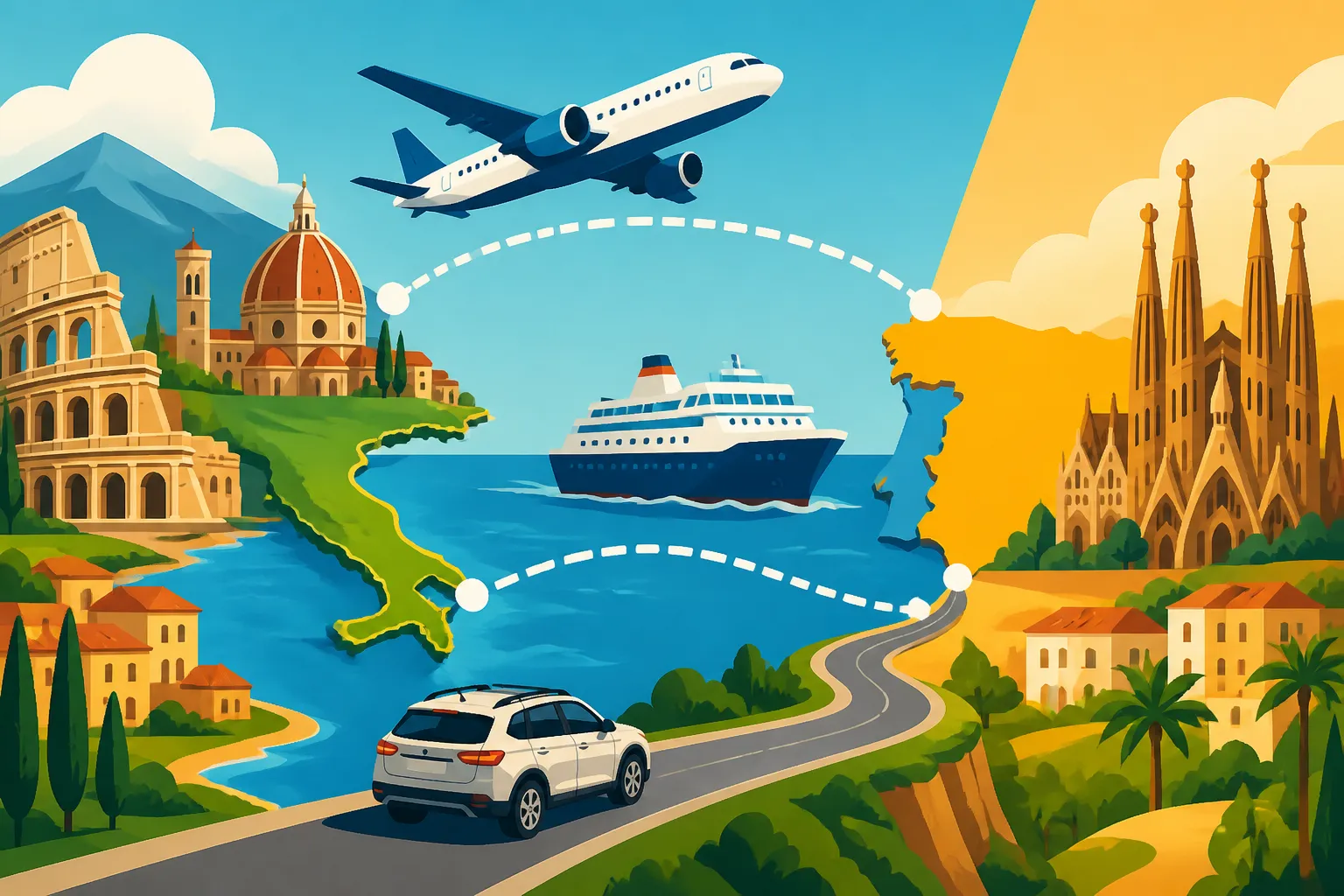
Let's be honest, for most of us, when we think of crossing from Italy to Spain, our minds immediately go to flying. It's often the quickest, and sometimes even the most economical, option, particularly if you're not planning to bring a car or embark on a multi-day journey. The convenience of air travel can't be overstated, especially when faced with the considerable distance between these two beautiful peninsulas.
Major Departure Airports in Italy
Italy boasts a fantastic network of airports, meaning you'll likely find a direct flight to Spain from a major hub not too far from wherever you're currently soaking up la dolce vita. Your primary departure points will almost certainly be Rome’s Fiumicino (FCO) and Milan’s Malpensa (MXP) or Linate (LIN). These are the giants, offering the widest range of flights, including numerous direct connections to Spain.
Beyond these behemoths, cities like Venice (VCE), Naples (NAP), Bologna (BLQ), Pisa (PSA), and even smaller regional airports sometimes offer direct flights, especially with budget carriers. For instance, if you're living up north, maybe you've been considering a weekend getaway to the Dolomites or even pondering how to get around Italy: trains, buses, flights, and car hire – remember that flights are often a strong contender for international jumps. Always check your closest major airport first, as the time and cost saved on connecting travel within Italy can often outweigh a slightly cheaper flight from a further-away hub.
Key Arrival Airports in Spain
Just as Italy has its major gateways, Spain has its own set of bustling arrival points that will most likely be your first taste of Spanish soil. Madrid’s Adolfo Suárez Madrid–Barajas Airport (MAD) and Barcelona’s El Prat Airport (BCN) are the undisputed kings, much like Rome and Milan for Italy. These airports handle the bulk of international traffic and offer excellent connections to other parts of Spain and beyond.
Depending on your final destination, you might also find direct flights to Valencia (VLC), Malaga (AGP) on the Costa del Sol, or even the Balearic Islands like Palma de Mallorca (PMI) if you're heading for a beach escape. It really boils down to where in Spain you want to land. For instance, if you're dreaming of the vibrant energy of Barcelona, finding a direct flight there will save you significant time and hassle compared to landing in Madrid and then taking a high-speed train.
Airlines and Booking Strategies
When it comes to airlines, you'll have a mix of budget and full-service options. Budget carriers like Ryanair and Vueling (which is Spanish-owned) are often your best bet for finding incredibly cheap fares, especially if you book in advance and travel light. Wizz Air is another player to watch. Be mindful, though, of their baggage policies and potential extra fees, which can quickly add up if you're not careful. Full-service airlines like Iberia (Spain's national carrier) and ITA Airways (Italy's national carrier) also operate on these routes, offering a more comfortable experience, often with checked luggage and in-flight service included, but usually at a higher price point.
My personal tip? Don't just check one airline's website. Use a comprehensive search engine that compares all the major carriers, both budget and traditional. This is where tools like Omio really shine. You can input your departure and arrival cities, and it will instantly pull up all available flights, displaying prices, durations, and even layover details, making the comparison process incredibly straightforward. It saves you the headache of hopping from website to website, trying to piece together the cheapest or fastest option. For those thinking about exploring Italy’s iconic cities before flying out, like Rome, Florence, and Venice: Italy's Great Cities Explorer's Guide, remember that connecting flights within Europe are generally seamless, so don't be afraid to utilize that.
Taking a Ferry from Italy to Spain: A Scenic Alternative
While flying is undeniably fast, there's something undeniably romantic and practical about traveling by sea, especially if you're not in a rush or want to bring your car. The ferry journey from Italy to Spain isn't just a means of transport; it's an experience in itself, allowing you to bypass airport queues and potentially even save on accommodation for a night. It's a proper adventure, rather than just a transfer.
Key Ferry Routes and Operators
Currently, the most direct and popular ferry routes between Italy and Spain connect the western Italian coast to Barcelona. The main operators you'll encounter are Grimaldi Lines and Grandi Navi Veloci (GNV). Both companies offer a comfortable journey, often with a range of cabin options, onboard restaurants, and entertainment.
The most common departure ports in Italy are Civitavecchia (near Rome) and Genoa. From Civitavecchia, you can catch a direct overnight ferry to Barcelona. This route is incredibly popular, especially for those looking to travel from the central and southern parts of Italy without having to drive all the way north. If you're starting from northern Italy, Genoa offers another excellent departure point for Barcelona. While less common, sometimes there are seasonal connections from Livorno or even connections from Sardinia (e.g., Porto Torres) which would then connect to mainland Spain via Barcelona or Valencia, though these typically require a bit more planning. You can also explore options that connect other parts of Italy, potentially even considering how to travel between Italian cities without a car and then catching a ferry.
What to Expect on Board
A ferry journey from Italy to Spain typically involves an overnight crossing, lasting anywhere from 18 to 22 hours, depending on the route and the specific vessel. This isn't just a quick hop across a channel; it's a mini-cruise! Expect to find a range of facilities on board, including restaurants, bars, shops, and sometimes even swimming pools or cinemas, especially on the larger vessels.
You'll have the option to book various types of accommodation, from a simple reclining seat (similar to an airplane seat, but often more spacious) to private cabins with en-suite bathrooms. For an overnight journey, I'd highly recommend splurging on a cabin. It allows you to get a good night's sleep, arrive refreshed, and have a private space for your belongings. If you're bringing a car, simply drive it onto the ferry, park it, and head up to the passenger decks. This is a huge advantage for those who are doing an extensive road trip through Europe or perhaps moving to Italy with pets. Remember, booking your vehicle space in advance is crucial, as car deck capacity is limited.
Pros and Cons of Ferry Travel
Let's weigh the good and the not-so-good about taking the ferry.
Pros:
- Bring your car: This is the absolute biggest advantage. If you're on a grand European road trip or moving with a lot of luggage, the ferry is a godsend. It saves you the hassle and cost of car rental, parking, and potentially even importing your car to Italy later.
- Relaxing journey: It's a much more leisurely pace than flying. You can enjoy the sea views, fresh air, and wander around the ship.
- Overnight travel saves accommodation costs: A cabin for the night can often be comparable to or even cheaper than a hotel room, and it gets you closer to your destination.
- More generous baggage allowance: No strict weight limits or exorbitant fees for extra bags, which is fantastic for long-term travelers or expats.
Cons:
- Time-consuming: This is the obvious drawback. An 18-22 hour journey is significantly longer than a 1.5-hour flight.
- Weather dependent: Rough seas can lead to delays or, in rare cases, cancellations, though modern ferries are quite robust.
- Cost: While sometimes comparable to a last-minute flight, ferry tickets, especially with a cabin and a car, can add up.
To find and compare ferry options, again, I’d point you to Omio. It often includes ferry routes in its search results, allowing you to see if a sea journey makes sense for your particular plans alongside train and bus routes. It's a great way to explore all your options for getting around Italy: trains, buses, flights, and car hire, including sea routes to other countries.
The Overland Route: Train and Bus Adventures
For the truly intrepid, or those with an aversion to flying and sea sickness, the overland route by train and bus offers a different kind of adventure. It's not for the faint of heart, as it involves significant travel time and usually at least one transfer, but it provides a unique perspective on the European landscape, crossing France along the way.
Italian Train Connections to France
To travel from Italy to Spain by train, your first logical step is to head west through France. Italy has excellent high-speed train connections from major cities like Turin and Milan. You can catch a high-speed Frecciarossa train from Turin or Milan to cities like Lyon or Paris. The journey from Milan to Paris, for example, is a comfortable and scenic ride, taking around 7 to 8 hours. This part of the journey is quite efficient thanks to the comprehensive European rail network.
If you're starting further south in Italy, say from Rome or Florence, you'd first need to take an Italian high-speed train, like a Frecciarossa, up to Milan or Turin. This means you're looking at a multi-leg journey right from the start. Planning these legs can be tricky, balancing connection times and maximizing efficiency. Remember that platforms like Omio are invaluable here for stitching together these different train segments, allowing you to see the full itinerary and book multiple tickets in one go. For those who frequently use the rails, understanding high-speed trains in Italy: Trenitalia, Italo, Routes, and Savings is key to navigating the network efficiently.
French to Spanish Connections
Once you've made it into France, your next challenge is connecting to Spain. The most straightforward high-speed option is typically from Paris to Barcelona, utilizing the TGV high-speed services. This direct train journey takes about 6.5 hours and is a fantastic way to cover a lot of ground quickly. However, getting from Lyon to Barcelona also offers direct connections, often taking around 5 hours.
If you opt for regional trains or need to connect through other parts of France, the journey can become more complex, involving multiple changes and significantly longer travel times. For example, going from Nice on the French Riviera to Barcelona might involve a few regional trains along the coast, which is scenic but much slower. It's a fantastic way to see the diverse landscapes of Europe, but be prepared for a long day or even a two-day journey. If you're an EU citizen, remember your European Health Insurance Card (EHIC) in Italy is valid across all EU countries, including Spain and France, for any unexpected medical needs during your overland trek.
Bus Options for Long-Haul Travel
For those on a tighter budget, or simply preferring a single, albeit long, journey, intercity buses are a viable option. FlixBus is the dominant player in this space, offering numerous routes connecting major Italian cities to various destinations in Spain. You can find direct buses, for instance, from Rome or Milan to Barcelona or Madrid.
These journeys are considerably longer than trains or flights, often stretching to 20-30 hours, sometimes with a change or two along the way. While modern buses are generally comfortable, with Wi-Fi and power outlets, spending that much time on a bus can be taxing. However, they are often significantly cheaper than train tickets, especially if booked in advance. For budget travelers or those not constrained by time, it's definitely an option worth considering. Again, Omio aggregates bus routes, including FlixBus, making it easy to compare bus travel against other modes. You can even filter by comfort level or duration, helping you find the right intercity buses in Italy: FlixBus and Regional Networks to get you across the continent.
| Travel Method | Approximate Duration (Italy to Spain) | Average Cost Range (One-way) | Ideal For | Pros | Cons |
|---|---|---|---|---|---|
| Flights | 1.5 – 3 hours (direct) | €30 – €200+ | Speed, budget-conscious, short trips | Fastest, often cheapest if booked early, wide airport network | Baggage fees, airport transfers, security lines, less scenic |
| Ferries | 18 – 22 hours (overnight) | €80 – €300+ | Bringing a car, large luggage, relaxed travel | Bring car, generous luggage, comfortable cabins, unique experience | Very slow, weather-dependent, can be expensive with cabin/car |
| Trains | 12 – 18 hours (with transfers) | €100 – €350+ | Scenic travel, comfort, city-center arrivals | Scenic, comfortable, no luggage limits, often city-center departure/arrival | Requires transfers, can be expensive, long duration |
| Buses | 20 – 30 hours (direct/with transfers) | €40 – €120 | Budget travelers, scenic route | Very affordable, good for budget, often direct routes | Very long duration, less comfortable than train/ferry cabin |
Note: Costs are estimates and can vary widely based on booking time, season, specific route, and class of travel.
Planning Your Journey with Omio: Your Travel Companion
Alright, so we've broken down the ways you can get from Italy to Spain. Now, let's talk about how to make that planning process less of a headache and more of a breeze. Because let's face it, navigating multiple websites, comparing schedules, and trying to figure out which connection makes the most sense can quickly turn into a bureaucratic nightmare that even Italians would sigh at. This is precisely where a tool like Omio comes into its own.
Why Omio Makes a Difference
As an expat who's planned countless trips across Europe, I can tell you that trying to manually compare flights, trains, and buses from different providers is exhausting. One airline might have a good deal, but then you find a faster train route that costs a bit more but saves you an entire day. Omio simplifies this dramatically. It acts as a single point of truth, pulling together data from various train operators (like Trenitalia, Italo, Renfe, SNCF), bus companies (like FlixBus, Alsa), and airlines (both budget and traditional).
The real game-changer is being able to see all your options side-by-side, in your preferred language and currency. You can filter by price, duration, number of transfers, and even environmental impact. This means you’re not just picking the cheapest option, but the best option for your specific needs, whether that’s speed, budget, or comfort. It genuinely takes the stress out of complex international trip planning, which, after dealing with Italian bureaucracy, is a welcome relief! For any expat planning extensive trips, keeping an eye on travel logistics in Italy: money, safety, and connectivity also involves smart booking strategies, and Omio fits right in.
Step-by-Step Booking with Omio
Using Omio is incredibly intuitive, making it a favorite among travelers. Here’s a quick run-through of how you’d typically use it to plan your Italy to Spain adventure:
- Enter Your Route: Open the Omio app or website. Input your departure city in Italy (e.g., Rome, Milan, Venice) and your arrival city in Spain (e.g., Barcelona, Madrid). Select your travel dates.
- Compare Options: Click "Search." Within seconds, Omio will display all available flights, train routes, and bus journeys for your chosen dates. You’ll see them clearly laid out with prices, travel times, and the mode of transport.
- Filter and Refine: Use the filters at the top or side of the screen. Want only direct flights? Filter for "no transfers." On a tight budget? Sort by "lowest price." Need to depart at a specific time? Adjust the time sliders. This is where you really tailor the results to your preferences.
- Select Your Journey: Once you find the perfect option, click on it for more details. For flights, it’ll show the airline and layover information. For trains and buses, it’ll detail the route and any transfers.
- Book Directly: When you're happy, proceed to booking. You can often book directly through Omio, which means you have one consistent booking experience regardless of the operator. You'll enter passenger details and payment information, and your tickets will be sent to you electronically, usually via email and stored within the app. No more juggling different booking confirmations from five different companies!
It's really that simple. And for anyone who's ever struggled with foreign language booking sites or confusing payment gateways, the unified, multi-language experience of Omio is a huge asset.
Tips for Finding the Best Deals
Even with a fantastic tool like Omio, a little bit of strategic planning can go a long way in snagging the best deals for your Italy to Spain journey.
- Book in Advance: This is the golden rule for most travel, especially flights and high-speed trains. Prices tend to creep up closer to the departure date. As soon as your travel dates are firm, start looking.
- Be Flexible with Dates: If your schedule allows, playing around with your travel dates by a day or two can yield significant savings. Sometimes traveling mid-week is cheaper than a weekend, or a red-eye flight could be a fraction of the cost of a daytime one. Omio often shows a calendar view highlighting cheaper days, which is super helpful.
- Consider Off-Peak Seasons: Traveling during shoulder seasons (spring or autumn) or even winter (excluding holidays) will almost always be cheaper than the peak summer months when everyone else is flocking to the Mediterranean. It also means fewer crowds, which is a bonus for many.
- Look at Different Modes of Transport: Don't fixate on just flying. While often fastest, sometimes a slightly longer train or bus journey via Omio can surprise you with a much lower price. This is especially true if you’re traveling to or from a city that isn’t a major international air hub. For effective financial planning, budgeting for Italy: cost of living by city includes these transport considerations, so every saving helps.
- Set Price Alerts: Many platforms, including Omio, allow you to set up price alerts for specific routes and dates. You'll get an email notification if the price drops, ensuring you don't miss out on a good deal.
Planning a trip from Italy to Spain doesn't have to be overwhelming. With a clear understanding of your travel options—be it flying for speed, ferrying for the experience, or bus/train for the overland adventure—and by leveraging powerful comparison tools like Omio, you can easily find the best fit for your itinerary and budget. Happy travels, and enjoy that Spanish sunshine!
Disclaimer
Please remember that travel information, including visa requirements, transport schedules, and pricing, can change rapidly. While I strive to provide the most accurate and up-to-date details, it is always advisable to verify all information with official sources (airlines, ferry operators, train companies, and government immigration websites) before making any travel commitments. This guide is for informational purposes only and does not constitute professional advice.