Italy to Greece: Adriatic Ferries From Ancona, Bari, and Brindisi
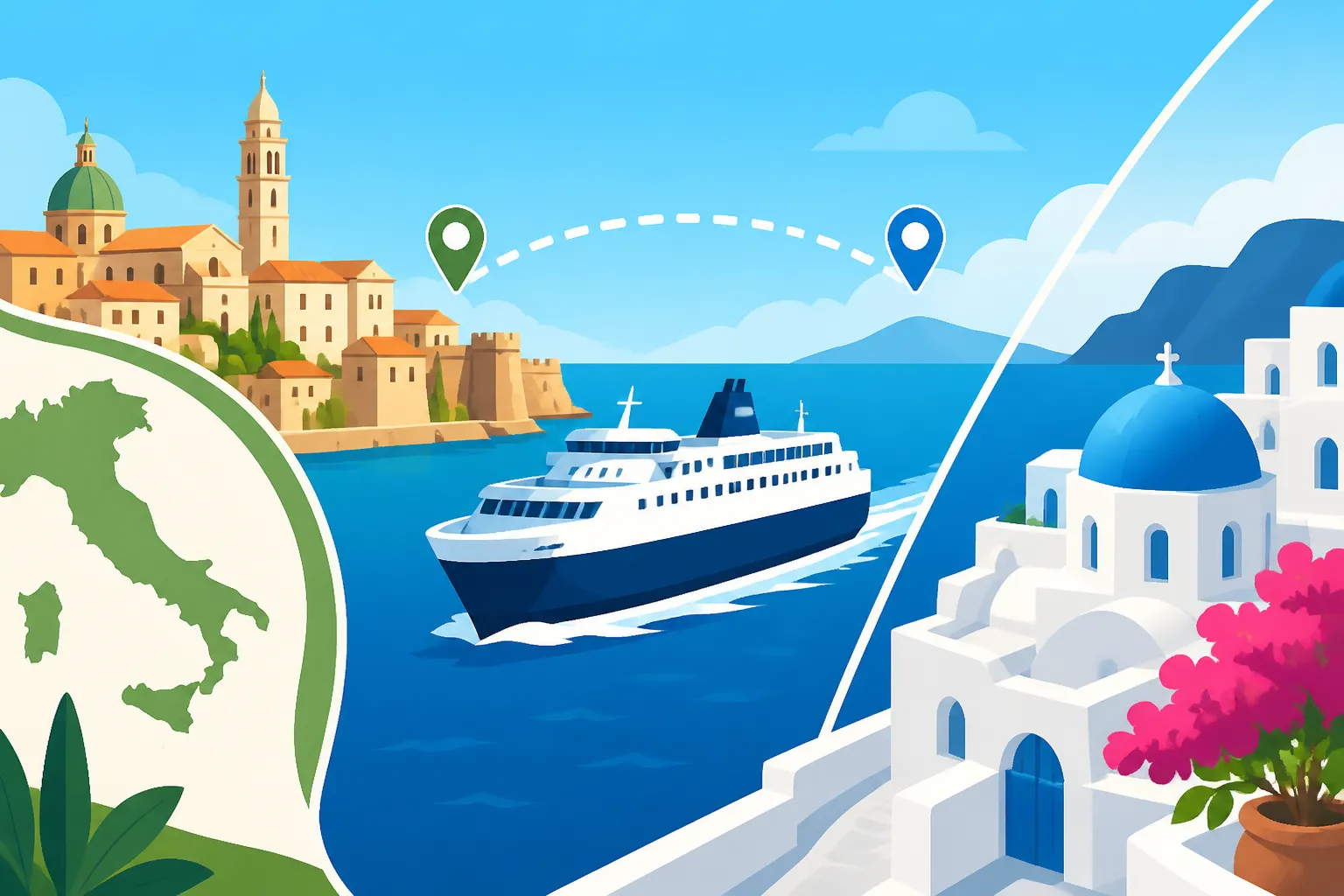
A familiar summer problem: you want to cross from Italy to Greece by sea, but the timetables are spread across several ferry companies, the ports are hundreds of kilometres apart, and you still have to get yourself to the dock. This guide compares Ancona, Bari, and Brindisi, shows how to reach each port by rail, and walks you through the crossing itself.
Disclosure: This post may contain affiliate links. We may earn a commission at no extra cost to you if you make a purchase through these links. Read full disclosure.
Choosing Your Italian Port: Ancona, Bari, or Brindisi
The first time I took the ferry to Greece, I picked my port almost at random. A friend in Bologna said “just go from Ancona,” so I did. The crossing was lovely. It was also much longer than I needed, because I was heading to Corfu, and a sailing from further south would have saved me a night on board. Your departure port shapes everything else: which train you take, how long you spend at sea, where you land in Greece, and how much of your holiday you spend in transit.
Italy’s main Adriatic gateways to Greece are Ancona in Le Marche, and Bari and Brindisi in Puglia. Venice and Trieste also have Greek connections at times, but most travellers and expats use one of these three. Between them, they serve the two big western Greek mainland ports, Igoumenitsa in the north-west and Patras in the Peloponnese, plus Corfu and, in season, some of the other Ionian islands.
The general rule is simple. The further north you board, the longer you stay at sea. The further south you board, the longer you spend on Italian trains first. Neither option is better in every case. It depends on where you start in Italy and where you want to land in Greece.
Ancona: The Northern Gateway
Ancona suits people coming from Milan, Bologna, Venice, Turin, or anywhere north of Florence. The Adriatic rail line runs down the coast through Rimini and Pesaro, and high-speed and intercity services reach Ancona without the long haul south to Puglia. The city’s ferry port sits close to the historic centre. Arriving by train is fairly painless, which I can’t say for every Italian port.
The trade-off is the crossing. Ancona sailings to Igoumenitsa and Patras are long, usually overnight and often longer than that. Operators on this route have included Superfast Ferries, ANEK Lines, and Minoan Lines. Their ships are big, cruise-style vessels with cabins, restaurants, and outdoor decks. If you think of the ferry as part of the holiday, a slow evening leaving the Italian coast with a glass of wine is genuinely pleasant. If you only want to get to Greece, it can feel like a lost day.
Think of a family in Verona with a car full of luggage and two kids. For them, Ancona is often the best choice. They skip the long drive down to Puglia, put the children to bed in a cabin, and wake up much closer to the Greek coast. A solo traveller in Rome heading for Athens may find a southern port faster overall.
Bari: The Balanced Middle Option
Bari is the busiest Italian port for Greek routes after Ancona, and for many travellers it is the best compromise. It has good rail links from Rome, through the Apennines, and from the north, down the Adriatic coast. Its crossings to Igoumenitsa, Corfu, and Patras are shorter than Ancona’s. Operators that have run Bari to Greece sailings include Superfast Ferries, ANEK Lines, and Ventouris Ferries.
The ferry terminal is at the port on the edge of the old town, Bari Vecchia. From Bari Centrale station you can take a short taxi ride or a local bus. On a cool day, if you are travelling light, you can walk it. I once had a long, slow lunch in Bari Vecchia before an evening sailing, eating orecchiette that was being shaped by hand in the doorways. It’s one of my favourite pre-ferry routines anywhere in Italy.
If you want to build a few days in Puglia into the trip, see Where to Stay in Puglia: Bari, Lecce, Ostuni, and the Trulli Valley. Many people sail out of Bari after a stay in the region rather than travelling straight through.
Brindisi: The Shortest Hop to Greece
Brindisi sits in the heel of Italy’s boot and offers the shortest crossings of the three ports, especially to Igoumenitsa and Corfu. Grimaldi Lines has run Brindisi to Greece services. In summer, smaller operators have added island routes, for example towards Kefalonia and Zakynthos. If you want the least time at sea, Brindisi is usually the answer.
The catch is getting there. Brindisi is beyond Bari on the line towards Lecce, so trains from the north take longer. The ferry terminal for Greek departures is at the Costa Morena area of the port, not next to the station. Allow for a taxi or shuttle transfer and don’t plan on walking with your bags. For train options into the region, see Reaching Puglia’s Coast: Trulli Country and the Salento by Rail.
| Italian Port | Main Greek Destinations | Crossing Character | Rail Access | Best For |
|---|---|---|---|---|
| Ancona | Igoumenitsa, Patras | Longest, typically overnight or more | Adriatic line from the north, port close to the centre | Travellers from northern Italy and drivers avoiding the long road south |
| Bari | Igoumenitsa, Corfu, Patras | Medium, often overnight | Strong links from Rome and the Adriatic coast | A balanced trip, especially with a stay in Puglia |
| Brindisi | Igoumenitsa, Corfu, seasonal Ionian islands | Shortest of the three | Beyond Bari, terminal outside the centre | Travellers who want minimum time at sea |
Getting to the Port by Train and Bus With Omio
This is where most Italy to Greece trips go wrong. The ferry is the easy part. The hard part is getting a train, a regional connection, a port transfer, and a sailing to line up on the same day without you sprinting down a platform in Foggia. I’ve seen it happen. Once, that person was me.
Omio is built for this kind of trip. It puts Trenitalia, Italo, coach operators, and ferries in one search, so you can compare routes and book in English without going through each company’s website. For a journey that combines several transport modes, that matters a lot.
Building a Door-to-Deck Itinerary
Start with the ferry and work backwards. Most people do the opposite: they book a convenient train and then hunt for a ferry that matches. Sailings are less frequent than trains, especially outside high summer, so the ferry departure is your fixed point.
Here’s how I do it:
- Choose your Greek arrival port first, whether Igoumenitsa, Patras, or Corfu, based on where you are going in Greece.
- Check which Italian ports have sailings to that port on your preferred date.
- Search Omio for the sailing on your chosen date. Where the crossing is listed, you can compare departure times and operators side by side.
- Search Omio again for trains from your home city to the departure port. Choose a train that arrives with a generous buffer before the ferry’s check-in cutoff.
- Check whether the station-to-port transfer needs a taxi, a local bus, or a shuttle, and add that time to your plan.
- Save every ticket in one place on your phone and keep offline copies in case of poor signal at the port.
For example, say you live in Rome and want to reach Corfu. You might find an evening sailing from Bari, then use Omio to compare morning high-speed trains to Bari Centrale. That leaves you most of the afternoon in the city before the transfer to the port. The whole plan comes together in one sitting, on one screen.
If you’re new to Italian rail, High-Speed Trains in Italy: Trenitalia, Italo, Routes, and Savings explains the difference between Frecce services, Italo, and slower intercity trains. That helps when Omio shows you several options at different prices. For the Rome to Puglia leg specifically, see Rome to Bari and Lecce: Reaching Puglia by Rail.
Port Transfers Once You Arrive
Each port has its own last-mile quirks, and they matter more than people expect.
In Ancona, the port is close to the city. Local buses and taxis cover the gap between the station and the ferry terminal easily. Ferry companies may also have ticket offices or check-in desks in the port area that you need to visit before boarding. Read your booking confirmation carefully, because some operators issue a boarding card at the terminal in exchange for your e-ticket.
In Bari, the terminal is a short ride from the station. Local buses serve the port, and taxis queue at the station. If you arrive in the late afternoon in summer, expect traffic around the port as cars, campervans, and lorries line up. On foot or in a taxi you avoid most of it, but leave some slack.
In Brindisi, plan the transfer seriously. The Costa Morena terminal is not where you would naturally walk from the train. Taxis are the simplest option. Check locally whether a port shuttle is running. I’ve watched travellers arrive at Brindisi station with a tight connection, assume the port is around the corner, and lose valuable time working out where to go.
Timing Your Connection
Ferry companies set a check-in cutoff before departure. Foot passengers usually have a shorter one than vehicles, but your ticket gives the exact rule. Treat that cutoff, not the sailing time, as your real deadline.
My rule is to arrive in the port city with enough spare time to absorb a delayed train and still have time for a coffee. Italian trains are often punctual on the main high-speed lines, but regional connections, engineering works, and occasional strikes can upset a tight plan. If your travel date might fall on a strike day, read Strikes in Italy: How Sciopero Days Work and How to Rebook before you commit to a same-day connection.
When the timing is very tight, I take an earlier train or stay the night in the port city. A night in Bari or Ancona costs less than a missed ferry and a scramble to rebook during peak season. Omio makes this easy: you can see the whole day’s departures to the port and choose a margin you’re comfortable with, instead of grabbing the first fare you see. For more ideas on making multi-leg trips hold together, see Combining Train, Bus, and Ferry in One Journey: Connections That Hold.
Booking the Crossing: Tickets, Cabins, and Vehicles
Adriatic ferries offer a range of ticket types that can confuse first-timers. The cheapest ticket isn’t always the best value, especially on an overnight sailing. Decide what sort of night you want before you book.
Deck, Seat, or Cabin
Most ships on these routes sell three main kinds of passenger accommodation. Names vary by operator, but the categories are similar.
| Ticket Type | What You Get | Pros | Cons |
|---|---|---|---|
| Deck passage | Access to public areas and open decks, no reserved spot | Lowest fare category, flexible | Little privacy, you find your own place to rest |
| Reserved seat | An assigned reclining seat in a lounge | A guaranteed place to sit, still budget-friendly | Sleeping upright on a long crossing is tiring |
| Cabin | A private or shared cabin with berths, often with a bathroom | Real sleep, a place to lock your bags, privacy | The highest fare category, sells out first in summer |
Deck passage has a romantic reputation, with backpackers stretched out under the stars. On a warm August crossing it can be fun. On a long sailing from Ancona in shoulder season, or on a windy night in the Adriatic, it’s much less charming. I’ve done both. The second time, I booked a cabin for the return trip before I even reached Greece.
My honest advice: on the shorter Brindisi crossings, a seat or deck passage is fine for most adults. On the longer Ancona and Bari overnight sailings, a cabin is often worth it, especially for families, older travellers, or anyone who has to drive after landing. Compare cabin and seat fares for the same sailing on Omio before you decide. Sometimes the gap is smaller than you’d expect, particularly when you book early.
Bringing Your Own Car or Campervan
Many expats in Italy take their own car to Greece, and the Adriatic ferries are made for it. Driving your Italian-registered car onto the ship at Ancona, Bari, or Brindisi and off again in Igoumenitsa or Patras is routine. You don’t import the car or register it in Greece for a holiday. You’re simply travelling with your own vehicle inside the EU.
Before you go, check these points:
- Carry the car’s registration document, your driving licence, and proof of insurance.
- Contact your insurer and confirm that your policy and roadside assistance cover driving in Greece.
- If the car belongs to someone else or is leased, carry written authorisation from the owner or leasing company.
- When booking, give the vehicle’s real length and height. Campervans, roof boxes, bike racks, and trailers can put you in a different fare category.
Vehicle fares are set by vehicle type and size, so the price shape is different from a foot passenger ticket. Check whether Omio shows a vehicle option for your chosen sailing. If it doesn’t, book the vehicle space directly with the ferry operator and still use Omio for any train legs, for example if part of your group travels separately to meet you at the port.
Some operators on the Ancona and Bari routes have offered a “camping on board” arrangement in season. Campervan travellers stay in their own vehicle on an open deck instead of booking a cabin. Availability and conditions vary by ship and season, so check the operator’s own page. Many of the general habits that work for car ferries to Italy’s islands also apply here. See Taking a Car to Sicily and Sardinia: Ferry Operators and Vehicle Fares for a useful comparison of how vehicle bookings work.
Drivers coming from northern Italy should also weigh the drive itself. The motorway down the Adriatic coast to Bari or Brindisi is long, with tolls and fuel to add on. Boarding at Ancona swaps that drive for more time at sea. Many families I know choose Ancona for exactly this reason.
Seasons, Holidays, and Strikes
The Adriatic ferry routes are very seasonal. In July and August, and especially around Ferragosto in mid-August, ships fill up with Italian families, Greek families visiting relatives, and international travellers. Cabins and vehicle spaces go first. Deck passage tends to stay available longer, but even that can get crowded.
Outside summer, the timetable thins out. Some seasonal island routes stop running, and the main routes to Igoumenitsa and Patras may sail less often. That’s when the “start with the ferry” planning method really matters, because you may have fewer departures to choose from.
If you’re travelling around Italian holiday periods, see Ferragosto, Easter, and Ponti: Italy’s Worst Weeks to Book Late to understand how demand surges on Italian transport at those times. It affects the trains to the port as much as the ferries. Booking both legs early on Omio during those weeks saves a lot of stress.
Before buying, check the cancellation and change terms on both your train and ferry tickets. Flexibility varies between fare types and operators. Refunds and Changes on Italian Transport: What You Actually Get Back explains the main patterns for the Italian rail side.
Step-by-Step: Your Departure Day
Even with everything booked, departure day can feel chaotic, especially at a busy port in summer. Here’s the routine I’ve settled into after years of sailing to Greece from all three ports.
The Departure Day Checklist
- In the morning, check your train status and any strike notices for the day.
- Take your train to the port city and confirm the connection on arrival.
- Use the local bus, taxi, or shuttle to reach the correct ferry terminal. At Brindisi, remember that Greek departures use the Costa Morena area.
- Find your operator’s check-in desk or ticket office if your booking says you need to exchange an e-ticket for a boarding card.
- Keep your passport or national ID card ready. Carriers check identity documents at boarding even on routes within the Schengen area.
- Foot passengers follow the signs to the passenger boarding area. Drivers join the vehicle lanes marked for their sailing and destination port.
- Once on board, find your cabin or seat, then note where the restaurant, the toilets, and your vehicle deck are.
- Before you sleep, set an alarm for well ahead of arrival. Announcements can be easy to miss.
The ID point surprises some people, so here it is plainly. Italy and Greece are both in Schengen, but ferry companies require valid identification to board and the name has to match your booking. When you book on Omio or with the operator, enter your name exactly as it appears on the passport or ID card you’ll carry.
Packing for the Crossing
Even if you book a cabin, pack a small overnight bag so you don’t have to reach into a large suitcase or go back to a vehicle deck. On many ships, vehicle decks are closed during the crossing, so whatever stays in the car stays out of reach until arrival.
My overnight bag usually contains:
- A warm layer, because indoor lounges can be heavily air-conditioned and open decks get cold at night.
- Snacks and a refillable water bottle, since onboard food is convenient but not always cheap.
- A phone charger and a power bank, because sockets in public areas can be scarce.
- Toiletries, a small towel, and earplugs or an eye mask for seat or deck passengers.
- Printed or offline copies of your ferry booking and your onward travel in Greece.
If you’re carrying big bags from home to the port by train, see Luggage Rules on Italian Trains and Buses: Limits and Fees before you set off. A large suitcase is easy on most Frecce trains and harder on crowded regional services. Families with prams and car seats should read Booking Italian Transport With Kids: Child Fares, Seats, and Prams. Children’s fares and practical space on board both affect how you plan the rail legs.
If you pay for tickets with a non-Italian card, a declined payment at the last minute can derail an otherwise tidy plan. Paying for Italian Transport With a Foreign Card: Declines and Fixes covers the common problems and workarounds for the rail side of the trip.
Arriving in Greece and Continuing Your Journey
Arrival at Igoumenitsa, Patras, or Corfu is usually straightforward. Foot passengers walk off and drivers roll off in the order the crew directs. From Igoumenitsa, many travellers continue by road or by bus towards the Epirus mountains, Meteora, or Thessaloniki. From Patras, Athens and the Peloponnese are within reach by road. Corfu arrivals can go straight to the island’s beaches and villages.
Some travellers carry on to a third country. Greece is a good base for island-hopping or for continuing into the Balkans. For ideas on chaining several countries together from an Italian starting point, see Multi-Country Europe Trips Starting in Italy: Route Planning and Booking.
The return trip deserves the same care as the outbound one. Book it early in summer, because the late-August rush back to Italy is just as intense as the early-August rush out. I usually book my return sailing and my train home from the Italian port on Omio while I’m still on the outbound ferry, often from my cabin with a coffee, watching the Greek coast appear. When the whole journey sits in one app, coming home feels as easy as setting out.
For a wider look at how ferries fit alongside trains, buses, and flights in Italy, Getting Around Italy: Trains, Buses, Flights, and Car Hire is a good next read.
Disclaimer
This article is for general informational purposes only and does not constitute professional advice. Laws, prices and regulations vary by location and change over time. Consult a qualified professional for guidance on your specific situation.