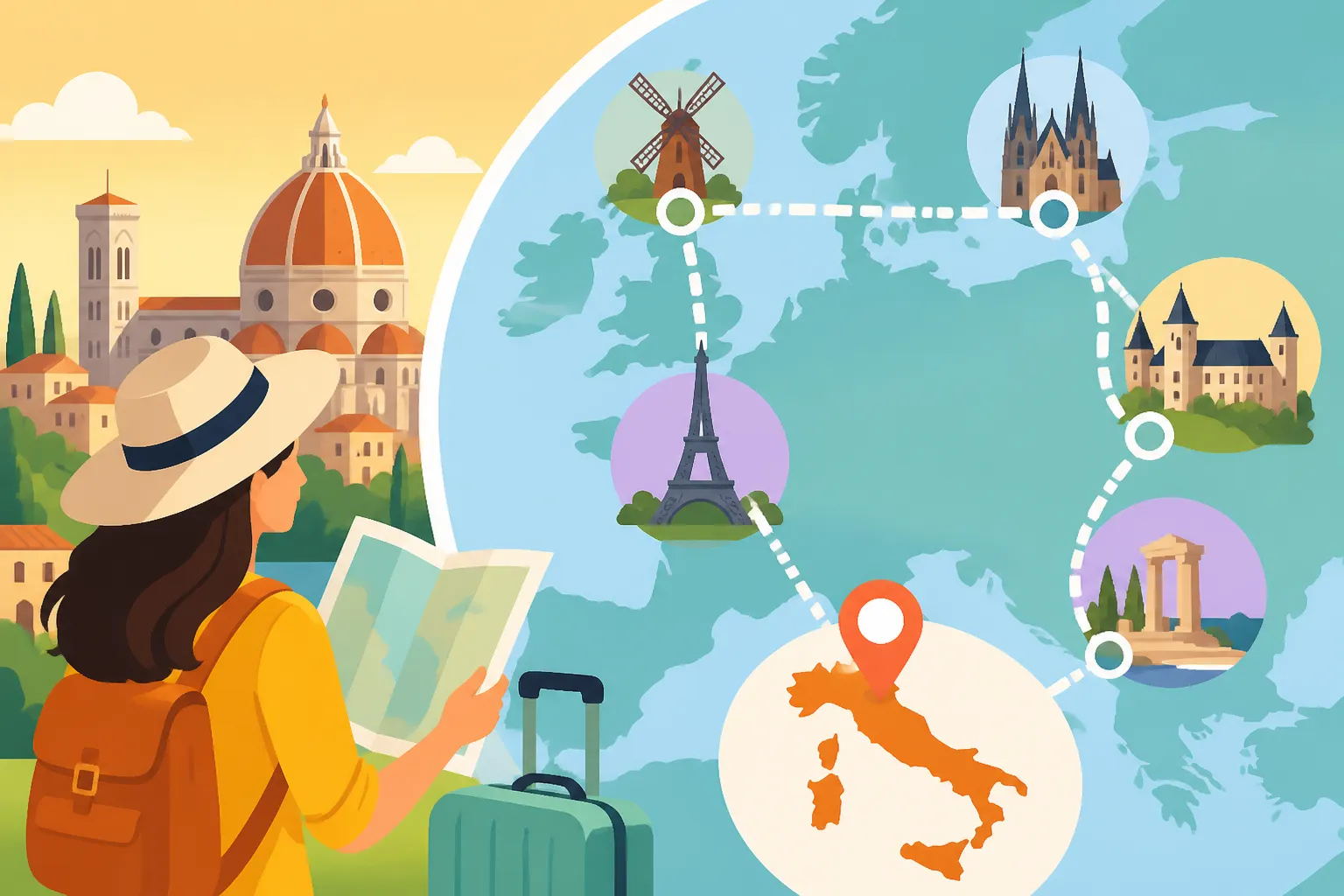
Multi-Country Europe Trips Starting in Italy: Route Planning and Booking
Oh, the dream of a multi-country European adventure! It’s on nearly every expat’s bucket list when they settle here in Italy, a magnificent starting point indeed. But let’s be real, the thought of coordinating trains, buses, and flights across different countries, dealing with varied booking systems, and making sure you don’t miss a connection can quickly turn that exciting dream into a logistical nightmare. This comprehensive guide is here to untangle that spaghetti junction of European travel, showing you how to plan and book your seamless multi-country trip, with a focus on making your life easier using tools like Omio.
Disclosure: This post may contain affiliate links. We may earn a commission at no extra cost to you if you make a purchase through these links. Read full disclosure.
Why Start Your European Adventure from Italy?
Living in Italy, you're already perfectly poised for exploring the rest of Europe. It’s like being handed a golden ticket to the continent’s best bits, situated right in the heart of it all. You’ve got the advantage of a robust local transport network, relatively central location, and a deep appreciation for la dolce vita that you can carry with you as you hop from one country to the next.
Italy's Strategic Gateway Location
Think about it: Italy is practically at the crossroads of Europe. To the north, you have the Alps, acting as a dramatic natural border to Switzerland, France, and Austria. Head east, and you're quickly into Slovenia, Croatia, and the Balkans. To the west, France and Spain are just a train or short flight away. And the south offers incredible links across the Mediterranean. This isn't just about geography; it's about the established travel corridors that have existed for centuries, now modernized with high-speed rail and efficient air travel. It means less time stuck in transit and more time sipping a spritz in Vienna or strolling along the Seine.
As expats, we often find ourselves exploring Italy's own diverse regions, from the bustling cities of Milan and Rome to the tranquil beaches of Puglia. But once you've settled in and seen a good chunk of il bel paese, the call of broader Europe becomes irresistible. Italy acts as that perfect launchpad, offering direct connections to nearly every major European city, whether you’re looking for a romantic Parisian getaway or an adventurous hike in the Swiss Alps.
Leveraging Italy's Transport Infrastructure
One of the great joys of living in Italy, once you get past the initial administrative hurdles, is its fantastic transport system. We're talking high-speed trains like Trenitalia's Frecce or Italo that zip you between major cities, efficient regional lines, and a surprising network of intercity buses. While navigating these systems can sometimes feel like a puzzle when you first arrive, you quickly learn the ropes. For more on getting around our beautiful host country, check out our guide on Getting Around Italy: Trains, Buses, Flights, and Car Hire.
This well-developed infrastructure extends beyond Italy’s borders. From Milan, you can catch a direct train to Geneva or Zurich. From Rome, a short flight can take you to Berlin or Barcelona. Major Italian airports like Rome Fiumicino (FCO), Milan Malpensa (MXP), and Venice Marco Polo (VCE) are well-connected hubs for international flights, often offering budget-friendly options to numerous European destinations. This means your multi-country trip can start with comfort and ease, without feeling like you're already halfway across the world just to begin.
The Allure of an Italian Kick-Off
Let’s be honest, what better way to start an epic European journey than from Italy? You're already steeped in incredible history, delicious food, and a vibrant culture. Imagine finishing your morning espresso in a Roman piazza, enjoying one last plate of cacio e pepe, and then hopping on a train that will take you to your next adventure. It’s a natural transition, not a drastic jump.
Starting from Italy also means you can often find better deals on flights or train tickets out of major Italian hubs compared to some smaller European countries. Plus, if you’re returning to Italy, the journey back is often just as smooth. It eliminates the feeling of needing a "warm-up" destination; Italy is already that and so much more, setting a high standard for the rest of your trip.
Crafting Your Multi-Country Itinerary: Key Considerations
This is where the real fun (and potential stress) begins! Planning a trip across multiple countries can feel like organizing a small invasion. But with a solid strategy, you can turn those endless possibilities into a coherent, unforgettable journey.
Choosing Your Destinations and Order
The first big question: where do you really want to go? Don’t just pick a list of famous cities; think about what kind of experience you're after. Do you want bustling metropolises, serene natural landscapes, historical deep dives, or a culinary tour? Once you have a general idea, consider the geographical flow. It makes little sense to ping-pong between Portugal and Poland if you’re trying to save time and money.
A common approach is to group countries by proximity or a shared theme. For example, a "Mediterranean Escape" might include Italy, the French Riviera, and Barcelona. A "Central European Charm" itinerary could link Italy with Austria, Czech Republic, and Germany. Map it out, literally. Look at a map of Europe and draw lines between your desired destinations. This visual aid will quickly reveal the most logical order, minimizing backtracking and maximizing efficiency.
Balancing Pace and Experience
This is a critical point that many first-time multi-country travelers get wrong. There's a temptation to cram as many cities or countries as possible into a limited timeframe. While you can technically visit 7 cities in 7 days, you’ll spend most of your time in transit, exhausted, and barely scratching the surface of each place. Trust me, I’ve done it, and the memories are mostly a blur of train stations and blurry photos.
A good rule of thumb for a multi-country trip is to allow at least 2-3 full days per major city or region. This gives you time to explore, soak in the atmosphere, and actually experience the local culture, rather than just check off a list of landmarks. Think about quality over quantity. If you only have two weeks, aiming for 3-4 countries max is usually a more rewarding experience. Remember, you're here in Italy, you have the luxury of returning to Europe again! For those managing finances, our article on Cost of Living in Italy 2026: Budgeting for Expats can offer insights that apply to broader European travel as well.
Budgeting for Your European Jaunt
Ah, the dreaded budget. It’s crucial to be realistic here. Europe can be as expensive or as affordable as you make it, but multi-country travel inherently adds layers of cost. Beyond flights, trains, and buses, you need to factor in accommodation, food, activities, local transport, travel insurance, and a buffer for unexpected expenses (because something always comes up, right?).
Consider how different countries affect your budget. Switzerland and Scandinavia are generally pricier than, say, Portugal or Eastern European nations. Look into ways to save: cooking some meals if your accommodation has a kitchen, utilizing free walking tours, and taking advantage of student or youth discounts if applicable. Always set a daily budget for food and miscellaneous spending, and track it. Even better, use a tool like Omio to compare travel costs efficiently, ensuring you get the best bang for your buck on transit.
Navigating European Transport from Italy: Options and Optimizations
Once you've got your itinerary roughly sketched out, it's time to figure out the how. Europe offers a fantastic array of interconnected transport options, and understanding which to use when is key to a smooth journey. This is where a reliable platform truly shines.
Mastering Trains Across Borders
Europe's train network is legendary, and for good reason. It’s often the most scenic, comfortable, and efficient way to travel between cities, especially within Western Europe. From Italy, high-speed trains can whisk you to France, Switzerland, Austria, and beyond. Imagine watching the changing landscapes from your window, from the Italian coastline to the Swiss Alps, all without the hassle of airport security.
You'll encounter various national operators like Trenitalia and Italo in Italy, SNCF in France, Deutsche Bahn (DB) in Germany, and so on. For true border-crossing efficiency, look into services like Eurocity or Thello (though specific routes can change). Booking in advance, especially for high-speed routes, is almost always cheaper. Websites for individual national rail companies are an option, but this is exactly where a platform like Omio becomes an absolute game-changer. It aggregates all these different operators, showing you the fastest, cheapest, and most convenient options in one place, saving you hours of research.
The Practicality of Inter-Country Buses
Don't dismiss buses, especially for shorter routes, cross-border journeys, or if you’re on a tighter budget. Companies like FlixBus offer extensive networks across Europe, often providing direct connections that trains might not, or reaching smaller towns. While usually slower than high-speed trains, modern coaches are generally comfortable, offer Wi-Fi, and are significantly more affordable.
From Italy, you can easily find buses heading to neighboring countries like France, Switzerland, Austria, or even longer journeys into Eastern Europe. They're particularly useful for cities not directly on a major train line. For example, getting from a specific city in northern Italy to a smaller town in southern France might be more direct and cheaper by bus than by combining multiple train legs. Again, Omio is brilliant for this, allowing you to compare bus options alongside trains and flights instantly.
When Flying Makes Sense (and How to Find Deals)
For longer distances, or if you're trying to save time between widely separated points (e.g., from Rome to Stockholm), flying is often your best bet. Europe has a huge network of budget airlines like Ryanair, EasyJet, and Wizz Air, offering incredibly cheap fares if booked in advance. However, remember that these prices often don't include baggage, seat selection, or airport transfers, which can add up.
Major Italian airports are well-served by these airlines. When deciding whether to fly, weigh the total cost (ticket + baggage + transfers) and time (travel to/from airport + security + flight time) against a train or bus alternative. Sometimes, a longer, slightly more expensive train ride can be more relaxing and efficient overall. Once more, this is where Omio steps in to streamline the decision-making process, presenting all your flight options and their associated details clearly. For local insights, our article on High-Speed Trains in Italy: Trenitalia, Italo, Routes, and Savings and Intercity Buses in Italy: FlixBus and Regional Networks can provide a solid foundation before you go international.
Seamless Booking with Omio: Your Travel Companion
Let me tell you, as an expat who’s spent years figuring out European transport, finding a platform that truly simplifies multi-country booking is gold. This is where Omio becomes your absolute hero. It's not just a booking site; it’s a smart travel planner that shows you all your options for trains, buses, and flights across Europe (and beyond!) in one single search.
Imagine wanting to go from Milan to Barcelona, then to Paris, and finally back to Rome. Instead of opening five different tabs for Trenitalia, Renfe, SNCF, Ryanair, and EasyJet, you just put in your city pairs into Omio. It pulls up all the available routes, prices, and travel times, allowing you to compare and book tickets for different modes and operators without leaving the site. It seriously cuts down on planning headaches and ensures you’re getting the most efficient and cost-effective journey. Using Omio helps you avoid the common pitfall of endlessly comparing prices across disparate websites, saving you precious time and sanity.
Essential Tools and Tips for Smart Booking (Featuring Omio)
Booking your multi-country trip can be a beast if you're juggling multiple websites, currencies, and languages. The right tools can turn chaos into calm.
Unifying Your Travel Plans with One Platform
This is perhaps the biggest advantage of using a comprehensive booking platform like Omio. Instead of dealing with different websites for different legs of your journey – one for a train from Rome to Munich, another for a bus from Munich to Prague, and a third for a flight from Prague back to Venice – Omio handles it all. You can book multiple legs of your trip, even across different transport types and countries, directly through their platform.
This unification doesn't just simplify booking; it centralizes your tickets and itineraries. No more digging through emails for different confirmations or struggling with a language barrier on a foreign operator's website. Omio provides all your tickets in one place, often accessible through their app, making your travel documents easily available on your phone. This is particularly valuable when you're moving fast between destinations and need quick access to your booking details.
Understanding Ticket Types and Flexibility
When booking, especially through a platform that compares multiple operators like Omio, pay close attention to the ticket types. Are you booking a non-refundable, fixed-time train ticket? Or is it a flexible bus ticket where you can change your departure? Low-cost flight tickets are almost always restrictive, meaning changes incur high fees.
For multi-country trips, consider a balance. While inflexible tickets are cheaper, if you’re planning a complex itinerary, a little flexibility on certain legs might be worth the extra cost. Life happens, and sometimes a delayed connection or an unexpected change in plans means you need to adjust. Omio helps by clearly displaying the terms associated with different ticket options, so you can make an informed decision about how much flexibility you need.
Leveraging Technology for Real-Time Updates
Beyond booking, modern travel tools are invaluable for day-of travel. The Omio app, for instance, provides real-time updates on your journey. Is your train delayed? Has your gate changed? It keeps you informed, allowing you to react quickly to any disruptions. This kind of immediate information is a lifesaver, especially in countries where English announcements might be limited or difficult to understand.
Furthermore, consider other useful apps: currency converters, offline maps (Google Maps allows you to download entire regions), and translation apps. While we love a good chat with the locals (and our guide on Italian Language and Everyday Communication for Visitors can help with that!), sometimes a quick translation app is essential for a smooth transaction or understanding crucial information.
Here's a handy comparison of European transport modes:
| Transport Mode | Pros | Cons | Best For | Booking Tips (via Omio) |
|---|---|---|---|---|
| High-Speed Train | Fast, comfortable, scenic, city-center to city-center | Can be expensive, less flexible, some routes require changes | Mid-long distances (3-8 hrs), cross-border, major cities | Book well in advance for best prices; check direct routes. |
| Regional Train | Affordable, frequent, reaches smaller towns | Slower, less comfortable, often standing room only | Shorter distances, local travel, exploring regions | Often fixed price, can be bought last minute; validate ticket! |
| Bus (e.g., FlixBus) | Very affordable, extensive network, good for budget travel | Slower, less comfortable for long journeys, traffic delays | Budget travel, destinations off major train lines, short-medium distances | Compare prices, check luggage policies, ensure timely departure. |
| Flight (Budget Airlines) | Fastest for long distances, good for separate regions | Hidden costs (baggage, transfers), airport hassle, environmental impact | Very long distances (8+ hrs), hopping between distant countries | Book months ahead, check total costs (inc. bags, transfers), be flexible with dates. |
Overcoming Common Multi-Country Travel Headaches
Even with perfect planning, international travel has its unique quirks and challenges. Being prepared for these common headaches can make all the difference between a smooth journey and a stressful one.
Schengen Area Rules: Keeping Track of Your Days
For non-EU citizens, navigating the Schengen Area rules is paramount. As you know from living in Italy, the Schengen Area allows free movement across 29 European countries. However, most non-EU citizens are allowed a maximum stay of 90 days within any 180-day period. This 90/180 rule applies to the entire Schengen Area, not per country.
It's easy to lose track, especially if you’re doing a longer multi-country trip. Keep a running tally of your days in and out of the Schengen zone. Overstaying can lead to fines, deportation, and even future entry bans. If your trip plans extend beyond this, you’ll need to explore specific long-stay visas for one of the countries. For more detailed information on visa requirements, our guide on Italy Schengen Visa Guide: Tourist and Business Travel is a fantastic resource.
Currency and Language Transitions
Moving between countries means changing currencies and languages. While many EU countries use the Euro, some (like Switzerland, Czech Republic, Poland) still have their own currency. Always have a small amount of local currency, especially for smaller purchases or emergencies, but rely primarily on credit/debit cards which usually offer better exchange rates. Inform your bank of your travel plans to avoid card freezes!
Language is another big one. While English is widely spoken in major tourist areas, venturing slightly off the beaten path can present challenges. Learn a few key phrases in each language (hello, please, thank you, excuse me, where is…). Google Translate is your friend, but don't forget to download languages for offline use. And remember, a smile and a good attitude go a long way, even if your Italian is still a work in progress!
Packing Smart for Diverse Climates and Activities
Packing for one country is hard enough; packing for several with different climates and activities is an art form. You might start in sunny Sicily, then head to the chilly Alps, and finish in a rainy Parisian spring. Layers are your best friend. Prioritize versatile clothing that can be mixed and matched.
Also, consider your activities. Will you be hiking? Bring appropriate shoes. Attending a fancy dinner? A versatile outfit that can be dressed up or down is key. Try to pack light – a carry-on size suitcase is often sufficient for a multi-country trip and avoids checked baggage fees and the risk of lost luggage. Using packing cubes can maximize space and keep things organized. Believe me, lugging a huge suitcase through cobblestone streets in Rome, then onto a packed train, then up five flights of stairs in an Airbnb in Prague, is not fun. You want to be agile!
Sample Itineraries: Italy as Your Launchpad
To inspire your planning, here are a few ideas for multi-country trips starting right here in Italy. Remember, these are just starting points, easily customizable using a flexible platform like Omio.
The Mediterranean Escape: Italy, France, Spain
This classic route takes advantage of Italy’s western borders and offers a fantastic blend of culture, coastline, and cuisine.
- Leg 1: Northern Italy (e.g., Milan/Turin) to French Riviera (Nice/Marseille)
- Start in Milan or Turin. Explore the fashion capital or the charming Piedmontese city.
- Catch a direct train or bus across the border to the French Riviera. Nice offers beautiful beaches and a vibrant Old Town, while Marseille provides a grittier, port city experience.
- Spend 3-4 days enjoying the Mediterranean sun, French food, and maybe a day trip to Monaco or Cannes.
- Leg 2: French Riviera to Barcelona, Spain
- From the south of France, you can take a high-speed train along the coast directly into Barcelona, or find a budget flight from Nice.
- Barcelona is a fantastic city to explore for 3-5 days, with Gaudí’s architecture, delicious tapas, and lively nightlife.
- Leg 3: Return to Italy (e.g., Rome/Florence)
- From Barcelona, you’ll likely take a direct flight back to a major Italian city like Rome or Florence. This allows you to finish your trip with more Italian charm or connect to your home base.
- This itinerary works beautifully because Omio seamlessly connects train lines across Italy, France, and Spain, and shows you relevant flight options when a longer hop is necessary.
Central European Wonders: Italy, Switzerland, Austria, Germany
For those who love mountains, classical music, and charming old towns, this route offers a stunning journey from Italy into the heart of Central Europe.
- Leg 1: Northern Italy (e.g., Milan) to Switzerland (Zurich/Lucerne)
- Begin in Milan, perhaps enjoying a visit to the Duomo or Leonardo da Vinci’s Last Supper.
- Take a direct, scenic train through the Alps from Milan to Zurich or Lucerne. The views alone are worth the journey.
- Spend 3-4 days exploring the pristine Swiss cities, beautiful lakes, or enjoying a mountain excursion.
- Leg 2: Switzerland to Austria (Vienna/Salzburg)
- From Switzerland, hop on a train to Austria. Vienna, the imperial capital, offers grand palaces and a rich musical heritage. Salzburg, Mozart’s birthplace, is equally enchanting.
- Dedicate 3-5 days to exploring Austrian culture, from coffee houses to alpine vistas.
- Leg 3: Austria to Germany (Munich/Berlin)
- Continue your journey by train into Germany. Munich offers Bavarian charm, beer halls, and easy access to the Alps. For a more historical and modern contrast, Berlin is a direct flight or a longer train ride away.
- Spend 3-5 days soaking in German history, culture, and perhaps a museum or two.
- Leg 4: Return to Italy
- From Germany, a direct flight back to Italy from Munich or Berlin is usually the most efficient option.
- This route, while spanning diverse terrains, is easily navigable by train, especially when using a tool like Omio to compare travel times and prices across the various national rail systems involved.
Eastern European Gems: Italy, Slovenia, Croatia, Hungary
For those seeking incredible value, vibrant cultures, and stunning landscapes slightly off the most beaten path, Eastern Europe offers a fantastic adventure starting from Italy.
- Leg 1: Northeastern Italy (e.g., Trieste/Venice) to Slovenia (Ljubljana/Lake Bled)
- Start in Venice or the often-overlooked border city of Trieste.
- Take a short, direct bus or train into Slovenia. Ljubljana is a charming capital, and Lake Bled is famously picturesque.
- Spend 3-4 days enjoying Slovenia’s green landscapes and friendly cities.
- Leg 2: Slovenia to Croatia (Zagreb/Split)
- From Slovenia, a bus is often the most straightforward way into Croatia. Zagreb offers a vibrant city experience, while coastal cities like Split or Dubrovnik (a bit further south) boast stunning Adriatic beauty.
- Allow 3-5 days to explore Croatia’s historical sites and beautiful coastline.
- Leg 3: Croatia to Hungary (Budapest)
- From Croatia, you can take an overnight train or a bus to Budapest, Hungary.
- Budapest is a captivating city with thermal baths, grand architecture, and a lively ruin bar scene. Dedicate 3-4 days to its exploration.
- Leg 4: Return to Italy
- From Budapest, you'll likely find a direct, budget-friendly flight back to a major Italian hub like Milan or Rome.
- This itinerary highlights the flexibility of combining buses for shorter, cross-border hops with trains for comfort, all researchable and bookable via Omio.
Remember, whatever your dream European adventure looks like, starting from Italy puts you in an excellent position to make it a reality. With careful planning, a flexible attitude, and reliable tools like Omio, you'll be hopping across borders with ease, making memories that will last a lifetime.
Disclaimer
The information provided in this guide is for general informational purposes only and does not constitute professional travel or legal advice. While we strive to keep information accurate and up-to-date, travel regulations, prices, and services can change rapidly. Always verify current visa requirements, travel restrictions, and booking details with official sources before making any travel arrangements. We are not responsible for any actions taken based on the information presented herein.