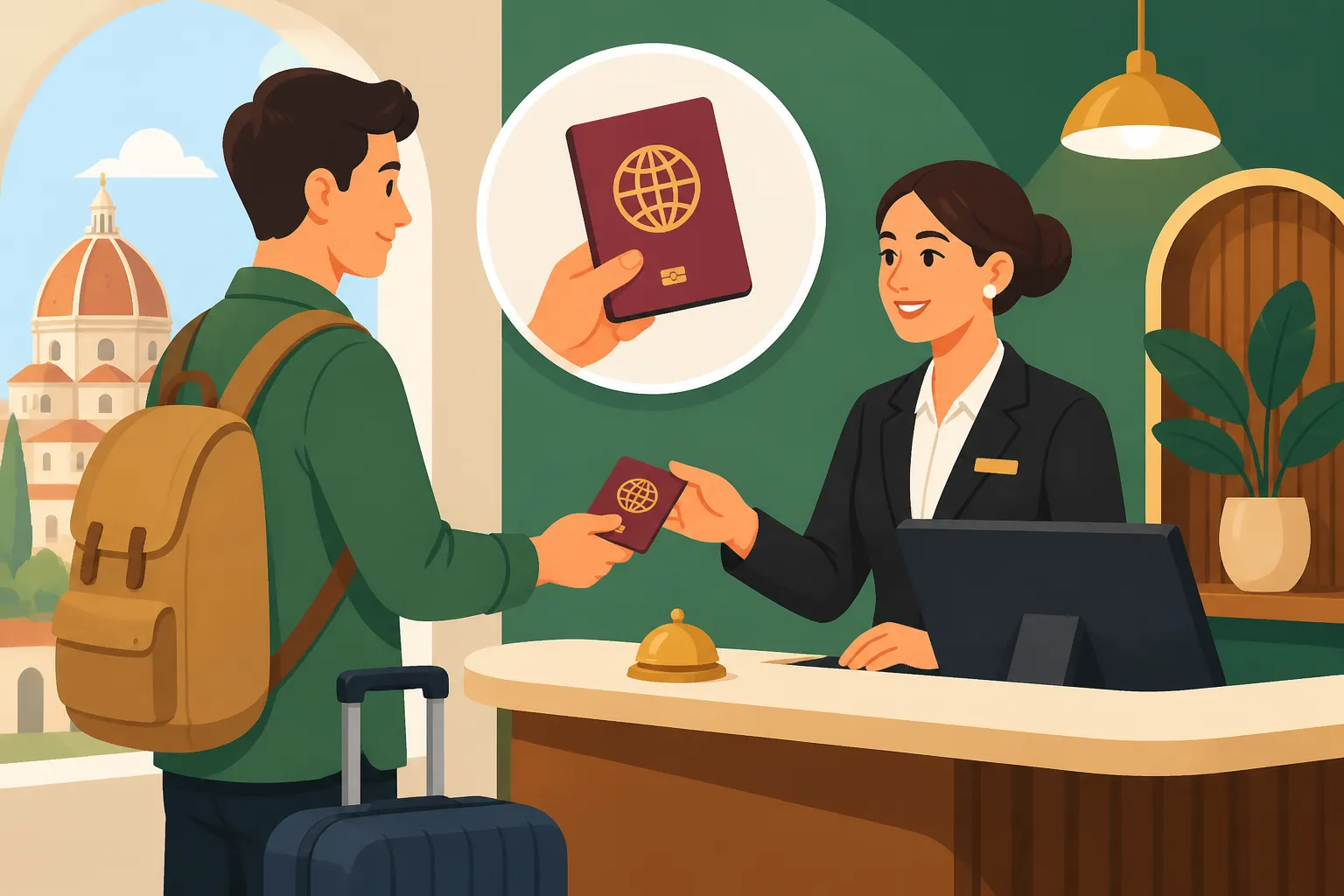
Why Italian Hotels Ask for Your Passport: Check-In Registration Explained
Ah, the classic Italian hotel check-in! You’ve just arrived, tired from your journey, dreaming of that first espresso, and then the desk clerk asks for your passport. Not just to glance at it, but often to take it away for a few minutes, or even longer. For many expats and tourists, this feels intrusive, even a bit unsettling. Why do they need it for so long? Is it normal? Rest assured, this isn't a personal affront or a scam. It's a deeply rooted legal requirement in Italy, and this guide will peel back the layers of Italian bureaucracy to explain exactly why your passport is the star of the check-in show.
Disclosure: This post may contain affiliate links. We may earn a commission at no extra cost to you if you make a purchase through these links. Read full disclosure.
The Italian Law: Public Safety and Registration (Questura)
Living in Italy, you quickly learn that some processes are relics of a different time, yet they endure with a stubborn charm. The requirement for hotels and other accommodations to register guests with the local police, known as the Questura, is one such tradition. It’s not about mistrust; it’s about public safety and historical protocol.
Historical Context and Current Regulations
Italy has a long history of meticulous record-keeping, particularly when it comes to who is residing within its borders. This stems from laws designed to maintain public safety and national security. The core regulation governing guest registration in Italy falls under the "Testo Unico delle Leggi di Pubblica Sicurezza" (TULPS) – essentially, the Consolidated Act on Public Security Laws. This isn't some newfangled rule; it dates back decades, though its implementation has certainly evolved with technology.
Every single guest, whether Italian, EU citizen, or non-EU foreigner, staying in commercial accommodation – be it a grand hotel, a cozy B&B, an agriturismo nestled in the countryside, or even a properly registered short-term rental – must have their details recorded and transmitted to the Questura. The information is typically sent electronically via a special online portal, sometimes referred to as the "alloggiati web" system. In the past, this was done with physical "schedine" (small cards) that you might still occasionally see in older, more traditional establishments. The purpose is straightforward: to track who is staying where, for how long, and to ensure accountability. It’s a measure that allows authorities to monitor movements, particularly useful in investigations or in case of emergencies, and it’s a non-negotiable part of doing business in Italian hospitality.
Who Needs to Be Registered?
The short answer is: everyone. It doesn't matter if you're popping over from Germany for a weekend, hailing from Canada for a month-long sabbatical, or even if you're an Italian citizen traveling within your own country. Each and every person, including children, checking into an accommodation in Italy is subject to this registration requirement.
This often surprises first-time visitors or those from countries with different privacy norms. You might think, "I'm just here for a night, why do they need my entire life story?" But from the Italian state's perspective, whether you're staying for an hour or a year, your presence needs to be recorded. For example, if you're traveling as a couple, both passports will be requested. If you're a family of four, all four passports (or ID cards) will be diligently noted. The hotel isn't doing this to be nosy; they're simply fulfilling a legal obligation, and failure to do so can result in hefty fines or even closure of their business. So, when they ask for your passport, remember it's a standard procedure, a part of the operational landscape here.
Your Passport: Why It's the Key Document
When you hand over your passport, it's not just a quick glance and a nod. Italian accommodation providers are looking for very specific data points that are required for their electronic submission to the Questura.
The Information Collected and Its Purpose
The primary reason hotels need your physical passport (or national ID card for EU citizens) is to accurately extract all the necessary identification details. This isn't just your name and date of birth, but a comprehensive set of data points required by the authorities. This includes:
- Name and Surname: Exactly as it appears on the document.
- Date and Place of Birth: Crucial for precise identification.
- Nationality: To differentiate between Italian, EU, and non-EU citizens.
- Type of Document: Passport, identity card, etc.
- Document Number: The unique identifier of your passport or ID.
- Issuing Authority: Where the document was issued (e.g., Department of State, Ministry of Interior).
- Expiry Date: To ensure the document is valid.
This information is then transferred, usually electronically, to the local police headquarters. The system verifies the data and registers your presence. This digital transmission is quick, efficient, and serves as an official record of your stay. It allows the police to have an overview of who is in their jurisdiction at any given time, which, as mentioned, is fundamentally about public safety, security, and even managing potential crises. It's a bit like the old "alien registration" cards, but much less intimidating and universally applied.
Different Document Types for Registration
While "passport" is the term most frequently used, especially for non-EU travelers, Italy accepts different forms of identification depending on your nationality.
- For Non-EU Citizens: A valid passport is almost always required. This is your primary document of international travel and identity. Without it, you might find yourself in a tricky situation at check-in. It’s critical that it’s current and not expired.
- For EU Citizens: A valid national identity card is generally sufficient. Many EU countries issue ID cards that are accepted for travel within the Schengen area and are legally recognized for identification purposes in Italy. A passport is also accepted, of course, but not always necessary if you have your national ID.
- For Italian Residents (Expats with Permesso di Soggiorno): If you are a long-term resident in Italy, your Permesso di Soggiorno (Residence Permit) is your key document. Even if you're traveling within Italy, the hotel will likely ask for this or your Italian ID card if you have one. For shorter trips outside Italy, your national passport remains essential.
So, while the term is often simplified to "passport," the underlying principle is that the accommodation needs a valid, officially recognized identity document that contains all the required information. Always make sure to have your primary form of identification readily available when checking into any lodging here. This helps speed things along and avoids any unnecessary delays or confusion.
The Check-In Experience: What to Expect
Let's face it, handing over your actual passport to a stranger, even a friendly hotel clerk, can trigger a little alarm bell. It’s a vital document, after all! But understanding the process can ease that anxiety.
The Handover Process and Trust
When you arrive at an Italian hotel, particularly if you're a non-EU citizen, the desk clerk will almost certainly ask for your passport. They might take it, walk away from the desk, and sometimes even disappear for a few minutes. This can feel unsettling, and I totally get it. I've been there myself, wondering if I'd ever see it again! However, in the vast majority of cases, this is a completely standard and legitimate procedure.
The clerk isn't off making illegal copies or planning identity theft. They are likely using a dedicated scanner to capture all the relevant data efficiently or manually inputting the details into their system. They may also need to cross-reference the information with your reservation. The physical document is needed for verification, ensuring that the person checking in is indeed the person named on the booking and the passport. This is crucial for their legal obligations and for your own safety and security as well. They need to ensure no one is impersonating you or using stolen documents.
Here's where platforms like Booking.com can be a small but mighty help. When you book your stay through Booking.com, you often have the option to provide some of your personal details in advance. While this doesn't eliminate the need for the physical passport check (that's a legal requirement for on-site verification), it can significantly streamline the initial data entry process for the hotel. Many hotels use the Booking.com messaging system to ask for a scanned copy of your passport ahead of time, allowing them to pre-fill their registration forms. This way, when you arrive, it's often just a quick check and scan of the physical document, and you get it right back. So, while you still need to present it, that initial data capture might already be done, thanks to your Booking.com reservation.
How Long Will They Keep It?
In most scenarios, the hotel staff will only keep your passport for a few minutes, typically long enough to scan it or accurately transcribe the required information. Once that's done, they should return it to you promptly. It’s rare for a reputable hotel to hold onto your passport overnight, or for an extended period, without a very clear and explained reason.
If, for some reason, they suggest keeping it longer (e.g., "we'll give it back tomorrow morning"), it's perfectly acceptable to politely inquire why and request its immediate return after they've completed their registration process. While this usually isn't an issue with established hotels, smaller, less experienced B&Bs might sometimes be a bit overzealous. Trust your gut: if something feels genuinely off, don't be afraid to speak up. However, generally speaking, after the brief check-in formalities are complete, your passport will be back in your hands, safe and sound. Remember that the staff are simply doing their job, following the rules, and likely want you settled in your room as quickly as you do!
Common Expat Frustrations and Realities
Even armed with knowledge, the check-in process can still feel a bit clunky, especially for newcomers. It's important to acknowledge and validate these common frustrations while understanding the underlying realities.
Language Barriers and Misunderstandings
One of the biggest sources of anxiety at check-in often boils down to a language barrier. When a hotel clerk, who might not speak fluent English (or your native language), asks for your passport and gestures for you to wait, it’s easy for misunderstandings to arise. Without a clear explanation in a language you understand, the simple act of handing over a crucial document can feel like an ominous request rather than a routine bureaucratic step.
I've heard countless stories from fellow expats who felt targeted or singled out, simply because they didn't fully grasp why their passport was being held. This lack of clear, empathetic communication can quickly turn a mundane process into a stressful one. It's a reality of living and traveling in Italy that not every interaction will be in perfect English, and administrative processes aren't always explained with the sensitivity foreigners might appreciate. Understanding that this is a systemic requirement, not a personal one, can help alleviate some of that initial discomfort, even if the explanation at the desk is less than ideal. Navigating Italian Bureaucracy: Comune and Prefettura often involves similar communication challenges, so it's a good skill to develop.
Feeling Uncomfortable or Targeted
It’s completely valid to feel a twinge of discomfort or even suspicion when asked to hand over your passport, especially if you’re from a country where such practices are uncommon for hotel stays. Many expats tell me they initially felt like they were being treated differently, or that their privacy was being invaded. This feeling can be particularly strong for non-EU citizens, who are already used to heightened scrutiny when dealing with visas and residence permits.
However, the reality in Italy is that this is not about targeting foreigners. This is a universal requirement for everyone staying in commercial accommodation. Italians visiting another Italian city are also registered. EU citizens using their ID cards are also registered. The process applies equally, from the grandest five-star hotel in Rome to the smallest family-run pensione in a remote village. It’s an ingrained part of the Italian administrative landscape, designed for broad public security, not for monitoring individual tourists or residents. Once you internalize that it's just "the way things are done," much of that feeling of being targeted tends to dissipate. It's a system for tracking, not for surveillance of specific individuals.
Making Your Italian Stays Smoother with Booking.com
Navigating the intricacies of Italian bureaucracy can be challenging, but modern booking platforms offer ways to ease the journey, even when it comes to passport registration.
Pre-filling Information and Communication
One of the best ways to make your check-in experience smoother is to use booking platforms that facilitate pre-arrival communication and information sharing. This is where Booking.com really shines. When you make a reservation through Booking.com, the platform allows you to securely share certain details with your chosen accommodation prior to your arrival. While it won't replace the need for the physical passport check upon arrival, it can significantly speed up the initial data entry.
Many hotels and B&Bs on Booking.com actively use the platform's messaging feature to request guest details, or even a scanned copy of your passport, before you even set foot in the lobby. This proactive approach means they can often pre-fill the required registration forms and submit the data to the Questura in advance. When you arrive, it then becomes a quick formality: they just need to physically verify your passport against the data they've already entered. This can shave precious minutes off your check-in time, getting you to your room (and that espresso!) much faster. Always check your Booking.com messages after booking to see if your accommodation has reached out with such a request.
Choosing Accommodations with Clear Policies
When selecting your accommodation, especially if you're concerned about the check-in process, transparency is key. Booking.com offers a vast array of properties, from large hotel chains to independent B&Bs and apartments. A savvy traveler can leverage the information available on Booking.com to choose places with clear communication and well-established procedures.
Look for properties that have detailed descriptions, high ratings, and reviews that mention smooth check-in experiences. Accommodations that are accustomed to international guests (often found by filtering for properties with multilingual staff on Booking.com) are more likely to have efficient processes in place and may even offer explanations in English about the passport requirement. Reading recent reviews on Booking.com can give you an excellent indication of how smoothly past guests have found the check-in process. Opting for a reputable property found through Booking.com minimizes surprises and increases the likelihood of a hassle-free arrival, as these establishments are typically well-versed in Italian hospitality laws. Accommodation in Italy: Hotels, B&Bs, and Agriturismi provides more insight into different types of stays.
Beyond Hotels: Short-Term Rentals and the Law
It's a common misconception that the passport registration rule only applies to traditional hotels. In reality, any legitimate commercial accommodation in Italy, including apartments, holiday homes, and agriturismi that operate as short-term rentals, is legally obligated to register their guests with the Questura. This means if you're booking an apartment for a week in Florence, the host will also need your passport details.
This is another area where Booking.com provides a clear advantage. When you use Booking.com to find short-term rentals, you're generally dealing with registered, professional hosts who understand and comply with these local laws. They will typically communicate their need for your passport information upfront, either through the Booking.com messaging system or upon your arrival. This ensures that your stay, whether in a hotel or a private rental, is fully compliant with Italian regulations, avoiding any potential issues for both you and your host. Always be prepared to show your identification, whether your booking is for a luxury suite or a cozy apartment booked via Booking.com. For more on different types of stays, see The Ultimate Guide to Renting and Buying a Home in Italy.
Document Requirements for Guest Registration in Italy
To help clarify which documents are generally accepted for guest registration, here's a quick overview:
| Nationality Group | Preferred Document | Acceptable Alternatives (where applicable) | Notes |
|---|---|---|---|
| Non-EU Citizens | Valid Passport | N/A | Essential for international travelers from outside the European Union. Must be unexpired. |
| EU Citizens | Valid National ID Card | Valid Passport | Many EU countries issue national ID cards valid for travel within the Schengen Area and for identification. |
| Italian Residents (with Permesso di Soggiorno) | Valid Permesso di Soggiorno | Valid Italian ID Card, Valid Passport | Your primary document demonstrating legal residency in Italy. Also useful for showing at the Anagrafe. |
| Children (All Nationalities) | Their own valid Passport | Their own valid National ID Card (EU) | Every individual, including minors, must be registered. |
Remember, the goal is always to provide a valid, current government-issued identification document that allows the accommodation provider to capture all the legally required data points.
Conclusion
So, the next time an Italian hotel or accommodation provider asks for your passport at check-in, you’ll know exactly why. It’s not about being nosey or singling you out; it’s a standard, decades-old legal requirement in Italy, designed for public safety and meticulous record-keeping. Every guest, regardless of nationality, goes through this process.
While the request might still feel a bit formal compared to what you’re used to, platforms like Booking.com can help streamline the experience by facilitating pre-arrival information sharing. Choosing well-reviewed accommodations through Booking.com also ensures you're dealing with hosts who are professional and well-versed in these requirements. Rest assured, your passport is usually returned swiftly once the brief formalities are complete. Consider it just another charming, albeit occasionally bureaucratic, part of your authentic Italian experience. Just make sure you always have your valid documents handy!
Disclaimer
This article is for general informational purposes only and does not constitute professional advice. Laws, prices and regulations vary by location and change over time. Consult a qualified professional for guidance on your specific situation.