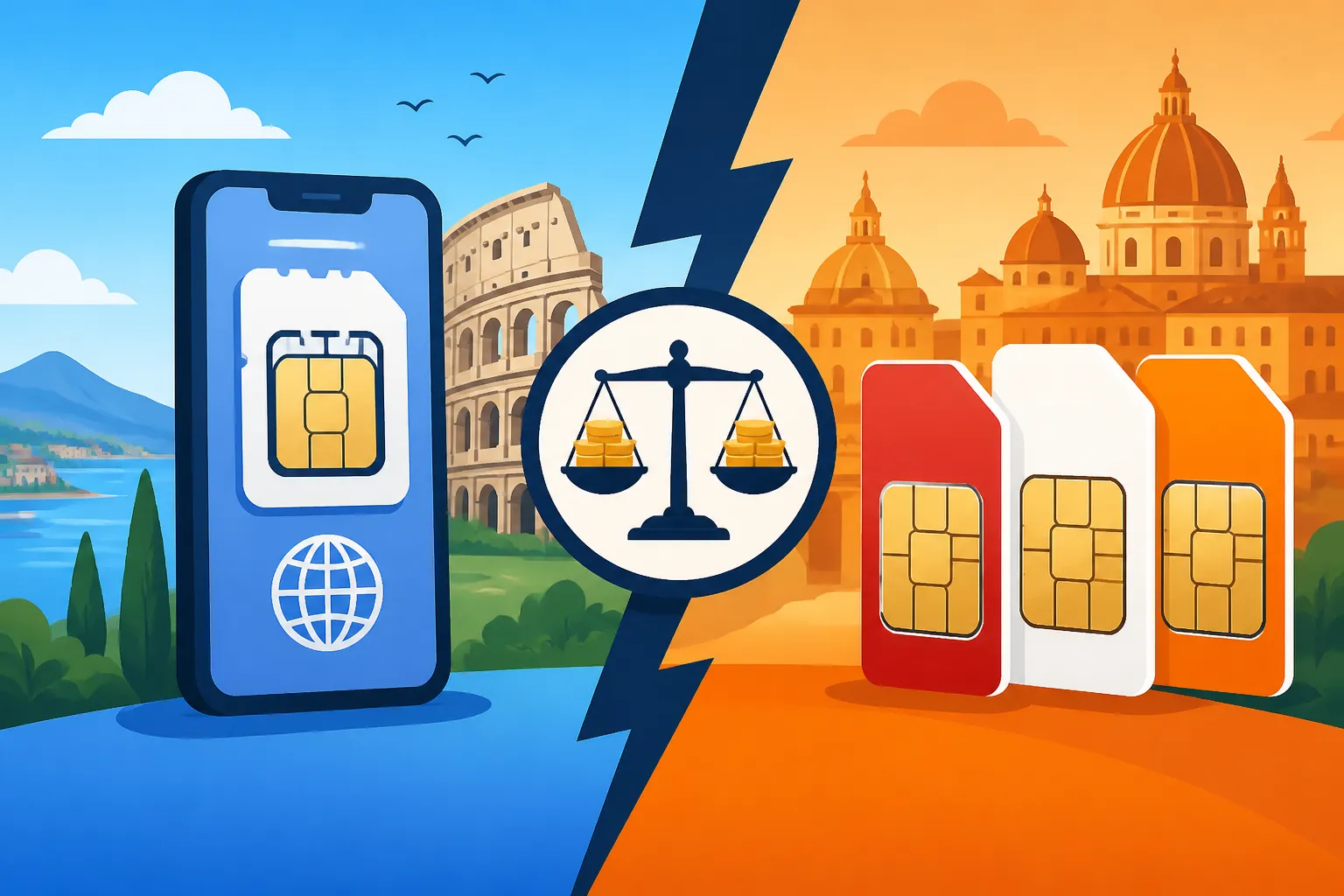
Travel eSIM vs TIM, Vodafone, and WindTre Prepaid: Price Per GB in Italy
Ah, the quest for reliable and affordable mobile data in Italy! It's one of those essential things that often turns into an unexpected bureaucratic adventure for us expats and travelers. You land, you need to check maps, find your Airbnb, tell loved ones you've arrived, and suddenly you're faced with a dizzying array of options, each with its own set of confusing rules and hidden catches. This guide is here to cut through the noise, specifically diving deep into how traditional Italian prepaid SIM cards from the big players stack up against the modern, increasingly popular eSIM solutions like Airalo, focusing on what really matters to your wallet: the price per gigabyte.
Disclosure: This post may contain affiliate links. We may earn a commission at no extra cost to you if you make a purchase through these links. Read full disclosure.
The Eternal Dilemma: eSIM vs. Physical SIM in Italy
When you first arrive in Italy, or any foreign country for that matter, one of the first things on your mind (after finding a decent espresso, of course!) is how you're going to stay connected. In today's digital age, our phones aren't just for making calls; they're our lifelines, our navigators, our personal translators, and our connection to home.
Why Mobile Data is a Must for Modern Travelers
Gone are the days when a paper map and a phrasebook were enough to get by. Now, whether you're trying to decipher the baffling public transport system in Rome, find that hole-in-the-wall trattoria in Florence that everyone raves about, or simply translate a grocery store label so you don't accidentally buy anchovy paste instead of tomato paste (trust me, it happens!), mobile data is absolutely indispensable. Imagine being lost in the winding streets of Venice, trying to coordinate with a friend, or needing to quickly book a last-minute train ticket from the station, and having no data. It’s not just inconvenient; it can be genuinely stressful and make your trip a lot less enjoyable. For emergencies, having a working phone with data can be literally life-saving, allowing you to quickly access local emergency numbers in Italy or use translation apps. Beyond practicality, sharing those breathtaking Italian moments with friends and family back home in real-time is part of the joy of travel, and for that, reliable data is a must.
The Core Differences: Convenience vs. Tradition
At its heart, the choice between an eSIM and a traditional physical SIM card boils down to a fundamental trade-off: unparalleled convenience versus a more traditional, often bureaucratic, approach. A physical SIM card requires you to find a store, physically insert a small chip into your phone, and go through an activation process that can be surprisingly complex in Italy. This usually involves showing your passport, filling out forms, and potentially needing a codice fiscale (Italian tax code) depending on the provider and the exact package you choose. For a tourist or short-term visitor, this can eat up valuable travel time and test your patience with Italian bureaucracy, which, bless its heart, operates on its own unique timeline.
An eSIM, on the other hand, is entirely digital. It’s essentially a virtual SIM card embedded directly into your phone’s hardware. Instead of swapping physical chips, you simply download a profile onto your phone. This means no fiddling with tiny cards, no searching for local stores, and often, no frustrating language barriers. You can purchase and activate an eSIM plan from pretty much anywhere in the world before you even board your flight to Italy, ensuring you're connected the moment your plane touches down. This immediate connectivity, especially after a long flight, is an absolute godsend and helps you settle into your new surroundings much more smoothly.
Unpacking the Traditional Players: TIM, Vodafone, and WindTre Prepaid SIMs
When you talk about mobile carriers in Italy, three names usually come to mind: TIM, Vodafone, and WindTre. These are the giants, the established networks with comprehensive coverage across the peninsula. For years, if you wanted local service, one of these was your go-to. But for foreigners, especially those on a short trip, getting set up with them can be a bit of a labyrinth.
TIM: Italy's Venerable Network
TIM, or Telecom Italia Mobile, is one of Italy's oldest and most extensive mobile networks. It generally offers excellent coverage, even in some more rural areas, which can be a real plus if your travels take you off the beaten path. They often have specific "Tourist SIM" or "Welcome Italia" packages designed for visitors, which typically include a bundle of data, some local calls, and sometimes international calls.
However, the process of acquiring one can be a bit of a hurdle. You'll need to visit a TIM store, present your passport, and fill out forms. Sometimes, you might even be asked for a codice fiscale, which can be problematic if you haven't applied for one yet. While some stores might waive it for tourists or use a generic one, it’s not guaranteed. The actual activation can take anywhere from a few hours to a full day, leaving you without connectivity during that crucial initial period. Moreover, these "tourist" plans, while seemingly straightforward, often come with an activation fee on top of the plan cost, and their data allowances might not always be the most generous for the price. Trying to find an English-speaking assistant in a smaller town's TIM store can also add to the frustration.
Vodafone: Reliable Coverage with a Price Tag
Vodafone is another major player in Italy, renowned for its strong network coverage and generally reliable service, particularly in urban centers and along popular tourist routes. Like TIM, Vodafone offers various prepaid options, including plans tailored for international visitors, such as "Dolce Vita" or similar tourist-friendly bundles. These packages usually boast a good amount of data and some international minutes, which can be appealing if you plan on making calls home.
The acquisition process for a Vodafone SIM mirrors that of TIM: a mandatory store visit, passport submission, and form-filling. Again, the codice fiscale might pop up as a requirement. While Vodafone stores are ubiquitous, especially in larger cities like Milan or Florence, expect potential queues and the same administrative delays for activation. While their network quality is often top-notch, this reliability frequently comes with a slightly higher price tag compared to other traditional carriers. If you're comparing purely on a price-per-GB basis, Vodafone plans for tourists can sometimes feel a bit steep once you factor in the initial SIM cost and activation fees. Plus, navigating their customer service in English after you've left the store can also be a challenge. If you're interested in understanding mobile costs more broadly, you might want to look into Mobile Phone and Internet Costs in Italy.
WindTre: The Value-Oriented Challenger
WindTre is the third major contender, formed from the merger of Wind and Tre Italia. It often positions itself as a more value-oriented option, frequently offering competitive rates and generous data allowances. Their coverage has improved significantly since the merger, making them a viable choice across much of Italy, though some rural areas might still see TIM or Vodafone with a slight edge. They also offer specific packages aimed at tourists or those with non-Italian ID.
The song remains the same when it comes to getting a WindTre SIM: a physical store visit, passport, forms, and the potential codice fiscale request. While their plans might appear cheaper on paper, remember to always factor in the initial SIM card cost and any activation fees. These upfront costs can quickly inflate the effective price per gigabyte. For instance, a plan advertised at €15 for X GB might end up costing €25-30 upfront due to the mandatory SIM purchase and activation, making the initial value proposition less appealing. The customer service experience can also be a mixed bag, and without solid Italian, resolving issues might prove taxing. All these factors contribute to the general administrative burden foreigners often experience, which can be just as frustrating as figuring out Understanding Italian Rental Contracts 101: 4+4, 3+2, and Transitorio.
Enter the Game Changer: Airalo eSIMs for Italy
Now, let's talk about a solution that’s been revolutionizing how many of us handle connectivity abroad: the eSIM. And among the various eSIM providers, Airalo has really emerged as a leader for travelers seeking a hassle-free experience in countries like Italy. It’s fundamentally different from the traditional approach, designed with the modern, on-the-go traveler in mind.
What Exactly is an eSIM, and How Does Airalo Work?
An eSIM, or embedded SIM, is a small chip built directly into your phone’s motherboard. Instead of having to physically insert a plastic SIM card, an eSIM allows you to download and activate a cellular plan digitally. Think of it like a digital movie ticket instead of a physical paper one – the functionality is the same, but the delivery method is entirely different. Most newer smartphones, especially those released in the last few years, are eSIM-compatible. You can easily check if your device supports eSIM technology on Airalo's website or your phone manufacturer's site.
Airalo simplifies the entire process. You download their app, select Italy as your destination, and then choose from a range of data packages that suit your travel duration and data needs. Once you’ve picked a package and made your payment, you simply follow a few straightforward steps within the app to install the eSIM profile onto your phone. This usually involves scanning a QR code or entering some manual settings, a process that takes mere minutes. The beauty of it all is that you can do this from the comfort of your home before your trip, on your flight, or even right after landing at the airport, entirely avoiding the need to find a physical store, deal with queues, or navigate language barriers. The activation is instant, meaning you are connected as soon as you arrive, ready to order that first taxi or look up directions without a moment's delay.
Airalo's Offerings for Italy: Data Packages and Pricing
Airalo understands that different travelers have different data appetites. For Italy, they offer a variety of data packages that are generally quite flexible, ranging from smaller bundles for short trips to larger ones for more extended stays. For example, you might find options like:
- 1 GB of data valid for 7 days: Perfect for a quick city break or if you mostly rely on Wi-Fi.
- 3 GB of data valid for 15 days: A good middle-ground for a week-long vacation with moderate usage.
- 5 GB of data valid for 30 days: Ideal for a longer, more adventurous trip where you're out and about frequently.
- 10 GB or more of data valid for 30 days: For heavy data users, digital nomads, or those on longer stays.
The pricing for these packages is transparent and upfront, with no hidden activation fees or mandatory top-ups. For instance, a 1GB plan might cost around $4.50, making the price per GB roughly $4.50. A 5GB plan might cost about $10, bringing the price per GB down to approximately $2. For a 10GB plan at around $16, your price per GB drops even further to $1.60. These are examples, and actual prices can vary slightly, but they illustrate the transparent and often competitive cost structure. This means you know exactly what you're paying for and how much data you're getting, making budgeting for your connectivity much easier and aligning with general Cost of Living in Italy 2026: Budgeting for Expats considerations.
The Undeniable Convenience Factor
The greatest strength of Airalo, especially for short-term visitors and tourists, is its unparalleled convenience. Imagine landing at Leonardo da Vinci–Fiumicino Airport in Rome, turning on your phone, and instantly having data without needing to hunt down a TIM or Vodafone store. No stress, no language fumbling, no waiting in line. You simply switch to your Airalo eSIM, and bada bing, bada boom, you’re online.
This ease of use extends beyond activation. If you run out of data, topping up your Airalo eSIM is just a few taps away in the app – no need to trek back to a store. This eliminates one of the biggest headaches associated with getting set up with a local SIM card, freeing up your valuable travel time to actually explore Italy, rather than getting tangled in its administrative web. It also means you don't have to hand over your personal passport details or worry about whether a generic codice fiscale will be accepted, simplifying the entire experience. This streamlined approach allows you to focus on enjoying your trip, from navigating local transportation to finding the best gelateria, rather than wrestling with local bureaucracy.
The Nitty-Gritty Comparison: Price Per GB Breakdown
When you're trying to decide between a traditional Italian prepaid SIM and an Airalo eSIM, simply looking at the advertised price for a data bundle isn't enough. You need to dig a little deeper, especially when it comes to the effective price per gigabyte (GB). This is where many traditional carriers can seem cheaper initially but end up costing more due to hidden fees and restrictive terms.
Analyzing Traditional Prepaid SIMs
Let's break down the real cost for TIM, Vodafone, and WindTre, keeping in mind that actual offers can change, but the underlying cost structure tends to remain.
TIM's True Cost for Tourists
TIM often has a "TIM Tourist" package. For instance, you might see an offer like 50 GB of data for €20. Sounds great, right? However, there's almost always an additional SIM card cost (typically €10) and an activation fee (sometimes €5-10, though often bundled with the SIM cost for tourists). So, that €20 plan suddenly becomes €30 or even €35 upfront.
If you pay €30 for 50 GB, your effective price per GB is €0.60. If it's €35 for 50 GB, it jumps to €0.70 per GB. Crucially, these plans often come with a limited validity (e.g., 30 days) and if you don't use all the data, it's simply gone. For a shorter trip or lighter user, a lot of that data might be wasted. This structure isn't always ideal for short visits, where you might not need a massive data allowance but still want decent value.
Vodafone's Price Point
Vodafone's tourist plans, such as the "Vodafone Holiday" or similar, are usually at a slightly higher price point. An offer might be 40 GB for €25, but again, factor in a SIM card cost of around €10-15 and possibly an activation fee. So, an initial outlay could easily be €35-€40 for 40 GB.
At €35 for 40 GB, the price per GB is about €0.875. If it's €40 for 40 GB, you're paying €1 per GB. Vodafone prides itself on its strong network, but this often translates to a premium. For travelers who only need data for navigation, social media, and quick communication, this can feel like overpaying, especially when you consider the time spent acquiring it.
WindTre's Value Proposition
WindTre frequently has competitive offers, perhaps 100 GB for €15. This seems incredibly cheap. But, like its competitors, it comes with a SIM card cost, often €10. So, your initial payment is €25 for 100 GB, making the price per GB €0.25. While this is indeed a fantastic price per GB if you utilize all that data, for many tourists, 100 GB is an excessive amount for a one or two-week trip. You're effectively paying for much more data than you'll ever use. Furthermore, if you need a specific amount of data that doesn't align with these large bundles, you might find yourself stuck with more than you need, again leading to wasted money. The core administrative process to get the SIM, including the potential requirement for How to Get a Codice Fiscale in Italy (and Why You Need One), is also a significant hurdle for many.
Airalo's Value Proposition
Airalo, on the other hand, operates with remarkable transparency. When you see a 5 GB plan for $10, that is truly the all-in cost. There are no extra SIM card fees, no activation charges, and no hidden surprises. The price you see is the price you pay.
Let's revisit the Airalo examples:
- 1 GB for $4.50: Price per GB = $4.50. Perfect for minimal usage or short stays.
- 3 GB for $8.50: Price per GB = $2.83. A good balance for moderate usage.
- 5 GB for $10: Price per GB = $2.00. Excellent value for typical vacation data needs.
- 10 GB for $16: Price per GB = $1.60. Outstanding value for heavier users or longer trips.
What stands out here is the flexibility. You can choose a plan that exactly matches your anticipated usage, minimizing wasted data and maximizing your budget. If you find you need more, a top-up is simple and quick, without having to buy a whole new plan or incur additional fees. This direct, no-nonsense pricing model is incredibly appealing, especially when you're trying to manage your expenses while traveling.
The Hidden Costs: Beyond Just GBs
When comparing these options, it's not just about the monetary price per GB; it's also about the hidden costs of time, effort, and peace of mind.
- Time is Money: Hunting for a phone store in an unfamiliar city, waiting in line (Italian lines can be legendary!), dealing with potential language barriers, and going through the activation process can easily consume half a day or more of your precious vacation time. That’s time you could be spending exploring the Colosseum, sipping an Aperol Spritz, or wandering through the Uffizi Gallery. With Airalo, you reclaim that time.
- Bureaucratic Headaches: The codice fiscale requirement for some traditional SIM activations is a pain point for many. Even if a tourist SIM doesn't require it, the mere thought of navigating that system can be daunting. Airalo completely bypasses this.
- Wasted Data: As mentioned, traditional prepaid SIMs often come with large, fixed bundles. If you only need 10 GB for your trip but the smallest available bundle is 50 GB, you're paying for 40 GB you won't use. Airalo's tiered options mean you only pay for what you reasonably expect to consume.
- Language Barriers: Trying to troubleshoot an issue or understand a complex plan in a foreign language with a customer service representative can be incredibly frustrating. Airalo's app-based support in English (and other languages) streamlines problem-solving significantly.
- Reclaiming your physical SIM slot: Many travelers need to keep their home country's physical SIM card in their phone for receiving important calls or SMS messages (like banking verification codes). With an eSIM, your physical SIM slot remains free, allowing you to use both numbers simultaneously.
Considering all these factors, the true value of Airalo often extends far beyond just its competitive price per GB, making it a powerful contender for savvy travelers.
Who Wins? Tailoring Your Choice to Your Travel Style
So, after all this digging, which option is truly best for you? The answer, as with many things in life (especially in Italy!), often depends on your specific needs, how long you're staying, and what kind of travel experience you're after.
When a Traditional Italian SIM Might Still Be Right
While I'm a big advocate for the sheer convenience of eSIMs, there are indeed specific scenarios where a traditional Italian prepaid SIM card from TIM, Vodafone, or WindTre might still be the preferable choice. If you're planning a long-term stay in Italy, perhaps for several months or even years as an expat, a local SIM card can offer benefits beyond just data. These often include more generous local call and SMS allowances, which become vital if you're integrating into daily Italian life – making appointments, calling local friends, or dealing with various services. If you plan to heavily rely on local calling rather than just data, a traditional SIM might edge out.
Furthermore, if you're not particularly tech-savvy or your phone isn't eSIM compatible, then a physical SIM is your only option. For those who are comfortable navigating the administrative hurdles, and perhaps already have an Italian codice fiscale, the slightly lower absolute price per GB on a very large data bundle from a provider like WindTre (if you manage to use it all) could be attractive for extensive, long-duration usage. But for most tourists and short-term visitors, the advantages of a physical SIM quickly diminish when weighed against the hassle.
Why Airalo is Often the Superior Choice for Tourists and Short-Term Visitors
For the vast majority of tourists, short-term visitors, and even digital nomads in Italy, Airalo is, without a doubt, the superior choice. The immediate connectivity it offers is an absolute game-changer. Imagine stepping off your flight, and within minutes, your phone is fully functional, allowing you to hail a taxi, navigate to your accommodation, or simply let loved ones know you’ve arrived safely, all without having to hunt for a store. This peace of mind alone is invaluable.
The transparent pricing and absence of hidden fees make budgeting incredibly easy. You know exactly what you’re paying for, and there are no surprise activation costs or mandatory large top-ups. This contrasts sharply with the often-opaque pricing structures and additional charges found with traditional carriers, which can make figuring out your overall Money Matters in Italy: Banking and Finance for Expats a headache. The flexibility to choose data packages that align perfectly with your actual needs means you're not paying for data you won't use, offering genuine cost-effectiveness.
Beyond the financial aspect, the convenience extends to your precious travel time. Instead of spending hours in a queue at a phone store, trying to communicate in broken Italian (or waiting for an English speaker), you can spend those hours exploring a quaint piazza, enjoying a leisurely aperitivo, or marveling at ancient ruins. Airalo empowers you to make the most of your Italian adventure from the moment you land, offering a seamless and stress-free way to stay connected. It truly makes your trip smoother, more enjoyable, and far less prone to those little administrative frustrations that can dampen the spirit of travel. So, if you're heading to Italy, do yourself a favor and check out Airalo – it's connectivity designed for the way we travel today.
Comparative Overview: Traditional SIM vs. Airalo eSIM in Italy
To help you make an informed decision, here's a quick comparison of the key aspects when choosing your mobile connectivity in Italy.
| Feature | Traditional Italian Prepaid SIM (TIM, Vodafone, WindTre) | Airalo eSIM for Italy |
|---|---|---|
| Ease of Acquisition | High friction (store visit, passport, forms, sometimes codice fiscale, waiting) | Very low friction (online purchase via app, instant digital download) |
| Initial Cost | SIM card cost (€10-€15) + activation fee (variable) + plan cost | Plan cost only (no separate SIM/activation fees) |
| Price per GB (Effective) | Often higher for initial bundles due to fees; can be low for huge, often unused bundles | Transparent, competitive, and flexible; buy only what you need |
| Flexibility | Fixed bundles, difficult to change mid-trip, potential wasted data | Variety of data sizes/validities, easy in-app top-ups |
| Network | Full access to local network (TIM, Vodafone, WindTre) | Utilizes local networks (e.g., Vodafone, WindTre) for data |
| Calls & SMS | Typically includes local calls/SMS; international calls may be extra | Data only (use VoIP apps for calls/SMS) |
| Setup Time | Hours to a day, depending on store efficiency and activation speed | Minutes, can be done anytime, anywhere |
| Language Barrier | Potential issue in stores or with customer service | App-based support, typically in English |
| Physical SIM Slot | Occupies your main SIM slot | Leaves your physical SIM slot free for home country SIM |
| Best For | Long-term residents, heavy local callers, specific local services | Tourists, short-term visitors, data-focused travelers, ease of use |
Disclaimer
Please note that all information regarding plan prices, data allowances, and specific offerings from mobile carriers (TIM, Vodafone, WindTre) and eSIM providers (Airalo) is subject to change. This guide provides general estimates and outlines typical scenarios based on current market trends. Always check the latest plans and terms directly with the provider before making a purchase. While every effort has been made to provide accurate and up-to-date information, the world of mobile plans, especially for tourists, can evolve rapidly. This content is for informational purposes only and does not constitute professional advice.