24-Hour Pharmacies and How They Work in Italy
Navigating medical needs at night in a foreign country can be stressful. This guide explains how Italy’s rotating farmacia di turno system ensures 24-hour pharmacy access, detailing how to find open locations, understand night surcharges, and purchase emergency medications.
Disclosure: This post may contain affiliate links. We may earn a commission at no extra cost to you if you make a purchase through these links. Read full disclosure.
Introduction
Understanding how to access medicine after hours is a crucial survival skill for any expatriate or traveler in Italy. The Italian healthcare system operates on a philosophy that prioritizes professional medical consultation over retail convenience. Consequently, you will not find aisles of self-serve medications in convenience stores, and the vast majority of standard pharmacies strictly adhere to traditional daytime business hours. When the sun goes down and the regular shops close their doors, a specialized network takes over to ensure that emergency pharmaceutical care is always available.
This network relies on the concept of the “farmacia di turno,” or the on-duty pharmacy. This rotating system guarantees that no matter where you are in the country—from the bustling streets of Rome to a quiet village in Tuscany—you are never entirely cut off from life-saving medications and professional health advice. However, using these after-hours pharmacies involves a specific set of unwritten rules, night surcharges, and security procedures that can easily catch foreigners off guard.
This comprehensive guide is designed to demystify the 24-hour pharmacy system in Italy. We will explore exactly how the duty rotation works, provide step-by-step instructions on how to locate the nearest open pharmacy in the dead of night, and explain the financial nuances of the “night surcharge.” Furthermore, we will break down what you can and cannot buy without a prescription after hours, and what steps you must take if you need a doctor’s authorization at 2:00 AM. By familiarizing yourself with this vital system, you can ensure that a midnight medical hiccup never turns into a full-blown crisis, giving you profound peace of mind during your Italian adventure.
The Concept of “Farmacia di Turno” (Duty Pharmacies)
To grasp how 24-hour pharmacies work in Italy, you must first understand the legal and cultural framework of the Italian pharmaceutical industry. Unlike in the United States or the United Kingdom, where pharmacies are often owned by massive corporate conglomerates that can afford to staff huge stores around the clock, Italian pharmacies (farmacie) are largely independent, privately owned businesses.
For more context on how the daily system works, you can explore our broader guide on Finding and Using Pharmacies in Italy. Because these businesses are independently operated by licensed pharmacists, it is physically and financially impossible for every single pharmacy to remain open twenty-four hours a day, seven days a week. Furthermore, Italian law requires that every municipality have at least one pharmacy per 3,300 inhabitants, guaranteeing access even in remote areas, which requires careful logistical management of working hours.
To bridge the gap between the need for rest and the public’s need for emergency medical access, the Italian government and the national federation of pharmacy owners (Federfarma) established the farmacia di turno system.
Translated literally as the “pharmacy on shift” or “duty pharmacy,” this system relies on a strictly coordinated, municipal rotation. Within any given city, district, or cluster of rural towns, the local health authority mandates that at least one pharmacy must remain open (or be on call) outside of normal business hours. This includes the traditional afternoon lunch closure, Sundays, major national holidays like Christmas and Ferragosto, and, most importantly, the overnight shift from evening until the following morning.
In massive metropolitan hubs like Milan, Rome, or Naples, you might find several pharmacies operating 24/7 on a permanent basis. However, in smaller towns, residential neighborhoods, and rural provinces, the duty rotates daily or weekly among the local shops. The pharmacy that is di turno tonight will close at normal hours tomorrow, and the responsibility will pass to a different pharmacy just a few streets over.
How to Find the Nearest 24-Hour Pharmacy
When you are feeling unwell in the middle of the night, panicking about where to find medicine is the last thing you want to do. Fortunately, finding the current farmacia di turno is a highly standardized process, and there are several ways to locate the open shop, whether you prefer traditional methods or digital tools.
The Traditional Method: Checking the Door
If you live in Italy, you likely already know the location of your local neighborhood pharmacy. If you walk up to your local pharmacy at night and find the lights off and the doors locked, simply look at the main entrance. By law, every single closed pharmacy in Italy is required to display a printed list or an illuminated digital screen in their window showing the current farmacie di turno for that specific night and the upcoming weekend.
This list will provide the name, exact street address, and usually the phone number of the pharmacy (or pharmacies) currently on duty in your immediate vicinity. In historical city centers, this ensures you won’t have to walk far, but in rural provinces, the designated duty pharmacy can sometimes be located in a neighboring town quite far away.
Using Digital Tools and Websites
If you are too sick to leave your hotel or apartment just to check a sign, the internet is your best resource. The national federation, Federfarma, alongside regional health authorities, maintains up-to-date online databases of duty pharmacies.
You can perform a simple web search using the phrase “farmacia di turno” followed by your city or municipality (for example, “farmacia di turno Venezia”). This will invariably bring up local municipal websites or dedicated pharmacy locators showing exactly which shops are open.
Many regions also have specific smartphone applications dedicated to this service (such as apps simply titled Farmacia di turno) that will display the open pharmacy on a GPS map. Additionally, while Google Maps can be helpful, the hours listed on Google for independent Italian businesses are notoriously unreliable, especially for rotating duty shifts. It is always safer to cross-reference Google Maps with the official local duty roster or call the pharmacy’s phone number before getting in a taxi.
Asking for Local Assistance
If you are staying in a hotel, the front desk concierge is a phenomenal resource. They deal with tourist medical emergencies constantly and usually know the local farmacia di turno schedule by heart or can look it up instantly. They can even call a taxi to take you directly to the correct address.
What to Expect When You Arrive at Night
Visiting an Italian pharmacy at 3:00 AM is a vastly different retail experience than walking in during a busy Tuesday afternoon. Security and safety are paramount for pharmacists working the night shift alone.
The Locked Door and the Bell
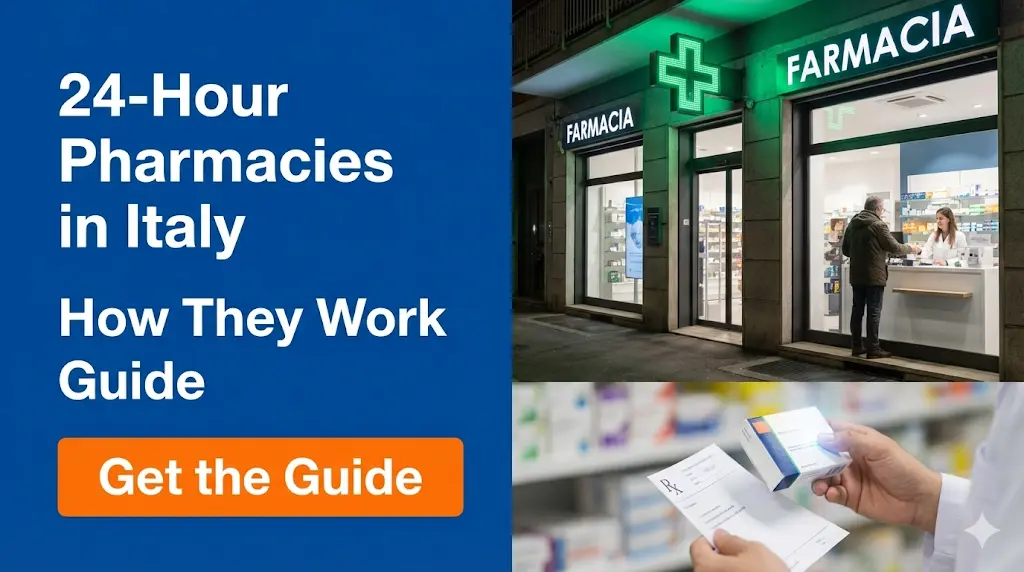
When you arrive at the duty pharmacy late at night, you will almost always find the main sliding glass doors locked. Do not assume the pharmacy is closed just because you cannot walk inside. Look for a small doorbell or intercom system located next to the entrance, often marked with a glowing green cross or a sign that says “Campanello” (Bell) or “Servizio Notturno” (Night Service).
Ring the bell and wait patiently. In some rural areas, the pharmacist may be resting in a back room specifically designated for the night shift, so it might take them a minute to get to the front.
The Security Hatch
Once the pharmacist answers, you will typically not be invited inside to browse. Instead, the transaction takes place entirely through a small, bulletproof glass hatch or a secure sliding drawer built into the front door or window. You will speak to the pharmacist through the intercom, explain your symptoms or slide your prescription through the slot, and they will retrieve the medication from the back and pass it to you.
The Night Surcharge (Diritto Addizionale)
One of the most important financial nuances of the Italian after-hours system is the “night surcharge,” legally known as the diritto di chiamata or diritto addizionale.
Because the pharmacist is working an unsociable, demanding shift—often having to wake up to answer the bell—Italian law allows the pharmacy to apply a fixed surcharge to your final bill during the night shift when operating with closed doors. This emergency surcharge is applied to the overall transaction, not a markup on each individual medication.
Waiving the Surcharge
There is a massive, legally mandated exception to this night surcharge. If you arrive at the pharmacy with an official prescription written by a doctor working the night shift—specifically, a doctor from the emergency room (Pronto Soccorso) or the state out-of-hours medical service (Guardia Medica)—and the doctor has specifically marked the prescription as urgent, the pharmacy is legally forbidden from charging you the fee. The state essentially covers the cost of the emergency dispensation. However, if you are just buying over-the-counter painkillers because you have a headache, you must pay the surcharge out of pocket. To better understand how the broader prescription ecosystem functions, you should read our deep dive on Italian Pharmacies: Prescription, Over-the-Counter, and Supplies.
Navigating Prescriptions in the Middle of the Night
A common point of frustration for foreigners is assuming that a 24-hour pharmacy operates like a hospital. It is vital to remember that an Italian pharmacist, no matter how highly educated, is not a doctor. They cannot diagnose severe illnesses, and, most importantly, they cannot legally dispense prescription medications without a valid, written prescription from an authorized physician.
What If You Run Out of Prescription Medication?
Imagine you arrive at your hotel in Venice at midnight and realize you lost your luggage, which contained your daily blood pressure medication. You cannot simply go to the farmacia di turno, explain your situation, and expect them to hand over a restricted drug.
In Italy, medications are strictly categorized. While mild painkillers (paracetamol, ibuprofen), throat lozenges, and basic antacids are over-the-counter (farmaci da banco), medications like antibiotics, strong painkillers, and psychotropic drugs strictly require a doctor’s authorization.
If you desperately need a prescription drug in the middle of the night, you have two primary options before visiting the pharmacy:
- Alternative 1: The Guardia MedicaYour first line of defense for non-life-threatening medical issues at night is the Guardia Medica. This is the state-funded, out-of-hours doctor service that operates when regular family doctors are closed. You can call the regional Guardia Medica phone number, explain your emergency, and a doctor will either advise you over the phone or invite you to their clinic. The Guardia Medica doctor can write you a valid Italian prescription, which you can then take directly to the farmacia di turno.
- Alternative 2: The Emergency RoomIf your situation is more severe, or if you cannot access the Guardia Medica, your only other option is to visit the nearest hospital emergency room (Pronto Soccorso). A triage doctor there can evaluate you and issue an emergency prescription. To understand exactly how these high-stress environments operate and what color-code triage system they use, consult our guide on Emergency Medical Services in Italy: 112 and Hospitals.
What Can You Buy at a 24-Hour Pharmacy?
When utilizing the night hatch at a duty pharmacy, you have access to a massive inventory of health and wellness products, but you must know what to ask for. Because you cannot browse the aisles, you must be specific in your requests.
Emergency First Aid and Over-the-Counter Medicine
The primary purpose of the night pharmacy is to dispense emergency relief. You can easily purchase:
- Fever reducers and mild painkillers (Ask for paracetamolo or ibuprofene, noting that brands like Tylenol and Advil are North American terms not used in Italy).
- Gastrointestinal relief (anti-diarrhea medication, antacids, probiotics like enterogermina).
- Basic wound care (bandages, sterile gauze, disinfectants).
- Cold and flu remedies (cough syrups, decongestant nasal sprays).
Infant and Baby Supplies
For expatriate parents, the farmacia di turno is a lifesaver. If you run out of essential baby supplies at 2:00 AM, the pharmacy will be able to provide high-quality infant formula, baby bottles, pediatric fever suppositories, and emergency diapers.
What You Cannot Buy
Do not use the night pharmacy as a convenience store. While daytime pharmacies sell high-end cosmetics, dietary supplements, and orthopedic shoes, the pharmacist working the night shift may decline to retrieve non-essential, purely cosmetic items through the security hatch at 4:00 AM. Furthermore, Italian pharmacies do not sell general snacks, sodas, or convenience groceries.
The Difference Between Farmacia and Parafarmacia
It is also essential to note the difference between a traditional Farmacia (marked by a green cross) and a Parafarmacia (marked by a blue cross). A parapharmacy only sells over-the-counter medications and health products; they are not legally authorized to dispense prescription drugs. Consequently, parapharmacies are almost never included in the municipal farmacia di turno night rotation. Always look for the glowing green cross when seeking emergency night care.
The Language Barrier: Communicating with the Pharmacist
Interacting through a thick glass window in the middle of the night can be challenging, especially if you do not speak fluent Italian. While pharmacists in major tourist centers like central Rome or Florence often speak conversational English, a pharmacist working the night shift in a quiet residential suburb might not.
If you are struggling with the language, the best strategy is to use a translation app on your smartphone before you ring the bell. Type out your exact symptoms or the generic name of the medication you need, translate it into Italian, and hold the screen up to the glass for the pharmacist to read.
To help you prepare, here is a useful table of essential Italian vocabulary for night pharmacy visits:
| English Phrase / Term | Italian Translation |
| I need medicine for a fever. | Ho bisogno di una medicina per la febbre. |
| Painkiller / Headache | Antidolorifico / Mal di testa |
| I have a prescription. | Ho una ricetta medica. |
| Stomach ache / Diarrhea | Mal di stomaco / Diarrea |
| Cough syrup | Sciroppo per la tosse |
| Do you speak English? | Parla inglese? |
| Duty Pharmacy / Night surcharge | Farmacia di turno / Diritto di chiamata |
Conclusion
Navigating a medical hiccup in the middle of the night in a foreign country can be an intimidating prospect, but the Italian farmacia di turno system is designed to provide an absolute safety net. Italy’s approach to emergency pharmaceutical care beautifully balances the labor rights of its highly trained medical professionals with the urgent health needs of the community.
While the experience of ringing a doorbell at 3:00 AM, speaking through a security hatch, and paying a night surcharge might seem alien to newly arrived expatriates, it is a highly efficient, deeply reliable system. By familiarizing yourself with how to locate the duty roster, understanding the strict rules surrounding emergency prescriptions, and knowing when to utilize the out-of-hours Guardia Medica instead, you can eliminate the panic of midnight illnesses. Embrace this unique aspect of the Italian healthcare infrastructure, and you can sleep soundly knowing that professional, life-saving medical advice is always just a green cross away.
References
Primary sources (official)
- Federfarma: The Italian National Federation of Pharmacy Owners, which coordinates the farmacia di turno system and provides official online locators for on-duty pharmacies across the country. https://www.federfarma.it
- Ministero della Salute (Ministry of Health): The central government authority that regulates Italian pharmaceutical laws, prescription classifications (Class A and Class C drugs), and out-of-hours medical care guidelines. https://www.salute.gov.it
Other helpful sources
- Estatefy: “Pharmacies in Italy: Everything You Need to Know,” an extensive overview of the duty pharmacy system, night surcharges, and the differences between prescription and OTC medications. https://www.estatefy.com/italy/pharmacies-in-italy-everything-you-need-to-know
- Saturdays in Rome: “Pharmacies in Italy – Complete Traveler’s Guide,” providing practical advice on locating the farmacia di turno and communicating with pharmacists in English. https://www.saturdaysinrome.com/blog/pharmacies-in-italy/
Disclaimer
The information provided in this article is intended for general informational and educational purposes only and does not constitute official medical, legal, or financial advice. Healthcare laws, pharmaceutical regulations, and the operational hours of the farmacia di turno system in Italy are subject to frequent changes by national and regional authorities. The night surcharge (diritto di chiamata) amounts may vary slightly depending on the specific regional legislation. Always consult directly with a licensed Italian medical professional, the Guardia Medica, or a registered pharmacist before taking any new medication. In the event of a severe, life-threatening medical emergency, do not wait for a pharmacy; dial 112 immediately or proceed to the nearest hospital emergency room.