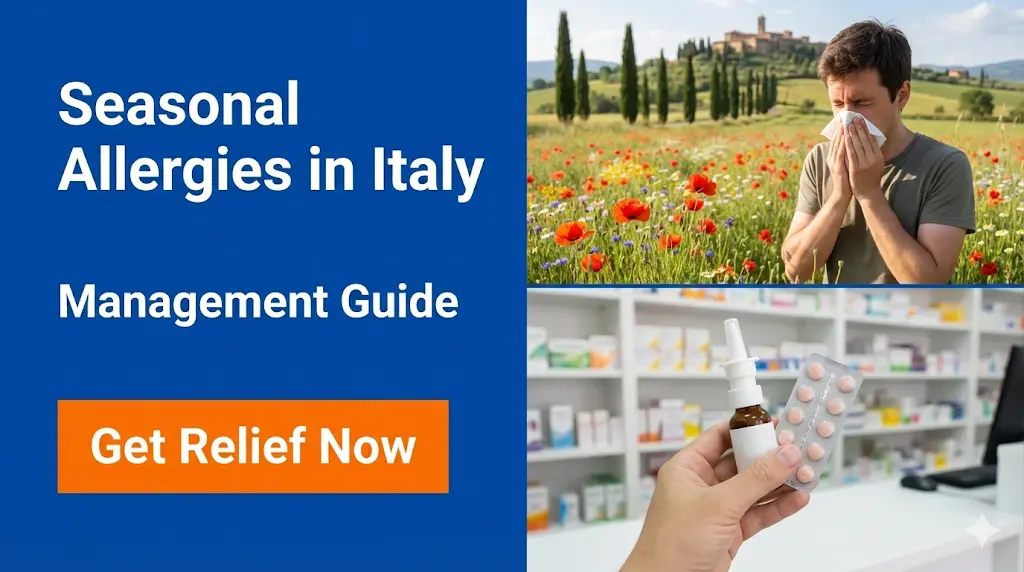
Managing Seasonal Allergies in Italy
Discover how to navigate seasonal allergies in Italy with this comprehensive guide. Learn about common Italian pollens, local allergy seasons, navigating pharmacies for antihistamines, natural remedies, and tips to protect your health during the blooming Mediterranean spring.
Disclosure: This post may contain affiliate links. We may earn a commission at no extra cost to you if you make a purchase through these links. Read full disclosure.
Introduction to Managing Seasonal Allergies in Italy
Moving to a new country involves acclimating to a myriad of changes, from local customs and language to culinary habits. Yet, one of the most unexpected shocks for many expatriates is the sudden onset or severe worsening of seasonal allergies. When you relocate to the Italian peninsula, your immune system is suddenly introduced to an entirely new ecosystem of flora. Plants, trees, and weeds that do not exist in your home country—or exist in much higher concentrations in the Mediterranean basin—can trigger intense allergic reactions.
Many expats who never suffered from hay fever in their native countries find themselves reaching for tissues during their first Italian spring. Conversely, some who suffered terribly back home may find brief relief, only to discover a new trigger a few years into their residency. Understanding the specific botanical landscape of Italy, recognizing the peak allergy seasons, and knowing exactly how to access relief through the local healthcare and pharmacy systems are crucial steps for maintaining your quality of life.
This exhaustive guide is designed to equip you with all the knowledge you need to effectively manage seasonal allergies in Italy. We will explore the unique pollens that dominate the Italian skies, provide a detailed calendar of when these allergens peak, and offer practical advice on securing over-the-counter medications and specialist care. By integrating these strategies, you can minimize your symptoms and get back to enjoying the unparalleled beauty of the Italian outdoors.
The Unique Botanical Landscape of Italy
Italy’s diverse geography—stretching from the snow-capped Alpine borders in the north to the sun-baked, arid coastlines of the deep south—creates a variety of microclimates. This geographical diversity means that the allergy season is not a uniform event across the country. It is staggered, prolonged, and highly dependent on where you choose to live.
In the northern regions, such as Lombardy and Veneto, the climate is continental. The winters are cold and damp, and the springs are characterized by a sudden, intense burst of tree pollens similar to what one might experience in Northern Europe or the Northeastern United States. As you move centrally into Tuscany and Umbria, the rolling hills are dominated by specific agricultural and wild species, extending the pollen season.
In the southern regions, including Campania, Puglia, and the islands of Sicily and Sardinia, the true Mediterranean climate takes hold. The winters are incredibly mild, meaning that some plants never truly go dormant. In these areas, the “spring” allergy season can actually begin as early as late January or February and stretch well into the autumn months. If you are struggling to adapt to these regional weather shifts, reviewing strategies for Acclimating to Italian Climate: Heat, Humidity, and Health can help you prepare your body and your home for the changing seasons.
Primary Allergy Triggers in the Mediterranean
To effectively combat your seasonal allergies, you must first identify the enemy. The Italian peninsula is home to several highly allergenic plant species. Some of these will be familiar to international visitors, while others are distinctly Mediterranean and notorious for causing severe reactions in unaccustomed expats.
Parietaria The Mediterranean Weed
If there is one plant that defines the Italian allergy experience, it is Parietaria judaica, commonly known as pellitory-of-the-wall. This resilient, unassuming weed thrives in the Mediterranean basin. As its name suggests, it grows prolifically out of the cracks of ancient stone walls, ruins, sidewalks, and unkempt urban areas.
Parietaria is the bane of Italian allergy sufferers for two reasons. First, its pollen is incredibly fine and highly allergenic. Second, its pollination period is exceptionally long. In southern Italy, Parietaria can release pollen almost year-round, with massive peaks from March through July, and a secondary peak in the early autumn. If you are exploring historic ruins in Rome or Naples and suddenly experience a severe asthma attack or sneezing fit, Parietaria is likely the culprit.
Olive Trees
The olive tree (Olivo) is an iconic symbol of the Italian landscape, vital to the country’s culture, economy, and cuisine. Millions of these trees blanket the hillsides of Tuscany, Puglia, and Calabria. Unfortunately, during their blooming phase in late spring—typically May and June—they release massive amounts of pollen into the air. Olive pollen is a heavy, potent allergen that travels vast distances on the wind, affecting people even if they live in urban centers far from the actual olive groves.
Cypress Trees
The tall, slender Cypress tree (Cipresso) is a staple of Italian landscaping, famously lining the driveways of Tuscan villas and providing shade in local cemeteries. While beautiful, Cypress trees are among the earliest bloomers in the country. They begin releasing dense clouds of yellow pollen as early as February and continue through March and April. For many residents, the Cypress marks the official, miserable beginning of the annual hay fever season.
Grasses
Grasses (Graminacee) are a universal allergy trigger, and Italy is no exception. Wild grasses grow abundantly in the countryside, in unmaintained urban lots, and along highways. The grass pollen season in Italy is intense, generally beginning in April, peaking in May and June, and tapering off in July.
Ragweed
Ragweed (Ambrosia) is an invasive species that has found a very comfortable home in Northern Italy, particularly in the Po Valley region (Lombardy and Piedmont). Unlike the spring bloomers, ragweed is a late-summer and early-autumn nightmare. It begins to pollinate in August and reaches its peak in September, extending the allergy season just when many people think they are finally in the clear.
The Italian Pollen Calendar
To help you anticipate and prepare for your specific triggers, it is helpful to visualize the blooming periods. Be aware that climate change and unusually warm winters are increasingly causing these pollens to release earlier than historical averages.
Table Regional Pollen Timelines in Italy
| Allergen Type | Italian Name | Primary Regions Affected | Peak Pollination Months |
| Cypress | Cipresso | Tuscany, Umbria, Lazio, South | February – April |
| Parietaria | Parietaria | Central and Southern Italy, Coasts | March – July (and Sep – Oct) |
| Olive | Olivo | Puglia, Calabria, Sicily, Tuscany | May – June |
| Grasses | Graminacee | Nationwide (Rural and Urban) | April – July |
| Birch | Betulla | Northern Italy, Alpine Valleys | March – May |
| Ragweed | Ambrosia | Northern Italy (Po Valley) | August – October |
| Dust Mites | Acari della Polvere | Nationwide (Indoor trigger) | Year-round (Peaks in humid winter) |
Recognizing Symptoms and Local Terminology
Seasonal allergies are collectively referred to in Italian medical terms as rinite allergica (allergic rhinitis) or, more colloquially, as allergia al polline (pollen allergy) or febbre da fieno (hay fever).
The symptoms are universal, but knowing how to describe them in Italian is vital when seeking help. Common symptoms include:
- Sneezing fits (starnuti)
- Runny or congested nose (naso che cola or naso chiuso)
- Itchy, red, and watery eyes (occhi rossi, che prudono e lacrimano)
- Scratchy throat and palate (prurito alla gola)
- Fatigue and lethargy (stanchezza)
- Asthma flare-ups or wheezing (asma or respiro sibilante)
It is highly common for newly arrived expats to mistake their first severe allergy attack in Italy for a prolonged spring cold. If your “cold” lasts for more than two weeks, produces clear, watery nasal discharge rather than thick mucus, and is accompanied by intensely itchy eyes, you are almost certainly dealing with seasonal allergies.
Navigating Italian Pharmacies for Relief
When allergy symptoms strike, your first line of defense is the local pharmacy. The pharmaceutical system in Italy is highly regulated, and you cannot buy allergy medication at a grocery store or a gas station. You must visit a licensed pharmacy (farmacia), identifiable by the illuminated green cross outside.
Understanding how to interact with the pharmacist is essential. The pharmacist (farmacista) in Italy is a highly trained clinical advisor. You do not browse the aisles for medication; you walk up to the counter, describe your symptoms, and the pharmacist will retrieve the appropriate remedies from behind the counter. For a comprehensive overview of how this system works, including after-hours access, you should review our guide on Finding and Using Pharmacies in Italy.
Over the Counter Antihistamines
Standard second-generation antihistamines are readily available over the counter in Italy without a doctor’s prescription. However, the brand names you are familiar with back home are likely different. You should always ask the pharmacist for the active ingredient rather than the foreign brand name.
- Cetirizine: (Known as Zyrtec in the US/UK) is commonly sold in Italy under the brand names Zirtec or Cerchio. You can also simply ask for the generic Cetirizina.
- Loratadine: (Known as Claritin) is sold as Clarityn or Fristamin.
- Fexofenadine: (Known as Allegra) is sold as Telfast or Fexallegra.
- Ebastine: A very common, non-drowsy antihistamine in Italy, sold under the brand name Clever or Kestine.
Nasal Sprays and Eye Drops
Oral antihistamines are often not enough to combat severe local symptoms. Italian pharmacists can provide excellent topical relief.
- Nasal Sprays (Spray Nasale): For a stuffy nose, the pharmacist may offer a decongestant spray like Rinazina. However, these should only be used for a few days. For long-term seasonal management, ask for a corticosteroid spray like Flixonase or a natural isotonic seawater spray like Isomar to physically wash the pollen out of your nasal passages.
- Eye Drops (Collirio): If your eyes are suffering, ask for a collirio antistaminico (antihistamine eye drops) such as Imidazyl Antistaminico or Zaditen, which provide rapid, targeted relief for itching and redness.
Table Allergy Vocabulary for the Pharmacy
| English Phrase / Term | Italian Translation |
| I have seasonal allergies. | Ho un’allergia stagionale. |
| Hay fever | Febbre da fieno / Rinite allergica |
| I need an antihistamine. | Ho bisogno di un antistaminico. |
| Does it cause drowsiness? | Provoca sonnolenza? |
| Eye drops for itchy eyes | Un collirio per gli occhi che prudono |
| Nasal spray for congestion | Uno spray nasale per il naso chiuso |
| Active ingredient | Principio attivo |
Seeking Specialist Care The Allergist
If over-the-counter medications from the pharmacy are not providing sufficient relief, or if your allergies are triggering severe asthma attacks, you must seek professional medical intervention. In Italy, you need to see a specialized doctor known as an allergologo (allergist).
Public vs Private Healthcare Routes
As an expat residing in Italy, you have two primary avenues for seeing an allergist: the public Servizio Sanitario Nazionale (SSN) or the private healthcare sector.
The Public Route:
If you are registered with the public healthcare system, you must first visit your assigned family doctor (medico di base). You will explain your symptoms, and they will write you a formal referral (impegnativa) to see a public allergist. You then use this referral to book an appointment through the regional centralized booking system (CUP).
The public route is highly affordable, requiring only a small co-payment (ticket sanitario). However, the waiting lists for non-urgent specialist appointments in the public system can be exceptionally long. You might request a referral in April but not secure an appointment until September, long after the pollen season has ended. If you are navigating this bureaucracy for the first time, read our detailed breakdown on How to Get a Referral to a Specialist Doctor to understand the priority coding system.
The Private Route:
To bypass the waiting lists, the vast majority of expats and many Italians turn to the private sector for allergy management. You do not need a referral to see a private allergist. You can simply research local private clinics, book an appointment, and be seen within a few days. While you will pay entirely out-of-pocket (usually ranging between €100 and €200 for an initial consultation), the speed of service and the high likelihood of finding an English-speaking doctor make this the preferred option.
Allergy Testing and Immunotherapy
During your specialist visit, the allergist will likely perform a Prick Test. They will place tiny drops of purified allergen extracts (including the specific local Italian pollens like Parietaria and Cypress) on your forearm and lightly prick the skin to observe the allergic reaction.
If your allergies are severe and chronic, the Italian specialist may recommend specific immunotherapy (immunoterapia specifica), commonly known as allergy shots or sublingual drops. This treatment involves gradually exposing your immune system to the allergen over several years to build long-term tolerance. Immunotherapy is highly advanced in Italy and is widely considered the most effective way to permanently reduce reliance on daily antihistamines.
Natural and Alternative Remedies in Italy
Italy has a profound cultural respect for herbalism and natural medicine. If you prefer to avoid daily pharmaceuticals, you will find a wealth of alternative options seamlessly integrated into the Italian healthcare landscape.
Instead of a traditional pharmacy, you can visit an Erboristeria (herbalist shop). The proprietors of these shops often hold university degrees in herbal sciences and are experts in creating custom, plant-based remedies. For comprehensive insight into how these practices fit into the broader medical culture, explore our guide on Complementary Medicine: Homeopathy and Acupuncture in Italy.
Ribes Nigrum (Blackcurrant Extract)
One of the most popular natural allergy remedies in Italy is Ribes Nigrum (Blackcurrant). It is widely prescribed by herbalists as a natural cortisone alternative. It possesses strong anti-inflammatory and antihistamine properties. It is typically sold as a macerated glycerin extract (gocce), and allergy sufferers often take several drops in water every morning starting a few weeks before the pollen season begins to build up natural resistance.
Local Honey and Propolis
The Mediterranean diet naturally supports immune health, and local Italian honey is frequently used as a preventative measure. Consuming a spoonful of raw, locally sourced honey every day is believed to micro-dose the body with local pollens, acting as a mild, natural form of immunotherapy.
Additionally, Propoli (Propolis), a resinous mixture produced by honey bees, is an Italian staple. It is highly valued for its natural antibacterial and anti-inflammatory properties. When the pollen counts are high and your throat is scratchy and irritated, Italian pharmacists and herbalists alike will almost universally recommend a propolis throat spray (spray alla propoli) for soothing relief.
Lifestyle Adjustments and Minimizing Exposure
Medical treatments are essential, but managing seasonal allergies effectively in Italy also requires adapting your daily lifestyle and understanding the unique features of Italian home architecture.
Mastering the Italian Shutters
Almost all Italian apartments and houses are equipped with heavy exterior shutters (persiane or tapparelle). While primarily used to block out the intense summer sun, they are also your best defense against pollen.
The cardinal rule of allergy management is to keep the pollen out of your living space. Do not leave your windows wide open during the middle of the day when pollen counts are at their highest and the wind is blowing. Instead, adopt the Italian habit of airing out the house (cambiare l’aria) very early in the morning, around 6:00 AM, or late at night when pollen levels drop. Keep the windows firmly shut and the shutters partially drawn during the peak afternoon hours.
The Problem with Hanging Laundry
Another quintessential aspect of Italian life is hanging your laundry outside to dry on a balcony or a courtyard clothesline (stendino). While this is environmentally friendly and leaves your clothes smelling sun-baked, it is a disastrous practice during allergy season.
Damp bedsheets, pillowcases, and clothing act like massive pollen traps, capturing thousands of microscopic particles blowing in the wind. When you bring the laundry inside and put it on your bed, you are essentially burying your face in pollen all night long. During your peak trigger months, you must dry your laundry indoors on a drying rack, or invest in a tumble dryer if your apartment accommodates one.
Upgrading Your Home Environment
Italian cities are stunning, but the combination of heavy pollen, Saharan dust storms (which frequently blow up from North Africa), and urban smog can create a toxic cocktail for your respiratory system.
Investing in a high-quality HEPA air purifier for your bedroom is one of the best purchases an expat can make. Run the purifier constantly to scrub the indoor air. Additionally, make it a strict habit to change your clothes and wash your hair immediately upon returning home from an outdoor excursion. Pollen sticks fiercely to hair fibers; going to sleep without washing your hair guarantees that you will be inhaling allergens off your pillowcase for eight hours.
Digital Resources for Tracking Pollen in Italy
Knowledge is power when fighting allergies. Just as you check the weather before planning a weekend trip to the Amalfi Coast or the Dolomites, you should make checking the pollen forecast a daily habit.
Italy possesses an excellent network of aerobiological monitoring stations that provide highly accurate, real-time data on atmospheric pollen concentrations.
- Il Meteo & 3B Meteo: The most popular Italian weather websites and smartphone apps (IlMeteo.it and 3BMeteo.com) feature dedicated “Bollettino Pollini” (Pollen Bulletin) sections. They provide color-coded risk levels for specific plant families based on your exact postal code.
- POLLnet: Operated by the national environmental protection agency (SNPA), POLLnet is the official institutional network for monitoring airborne allergens. Their website provides highly scientific, regional breakdowns of pollen trends, which is particularly useful for tracking sneaky allergens like Parietaria and Ragweed.
By checking these apps, you can strategically plan your outdoor activities. If the Cypress pollen is exceptionally high in Tuscany on a Saturday, it might be the perfect day to explore indoor museums rather than planning a long hike in the rolling hills.
Conclusion
Managing seasonal allergies in Italy is a multi-faceted endeavor that requires preparation, adaptation, and a proactive approach to your health. The sheer beauty of the Italian spring is undeniable, but the Mediterranean ecosystem introduces a potent array of unfamiliar pollens that can quickly overwhelm an unaccustomed immune system.
By familiarizing yourself with the specific regional triggers like Parietaria and Olive trees, and tracking the blooming seasons through local pollen calendars, you can anticipate your symptoms before they peak. The Italian healthcare system, bridging highly trained pharmacists, specialized allergists, and a rich tradition of natural herbalism, provides all the necessary tools for profound relief. Combine these medical resources with intelligent lifestyle adjustments—such as mastering your window shutters and drying your laundry indoors—and you can regain control over your environment. Do not let hay fever dictate your expatriate experience; with the right strategy, you can breathe easy and fully embrace the magnificent, blossoming Italian landscape.
References
Primary sources (official)
- Ministero della Salute (Ministry of Health): Official guidelines regarding the Servizio Sanitario Nazionale, allergic rhinitis prevention, and the categorization of over-the-counter medications. https://www.salute.gov.it/
- SNPA – POLLnet: The official institutional network of the National System for Environmental Protection, providing scientific, real-time aerobiological monitoring and regional pollen bulletins across Italy. https://www.pollnet.it/
Other helpful sources
- Federasma e Allergie Onlus: The Italian national federation for asthma and allergy patients, offering extensive resources, advocacy information, and practical patient guides for navigating seasonal triggers. https://www.federasmaeallergie.it/
- The Local Italy: A comprehensive English-language news resource providing practical guides for expatriates on surviving the Italian allergy season, interacting with pharmacists, and understanding Mediterranean flora. https://www.thelocal.it/
Disclaimer
The information provided in this article is intended for general informational and educational purposes only and does not constitute official medical advice. Allergy triggers, medical treatment options, and the availability of specific pharmaceutical brands in Italy are subject to change. Always consult directly with a licensed Italian medical professional, a registered pharmacist, or a specialized allergologo to receive an accurate diagnosis and a personalized treatment plan for your specific allergic conditions.