Commuting Options: Trains, Buses, Cars in Italy
Navigate Italy’s dynamic transportation network with confidence. This comprehensive guide details everything expats need to know about commuting, covering high-speed and regional trains, urban and intercity buses, driving regulations, toll roads, and alternative commuting methods for daily travel.
Disclosure: This post may contain affiliate links. We may earn a commission at no extra cost to you if you make a purchase through these links. Read full disclosure.
Introduction
Italy is a country of intense geographical and infrastructural contrasts. It boasts one of the most advanced high-speed railway networks in the entire world, capable of whisking passengers between major metropolises at over three hundred kilometers per hour. Yet, simultaneously, its historical city centers are notoriously impenetrable to modern vehicles, characterized by winding, narrow cobblestone alleys and aggressive traffic restrictions designed to preserve ancient monuments.
For the newly arrived expatriate, designing your daily commute requires balancing cost, convenience, and local geography. If you live and work in a major urban center like Milan or Turin, owning a car might be an absolute liability, draining your finances through parking fees and traffic fines while the subway system offers a faster, stress-free alternative. Conversely, if you choose to live in the rolling countryside or a smaller provincial town, relying on regional buses might severely limit your autonomy, making a personal vehicle an absolute necessity.
Furthermore, the Italian commuting culture is governed by specific rules and unwritten etiquette. Forgetting to validate a paper ticket on a regional train can result in steep, on-the-spot fines from relentless inspectors, while casually driving into a city center without understanding the local zoning laws can result in hundreds of euros in automated penalties.
This extensive guide is designed to demystify the Italian commuting landscape. We will thoroughly explore the national railway system, detailing the differences between high-speed networks and regional commuter lines. We will break down the intricacies of urban and intercity bus networks, explain the realities of driving on the Autostrada and navigating traffic restriction zones, and introduce the growing popularity of alternative commuting methods. By understanding these systems, you can transform your daily transit from a source of stress into an enjoyable part of your new Mediterranean lifestyle.
The Italian Railway System (Trains)
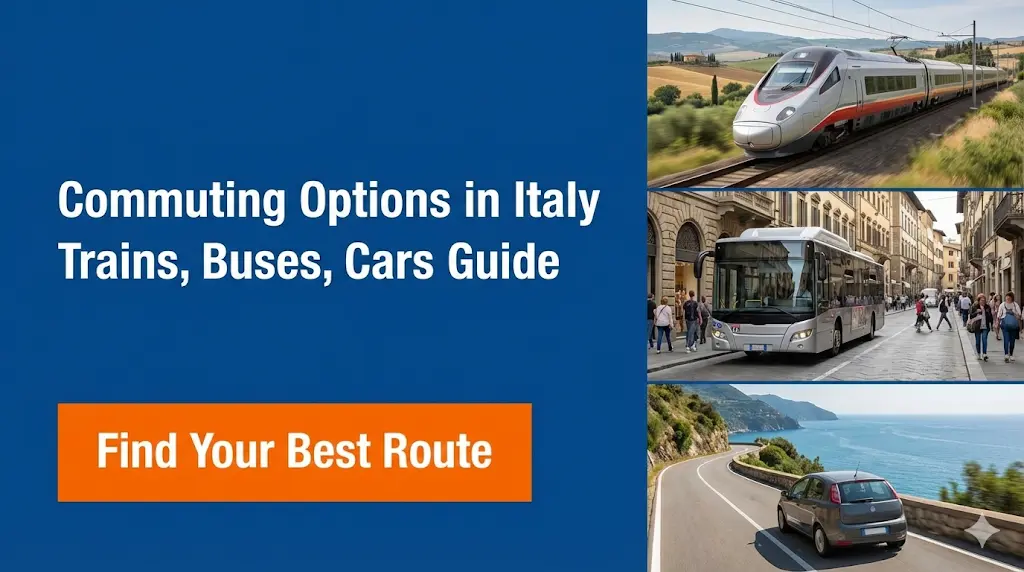
For millions of Italians, the railway system is the undisputed backbone of the daily commute. Italy’s train network is extensive, relatively affordable compared to other Western European nations, and highly stratified based on speed and comfort.
High-Speed Trains (Le Frecce and Italo)
If your commute involves traveling between major cities—for example, living in Bologna but working in Florence or Milan—the high-speed network is a modern marvel. There are two primary operators in this space:
- Trenitalia (Le Frecce): The state-owned railway company operates a tiered fleet of high-speed trains. The crown jewel is the Frecciarossa (Red Arrow), which reaches speeds of 300 km/h and connects major hubs like Turin, Milan, Bologna, Florence, Rome, and Naples. The Frecciargento (Silver Arrow) and Frecciabianca (White Arrow) operate at slightly lower speeds but connect secondary cities that the Frecciarossa bypasses.
- Italo Treno: A private high-speed operator that directly competes with Trenitalia on the major north-south corridors. Italo trains are highly modern, featuring excellent onboard Wi-Fi, sleek leather seating, and very competitive pricing if booked in advance.
High-speed trains require mandatory seat reservations. You cannot simply buy a ticket and jump on the train; your ticket is tied to a specific train number, carriage, and seat. Commuters who utilize these routes daily or weekly often purchase an abbonamento (subscription pass) to drastically reduce the per-trip cost.
Regional Trains (Regionale and Regionale Veloce)
For the vast majority of local commuters, the Treno Regionale (Regional Train) is the workhorse of the system, operated entirely by Trenitalia and its regional subsidiaries (such as Trenord in Lombardy).
These trains connect smaller towns and suburbs to major city centers. They are much slower than the Frecce, stopping at almost every station along the route. The Regionale Veloce (Fast Regional) skips the smallest stations, offering a quicker commute.
Crucially, regional train tickets do not come with reserved seating. You sit wherever you can find an empty space. Because these tickets are open-ended and valid for a specific timeframe rather than a specific seat, they are subject to strict validation rules.
The Golden Rule: Ticket Validation (La Convalida)
This is the most common trap for expatriates and tourists alike. If you purchase a physical, paper ticket for a regional train, it is completely invalid until you stamp it.
Before boarding the train, you must locate the small validation machines (usually green, white, or yellow) scattered around the station platforms and waiting halls. You insert the end of your ticket into the slot, and the machine prints the current time, date, and station code onto the paper. If a conductor (controllore) checks your ticket on the train and it has not been validated, you will be treated as if you do not have a ticket at all, resulting in an immediate and hefty fine (often starting at 50 euros).
If you purchase your regional ticket digitally via the Trenitalia smartphone app, the rules have recently modernized. You must perform a “digital validation” by clicking a “Check-In” button within the app before your scheduled train departs.
Urban and Intercity Buses
When the train tracks end, the Italian bus network takes over. Buses are essential for navigating the dense urban cores of major cities and connecting the remote, mountainous villages that lack railway infrastructure.
Urban Public Transit (Autobus)
Every major Italian city operates its own municipal transit authority. In Rome, it is ATAC; in Milan, it is ATM; in Florence, it is Autolinee Toscane. These companies manage the fleets of city buses, trams, and metro lines.
Commuting by urban bus in Italy requires a strong dose of patience. While cities like Milan boast highly efficient and punctual transit, traffic congestion in cities like Rome or Naples means that bus timetables are often viewed as loose suggestions rather than strict schedules.
The ticketing system for urban transit operates on an honor system backed by random, aggressive enforcement. You generally cannot purchase a ticket from the bus driver. You must buy your ticket in advance at a Tabaccheria (tobacco shop displaying a large “T” sign), a newsstand (edicola), or via the local transit authority’s mobile app.
When you board the bus, you must immediately insert your paper ticket into the yellow or electronic stamping machine to validate it. Most urban tickets are time-based, allowing you unlimited transfers within a specific window (e.g., 90 minutes in Rome) from the moment of validation. If you plan to commute daily, purchasing a monthly or annual abbonamento (pass) is vastly more economical and eliminates the need to validate a ticket every single time you board.
To gain a deeper understanding of how these municipal systems integrate with subway lines and trams, we highly recommend reading Public Transportation in Italian Cities: A Guide.
Intercity and Long-Distance Coaches
For commuting between towns without direct train links, or for budget-friendly long-distance travel, coach services are incredibly popular.
Companies like FlixBus and Itabus operate massive networks connecting virtually every region of Italy. These modern coaches are equipped with air conditioning, onboard restrooms, and Wi-Fi. While slower than the high-speed trains, they are often significantly cheaper. Additionally, regional bus companies (such as Cotral in the Lazio region) serve as the primary lifeline for commuters living in smaller provincial towns, bringing them into the central transport hubs of the major cities every morning.
Commuting by Car
Despite the robust public transit network, Italy remains a car-centric culture. For expatriates living in rural areas, industrial zones, or smaller towns, owning a vehicle is the only viable way to commute. However, driving in Italy involves navigating aggressive driving styles, complex toll systems, and severe municipal restrictions.
The Autostrada and Tolls (Pedaggio)
Italy’s highway system, the Autostrada, is an extensive, well-maintained network of high-speed toll roads. The speed limit is generally 130 km/h. When you enter the Autostrada, you pass through a toll booth (casello) and take a ticket. When you exit, you present the ticket to a machine or an attendant and pay the toll based on the exact distance traveled.
If your daily commute requires utilizing the Autostrada, paying out of pocket every day will quickly become tedious and cause you to get stuck in long queues during rush hour. To solve this, regular commuters utilize a service called Telepass. This is a small electronic transponder that mounts to your windshield. As you approach a designated Telepass lane at the toll plaza, you slow down, the barrier automatically raises, and the toll is digitally deducted directly from your linked Italian bank account, allowing you to bypass the traffic entirely.
Zona a Traffico Limitato (ZTL)
This is arguably the most critical acronym any expat driver must learn. To protect historic architecture, reduce pollution, and make city centers pedestrian-friendly, almost every Italian city and large town enforces a Zona a Traffico Limitato (Limited Traffic Zone).
These zones strictly prohibit unauthorized vehicles from entering the city center during specific hours of the day. The entrances to these zones are marked by a white circular sign with a red border, monitored heavily by automated security cameras.
If you drive past a ZTL camera without a registered resident permit, you will automatically be mailed a fine ranging from 80 to 300 euros. Crucially, GPS navigation apps like Google Maps do not always reliably route you around active ZTLs. As a commuter, you must memorize the exact boundaries of your city’s ZTL and learn where the peripheral commuter parking lots are located to avoid bankrupting yourself with municipal fines.
Before you even consider buying a car for your commute, you must ensure your legal right to drive is recognized. Non-EU citizens have a strict one-year grace period to use their home country’s license. To avoid losing your driving privileges, review the complex conversion rules in Driving in Italy: Obtaining an Italian Driver’s License. If you are considering shipping your existing vehicle from abroad instead of buying locally, you must first calculate the heavy import taxes outlined in Importing Your Car to Italy: Regulations and Costs.
Alternative Commuting Methods
As Italian cities aggressively push toward sustainable urban mobility, alternative commuting methods have exploded in popularity, offering expats highly flexible ways to navigate dense urban centers without the burden of car ownership.
Car Sharing
Car sharing has revolutionized the daily commute in cities like Milan, Rome, Turin, and Florence. Companies like Enjoy (operated by Eni) and Share Now provide fleets of vehicles—often small Fiat 500s or Smart cars—scattered randomly throughout the city.
Using a smartphone app, you locate the nearest available car, unlock it digitally, and pay a flat per-minute rate to drive it to your destination. When you are finished, you simply park the car in any legal street parking spot and end the rental via the app. The massive advantage of car sharing is that these specific vehicles are usually legally permitted to enter the ZTL zones and can park in designated resident spots for free, eliminating the two biggest headaches of urban driving. To learn how to register for these specific platforms, consult our article on Car Sharing Services (Car2Go, Enjoy) in Italy.
E-Bikes and Scooters (Monopattini)
The micro-mobility sector has also surged. Ride-sharing apps like Lime, Dott, and Tier offer electric kick-scooters (monopattini elettrici) and electric bicycles parked on countless street corners. For commuters traveling the “last mile”—from the central train station to their final office building—these provide a rapid, cheap, and environmentally friendly alternative to waiting for a crowded city bus. Be aware, however, that municipal crackdowns have introduced strict new rules for scooters, including mandatory helmets for certain age groups, strict speed limits, and designated parking corrals to prevent sidewalks from becoming cluttered.
Comparing Commuting Methods
To help you strategize your daily transit, utilize this comparative matrix of the primary commuting options in Italy.
| Commuting Method | Speed & Efficiency | Average Cost Profile | Best Used For | Key Drawback |
| High-Speed Train | Extremely Fast | High (Unless using a monthly pass) | Intercity commuting (e.g., Turin to Milan). | Must book specific times; limited stops. |
| Regional Train | Moderate | Low to Moderate | Suburban to city center travel. | Frequent delays; strict validation rules. |
| Urban Bus/Tram | Slow (Traffic dependent) | Very Low | Navigating within city limits. | Susceptible to heavy congestion. |
| Personal Car | High | High (Fuel, Tolls, Insurance, Maintenance) | Rural living; industrial park access. | ZTL fines and lack of urban parking. |
| Car Sharing | High | Moderate (Pay per minute) | Spontaneous cross-city trips in rain or at night. | Availability is not guaranteed during rush hour. |
| E-Scooter / Bike | Moderate | Low | “Last mile” transit; short urban distances. | Dangerous in heavy Italian traffic; weather dependent. |
Tips for a Stress-Free Commute
Mastering the mechanics of the transport system is only half the battle. Thriving as a commuter in Italy requires adapting to the specific cultural rhythms and technological tools available.
The Reality of “Lo Sciopero” (The Strike)
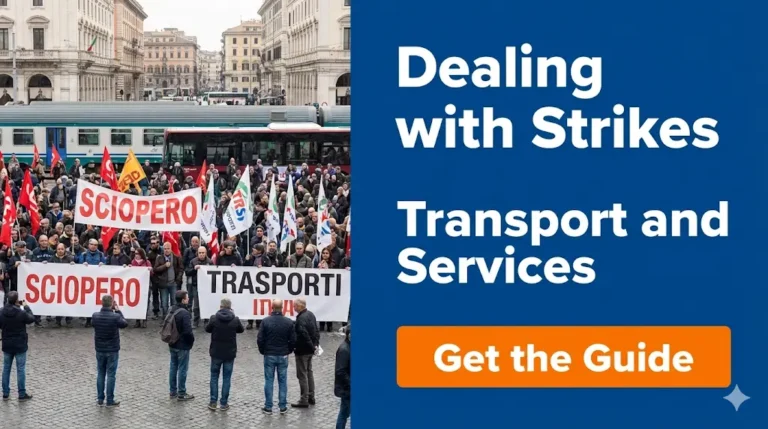
If you commute using public transportation in Italy, you must become intimately familiar with the concept of lo sciopero (the strike). Labor strikes by transport unions are a deeply ingrained, highly regulated part of Italian civic life.
Strikes occur frequently, often on Fridays, affecting trains, buses, and metro lines. Fortunately, they are rarely spontaneous. Strikes are announced well in advance and published on the official Ministry of Transport website and local news outlets.
Furthermore, Italian law dictates the existence of fasce di garanzia (guaranteed time bands). During a transport strike, the government mandates that essential services must run during peak commuter hours to allow citizens to get to work and return home. These guaranteed windows are typically from 6:00 AM to 9:00 AM, and again from 6:00 PM to 9:00 PM. Outside of these hours, you should expect total network paralysis.
Essential Commuting Apps
Your smartphone is your greatest ally in defeating the chaos of the Italian commute. You should immediately download the following applications:
- Trenitalia & Italo Treno: The official apps for purchasing and managing all your train tickets digitally, completely bypassing the physical validation machines.
- MooneyGo (formerly MyCicero): A phenomenal aggregator app that allows you to purchase urban bus and metro tickets for dozens of different Italian cities within a single interface, as well as pay for blue-line street parking.
- Citymapper & Moovit: While Google Maps is reliable, Citymapper and Moovit often provide vastly superior, real-time tracking for local urban buses and trams, including accurate alerts regarding ongoing strikes and detours.
- Waze: If you are driving, Waze is incredibly popular in Italy, heavily updated by users to warn you of upcoming traffic jams, police speed traps (autovelox), and accidents on the Autostrada.
Conclusion
Choosing how to commute in Italy dictates the daily rhythm of your expatriate experience. While the country’s public transit network may occasionally test your patience with unannounced delays or highly localized labor strikes, it remains an incredibly vast, affordable, and comprehensive system that connects the deepest corners of the peninsula.
By understanding the strict ticket validation rules of the regional railways, respecting the invisible boundaries of the urban ZTL zones, and utilizing modern micro-mobility and car-sharing applications, you can build a flexible, multi-modal commuting strategy. The key to success is preparation. Buy your monthly transit passes, download the essential tracking apps, keep a close eye on the national strike calendar, and allow yourself the grace to occasionally take the slower, scenic route. In Italy, the journey itself is often just as culturally enriching as the final destination.
References
Primary sources (official)
- Ministero delle Infrastrutture e dei Trasporti (Ministry of Infrastructure and Transport) – Official governmental updates on transport infrastructure, regulations, and authorized national strikes: https://www.mit.gov.it/en
- Trenitalia – The official portal of the Italian state railway for timetables, high-speed (Frecce), and regional train bookings: https://www.trenitalia.com/en.html
Other helpful sources
- Telepass – Official service information regarding automated highway toll payments and mobility integration: https://www.telepass.com/en/consumer
- The Local Italy – Understanding Italian train travel, ticket validation, and navigating transport strikes: https://www.thelocal.it/
Disclaimer
The information provided in this article is for educational and informational purposes only and does not constitute official legal, financial, or travel advice. Public transportation schedules, ticket pricing, Autostrada toll rates, and municipal ZTL (Limited Traffic Zone) boundaries are subject to frequent changes by local and national authorities. Always verify current transit schedules, strike announcements, and driving regulations directly with the specific transport operators and local municipal websites before finalizing your daily commuting plans.