Housing Permit (Hygiene Permit) for Second Home in Italy
Securing a housing permit or hygiene certificate for your second home in Italy is a crucial bureaucratic step. This guide explains the strict habitability standards, application procedures, required documents, and expert tips for navigating local municipal regulations successfully.
Disclosure: This post may contain affiliate links. We may earn a commission at no extra cost to you if you make a purchase through these links. Read full disclosure.
Introduction
Entering the Italian real estate market requires an understanding that property ownership here is heavily regulated by both national laws and highly localized municipal codes. Unlike some countries where purchasing a home grants you the absolute freedom to use it however you see fit, Italy enforces stringent health, safety, and architectural standards. To legally inhabit, rent out, or use a property for immigration purposes, the building must be officially certified as safe and hygienic by the local government.
For foreign buyers, this usually introduces two critical pieces of documentation: the general certificate of habitability and the specific certificate of housing suitability. Without these permits, your beautiful second home is legally considered unfit for human habitation. This can lead to disastrous consequences, including the inability to finalize a property purchase, the rejection of long-stay visa applications, and heavy fines if you attempt to rent the property to tourists.
This comprehensive guide is designed to demystify the complex world of Italian housing and hygiene permits. We will explore the exact definitions of these certificates, the strict mathematical standards regarding room sizes and ceiling heights established by Italian health decrees, and the step-by-step process of acquiring the necessary approvals from your local town hall. Furthermore, we will delve into the costs involved, the critical role of local architectural surveyors, and the unique challenges presented by historic and older properties. By understanding these regulations, you can ensure your Italian second home is a secure, legal, and truly welcoming sanctuary.
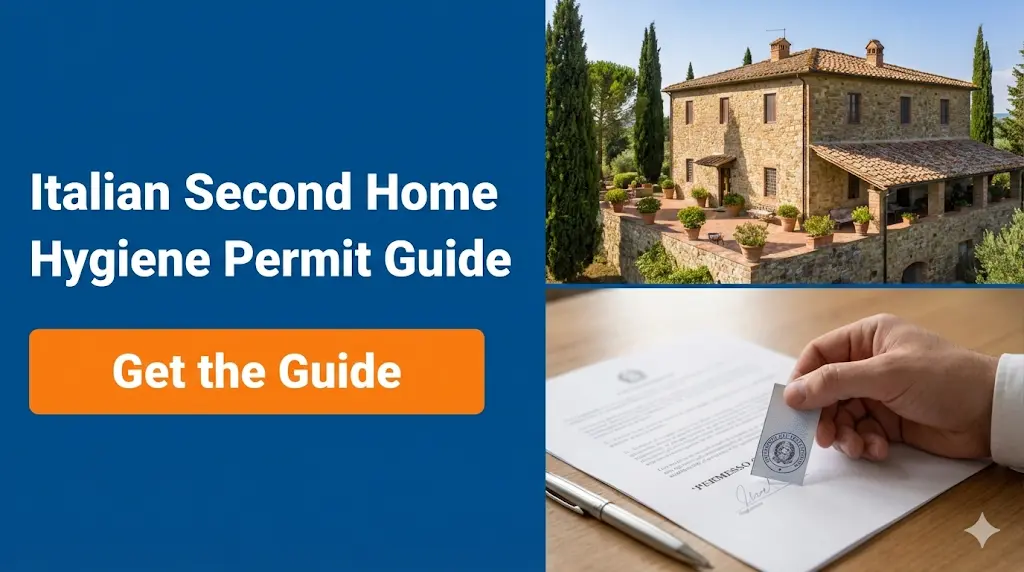
Decoding the Terminology of Italian Housing Permits
To navigate this process successfully, you must first understand the specific Italian terminology used by real estate agents, lawyers, and municipal workers. The umbrella concept of a “housing permit” or “hygiene permit” is typically divided into two distinct but interconnected certificates in the Italian legal system.
The Certificate of Habitability
Known in Italian as the Certificato di Agibilità, this is the foundational document for any residential building. It acts as the official declaration from the local municipality that the property was constructed or renovated in strict accordance with the approved architectural plans. More importantly, it certifies that the building meets all national safety, hygiene, health, and energy efficiency standards.
When you purchase a second home, verifying the existence of this certificate is arguably the most important step in your due diligence. If you buy a property without this certificate, you inherit a home that cannot be legally occupied until the structural and systemic deficiencies are rectified. The absence of this document can severely impact the market value of the property and complicate future sales. Before committing to a purchase, we highly recommend reading The Ultimate Guide to Renting and Buying a Home in Italy to understand how to structure your preliminary contracts to protect yourself against missing permits.
The Certificate of Housing Suitability
Known as the Attestazione di Idoneità Alloggiativa, this is a highly specific hygiene and suitability permit. While the habitability certificate focuses on the building’s overall compliance, the housing suitability certificate focuses on the capacity and specific hygiene standards of the individual apartment or house in relation to the people living inside it.
This certificate explicitly states how many individuals can legally and safely reside within the property based on its square footage, ventilation, and sanitary facilities. For foreign nationals, this document is incredibly important. If you intend to use your second home as a registered base to secure an Elective Residence Visa, or if you plan to eventually bring family members over through family reunification processes, the immigration authorities will demand to see this certificate to prove you are not moving into overcrowded or unsanitary conditions.
The National Health and Hygiene Standards
The parameters that dictate whether your second home will pass a hygiene inspection are not arbitrary. They are strictly defined by a national law, specifically the Ministerial Decree of July 5, 1975, which established the mandatory health and hygiene requirements for residential properties across the entire Italian peninsula.
If you are purchasing a property to renovate, your architectural plans must adhere to these minimum standards, or the municipality will refuse to issue your permits.
Minimum Square Footage Requirements
The Italian state strictly regulates living space to prevent overcrowding and ensure psychological and physical well-being. The hygiene permit dictates the maximum capacity of your home based on the following minimum net surface area requirements:
- For one person: A minimum of 14 square meters of living space.
- For two people: A minimum of 28 square meters.
- For every additional person beyond the first two: An additional 10 square meters per person is required.
Furthermore, individual bedrooms must meet specific size standards. A single bedroom must be at least 9 square meters, while a double bedroom (or master bedroom) must be at least 14 square meters. The main living room must be a minimum of 14 square meters.
Ceiling Heights
Ceiling height is a heavily scrutinized factor during a hygiene inspection. For standard living spaces—such as bedrooms, living rooms, and dining rooms—the minimum legal ceiling height is 2.70 meters.
For service areas—such as bathrooms, hallways, corridors, and utility closets—the minimum ceiling height is slightly lower, set at 2.40 meters.
There is a notable exception to this rule for mountain communities. In municipalities located at an altitude higher than 1,000 meters above sea level, the minimum ceiling height for living areas can be reduced to 2.55 meters. This exception exists to account for the unique architectural styles of historic alpine chalets and the need for energy efficiency in extremely cold climates.
Ventilation and Natural Light
A critical component of the Italian hygiene permit is the requirement for adequate natural light and air circulation. Every residential room (excluding bathrooms and hallways) must have a window that opens directly to the outside.
The mathematical rule enforced by inspectors is the aero-illuminating ratio. The total surface area of the openable windows in a room must be no less than one-eighth of the total floor area of that same room. If you are renovating a historic home with tiny, medieval windows, you may need to apply for specialized architectural variances or widen the windows to meet this modern hygiene standard.
Bathroom and Sanitary Regulations
The regulations surrounding bathrooms are highly specific. Every independent residential unit must have at least one bathroom equipped with a toilet, a bidet, a bathtub or shower, and a sink. The bathroom must be properly partitioned from the rest of the living space; for example, a bathroom door cannot open directly into a kitchen or a dining area. There must be an intermediate space, known as an antibagno (an anteroom or vestibule), separating the sanitary facilities from food preparation zones.
Additionally, the primary bathroom must have a window to the outside. If the creation of a window is architecturally impossible (such as in the center of a large apartment block), the bathroom must be equipped with a mechanical extraction fan capable of ensuring continuous air exchange.
System Compliance and Safety Certifications
Meeting the spatial and architectural dimensions is only half of the hygiene and habitability equation. The internal systems of the house—specifically the electrical, plumbing, heating, and gas systems—must be certified as safe by licensed Italian professionals.
Whenever a technician installs, modifies, or inspects a major system in your home, they must issue a Declaration of Conformity. This document proves that the work was executed according to current national safety codes.
For your second home to receive its permits, you must present the conformity certificates for:
- The electrical grid and fuse box.
- The gas lines, boiler, and heating systems.
- The water and plumbing networks.
If you purchase an older property where these certificates have been lost to time, you must hire certified technicians to inspect the existing systems. If the systems are safe but old, the technician can issue a Declaration of Responsiveness. If the systems are deemed unsafe, you will be required to completely rewire or replumb the house before the municipality will grant your hygiene permit.
The Crucial Role of the Italian Geometra
Foreign buyers are often surprised to discover that they cannot navigate the housing permit process alone. You must engage the services of a specific Italian professional known as a Geometra.
A Geometra is a uniquely Italian profession that blends the roles of a land surveyor, a junior architect, and a municipal project manager. While you could hire a fully licensed architect or an engineer, a Geometra is typically the most cost-effective and practical professional for handling residential permits, renovations, and municipal bureaucracy.
Your Geometra will be responsible for:
- Measuring the property to ensure it meets all the 1975 health decree minimums.
- Drafting the technical floor plans required by the town hall.
- Verifying that the physical state of the house perfectly matches the official blueprints registered with the national cadastral registry.
- Submitting the formal application for the habitability or housing suitability certificate to the local government.
- Acting as your sworn representative and liaison with municipal building inspectors.
Building a strong relationship with a competent, locally connected Geometra is the single most important investment you can make when dealing with Italian property laws.
Step by Step Guide to Applying for the Permit
If you need to apply for a new Certificate of Habitability or a Housing Suitability Certificate for your second home, the process follows a structured bureaucratic path. You will likely be dealing with the local town hall extensively, so review Navigating Italian Bureaucracy: Comune and Prefettura for tips on handling local civil servants and understanding office hierarchies.
Step One Hire Your Professional
Begin by officially retaining a local Geometra, architect, or engineer. It is highly advisable to choose a professional who operates within the specific municipality where your second home is located. Local professionals understand the unwritten preferences of the town hall clerks and are deeply familiar with regional architectural exceptions.
Step Two Gather the Documentation
Your hired professional will compile the necessary technical dossier. You will need to provide your personal identification (passport and Italian tax code), a copy of the property deed proving your ownership, and any existing historical floor plans. The professional will collect all the system conformity certificates from your electricians and plumbers.
Step Three Submit to the Sportello Unico
The completed application is submitted to a specific municipal office known as the Sportello Unico per l’Edilizia (the Single Desk for Construction). In modern times, this submission is almost always done digitally via a certified electronic portal.
For the Certificate of Habitability, the process utilizes a mechanism called Certified Notification of Certified Agibility. Instead of waiting months for the municipality to approve the application, your Geometra assumes legal responsibility and self-certifies that the property meets all requirements. The certificate becomes valid immediately upon submission, though the municipality retains the right to conduct random inspections within 30 to 60 days to verify the Geometra’s claims.
For the Housing Suitability Certificate (often required for visas), the process requires a physical review by the municipality, and sometimes a visit from the local health authority inspector, to verify the hygiene standards before the official certificate is printed and handed over.
Estimated Costs and Processing Times
Budgeting for these permits is an essential part of your second home financial planning. The costs are divided into professional fees paid to your Geometra and administrative taxes paid to the government. Finally, owning a second home triggers fiscal duties; learn more through Understanding Local Property Taxes: IMU, TASI, etc..
The following table provides an estimated breakdown of the costs and timelines associated with securing a housing or hygiene permit in Italy.
| Expense Category | Estimated Cost Range (EUR) | Description and Notes |
| Geometra / Professional Fees | €500 – €1,500+ | Fees vary wildly based on the complexity of the property, the need for new blueprints, and the region. |
| Municipal Secretarial Fees | €50 – €150 | Mandatory administrative fees charged by the town hall to process the application. |
| Revenue Stamps | €16 – €32 | Physical or digital tax stamps required for official government applications. |
| System Certifications | €200 – €800 per system | If old systems need to be inspected and certified by new technicians to generate missing paperwork. |
| Expected Processing Time | 30 to 60 Days | Habitability is often immediate via self-certification, but Suitability certificates can take weeks to be issued by the clerk. |
Note: These are estimated figures. Costs in luxury markets like Milan or Lake Como will be significantly higher than in rural southern regions.
Navigating Historic Properties and Rural Ruins
One of the most complex aspects of Italian housing permits arises when dealing with historic properties. Italy is filled with breathtaking medieval apartments and centuries-old rural farmhouses that were built long before the 1975 health decree was even conceived.
The 1967 Dividing Line
In Italian real estate law, September 1, 1967, is a critical date. Properties built before this date are often granted leniency regarding modern habitability standards, provided no major structural changes have been made since their original construction. If your second home is a historic building that has remained untouched, you may not possess a modern Certificate of Habitability, and it may still be completely legal to buy and inhabit.
However, the moment you decide to renovate a pre-1967 property—for example, knocking down a wall to create an open-concept kitchen, or converting an attic into a bedroom—you trigger modern building codes. The newly renovated spaces must comply with current hygiene and habitability standards, meaning you must apply for a new permit upon completion of the work.
Dealing with Unpermitted Works
A major trap for foreign buyers is purchasing a second home that features unpermitted building works. If a previous owner enclosed a balcony, built a secondary bathroom, or added a mezzanine without securing municipal permits and updating the cadastral plans, the property’s Certificate of Habitability is legally void.
To restore the hygiene and housing permits, you must apply for a retroactive building amnesty. This process involves paying heavy municipal fines to legalize the unauthorized work, provided the work actually complies with modern zoning and hygiene laws. If the unpermitted work violates hygiene laws—such as a bedroom lacking proper window ratios—the municipality will force you to demolish the addition and restore the property to its original, legal state.
Implications for Short Term Rentals
Many expats purchase a second home in Italy with the dual intention of enjoying it for personal holidays and renting it out to tourists to cover maintenance costs. If this is your plan, securing your housing and hygiene permits is absolutely non-negotiable.
The Italian government has recently cracked down heavily on the short-term rental market. To list your property on platforms like Airbnb or Booking.com, you must obtain a National Identification Code. To secure this code, you are required to declare to the regional tourism and health authorities that your property meets all safety and hygiene standards.
If you operate a short-term rental in a property that lacks a valid Certificate of Habitability or violates the occupancy limits set by a Housing Suitability certificate, you face massive financial penalties and the immediate shutdown of your rental business. The authorities view renting unsafe or unhygienic properties to tourists as a severe liability. For those looking to generate income, check out Short-Term Rentals and Airbnb: Rules in Italy to ensure your property complies with all recent hospitality regulations and tax structures.
Conclusion
Securing a housing permit and hygiene certificate for your second home in Italy is far more than a mere bureaucratic formality. It is a fundamental guarantee that your property is structurally safe, sanitary, and legally recognized by the Italian state. While the sheer volume of regulations—from calculating aero-illuminating window ratios to ensuring your bathroom ceilings meet the 2.40-meter threshold—can feel overwhelming, it is a process designed to protect the integrity of Italy’s historic housing stock and the health of its residents.
By engaging the services of a qualified local Geometra early in your property journey, demanding transparent system certifications from sellers, and respecting the rigid guidelines of the municipal building desks, you can navigate this complex landscape smoothly. Ultimately, holding that finalized Certificate of Habitability in your hands provides the ultimate peace of mind. It allows you to freely enjoy your Italian sanctuary, host your family and friends safely, and fully immerse yourself in the unparalleled joy of your new Mediterranean lifestyle without the shadow of bureaucratic anxiety.
References
Primary sources (official)
- Ministero della Salute (Ministry of Health) – Official documentation regarding the Ministerial Decree of 1975 establishing minimum residential hygiene and habitability standards: https://www.salute.gov.it/
- Normattiva – The official portal of the Italian Republic for searching current building codes, urban planning texts, and laws regarding the Certificato di Agibilità: https://www.normattiva.it/
Other helpful sources
- Idealista – Explaining the Certificate of Habitability (Agibilità) when buying a house in Italy: https://www.idealista.it/en/news/property-for-sale-in-italy/2021/11/04/3020-certificate-habitability-agibilita-when-buying-house-italy
- Gate-away – What is the Italian Certificato di Agibilità and why it is so important for foreign buyers: https://www.gate-away.com/blog/what-is-the-italian-certificato-di-agibilita
Disclaimer
The information provided in this article is for educational and informational purposes only and does not constitute official legal, architectural, or real estate advice. Italian building codes, municipal hygiene regulations, and visa requirements are subject to frequent legislative updates at both the national and regional levels. Always consult with a licensed Italian real estate attorney, a registered notary, and a qualified municipal Geometra or architect before purchasing a property, initiating renovations, or applying for official housing and immigration certificates.