Understanding Local Property Taxes: IMU, TASI, etc.
Owning property in Italy involves navigating a complex system of local taxes. This comprehensive guide explains the primary Italian property taxes, including IMU, the abolished TASI, and TARI, covering calculation methods, primary residence exemptions, and essential payment deadlines for expats.
Disclosure: This post may contain affiliate links. We may earn a commission at no extra cost to you if you make a purchase through these links. Read full disclosure.
Introduction to Understanding Local Property Taxes
Owning a piece of Italian real estate—whether a rustic Tuscan farmhouse or a sleek Milanese apartment—is a lifelong dream for many. However, the romance of Italian homeownership is quickly accompanied by the practical reality of the country’s local tax system. Unlike in many other countries where a single, consolidated council tax bill arrives in your mailbox every year, Italy requires property owners to proactively understand, calculate, and pay their local taxes.
For expatriates and foreign investors, navigating Italian property taxes can be a steep learning curve. The acronyms alone—IMU, TASI, TARI—are enough to cause confusion. Moreover, the legal distinction between a primary residence (prima casa) and a second home (seconda casa) drastically alters your financial obligations. If you assume the local municipality will simply send you an invoice when payment is due, you are setting yourself up for hefty fines and accrued interest.
In this comprehensive guide, we will demystify the local property tax landscape in Italy. We will explain exactly what happened to the TASI tax, how to calculate your IMU obligations using your property’s cadastral value, and who is responsible for paying the TARI waste tax. Whether you are a full-time resident or a foreign investor holding a vacation home, understanding these financial responsibilities is crucial for maintaining your Italian property legally and cost-effectively.
The Evolution of Italian Property Taxes: What Happened to TASI?
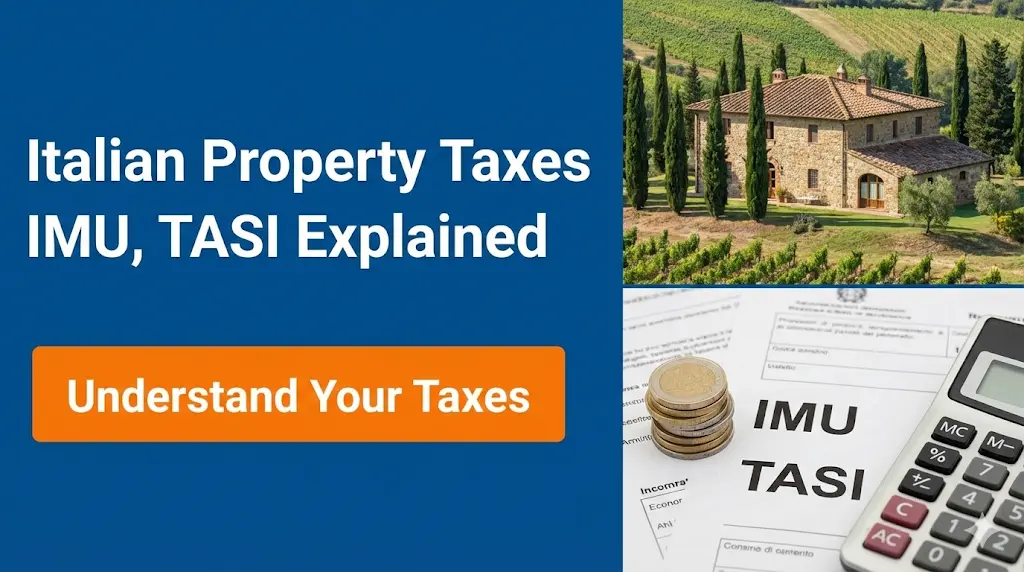
If you have been researching Italian real estate, you have likely encountered the term TASI (Tributo per i Servizi Indivisibili). TASI was originally introduced to fund indivisible municipal services, such as street lighting, road maintenance, and public security.
However, to simplify the bureaucratic burden on taxpayers, the Italian government abolished TASI as a standalone tax effective January 1, 2020. Its functions and the associated costs were fully absorbed into the primary property tax, IMU. Therefore, if you are buying property in Italy today, you no longer need to calculate or pay a separate TASI bill; it is already baked into your IMU rate. (Note: If you owned property prior to 2020 and missed a TASI payment, you are still liable for those historical arrears).
IMU (Imposta Municipale Unica): The Main Property Tax
IMU is the bedrock of local property taxation in Italy. It is a municipal wealth tax levied on the ownership of real estate, including buildings, buildable land, and agricultural land.
Who Must Pay IMU?
Your liability for IMU depends entirely on your residency status and the classification of your property.
- The “Prima Casa” Exemption: If the property is your officially registered main residence (abitazione principale) and your habitual abode, it is completely exempt from IMU. To qualify, you must be a registered resident of that municipality.
- The Luxury Exception: Even if a property is your primary residence, you must still pay IMU if the home falls under the luxury cadastral categories of A/1 (stately homes), A/8 (villas), or A/9 (castles and historic palaces).
- Second Homes (Seconda Casa): IMU is mandatory for all second homes, vacation properties, and investment properties.
- Foreign Owners and Non-Residents: If you do not hold official residency in the Italian municipality where your property is located, it is legally classified as a second home. Therefore, virtually all non-resident foreign owners are subject to the full IMU tax. Being registered in AIRE (Registry of Italians Resident Abroad) does not exempt you; it actually confirms your non-resident status.
How is IMU Calculated?
One of the most unique aspects of IMU is that it is not based on the actual market value or purchase price of your home. Instead, it is calculated using the property’s Rendita Catastale (cadastral income), a notional value assigned by the Italian Land Registry.
The calculation follows a specific formula:
- Revalue the Cadastral Income: Take the Rendita Catastale (found on your deed) and increase it by 5% (multiply by 1.05).
- Apply the Multiplier: Multiply that figure by the statutory coefficient for your property type. For standard residential properties (Categories A/2 to A/7), the multiplier is 160. This gives you the taxable base.
- Apply the Municipal Rate: Multiply the taxable base by the IMU rate set by your local town hall (Comune). The national base rate is 0.86%, but municipalities can adjust this anywhere from 0.76% to a maximum of 1.14%.
When and How to Pay IMU
IMU is paid in two annual installments using the standard Italian tax form known as the Modello F24, or via the digital PagoPA platform.
- Acconto (Advance Payment): Due by June 16th. This covers the first half of the year and is calculated using the previous year’s municipal rates.
- Saldo (Balance Payment): Due by December 16th. This covers the second half of the year and includes any adjustments if the municipality changed its rates during the year.
If you bought or sold the property mid-year, the tax is prorated based on the months of ownership (owning the property for 15 days or more in a month counts as a full month).
If you are just starting your real estate journey and want to understand the initial acquisition taxes alongside these recurring costs, read our comprehensive guide on Buying Property in Italy: Notary Fees and Taxes.
TARI (Tassa sui Rifiuti): The Municipal Waste Tax
While IMU is a tax on ownership, TARI is a tax on the service of waste collection and disposal.
Who Must Pay TARI?
TARI is owed by whoever actually occupies or uses the property. If you live in your home, you pay it. If you rent your property out on a long-term lease (over six months), your tenant is responsible for paying the TARI. However, if the property is vacant, the owner is liable.
The Italian Supreme Court operates on the logic that TARI is due based on the potential to produce waste. Therefore, simply leaving your Italian holiday home empty for 10 months of the year does not automatically exempt you from the waste tax. Exemptions are usually only granted if the property is completely unfurnished and disconnected from all utility grids (water, gas, electricity), rendering it officially uninhabitable.
Calculation and Billing
Unlike IMU, TARI is calculated based on two main factors:
- The size of the property in square meters.
- The number of occupants living in the household.
Deadlines for TARI fluctuate wildly depending on the municipality. Some towns require a single annual payment, while others split it into two, three, or four installments (usually in spring and autumn). Unlike IMU, local municipalities generally do mail out a physical TARI bill and payment slip. However, relying on international postage is risky, and non-residents frequently miss these bills.
Summary Table: IMU vs. TARI
To clarify your obligations, use this quick-reference comparison.
| Feature | IMU (Imposta Municipale Unica) | TARI (Tassa sui Rifiuti) |
| What it taxes | Real estate ownership. | Waste collection and disposal services. |
| Who pays | The property owner. | The occupant/tenant (or owner if vacant). |
| Calculation Basis | Cadastral value (Rendita Catastale) + Municipal rate. | Square meters + Number of occupants. |
| Primary Residence | Exempt (unless luxury category A/1, A/8, A/9). | Mandatory for all. |
| Billing Method | Self-assessed. No bill is sent. | Billed directly by the municipality. |
| Payment Deadlines | June 16 (Acconto) and December 16 (Saldo). | Varies heavily by local municipality. |
Crucial Traps for Foreign Owners
The most dangerous trap for expats and foreign buyers is the “no bill” nature of the IMU tax. Because the local government will not send you an invoice or a reminder, it is incredibly easy to accidentally miss the June 16th and December 16th deadlines.
If you miss a payment, the Italian tax agency will eventually catch the discrepancy, resulting in heavy fines and accumulated interest. Fortunately, Italy offers a system called Ravvedimento Operoso (voluntary correction). If you realize you missed a deadline, you can voluntarily pay the overdue tax along with a drastically reduced penalty. If paid within 14 days, the penalty is just 0.1% per day; within 30 days, it is 1.5%.
Given the complexities of the Modello F24 payment system—which often requires an Italian bank account—many expats choose to hire a local commercialista (accountant) to manage these deadlines. To better manage your overall financial life in the country, explore our guide on Understanding Italy’s Tax System: A Guide for Foreigners. Furthermore, keeping a buffer for these taxes is a vital part of planning your Cost of Living in Italy 2026: Budgeting for Expats.
Conclusion
Understanding your local property tax obligations is a non-negotiable aspect of owning real estate in Italy. While the abolition of TASI has streamlined the system slightly, the self-assessed nature of the IMU and the strict deadlines of the TARI require proactive management.
Remember that your status as a non-resident or a registered resident dictates whether you qualify for the coveted prima casa exemption. By marking the June and December deadlines on your calendar, calculating your cadastral base accurately, and setting up reliable payment methods, you can avoid bureaucratic headaches and enjoy your Italian home with complete peace of mind.
References
Primary sources (official)
- Agenzia delle Entrate (Italian Revenue Agency) – Information regarding Modello F24, IMU calculations, and Ravvedimento Operoso: https://www.agenziaentrate.gov.it/portale/web/english
- Ministero dell’Economia e delle Finanze – National guidelines on local municipal taxation and statutory IMU parameters: https://www.mef.gov.it/en/
Other helpful sources
- The Italian Lawyer – Italian property taxes for foreign owners (IMU and TARI explanations): https://theitalianlawyer.com/italian-property-taxes/
- Studio Legale Metta – Italian real estate taxes – IMU & TASI integration and Prima Casa rules: https://www.studiolegalemetta.com/legal-questions-and-answers/italian-real-estate-taxes-imu-tasi/
Disclaimer
The information provided in this article is intended for educational and informational purposes only and does not constitute official legal, financial, or tax advice. Italian property tax laws, municipal IMU rates, cadastral multipliers, and TARI payment schedules are highly localized and subject to frequent legislative changes. Always consult a certified Italian accountant (commercialista) or a licensed real estate attorney for personalized guidance regarding your specific tax liabilities and property classification.