COVID-19 Travel and Entry Requirements for Italy
Planning a trip to Italy? This comprehensive guide explains the current COVID-19 travel and entry requirements, general health protocols, upcoming ETIAS updates, what to do if you fall ill, and how to navigate the Italian healthcare system safely.
Disclosure: This post may contain affiliate links. We may earn a commission at no extra cost to you if you make a purchase through these links. Read full disclosure.
Introduction
When you are preparing for an international trip or a long-term relocation, understanding the exact rules of your destination is the foundation of a stress-free journey. During the height of the global health crisis, Italy implemented some of the most rigorous and protective public health measures in Europe. Travelers were required to present passenger locator forms, proof of vaccination, certificates of recovery, or negative test results just to board their flights. Navigating these rules was often the most stressful part of the vacation.
Fortunately, the era of mandatory health passes and border testing has concluded. The Italian government, aligning with global health authorities and the broader European Union, has lifted all pandemic-era travel restrictions. However, “no restrictions” does not mean that travelers should arrive completely unprepared. Respiratory illnesses, including newer variants of COVID-19, the seasonal flu, and common colds, remain a reality of global travel. Knowing how to protect yourself, understanding what to do if you contract an illness while abroad, and being fully aware of Italy’s standard entry requirements are crucial steps for any modern traveler.
This extensive guide will explore everything you need to know about traveling to Italy today. We will detail the current state of COVID-19 protocols, provide a comprehensive overview of general entry and visa requirements, explain how to access the Italian healthcare system if you become sick, and highlight the critical importance of travel insurance. Whether you are visiting for a two-week holiday in Tuscany or preparing for a permanent move to Rome, this information will ensure you are fully prepared for a safe and healthy Italian adventure.

Current Health Protocols for Entering Italy
The most immediate question on the minds of anyone booking a flight to Rome, Milan, or Venice is whether they need to present any health-related documentation at the border. The answer is a definitive no. Italy has completely normalized its border entry procedures, reverting to the standard immigration checks that existed prior to 2020.
No Vaccination Proof Required
Travelers entering Italy from any country in the world are no longer required to present proof of vaccination against COVID-19. The border police and airline staff will not ask to see your vaccination card, digital health pass, or any international equivalent. Your vaccination status has no bearing on your ability to enter the country, check into a hotel, dine at a restaurant, or visit cultural heritage sites like the Colosseum or the Uffizi Gallery.
No Pre Departure Testing
Similarly, the requirement to present a negative rapid antigen or PCR test result prior to boarding a flight or crossing a land border has been entirely abolished. You do not need to schedule expensive travel testing before your departure, nor will you be subjected to random health testing upon arrival at Italian airports or seaports.
No Quarantine or Passenger Locator Forms
The digital European Passenger Locator Form, which was once a mandatory document for contact tracing purposes, has been retired. Furthermore, there are no mandatory quarantine or self-isolation periods for travelers arriving from high-risk areas, as the categorization of countries based on viral risk levels has been discontinued by the Italian Ministry of Health. You are free to begin exploring the country the moment you clear standard passport control and collect your luggage.
General Entry Requirements for Italy
While health-specific restrictions have been lifted, Italy maintains strict general entry requirements based on your nationality, the purpose of your visit, and your intended length of stay. Because Italy is a member of the European Union and the Schengen Area, its border policies are heavily integrated with broader European immigration laws.
Passport Validity Rules
If you are traveling from outside the European Union or the Schengen Area, your passport must meet specific validity criteria. Your passport must be valid for at least three months beyond the date you intend to leave the Schengen Area. Additionally, your passport must have been issued within the last ten years. European border guards enforce this rule strictly; if your passport expires in two months, you will likely be denied boarding by your airline before you even leave your home country.
The Schengen Visa Exemption
Citizens of many countries, including the United States, Canada, the United Kingdom, Australia, and Japan, currently enjoy visa-free access to Italy and the wider Schengen Area for short-term tourism or business trips. Under this rule, you are permitted to stay in the Schengen Area for up to 90 days within any 180-day period. It is crucial to remember that this 90-day limit applies to the entire Schengen zone collectively, not just Italy.
The Upcoming ETIAS Implementation
A significant change to Italian entry requirements is on the horizon. The European Travel Information and Authorization System is a new electronic travel authorization that will soon become mandatory for citizens of countries who currently enjoy visa-free access to the Schengen Area.
Similar to the ESTA system used by the United States, travelers will need to fill out a brief online application, pay a small processing fee, and receive digital pre-approval before boarding their flight to Italy. The authorization will be electronically linked to your passport and will generally be valid for three years or until your passport expires. While this is not a health pass, the application may include standard background and security questions. Travelers should monitor official European Union channels for the exact launch date of this system to ensure compliance.
What to Do if You Contract a Respiratory Illness in Italy
Even with the lifting of travel restrictions, catching a virus while on vacation is a highly disruptive and unpleasant experience. Traveling exposes you to crowded airports, busy train stations, and dense tourist attractions, increasing the likelihood of contracting a respiratory illness. If you develop a fever, a persistent cough, or other flu-like symptoms while in Italy, it is important to know how to handle the situation responsibly and comfortably.
Voluntary Isolation and Best Practices
The Italian government no longer legally mandates forced quarantine for individuals who test positive for COVID-19. However, the Ministry of Health strongly recommends following standard public health best practices if you are symptomatic. If you feel ill, the most responsible action is to voluntarily isolate yourself in your hotel room or rental accommodation until your fever subsides and your symptoms improve.
Avoid visiting crowded museums, dining in enclosed restaurants, or using public transportation while you are actively coughing or sneezing. If you must leave your accommodation to purchase food or medical supplies, it is highly encouraged to wear a high-quality FFP2 mask to protect the local community and other travelers.
Acquiring Tests and Over the Counter Medicine
If you want to confirm whether you have COVID-19, the flu, or a common cold, you do not need to visit a hospital. Rapid antigen test kits are widely available for purchase at local pharmacies. The Italian pharmacy system is highly efficient, and the professionals behind the counter are excellent resources for travelers. If you need throat lozenges, fever reducers, or cough suppressants, you must speak directly to the pharmacist, as most medications are kept behind the counter. For a detailed breakdown of how to communicate your symptoms and understand local medication equivalents, you can review our guide on Finding and Using Pharmacies in Italy.
Accessing Medical Care as a Tourist or Expat
If your symptoms escalate, or if you develop breathing difficulties, chest pain, or prolonged high fevers, you must seek professional medical attention. The Italian healthcare system is world-class, but accessing it requires an understanding of how services are categorized.
The Emergency Room
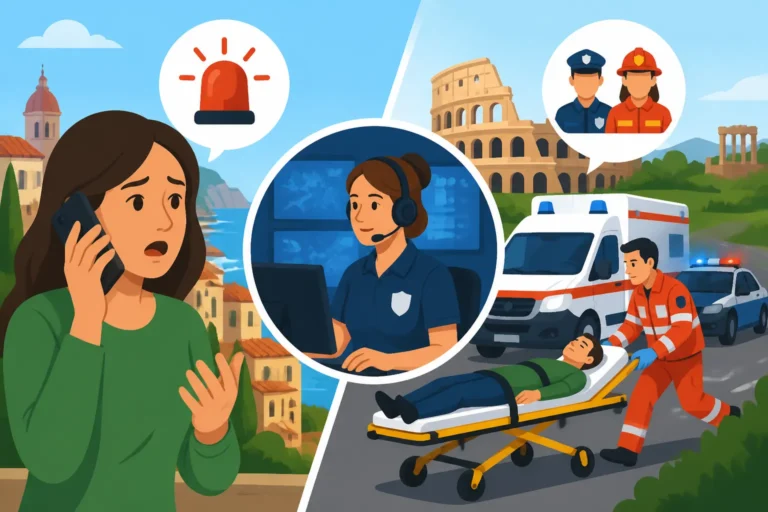
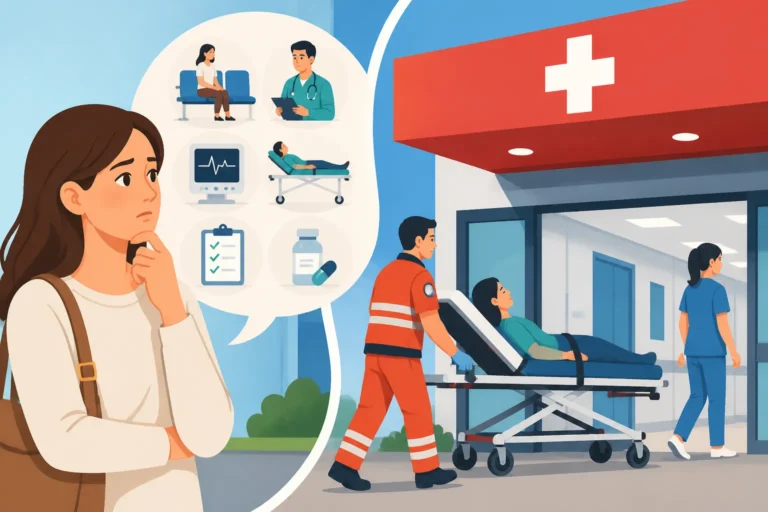
In the event of a severe, life-threatening medical emergency, you should go directly to the nearest hospital’s emergency department, known as the Pronto Soccorso. Alternatively, you can call the universal European emergency phone number, 112, to request an ambulance. Emergency medical care that is deemed urgent and life-saving is provided to everyone in Italy, regardless of their nationality or insurance status. To understand the triage color-code system used in these hospitals and what to expect when you arrive, consult our detailed overview of Emergency Medical Services in Italy: 112 and Hospitals.
Out of Hours Care and Tourist Doctors
For non-emergency situations, such as needing a prescription for a mild chest infection or seeking a consultation for a lingering fever, you should avoid the emergency room, as non-urgent cases face extremely long wait times. Instead, you can utilize the Guardia Medica, an out-of-hours state medical service.
During the peak summer tourist season, many popular coastal towns and historic cities also operate a specialized clinic called the Guardia Medica Turistica, which is specifically designed to treat non-resident visitors. You can visit these clinics for a small fee, and the doctors there can perform a basic examination and issue valid Italian prescriptions that you can fulfill at any local pharmacy.
Private International Clinics
For expatriates and tourists who prefer not to navigate the public system and want the guarantee of an English-speaking physician, Italy’s major cities offer numerous private international clinics. These facilities cater explicitly to foreigners and can provide rapid appointments, laboratory testing, and general consultations in a comfortable environment. While private care requires out-of-pocket payment, it eliminates the stress of the language barrier during a vulnerable time.
The Importance of Comprehensive Travel Insurance
One of the most vital preparations you can make before traveling to Italy in the post-pandemic era is securing robust travel and health insurance. While Italy’s public healthcare system is deeply humane and will never deny emergency life-saving care, it is not entirely free for non-residents.
Understanding the Financial Risks
If you are a non-EU citizen and you visit an Italian emergency room for a non-life-threatening issue, or if you are admitted to the hospital for several days due to severe pneumonia, you will be billed for the medical services rendered. While Italian medical costs are generally much lower than those in the United States, a multi-day hospital stay can still result in a bill totaling thousands of euros.
Furthermore, if your illness forces you to cancel your trip, extend your hotel stay to recover, or rebook your expensive return flights at the last minute, the financial impact can be devastating. Comprehensive travel insurance protects you against these unforeseen expenses.
Medical Evacuation and Repatriation
Perhaps the most critical component of a premium travel insurance policy is coverage for medical evacuation and repatriation. If you suffer a severe health crisis and need to be medically transported back to your home country for specialized ongoing care, the cost of a private medical flight can easily exceed fifty thousand dollars. This is an expense that public healthcare systems and standard credit card insurances will almost never cover.
When purchasing a policy, ensure that it explicitly includes coverage for respiratory illnesses, trip interruption due to sickness, and high limits for emergency medical evacuation.
Coverage for European Citizens
The situation is slightly different for citizens of the European Union, the European Economic Area, and Switzerland. If you fall into this category, you should travel with your European Health Insurance Card. This card entitles you to medically necessary, state-provided healthcare in Italy under the same conditions and at the same cost as Italian residents. For a deeper dive into the specific administrative differences between these two groups, you can read our article on Healthcare Differences for EU vs Non-EU Residents.
Healthcare Options for Tourists in Italy
To help you quickly understand your options if you fall ill during your trip, the following table breaks down the primary healthcare avenues available to visitors in Italy.
| Healthcare Option | Best Used For | Estimated Cost for Tourists | Language Support |
| Local Pharmacy (Farmacia) | Minor ailments, OTC medications, rapid tests, mild fever. | Low (Retail cost of medicine). | Moderate; many pharmacists in cities speak English. |
| Tourist Medical Service (Guardia Medica Turistica) | Non-emergency illnesses, basic prescriptions, minor injuries. | Low (Typically €15 – €30 flat fee). | Varies; basic English is common in tourist zones. |
| Private International Clinic | Comfort, speed, complex non-emergencies, specialist access. | High (Out-of-pocket or via private insurance). | Excellent; specifically staffed by bilingual professionals. |
| Public Emergency Room (Pronto Soccorso) | Severe trauma, life-threatening emergencies, severe breathing issues. | Varies (Free for life-saving care; fee applies for non-urgent cases). | Low; relies on available staff or translation apps. |
Testing Requirements for Return Travel
While Italy does not require any testing to enter the country, you must also consider the requirements of your onward destination or your home country. Most major nations have dropped their pre-departure testing requirements for returning citizens, but rules can fluctuate based on emerging global health data.
If you find yourself needing an official, certified negative test result to board a cruise ship, cross a specific international border, or satisfy your employer’s return-to-work policy, obtaining one in Italy is highly convenient. You do not need to visit a hospital to get tested. The vast majority of Italian pharmacies are authorized to administer rapid antigen tests and provide official printed or digital certificates in English and Italian.
Additionally, specialized private medical laboratories offer rapid PCR testing for travel purposes, usually delivering certified results via email within twenty-four hours.
Packing for a Healthy and Safe Trip
The key to a successful Italian vacation is preparation. While you can buy almost anything you need in Italy, bringing a small, personalized health kit will save you time and stress if you start feeling unwell late at night or on a Sunday when many shops are closed.
Essential Health Items to Pack
- High-Quality Masks: Even though masks are no longer legally mandated on public transportation or in museums, packing a few FFP2 or N95 masks is highly recommended. They are invaluable if you find yourself coughing on a crowded train or if you wish to protect yourself in tightly packed indoor spaces.
- Prescription Medications: Bring an adequate supply of any daily prescription medications you take, along with a copy of your doctor’s original prescription. Keep these in your carry-on luggage to prevent loss.
- Basic Pain Relievers: Pack a small supply of your preferred brand of ibuprofen or acetaminophen. While these are easily found in Italy, having them on hand immediately when a headache strikes is a great comfort.
- Digital Thermometer: A small travel thermometer is excellent for monitoring your health if you begin to feel feverish.
- Hand Sanitizer: Maintaining good hand hygiene is the easiest way to prevent the transmission of common travel bugs after touching handrails, museum audio guides, and currency.
The Legacy of Health Protocols in Italian Society
While the strict legal mandates have faded into history, the years of managing a global health crisis have left a subtle but permanent mark on Italian society and travel culture.
You will notice that hand sanitizer dispensers remain a common fixture at the entrances of supermarkets, restaurants, and historical sites. Furthermore, the cultural attitude toward personal space and hygiene has evolved. Prior to the crisis, Italians were famously tactile, greeting friends and acquaintances with double cheek kisses and warm embraces. While this warmth has undoubtedly returned, there is a heightened respect for individuals who choose to wear masks in public or maintain a respectful distance in crowded queues.
If you choose to wear a mask in a museum, on a high-speed train, or while navigating a busy outdoor market, you will not be viewed with suspicion. It is now widely accepted as a standard personal health choice. By exercising basic courtesy, respecting local hygiene practices, and staying home if you feel severely unwell, you contribute to a safe and welcoming environment for everyone.
Conclusion
The complete lifting of COVID-19 travel and entry restrictions is a monumental relief for expatriates, tourists, and the global travel industry. Italy has fully reopened its doors, inviting the world back to experience its unparalleled cultural heritage, stunning coastlines, and vibrant city life without the burden of complex health paperwork. The anxiety of securing last-minute tests and uploading passenger locator forms has been replaced by the simple joy of packing a suitcase and boarding a flight.
However, the lessons learned over the past few years remain highly relevant. Smart travel in the modern era requires a balance of excitement and preparedness. By understanding the general entry requirements, monitoring the upcoming ETIAS rollout, and securing comprehensive travel insurance, you protect your financial and logistical investments. Moreover, knowing exactly how to access the excellent Italian healthcare system, locate an English-speaking doctor, and navigate the local pharmacy ensures that a minor illness will never ruin your magnificent Italian adventure. Travel safely, pack intelligently, and enjoy the profound beauty of Italy with absolute peace of mind.
References
Primary sources (official)
- Ministero della Salute (Italian Ministry of Health): Official portal providing up-to-date information on public health guidelines, the lifting of travel restrictions, and recommendations for managing respiratory illnesses. https://www.salute.gov.it/
- Ministero degli Affari Esteri e della Cooperazione Internazionale (Ministry of Foreign Affairs): Official Italian government site detailing visa requirements, Schengen entry rules, and updates for international travelers. https://www.esteri.it/
Other helpful sources
- European Union Official Website: Comprehensive information on the upcoming European Travel Information and Authorization System (ETIAS) and Schengen border policies. https://travel-europe.europa.eu/etias_en
- Re-open EU: The official European Union tool providing real-time data on travel measures, health protocols, and entry requirements across all member states. https://reopen.europa.eu/
Disclaimer
The information provided in this article is for general educational and informational purposes only and does not constitute official medical, legal, or immigration advice. International travel regulations, Schengen visa policies, ETIAS implementation dates, and public health guidelines are subject to change without notice by national and international authorities. Always verify the current entry requirements with your airline and the official Italian embassy or consulate in your home country prior to booking your travel and departing for your trip.