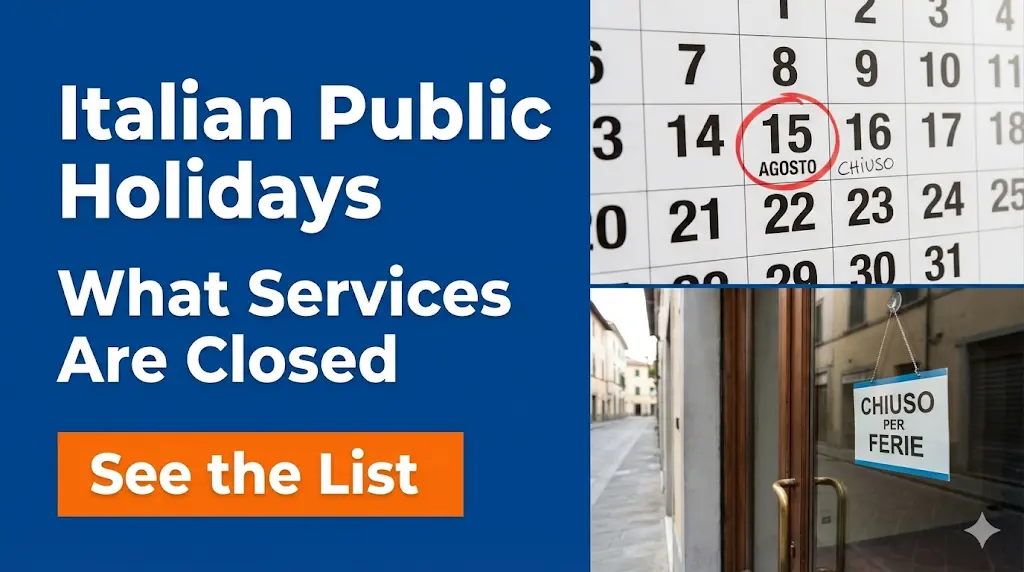
Italian Public Holidays: What Services Are Closed
Moving to or visiting Italy? Understanding the calendar of Italian public holidays is essential. This comprehensive guide covers national and local festivities, details what government offices, shops, and transport services close, and explains how to navigate the August Ferragosto shutdown.
Disclosure: This post may contain affiliate links. We may earn a commission at no extra cost to you if you make a purchase through these links. Read full disclosure.
Introduction to Italian Public Holidays
In Italy, a public holiday—known as a giorno festivo—is not merely a suggestion; it is a legally enforced and culturally revered pause in the country’s daily operations. Established by the Italian parliament, these dates represent a unique blend of national historical anniversaries and profound Catholic traditions. When a red letter day appears on the Italian calendar, the societal expectation is that work ceases, families gather, and the pace of life slows to a crawl.
Navigating these days successfully requires foresight and a deep understanding of which essential services cease to operate. Assuming that you can simply run errands on a public holiday will inevitably lead to frustration. Furthermore, the Italian approach to holidays extends far beyond the single calendar date. The culture has mastered the art of maximizing time off through concepts like il ponte (the bridge) and the legendary, month-long summer slowdown known as Ferragosto.
This exhaustive guide is designed to demystify the Italian holiday calendar for newly arrived expatriates and long-term visitors. We will provide a complete breakdown of the national and regional public holidays, explain the logistical realities of what exactly closes—from pharmacies and post offices to supermarkets and public transport—and offer actionable strategies for managing your life around these unavoidable bureaucratic shutdowns. By anticipating these closures, you can transition from feeling inconvenienced to fully embracing the restorative Italian lifestyle.
The Complete Calendar of Italian National Holidays
Italy observes twelve primary national public holidays each year. These days apply nationwide, from the alpine borders of South Tyrol to the southern shores of Sicily. It is highly recommended to mark these dates on your personal calendar immediately upon arriving in the country.
Table: National Public Holidays in Italy
| Date | Italian Name | English Translation | Cultural Significance & Notes |
| January 1 | Capodanno | New Year’s Day | Marks the beginning of the year, usually spent resting after large New Year’s Eve dinners featuring lentils and sausage for good luck. |
| January 6 | Epifania | Epiphany / La Befana | Concludes the Christmas season. Traditionally, an old woman named La Befana delivers sweets to children. |
| Variable | Pasqua | Easter Sunday | A major holiday featuring large family meals. (Falls between March 22 and April 25). |
| Variable | Pasquetta (Lunedì dell’Angelo) | Easter Monday | The Monday immediately following Easter. Traditionally a day for outdoor excursions, countryside picnics, and day trips. |
| April 25 | Festa della Liberazione | Liberation Day | Commemorates the end of World War II in Italy and the liberation from Nazi occupation and fascist rule in 1945. |
| May 1 | Festa del Lavoro (or dei Lavoratori) | International Workers’ Day / Labor Day | A celebration of the labor movement, often marked by massive concerts (like the famous Concerto del Primo Maggio in Rome) and union rallies. |
| June 2 | Festa della Repubblica | Republic Day | Commemorates the 1946 institutional referendum where Italians voted to abolish the monarchy and establish a Republic. Marked by a massive military parade in Rome. |
| August 15 | Ferragosto (Assunzione) | Assumption of Mary | The absolute peak of the Italian summer holiday season, sparking a mass exodus to the beaches and mountains. |
| November 1 | Tutti i Santi (Ognissanti) | All Saints’ Day | A religious holiday honoring all Catholic saints. |
| December 8 | Immacolata Concezione | Immaculate Conception | Traditionally the day Italians decorate their homes and mount their Christmas trees, kicking off the winter festive season. |
| December 25 | Natale | Christmas Day | The most significant winter holiday, dedicated to massive family feasts. |
| December 26 | Santo Stefano | St. Stephen’s Day / Boxing Day | An extension of the Christmas holiday, allowing families to continue celebrating and resting. |
(Note: As of recently, the Feast of St. Francis of Assisi on October 4th has been discussed as a newly reinstated national holiday, adding further richness to the calendar). Additionally, Sunday is always considered a public holiday by default in Italy.
The Unique Italian Tradition of Local Patron Saint Days
One of the most surprising aspects of the Italian holiday calendar for expatriates is the existence of the Festa del Santo Patrono (Patron Saint Day).
In addition to the twelve national holidays, every single municipality (comune) in Italy has its own designated patron saint. The feast day of this specific saint is treated as a legally binding public holiday, but strictly within the territorial borders of that specific municipality.
If you live in Rome, your local holiday is the Feast of Saints Peter and Paul on June 29. If you live in Milan, the city shuts down on December 7 for Saint Ambrose (Sant’Ambrogio). In Naples, the city halts on September 19 to honor Saint Januarius (San Gennaro), waiting for the miraculous liquefaction of his blood. Florence, Genoa, and Turin all share June 24 to celebrate Saint John the Baptist (San Giovanni), while Venice celebrates the Feast of St Mark on April 25 (which overlaps with Liberation Day) and Saint Mary of Health on November 21.
On these highly localized days, all local government offices, schools, and many businesses within that specific city will be entirely closed. However, if you drive twenty minutes to a neighboring town located in a different municipality, everything will be operating on a normal business schedule.
The Cultural Phenomenon of “Il Ponte” (The Bridge)
To fully grasp how holidays impact Italian services, you must understand the cultural phenomenon of il ponte.
Translated literally as “the bridge,” a ponte occurs when a national public holiday falls on a Tuesday or a Thursday. Instead of returning to work for a single, isolated day, the vast majority of Italians will “bridge” the gap by taking the Monday or the Friday off. This creates a massive, uninterrupted four-day weekend.
For example, if Republic Day (June 2) falls on a Tuesday, many businesses, private offices, and independent clinics will simply close from Friday evening until Wednesday morning. During these ponti, the operational capacity of the entire country is drastically reduced. If you are planning to rent an apartment, buy a car, or secure vital legal documents, you must look at the calendar in advance. Scheduling property viewings, notary appointments, or major logistical meetings during a ponte is practically impossible, as the professionals you need to speak with will likely be out of town.
What Services Are Closed on Italian Public Holidays?
When a giorno festivo arrives, what exactly ceases to function? Expatriates must differentiate between absolute closures (like government offices) and reduced-service closures (like public transit).
Government Offices and Bureaucracy
If a date is marked in red on the calendar, absolutely every branch of the Italian government is closed.
- The Comune: You cannot register your residency, request vital certificates, or pay municipal taxes.
- The Questura: The immigration police headquarters will be closed, meaning you cannot attend fingerprinting appointments or pick up a renewed Permesso di Soggiorno.
- Agenzia delle Entrate: The revenue agency is closed, meaning you cannot generate a Codice Fiscale or register a new rental lease.
Attempting to navigate these local civic duties requires precision timing; for a deeper understanding of how these offices function on normal working days, review Navigating Italian Bureaucracy: Comune and Prefettura.
Postal Services and Banks
Poste Italiane is a cornerstone of Italian administrative life, but its thousands of branches lock their doors tightly on all national and local patron saint holidays. You cannot mail registered letters, pick up missed packages, or pay utility bills (bollettini) at the post office counter. For insights on managing these logistical tasks when the offices are actually open, consult Using Italian Postal Services: Tracking and Tips.
Similarly, all brick-and-mortar banking institutions are closed. While you can still use ATMs (Bancomat) to withdraw cash, you must be cautious during long holiday weekends (especially during Easter or a long ponte); ATMs in heavily trafficked areas frequently run out of physical cash by Sunday afternoon, and they will not be restocked until the bank reopens on Monday or Tuesday. Furthermore, standard SEPA bank transfers initiated on a public holiday will not begin processing until the next valid business day.
Healthcare and Pharmacies
The Italian healthcare system (Servizio Sanitario Nazionale) operates on a tiered system during public holidays.
- Hospitals and Emergencies: Public hospitals, emergency rooms (Pronto Soccorso), and urgent medical services (like the Guardia Medica) remain open 24/7, 365 days a year.
- General Practitioners: Your assigned local family doctor (Medico di Base) and pediatricians will be closed.
- Pharmacies (Farmacie): Standard pharmacies close on Sundays and public holidays. However, by law, municipalities operate a strict rotation system known as the Farmacia di Turno (On-Duty Pharmacy). This system ensures that there is always at least one designated pharmacy open in your area during nights, weekends, and public holidays to dispense essential and emergency medications. Every pharmacy has a printed calendar or a digital screen in its front window displaying the address of the nearest currently open farmacia di turno. You can also verify these locations online via regional health portals or websites like Federfarma.
Public Transportation Infrastructure
Italy’s vast public transit networks do not shut down completely, but they shift to a heavily reduced schedule.
When you look at a bus or train timetable at a station, you will see two main columns: Feriale (Working Days, usually Monday through Saturday) and Festivo (Sundays and Public Holidays).
On a public holiday, buses, trams, and metro lines operate on the Festivo schedule. This means vehicles arrive far less frequently, and service often begins later in the morning and ends earlier in the evening. During massive holidays like Christmas Day (December 25) or Labor Day (May 1), local city transit may operate on a highly limited skeleton schedule, perhaps only running from 7:00 AM to 7:30 PM, or shutting down entirely for several hours in the mid-afternoon. National train lines (Trenitalia and Italo) continue to run, but regional commuter trains will be sparse. To master the nuances of these transit schedules, read our guide on Public Transportation in Italian Cities: A Guide.
Supermarkets and Retail Shops
Historically, absolutely all retail commerce in Italy ceased on Sundays and public holidays. While the laws have been liberalized in recent years, the holiday closure culture remains remarkably strong.
On major holidays like Easter Sunday, Christmas, New Year’s Day, and Labor Day, virtually all supermarkets—from small neighborhood grocers to massive hypermarkets—will be closed. For lesser holidays (like November 1 or December 8), large supermarket chains (such as Conad, Coop, or Esselunga) might open for a half-day, typically closing their doors promptly at 1:00 PM.
Local open-air food markets, independent butchers, bakeries, and clothing boutiques will almost certainly be closed. Expatriates must learn to plan their meals in advance; for a broader understanding of how the retail food landscape operates, consult Grocery Shopping in Italy: Supermarkets vs Markets.
Restaurants, Cafes, and Tourist Attractions
The hospitality sector presents a mixed bag. In highly tourist-dense areas (like the historical centers of Rome, Florence, and Venice), many restaurants, cafes, and gelato shops remain open on public holidays to capitalize on the massive influx of domestic and international visitors.
However, in residential neighborhoods or smaller provincial towns, family-owned trattorie and local bars will likely close so the owners can celebrate the holiday with their own families. Regarding cultural sites, state-run museums and archaeological parks generally remain open on holidays like Liberation Day or Republic Day, but they are almost universally closed on Christmas Day and New Year’s Day.
The August Shutdown: Understanding Ferragosto
If there is one public holiday that utterly baffles expatriates, it is August 15th—Ferragosto.
The origins of Ferragosto date back over two millennia to 18 BC, when Emperor Augustus introduced the Feriae Augusti as a designated period of rest for agricultural workers after the grueling summer harvest. Later, the Catholic Church assimilated the date to celebrate the Assumption of the Virgin Mary.
Today, Ferragosto is not just a single public holiday; it is the epicenter of the Italian summer. It triggers an astonishing national shutdown. While the official bank holiday is only on the 15th, the reality is that a massive percentage of the Italian population takes two to three weeks of vacation surrounding this date.
Throughout August, cities empty out as residents flee the sweltering urban heat for the cooler coastal beaches or the northern Dolomites. As you walk through residential neighborhoods in August, you will see handwritten signs taped to the iron shutters of businesses reading “Chiuso per Ferie” (Closed for Holidays).
This shutdown extends far beyond retail. Finding an available plumber, electrician, auto mechanic, or specialized medical professional during the weeks surrounding Ferragosto is notoriously difficult. Real estate agencies pause operations, meaning it is the absolute worst time of the year to try and schedule property viewings or negotiate a new lease. Bureaucratic offices operate on skeleton staffing, leading to massive backlogs in processing permits. As an expat, you must accept that trying to accomplish any serious administrative or logistical tasks in August is an exercise in futility. The only viable strategy is to follow the locals: pack a bag, head to the coast, and embrace the collective pause.
How to Prepare for Public Holiday Closures
Adapting to the Italian calendar is a vital step in your cultural integration. To avoid being caught off guard, implement these practical strategies:
- Stock the Pantry in Advance: Never assume you can buy groceries on the morning of a holiday. Always do your heavy shopping one or two days prior. Pay special attention to long ponti and the days leading up to Easter or Christmas, as supermarkets will be incredibly crowded with locals doing the exact same thing.
- Pre-Purchase Transit Tickets: If you rely on public transportation, buy your bus or metro tickets in advance. The tabaccherie (tobacco shops) and newsstands that normally sell these tickets will likely be closed.
- Locate Your Emergency Pharmacy: Do not wait until you have a fever on a Sunday afternoon to figure out how the Farmacia di Turno system works. Find your nearest pharmacy and familiarize yourself with where they post their after-hours rotation schedule.
- Avoid Bureaucratic Deadlines Near Holidays: If your residence permit is expiring or you need to submit a vital tax document, do not plan to do it the week of a major holiday or a ponte. Government offices may technically be open on the non-holiday days of a ponte, but they are often severely understaffed.
- Check Museum Websites: If you plan to visit a specific museum or monument on a public holiday, always verify the opening hours on the official Ministry of Culture website, as standard hours rarely apply.
Conclusion
Understanding the rhythm of Italian public holidays is an indispensable survival skill for any expatriate. While the sudden closure of essential services, the reduced transit schedules, and the infamous August shutdown may initially seem wildly inconvenient to a newcomer, they are reflective of a culture that profoundly values rest, family, and historical heritage.
By familiarizing yourself with the twelve national holidays, identifying your local municipality’s patron saint day, and learning to anticipate the prolonged closures caused by il ponte and Ferragosto, you can completely eliminate the stress of running into locked doors. Rather than fighting the system, expats who thrive in Italy are those who learn to surrender to it. When the calendar turns red, put away your to-do list, avoid the empty bureaucratic offices, and join the locals in celebrating the beautiful, unhurried pace of the Italian giorno festivo.
References
Primary sources (official)
- Governo Italiano (Italian Government) – Official list of recognized national public holidays and civil observances: https://www.governo.it/
- Ministero della Salute (Ministry of Health) – Guidelines on the Farmacia di Turno rotation system and public access to emergency medications during holidays: https://www.salute.gov.it/
Other helpful sources
- Wikipedia – Public holidays in Italy (Detailed breakdown of civil, religious, and patron saint days): https://en.wikipedia.org/wiki/Public_holidays_in_Italy
- Profee Blog – Italy Public Holidays 2026: Official National Calendar (Insights on ponti and grocery closures): https://www.profee.com/articles/italy-public-holidays-in-2026
Disclaimer
The information provided in this article is for educational and informational purposes only and does not constitute official legal, administrative, or travel advice. The specific dates of variable holidays (like Easter), local patron saint days, and the exact operational hours of public transportation and the Farmacia di Turno system are highly localized and subject to change. Always verify current holiday schedules directly with your local municipality (Comune), transit authority, and healthcare providers before making critical administrative or logistical plans.